
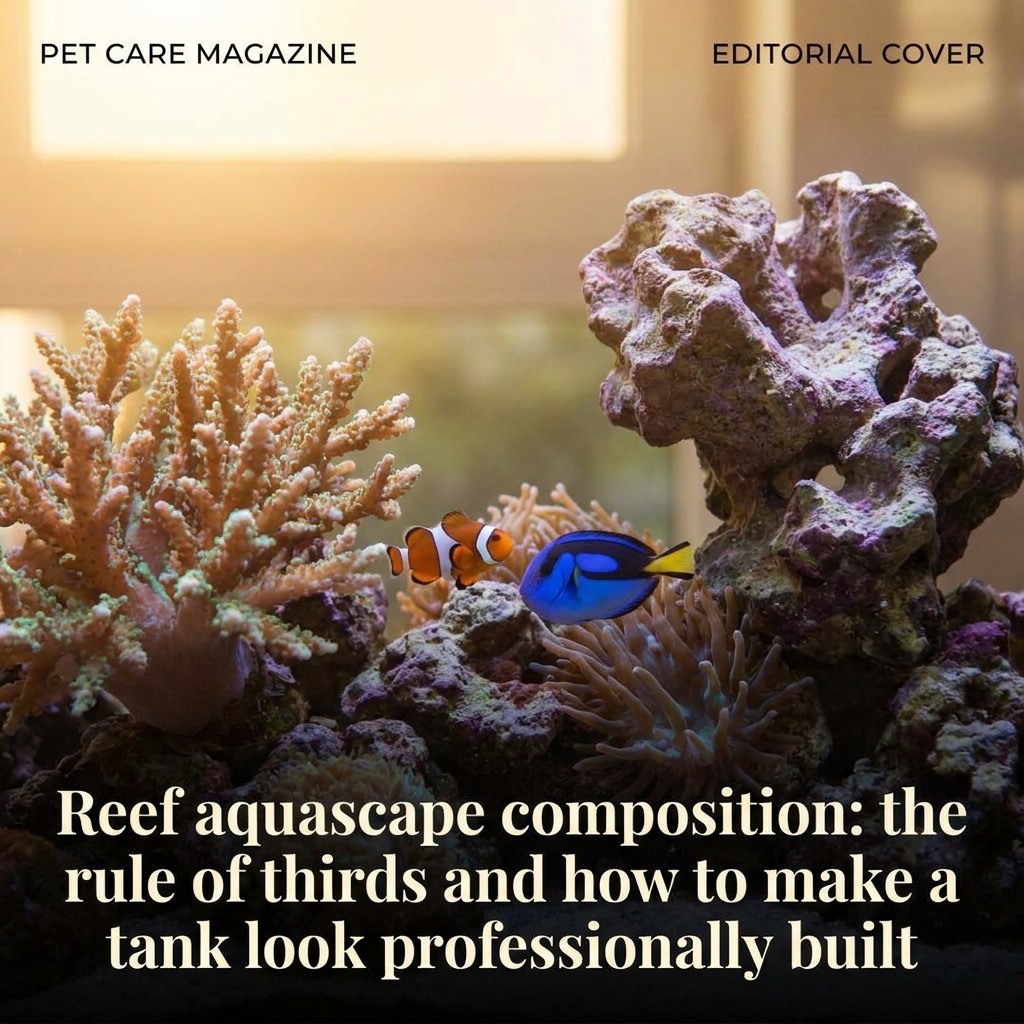
Reef aquascape composition: the rule of thirds and how to make a tank look professionally built
Most reef tanks look like a pile of live rock dropped into a glass box. A few tanks look like a piece of natural reef transplanted into the living room. The difference isn't the equipment or the corals — it's the composition. Composition is the arrangement of rock, sand, and negative space into something that reads as intentional and balanced.
Composition is a learnable skill. It's not about being artistic — it's about knowing a small set of rules and applying them consistently. The rules come from photography, painting, and landscape design, but they translate directly to reef aquascape. This is the framework, with the practical reef-specific application.
The rule of thirds
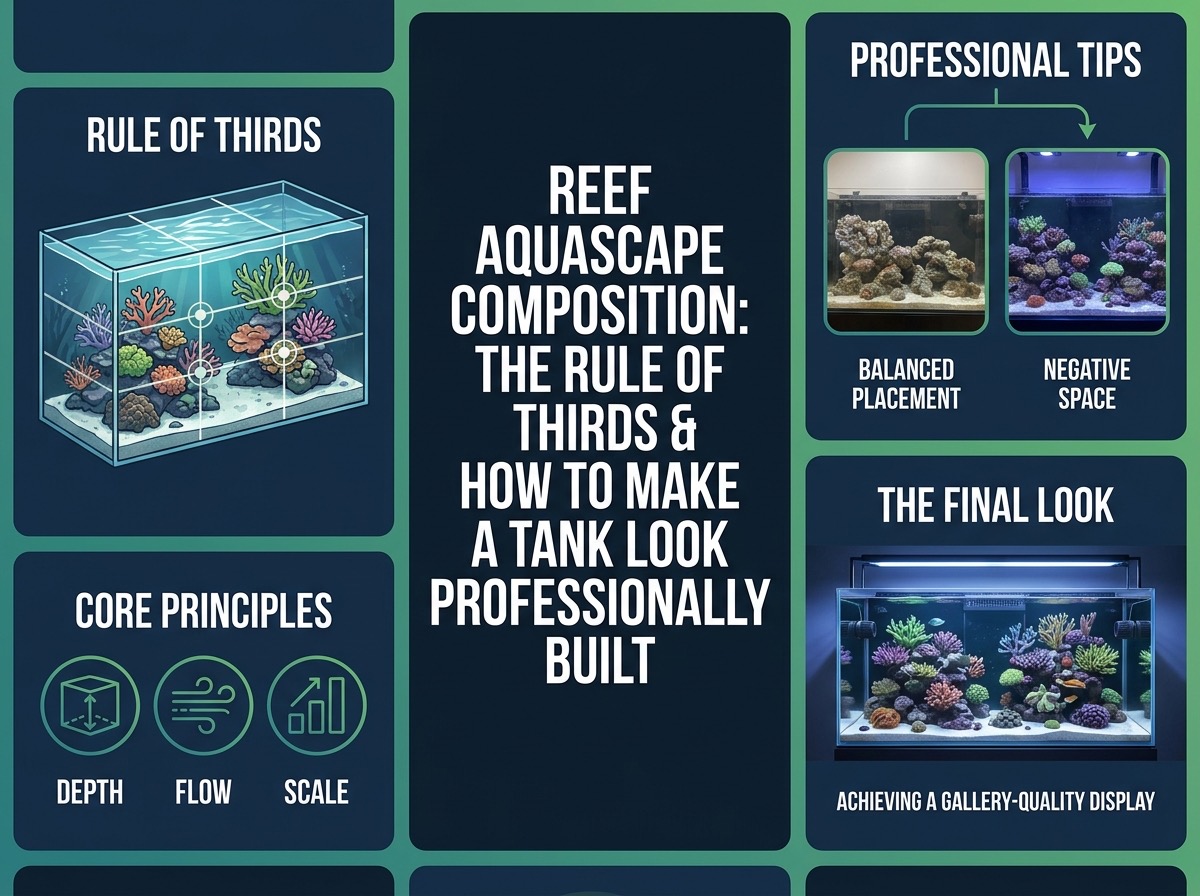
The rule of thirds is the single most useful composition principle for reef tanks. The principle:
- Divide the tank visually into a 3x3 grid (two vertical lines, two horizontal lines)
- Place the most important elements at the intersections of the grid lines
- Place the secondary elements along the grid lines
- Leave the rest of the tank as negative space
The "thirds" rule works because it produces visually balanced compositions. The eye doesn't rest on the centre (which feels static and forced), nor on the edges (which feel cut off). The eye lands on the thirds, which feel natural and intentional.
In a reef tank, the rule of thirds applies to:
- The main rock structure: place the highest point of the rock at one of the upper-third intersections, not in the centre and not at the back
- The main focal coral: place the most striking coral at one of the lower-third intersections
- The sand line: the sand-to-rock transition should follow a curve, not a straight line, and should fall along one of the horizontal thirds
The result: a tank that draws the eye around, that has a clear focal point, and that feels balanced.
The "golden ratio" version
The rule of thirds is the simplified version. The more precise version is the golden ratio (also called the "phi grid" or "Fibonacci composition"). The golden ratio uses slightly different division points (1:1.618 instead of 1:1) that produce more dynamic compositions.
For practical purposes, the rule of thirds is close enough. The golden ratio adds 5-10% visual refinement for a much more complex mental math. Most aquascapers work with the thirds.
The "one focal point" rule
A common reef tank mistake: too many focal points. The eye doesn't know where to land. The tank looks busy and unfocused.
The rule: a tank should have one clear focal point — the place the eye lands first. Everything else supports the focal point.
The focal point in a reef tank is usually:
- A large, striking coral (a showpiece clam, a bubble-tip anemone, a large LPS colony)
- The highest point of the rock structure
- An open area of sand with a striking feature
Once the focal point is identified, the rest of the tank is composed to support it. The other corals, the rock, the open space — all of it leads the eye to the focal point.
The negative space rule
Negative space is the empty area of the tank — the sand bed, the open water column, the area between rock structures. Negative space is what allows the eye to rest and the focal points to stand out.
The mistake: fill every inch of the tank with rock and coral. The result looks crowded and busy. The eye doesn't know where to go.
The rule: at least 30-40% of the visible tank area should be negative space. For a 100-gallon tank, this means a sand bed that takes up 25-40% of the floor, with the rock structure occupying 30-40% of the volume, leaving 20-30% as open water.
The "reef-scape" style (mostly rock and coral, minimal sand) works only with very deliberate composition. The "island" style (a single rock structure in the middle of a large sand bed) is easier to compose and more forgiving of mistakes.
The triangle composition
The triangle is the most common and most stable composition in reef aquascape. The principle:
- The rock structure has a clear highest point (the apex of the triangle)
- Two lower points (the front-left and front-right bases of the triangle)
- The triangle is asymmetric — not pointing straight up, but tilted slightly to one side
The triangle composition works because it creates a clear hierarchy of heights. The eye follows the apex, then drops to the bases, then sweeps through the middle. The composition feels stable but not static.
The most common mistake: a flat rock structure. All the rock is the same height, with no apex. The eye doesn't know where to land. The tank looks like a coral plateau rather than a reef.
The diagonal flow
A related principle: the composition should flow diagonally, not horizontally or vertically. A horizontal flow feels static. A vertical flow feels unnatural (corals don't grow straight up in nature). A diagonal flow feels dynamic and natural.
In a reef tank, the diagonal is usually from front-left to back-right (or vice versa). The apex of the rock is at the back, the bases of the triangle are at the front. The eye sweeps diagonally through the tank.
The mistake: a vertical wall of rock at the back of the tank, with no diagonal flow. The tank looks like a cliff face. The eye doesn't know where to start.
The "Asian style" vs the "Caribbean style"
Two major reef aquascape traditions, each with different composition principles:
Asian style
- The rock structure is built into a clear island or peninsula shape
- The focal point is usually a single showpiece coral or clam
- Heavy use of negative space
- Minimal, deliberate coral placement
- Sand bed is usually small, with the rock occupying most of the tank
- Inspired by Japanese aquascaping traditions (Takashi Amano, ADA)
- Typical fish load: small, peaceful, with deliberate selection
Caribbean style
- The rock structure spans the back wall, creating a "wall" effect
- The focal point is the centre of the wall
- Heavy coral coverage, often with a wide variety of species
- Less negative space
- Inspired by Caribbean reef photography
- Typical fish load: heavier, more active species
Neither style is "correct" — they're different aesthetic traditions. The Asian style is more minimal and refined. The Caribbean style is more lush and busy. A skilled aquascaper can blend elements of both.
The three main rock arrangement patterns
Three common patterns, each with its own composition principles:
The island
A single rock structure in the centre or off-centre of the tank, surrounded by sand. The island has a clear apex, asymmetric bases, and a triangular profile.
Best for:
- Tanks with a clear focal point (a showpiece clam, a large LPS colony)
- The Asian style
- Smaller tanks where a single structure can dominate
Challenges:
- The tank can look empty if the coral placement is sparse
- The island can feel isolated if there's no connection to the back wall
The peninsula
A rock structure that extends from one side of the tank (usually the back) toward the centre, with sand surrounding the rest. The peninsula has a clear "shore" where rock meets sand, often with the highest point at the back.
Best for:
- Most mixed reef tanks
- The Caribbean style
- Tanks where the focal point is a coral on the peninsula, not in the centre
Challenges:
- The peninsula can block flow to the back of the tank
- The far side of the tank (away from the peninsula) can look sparse
The wall
A rock structure along the entire back of the tank, with sand in the front. The wall has multiple peaks and valleys, often with several "towers" of rock.
Best for:
- Heavy coral coverage
- The Caribbean style
- Tanks with many coral colonies
Challenges:
- The wall is the hardest composition to get right
- The wall can look like a literal wall if not composed carefully
- The wall can block flow and water movement
The "live rock vs dry rock" consideration
Modern reef tanks are often built on dry rock (Pukani, MarcoRocks, CaribSea LifeRock) rather than live rock. The reasons:
- Pest-free: dry rock doesn't carry hitchhikers (mantis shrimp, aiptasia, bristleworms)
- Predictable: dry rock is consistent in shape and size
- Cheap: dry rock is much less expensive than live rock
The composition principles apply equally to dry and live rock. The advantage of dry rock is that the aquascaper can choose exactly the right pieces for the composition, then arrange them with full control.
Live rock has the advantage of established biological filtration, but the shapes are more random and the composition is harder to control. Many modern tanks use a mix: dry rock for the main structure, with a few pieces of live rock for the biological seeding.
The construction process: from bare tank to aquascape
The aquascape is built before the tank is filled with water. The process:
Step 1: plan the composition
- Decide on the style (Asian island, Caribbean wall, peninsula, etc.)
- Identify the focal point
- Sketch the composition on paper or in a 3D modelling program
- Note the locations for the main corals
Step 2: lay the foundation
- Place the largest rock pieces first — these are the structural elements
- The foundation determines the overall shape of the structure
- Use rock epoxy (Two-Part Epoxy Putty, Aqua-Stick) to secure the foundation pieces to the tank bottom
Step 3: build the structure
- Add medium rock pieces on top of the foundation
- Build toward the apex, not from the apex
- The structure should be stable — if it wobbles, the structure is unsafe
- Continue to use epoxy for stability
Step 4: add detail and texture
- Small rock pieces, rubble, and branches add visual interest
- Place detail pieces at the thirds intersections
- Create small caves and crevices for fish to retreat to
Step 5: check from all viewing angles
- The tank is usually viewed from the front, but the side and top views matter
- Step back and look at the composition from across the room
- Adjust pieces that don't read well
Step 6: cure the epoxy
- Allow the epoxy to cure for 24-48 hours before adding water
- The epoxy should be fully hardened before the water weight is applied
Common aquascape mistakes
A list of the most common mistakes, in order of frequency:
The wall of rock
The aquascaper stacks rock all along the back of the tank, creating a wall. The composition is flat, the focal point is unclear, and the water flow is blocked. The fix: pull the rock away from the back wall, create space between the back glass and the structure.
The volcano
The aquascaper builds a single tall structure in the middle, with all the rock piled at one apex. The composition is unstable (literally and visually), the water flow is blocked, and the tank looks like a pile rather than a reef. The fix: spread the rock out, build a triangle composition, leave the centre as negative space.
The empty foreground
The aquascaper builds the rock structure at the back, leaving the front 1/3 of the tank empty. The result looks like a stage with no performers. The fix: extend the rock into the foreground, or place a low-profile rock island in the front to balance the composition.
The flat plateau
The aquascaper builds the rock at a consistent height across the tank, with no apex. The composition lacks hierarchy. The fix: identify the highest point and emphasise it. Pull down the surrounding rock to create contrast.
The overcrowded tank
The aquascaper fills every space with rock and coral. The composition is busy and the focal point is unclear. The fix: remove rock pieces until the composition reads. Less is usually better.
The hidden coral
The aquascaper places corals in crevices and caves where they can't be seen. The corals grow toward the light, becoming misshapen and weak. The fix: place corals on the visible faces of the rock, where they get light and can be appreciated.
The unstable structure
The rock stack is not epoxied, the tank is bumped during maintenance, and the rock collapses. The fix: epoxy every piece that doesn't naturally rest on another piece. The rock should be solid when complete.
The "viewing distance" consideration
The composition is judged at viewing distance, not at arm's length. A composition that looks good up close may look busy from across the room. A composition that looks empty up close may look balanced from across the room.
The fix: step back. Photograph the tank from the typical viewing distance (usually 2-4 metres from the glass). Review the photo. The composition should read well at this distance.
The "time" consideration
A reef aquascape changes over time. The rock accumulates coralline algae (purple and pink), the corals grow and shift the visual balance, the fish swimming through create movement. A composition that looks sparse at the start will look full in 12-18 months.
The fix: build the initial composition with the long-term view in mind. The "final" composition is 18 months in. The initial composition should account for coral growth.
The bottom line
Reef aquascape composition is a learnable skill, not a gift. The rules — thirds, focal point, negative space, triangle, diagonal flow — are principles that work across photography, painting, and reef design. The aquascaper who knows the rules and applies them consistently builds a tank that looks intentional. The aquascaper who doesn't know the rules builds a tank that looks like a pile of rocks. The tools are epoxy, dry rock, and the patience to undo and rebuild. The result is a tank that becomes more beautiful over time.
---
About the author: [Olivia Brown](../Olivia%20Brown.md) holds an MSc in Marine Biology from James Cook University and has 12 years of experience in public aquaria, with a specialisation in coral husbandry and reef ecosystem management.