Biosecurity and quarantine for marine livestock: how to skip the ich outbreak
The most common reason a healthy reef tank crashes is a new fish. The new fish looks clean at the store, the new fish goes into the display, the new fish carries marine ich (Cryptocaryon irritans) or velvet (Amyloodinium ocellatum), and four weeks later the entire tank is infected. The aquarist now faces the choice between treating the display (which kills the invertebrates) or letting the disease run its course (which kills the fish).
This is preventable. The quarantine protocol is the single most effective piece of biosecurity a marine aquarist can implement. It costs time and a small setup. It saves the tank.
This is the protocol that the modern reefkeeping community has converged on after decades of trying to skip the step.
The principles
The quarantine protocol rests on three principles:
1. Every new fish is potentially infected
Even fish from the best stores. Even fish from breeders. Even fish that have been in the store for months. The pathogens that matter — Cryptocaryon, Amyloodinium, Brooklynella, Uronema, and a dozen less common ones — have life cycle stages that aren't visible. A fish can look perfect and be carrying a fatal infection that will activate under the stress of transport.
The only way to know the fish is clean is to quarantine it through at least one full life cycle of the target pathogen (typically 4-6 weeks for ich) and observe it carefully.
2. The display tank is too risky to treat
Most medications that kill fish pathogens also kill invertebrates, corals, and beneficial bacteria. Copper, formalin, and many antibiotics are deadly to reef tanks. Treating a sick display is a last resort that usually produces a worse outcome than the disease would have.
The quarantine tank is a separate, treatable system. The fish is treated in the quarantine tank before it enters the display. The display is never exposed to the medication.
3. Stress activates latent infections
A fish that carries Cryptocaryon may not show symptoms in the store's stable environment. The stress of transport, the new tank, the new social structure — these suppress the fish's immune system and activate the parasites. The fish looks fine in the bag, looks fine in the quarantine, and 3 weeks later has white spots.
The quarantine period is long enough to outlast this delayed activation. By the time the fish enters the display, the latent infection (if any) has either manifested in quarantine (and been treated) or never will.
The quarantine tank setup
The quarantine tank is a small, separate, fully controllable system. The minimum setup:
Tank
- 10-20 gallons for small fish (clownfish, gobies, wrasses)
- 20-40 gallons for medium fish (angelfish, tangs, larger wrasses)
- 40-75 gallons for large or active fish (large tangs, large angelfish, triggers)
- Bare bottom (no sand, no rock)
- PVC pipe fittings or flower pots for hiding spots
- A tight-fitting lid (fish jump)
Equipment
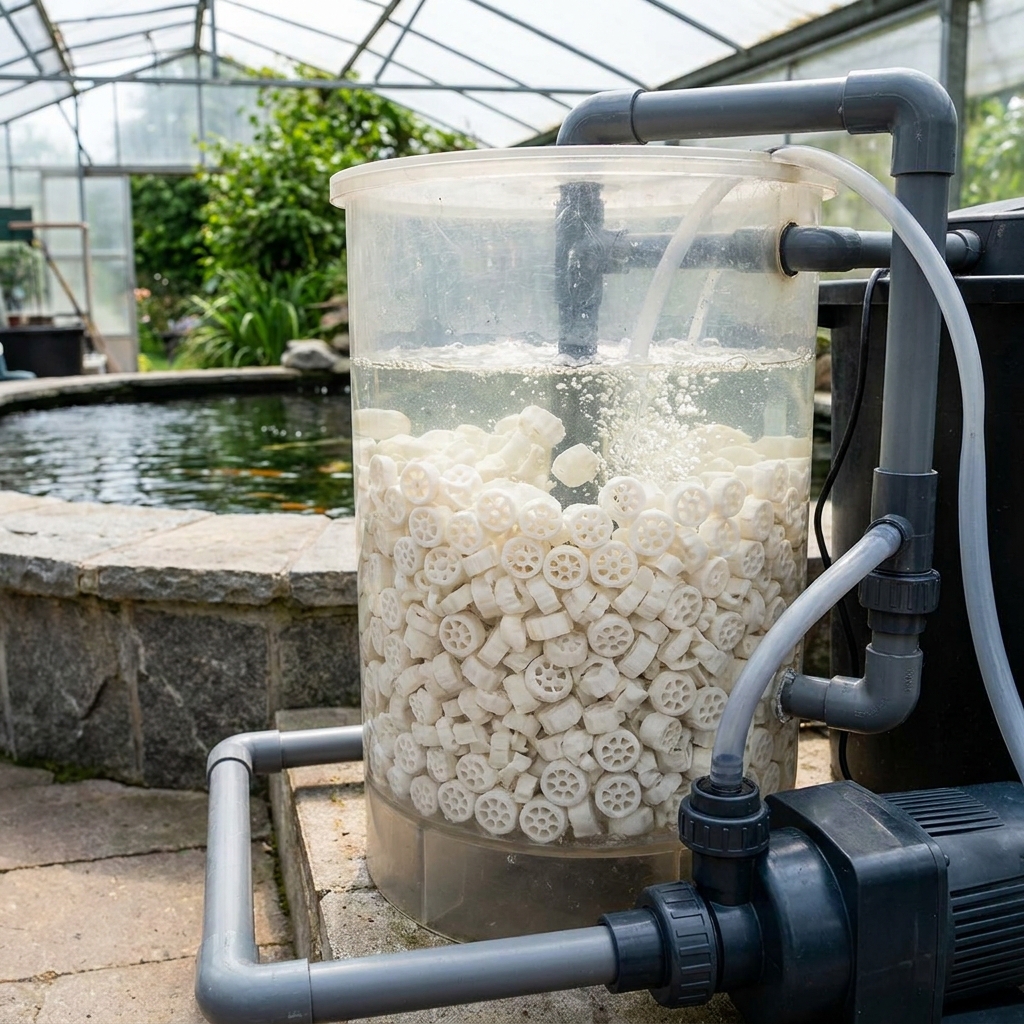
- Filter: a sponge filter seeded with bacteria from an established tank, OR a small hang-on-back filter with biological media
- Heater: 50W or 100W, depending on tank size
- Powerhead or air stone: for water movement and surface agitation
- Thermometer: to monitor temperature
- Light: a simple LED or fluorescent, on a basic day/night cycle
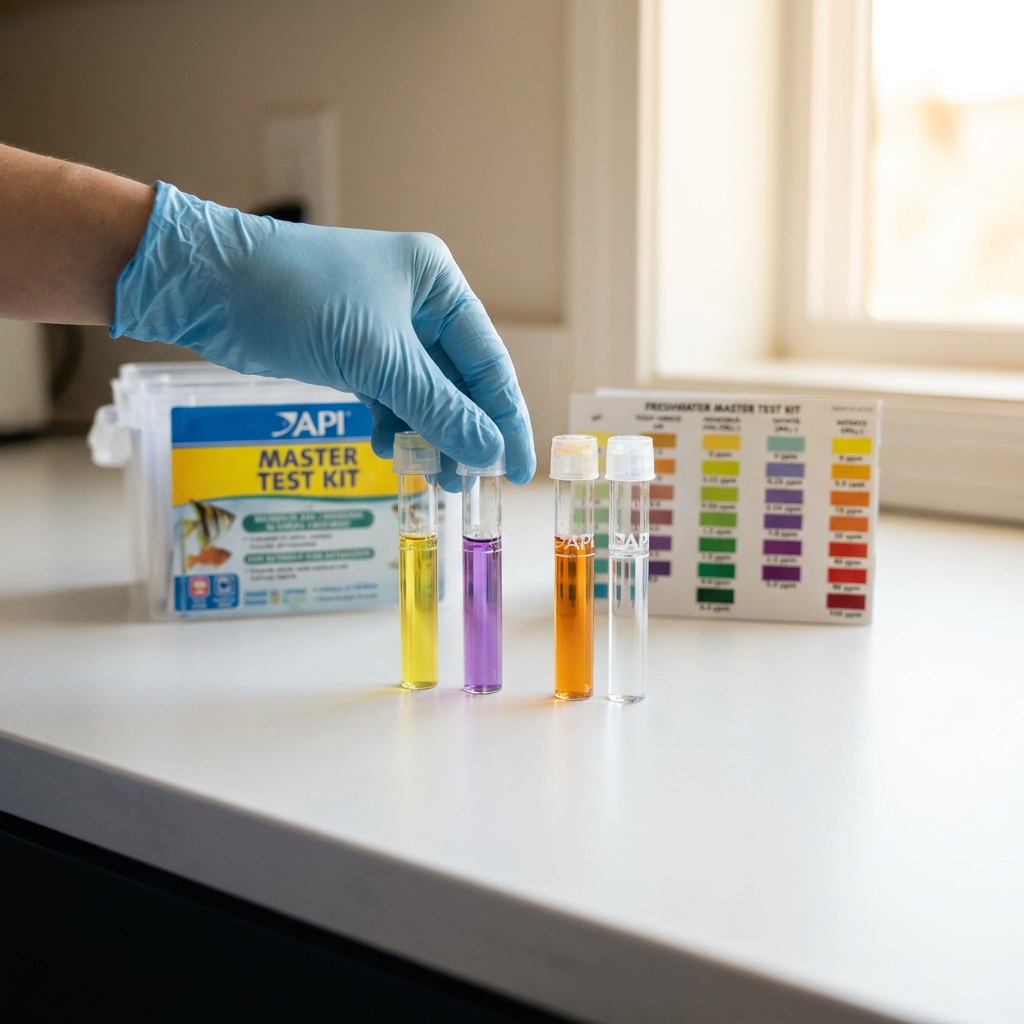
- Test kit: ammonia, nitrite, pH at minimum
Why bare bottom and no rock
A bare-bottom quarantine tank is easier to clean, easier to observe the fish, and impossible for the fish to hide in. There are no corals to worry about, no rock for the fish to wedge itself into, no places for the medication to absorb into.
The PVC pipes provide hiding spots without the complexity of rock. The fish feels secure, and the aquarist can see the fish at all times.
Cycling the quarantine tank
The quarantine tank must be cycled before fish are added. The options:
- Run the tank for 4-6 weeks with a small ammonia source (fish food, pure ammonia)
- Seed the filter with bacteria from an established tank — the most efficient method. Move a sponge filter or some ceramic media from a running display tank to the quarantine tank
- Use bottled bacteria (DrTim's, Seachem Stability) for an instant cycle. Less reliable than seeding but acceptable in a pinch
The quarantine tank should be cycled and ready to go at all times. Many reefkeepers keep the quarantine tank running permanently, with a sponge filter on the display tank to keep the bacteria active. When a new fish arrives, the quarantine tank is ready.
The quarantine protocol
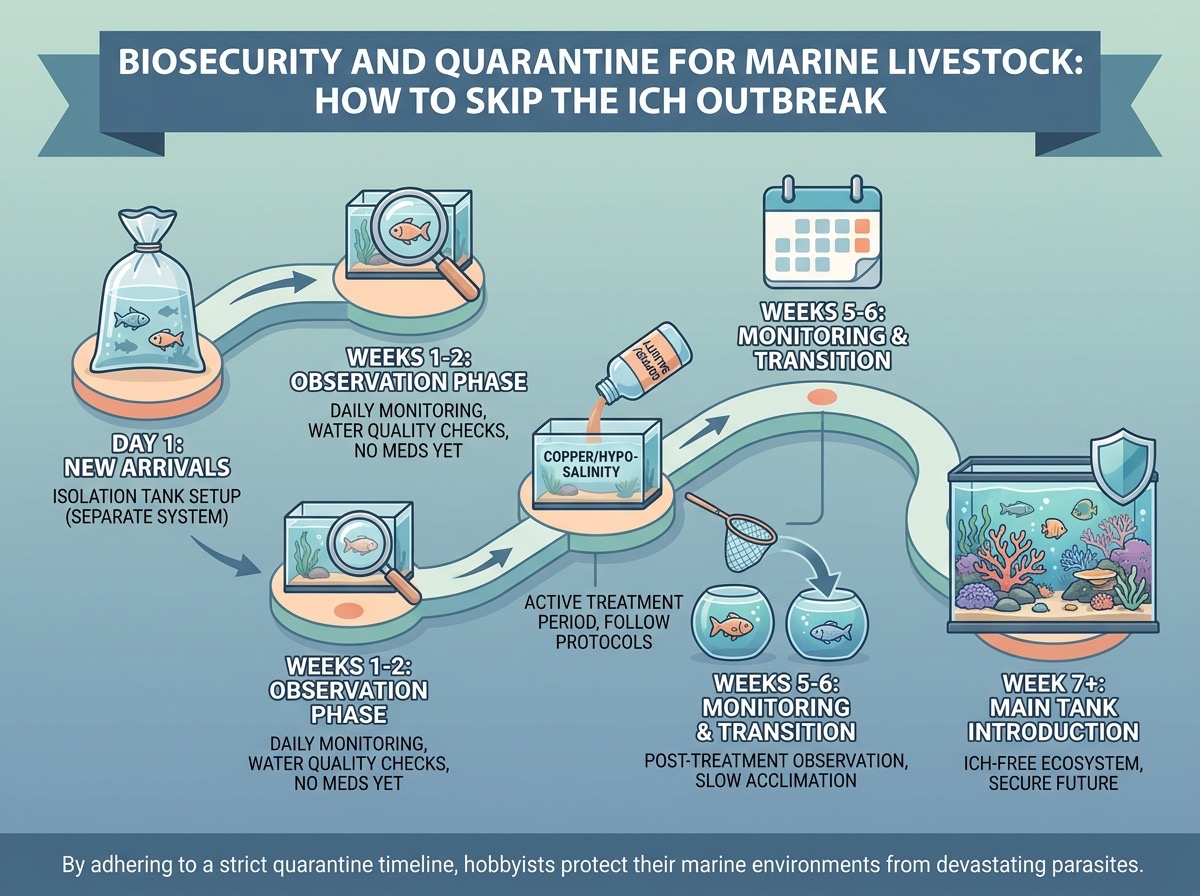
The standard 4-6 week protocol:
Week 1: arrival and observation
- Acclimate the fish to the quarantine tank over 1-2 hours (drip acclimation is best)
- Observe the fish for signs of disease: white spots, scratching against objects, rapid breathing, lethargy, clamped fins
- Feed a high-quality diet (the fish is stressed and needs nutrition)
- Do not start any medications yet — observe first
Week 2: continued observation and prophylactic treatment
- Continue observation
- Most aquarists begin prophylactic treatment for ich and velvet at this point, because the stress of transport often activates latent infections
- The prophylactic treatment is typically copper (see below)
Weeks 3-4: continued treatment and observation
- Continue the prophylactic treatment for the full duration
- Continue observation for any signs of disease
- Watch the appetite, behaviour, and physical condition
Weeks 5-6: end of treatment and observation
- Complete the prophylactic treatment
- Continue observation for 2-4 weeks after the medication course ends
- Any disease that was incubating should have manifested by this point
- If the fish has been healthy for the full 4-6 weeks, it's ready for the display
The prophylactic medication: copper
The most widely used prophylactic treatment in marine quarantine is copper. Copper at therapeutic levels (typically 0.15-0.20 mg/L free copper for the formalin/citrate preparation, or as labelled for chelated copper products) kills the free-swimming stages of Cryptocaryon and Amyloodinium.
Copper forms
- Cupramine (copper sulfate pentahydrate, Seachem): ionic copper. Effective but requires careful dosing
- Copper Power (Seachem): chelated copper. More forgiving, less likely to cause toxicity, but slightly less potent
- Copper Safe (Marineland): another chelated copper, similar to Copper Power
For most reefkeepers, chelated copper (Copper Power or Copper Safe) is the right choice. The dosing is more forgiving and the toxicity risk is lower.
Copper testing
The free copper level must be tested regularly. A copper test kit (Salifert, API, Hanna) is essential. Test every 1-2 days during treatment.
Target levels:
- Ionic copper (Cupramine): 0.15-0.20 mg/L
- Chelated copper (Copper Power, Copper Safe): 1.5-2.0 mg/L (per the product label)
Levels below the target are ineffective. Levels above the target are toxic to the fish.
Copper duration
The standard protocol is 14-21 days of copper treatment at therapeutic levels. After 14-21 days, the medication is removed via water changes and the fish is observed for an additional 2-4 weeks without copper.
The total quarantine period is 4-6 weeks, with the first 2-3 weeks including copper treatment and the remaining 2-4 weeks for observation.
The "no copper" alternatives
Some fish are sensitive to copper (especially scaleless fish like sharks, rays, and some wrasses). For these fish, alternatives include:
- Ttm (tank transfer method): a labour-intensive but copper-free approach. The fish is moved between multiple tanks every few days, breaking the ich life cycle. Effective but requires dedicated tanks
- Chloroquine phosphate: a malaria drug that is effective against ich. Used by some reefkeepers but requires a prescription or research supply
- Formalin: a traditional ich treatment. Effective but stressful to the fish and dangerous to the user
- Hyposalinity: reducing salinity to 1.009-1.010 for 4-6 weeks. Kills ich but doesn't kill all pathogens. Stressful to some fish
Most modern reefkeepers use copper prophylactically. The "no copper" alternatives are reserved for copper-sensitive species.
The most common quarantine pathogens
A brief list of the pathogens the quarantine protocol is designed to catch:
Cryptocaryon irritans (marine ich)
- Signs: white spots (1-2 mm) on body and fins, scratching, rapid breathing, clamped fins
- Latency: can be carried for weeks before showing signs
- Treatment: copper, TTM, chloroquine
- Lethality if untreated: high. Will eventually kill the fish, but the timeline is weeks to months
Amyloodinium ocellatum (velvet / "Oodinium")
- Signs: gold or rust-coloured dust on the body, rapid breathing, scratching, lethargy
- Latency: shorter than ich. Usually shows signs within 1-2 weeks
- Treatment: copper, formalin
- Lethality if untreated: very high. Often kills fish within days. The most lethal marine aquarium parasite
Brooklynella hostilis (clownfish disease)
- Signs: skin peeling, excessive mucus, rapid breathing, lethargy
- Latency: 1-2 weeks
- Treatment: formalin, copper (less effective)
- Lethality if untreated: high. Often affects clownfish but can affect other species
Uronema marinum
- Signs: red sores, often on the side of the body. Affects angelfish, butterflies, and chromis particularly
- Latency: 1-2 weeks
- Treatment: difficult. Formalin, metronidazole, sometimes chloroquine
- Lethality if untreated: high
Internal parasites (nematodes, intestinal worms)
- Signs: weight loss despite eating, white stringy faeces
- Latency: weeks to months
- Treatment: praziquantel, fenbendazole in food
- Lethality if untreated: gradual wasting, death over months
A 4-6 week quarantine with observation and prophylactic copper catches most of these. Some internal parasites require additional medication (praziquantel).
The "fallow display" approach
For tanks that have already had an ich or velvet outbreak, the standard treatment is to leave the display fishless for 6-8 weeks (the "fallow period"). The parasites cannot complete their life cycle without a host, and they die out.
The fallow period:
- Move all fish to a treatment tank (copper or TTM)
- Leave the display fishless for 6-8 weeks
- The display's invertebrates and corals are unaffected
- After 6-8 weeks, the display is ich-free, and the fish can return
This is the only way to break the ich life cycle in a reef tank with invertebrates. It is disruptive but necessary.
The coral and invertebrate quarantine
Fish aren't the only livestock that can introduce disease. Corals, inverts, and macroalgae can carry:
- Aiptasia (pest anemones): brought in on live rock and coral bases
- Flatworms (Acropora-eating flatworms, AEFW): brought in on Acropora frags
- Nudibranchs: brought in on macroalgae
- Pest algae (bubble algae, hair algae): brought in on live rock
- Parasites and pathogens: less common in corals, but possible (white syndrome, brown jelly disease in Euphyllia)
Coral quarantine
The coral quarantine is different from the fish quarantine. The coral goes into a separate tank with:
- Low light (the coral is stressed; high light can bleach it)
- Low flow
- No fish (the fish aren't the concern)
- Iodine dip (1-2 minutes in a coral-specific iodine solution) to kill surface pests
After 2-4 weeks in quarantine, the coral is examined for hitchhikers and added to the display.
Invert quarantine
Inverts (snails, crabs, shrimp) are usually added directly to the display after a brief acclimation. The risk of disease transmission is low, but the risk of hitchhiker introduction is high. A 1-2 week observation period in a separate tank is often worthwhile.
The "skipping quarantine" scenarios
A few situations where aquarists commonly skip quarantine, and why they shouldn't:
"The fish has been at the store for months"
The store's display is not a quarantine. The fish may have been exposed to pathogens during its time at the store. The store's environment is stable, but the fish may be carrying latent infections. The fish is not "clean" because it's been at the store for a long time.
"I trust the breeder"
A reputable breeder with closed-system facilities and biosecurity protocols is lower risk, but not zero risk. Even the best breeders have had ich outbreaks. Quarantine is not about trust; it's about the limitations of detecting latent infections.
"I have a copper-sensitive fish and don't want to deal with it"
The alternatives (TTM, formalin, hyposalinity) are more work but viable. Skipping quarantine is not the answer. The fish is at risk of bringing disease to the display.
"My display is already ich-positive and I treat the display"
Treating a display with copper kills the invertebrates. Treating with formalin is dangerous. The fallow period is the only safe approach. The fish should still be quarantined before re-introduction.
"I have a 5-gallon pico tank with one clownfish"
Even a small tank deserves a quarantine. The investment is minimal (a 5-10 gallon tank, a sponge filter, a heater). The protection is real.
The cost-benefit of quarantine
The cost of a quarantine setup:
- 10-20 gallon tank: $20-50
- Sponge filter: $10-20
- Heater: $15-30
- PVC pipe fittings: $5
- Light: $10-20
- Test kit: $20-50
- Total: $80-170
The cost of a single ich outbreak in a display:
- 4-8 weeks of fallow (display fishless)
- Hospital tank for the display fish during treatment
- Medication costs
- Loss of fish (often 30-100% of the population, depending on the pathogen and the speed of response)
- Stress and disruption
The quarantine pays for itself the first time it prevents an outbreak.
The bottom line
The marine quarantine is the single most effective piece of biosecurity a marine aquarist can implement. A 10-20 gallon bare-bottom tank, a cycled filter, a heater, and a 4-6 week observation period with prophylactic copper. The investment is small, the effort is moderate, and the protection is significant. The new fish arrives, is observed and treated in quarantine, and enters the display only when it's been healthy for the full quarantine period. The display never sees the pathogen. The ich outbreak never happens. The velvet wipeout is avoided. The reef survives for years. The science is straightforward, the protocol is established, the result is a healthy tank.
---
About the author: [Olivia Brown](../Olivia%20Brown.md) holds an MSc in Marine Biology from James Cook University and has 12 years of experience in public aquaria, with a specialisation in coral husbandry and reef ecosystem management.