

Protein skimmers: how they work, how to tune one, and the mistakes that make them useless
The protein skimmer is the most efficient piece of nutrient export equipment in a marine aquarium. A well-tuned skimmer removes 30-50% of the dissolved organic carbon (DOC) before it breaks down into nitrate. A poorly tuned skimmer — and most are — removes 5-10% of the DOC. The difference between a clean, low-nutrient reef and an algae-plagued, high-nutrient reef is often the difference between a well-tuned skimmer and a poorly tuned one.
Most skimmers are not tuned correctly. The skimmer is plugged in, it makes bubbles, and the owner assumes it's working. It may not be. This is how skimmers actually work, how to tune one, and the mistakes that make them useless.
The principle: foam fractionation
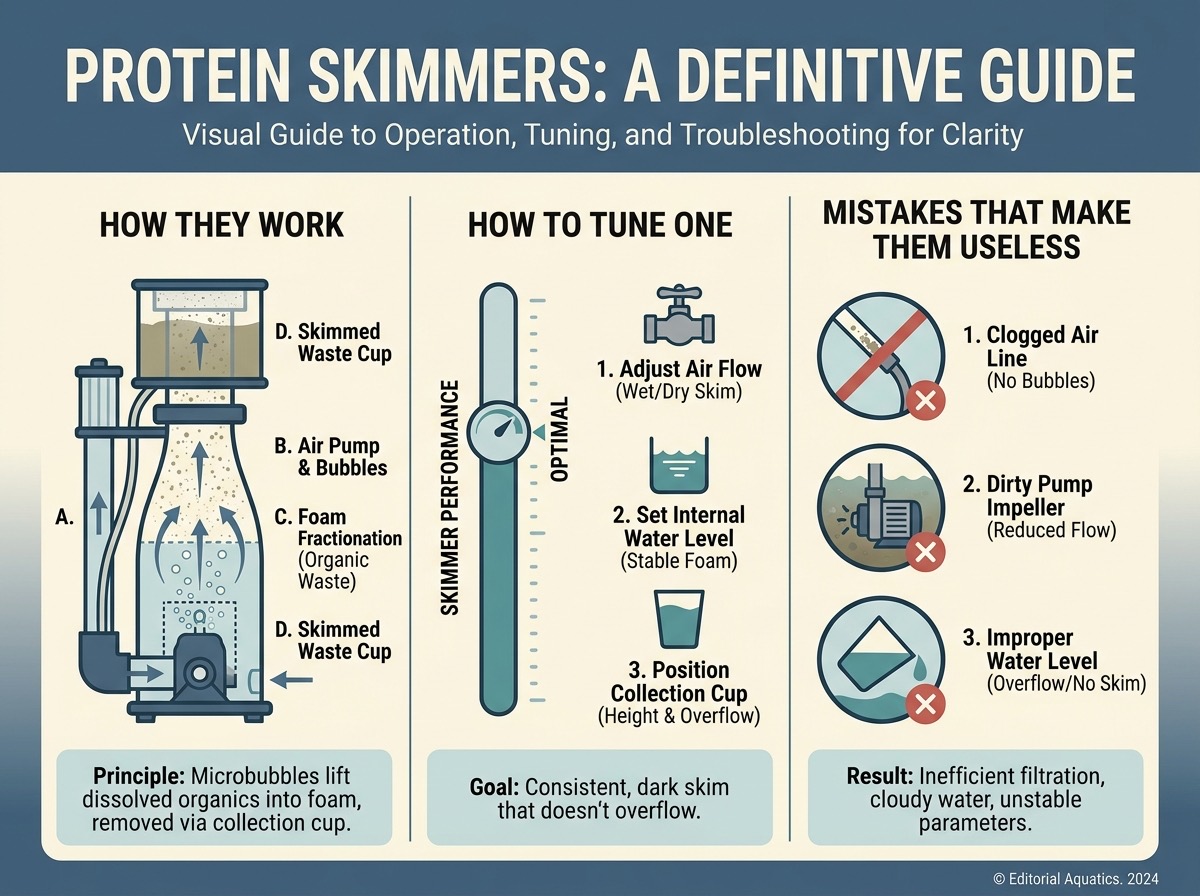
The protein skimmer is a foam fractionation device. It separates dissolved organic compounds from the water by adsorbing them onto the surface of air bubbles. The bubbles rise through a column of water, accumulate organics on their surface, and form a foam at the top of the skimmer. The foam is collected in a cup, where it condenses into a dark, smelly liquid. The liquid is removed. The organics are exported from the tank.
The science:
- Organic molecules in saltwater (proteins, amino acids, sugars, fatty acids) are surface-active. They concentrate at air-water interfaces
- The skimmer produces thousands of small air bubbles. Each bubble has a large surface area relative to its volume
- As the bubbles rise, organic molecules adsorb onto the bubble surface
- The bubbles accumulate at the top of the skimmer, forming a foam
- The foam is denser than water and rises to the collection cup
- The cup is removed and emptied, exporting the organics
The skimmer doesn't remove ammonia, nitrite, or nitrate directly. It removes the dissolved organic compounds that would otherwise be broken down by bacteria into ammonia, then nitrite, then nitrate. The skimmer is upstream of the nitrogen cycle, removing the load before it can become a problem.
The components of a skimmer
A typical protein skimmer has the following components:
The reaction chamber
The chamber where the bubbles rise through the water. The size and shape of the chamber determine the contact time between the bubbles and the water. A taller, narrower chamber produces more efficient skimming than a shorter, wider chamber.
The pump
The pump (or venturi) that creates the bubbles. The pump is the most critical component. A weak pump produces large bubbles that have less surface area and less efficient organic removal. A strong pump produces fine bubbles that have more surface area and more efficient organic removal.
Most modern skimmers use one of:
- Needle wheel pump: a pump with a needle wheel impeller that shears the water and air into very fine bubbles. The most common pump type in modern skimmers
- Venturi pump: a pump that uses a venturi to draw air into the water. Produces coarser bubbles than a needle wheel, but is simpler
- Air-driven (wooden) skimmer: uses an airline and a venture to produce bubbles. Less common in modern use
- Downdraft skimmer: water is pumped down through the chamber, with air being drawn in. Different design but similar principle
The collection cup
The cup at the top of the skimmer that collects the foam. The cup is removable for emptying. The cup volume determines how often the skimmer needs to be emptied. Most cups hold 1-2 weeks of skimmate for a moderate-bioload tank.
The water inlet and outlet
The water enters the skimmer from the sump (or from the tank directly in some models) and exits back to the sump. The flow rate through the skimmer affects the contact time and the skimming efficiency. Most skimmers have a flow rate of 200-500 gallons per hour for a moderate tank.
The venturi or air intake
The venturi or air intake determines how much air is mixed with the water. More air produces more bubbles but also more turbulence. The right balance is needed for efficient skimming.
The tuning: making the skimmer actually work
A skimmer is tuned by adjusting:
1. The water level in the reaction chamber
The water level inside the skimmer (not the sump level) is the most important tuning variable. Most skimmers have an adjustable outlet or gate valve that controls the water level.
- Water level too high: the bubbles exit the chamber too quickly. Contact time is too short. Skimming is inefficient
- Water level too low: the bubbles don't rise high enough to form a foam column. Skimming is weak or non-existent
- Optimal water level: typically 6-10 inches below the top of the reaction chamber. The skimmer should produce a tight, dense foam column that rises to the cup
2. The air intake
The air intake determines how much air is mixed with the water:
- Air intake too open: too much air, turbulent foam, less efficient skimming. The cup fills with watery foam
- Air intake too closed: too little air, weak bubble production, weak skimming. The cup fills with dark, wet skimmate (because the bubbles are too coarse)
- Optimal air intake: a steady, dense column of fine bubbles. The skimmate is dark and moist but not watery. The cup fills at a rate appropriate for the bioload
3. The water flow
The water flow through the skimmer affects the contact time:
- Flow too high: water passes through too quickly. Skimming is weak
- Flow too low: water stays too long, may cause the skimmer to overflow. Skimming is watery
- Optimal flow: depends on the skimmer, typically 1-2x the tank volume per hour for the skimmer's rated flow
4. The pump performance
The pump performance degrades over time. The pump impeller wears, the venturi clogs, the air intake gets blocked. A skimmer that worked well when new may perform poorly a year later.
- Clean the pump impeller every 3-6 months
- Clean the venturi every 1-3 months
- Replace the pump every 2-3 years, or as needed
The signs of a well-tuned skimmer
A well-tuned skimmer has these characteristics:
- Dark, moist skimmate: the cup fills with a dark liquid that smells like the ocean (or worse). The colour is the key — a well-tuned skimmer produces dark, almost black, skimmate
- Steady foam column: a tight, dense column of foam rises to the cup
- Cup fills at the right rate: for a moderate-bioload tank, the cup fills in 3-7 days. Too fast (watery) or too slow (overly dry) is a sign of mistuning
- pH stable: the skimmer removes CO2, which helps stabilise pH
- DOC removal: the tank has lower nitrates, less algae, less yellowing of the water
The signs of a poorly tuned skimmer
A poorly tuned skimmer has these characteristics:
- Light, watery skimmate: the cup fills with a clear or pale yellow liquid that doesn't smell strongly. The skimmer isn't removing much
- No foam column or wet bubbles: the bubbles burst before reaching the cup, or no foam is forming
- Cup fills too fast or too slow: the rate is wrong for the bioload
- High nitrates despite skimming: the skimmer isn't removing enough DOC
- Algae growth despite skimming: the skimmer isn't keeping up with the nutrient export
The common mistakes
The mistakes that make a skimmer useless:
Mistake 1: water level too high
The most common mistake. The skimmer is set up with the water level at the top of the reaction chamber. The bubbles exit before they can form a foam column. The result: a wet, weak skimmate that doesn't remove much.
The fix: lower the water level in the reaction chamber. The skimmer's outlet height or gate valve is the adjustment point.
Mistake 2: air intake fully open
The owner opens the air intake fully, assuming more air is better. The result: too much turbulence, watery foam, inefficient skimming.
The fix: close the air intake to 50-75%. Adjust until the foam is dense and the skimmate is dark.
Mistake 3: pump not cleaned
The pump impeller is clogged with salt creep, algae, or debris. The pump performance has degraded by 30-50%. The skimmer produces fewer and coarser bubbles.
The fix: clean the pump impeller and venturi every 1-3 months. The pump should be disassembled and cleaned, not just rinsed.
Mistake 4: water flow too high
The skimmer's water inlet is connected to a high-flow pump. The water passes through too quickly. The contact time is insufficient.
The fix: reduce the water flow to the skimmer. The flow rate should match the skimmer's rating.
Mistake 5: skimmer too small for the bioload
The skimmer is undersized for the tank. The bioload exceeds the skimmer's capacity. The skimmer is producing as much skimmate as it can, but it's not enough.
The fix: upgrade to a larger skimmer, or reduce the bioload. A general rule: the skimmer should be rated for 1.5-2x the tank volume.
Mistake 6: skimmer used as the only filtration
The skimmer is a component of a filtration system, not the whole system. The skimmer doesn't replace water changes, the refugium, the biological filter, or the regular maintenance.
The fix: combine the skimmer with other filtration methods. The skimmer is one part of the system.
Mistake 7: skimmate not emptied
The cup fills with skimmate, the owner doesn't empty it, the skimmate overflows back into the sump, the nutrients are returned to the tank. The skimmer becomes a nutrient recycling device.
The fix: empty the cup regularly. Most cups should be emptied every 3-7 days. Set a reminder.
Mistake 8: skimmer turned off at night
The owner turns the skimmer off at night to "let the fish rest" or to reduce noise. The result: 8 hours of unskimmed DOC accumulation per night.
The fix: run the skimmer 24/7. The skimmer doesn't disturb the fish, and the noise is acceptable in a sump location.
The skimmer size: matching the skimmer to the tank
A skimmer is sized to the bioload, not the tank volume. The general rules:
- Light bioload (fish only, no coral, low stocking): skimmer rated for 1.5x tank volume
- Moderate bioload (mixed reef, moderate stocking): skimmer rated for 2x tank volume
- Heavy bioload (heavy fish stocking, heavy feeding): skimmer rated for 2.5-3x tank volume
- LPS-dominant tank (less nutrient-sensitive): skimmer rated for 1-1.5x tank volume
- SPS-dominant tank (very nutrient-sensitive): skimmer rated for 2-3x tank volume
A skimmer that is too small is a bottleneck. A skimmer that is too large is just oversized (it produces less skimmate because the water is already low in DOC). The right size is the one that produces dark, moist skimmate at a steady rate.
The skimmer vs. other filtration methods
The skimmer is one part of a complete filtration system. The other components:
- Biological filtration: live rock, ceramic media, deep sand bed. Converts ammonia to nitrate
- Refugium: macroalgae that consume nitrate and phosphate. Exports nutrients through harvesting
- Water changes: the ultimate reset, removing accumulated nutrients
- Carbon and GFO: media for chemical filtration, removing dissolved compounds
The skimmer is upstream of the biological filter. The skimmer removes DOC before it becomes ammonia. The refugium and water changes remove the nitrate that the biological filter produces. The skimmer is the first line of defense; the other methods are the backup.
A tank with a skimmer but no refugium and no water changes: the skimmer reduces the nutrient load, but the nitrate still accumulates. The skimmer is necessary but not sufficient.
A tank with a refugium and water changes but no skimmer: the skimmer's absence means the refugium and water changes are working harder. The nutrients accumulate faster. The skimmer is recommended but not essential for low-bioload tanks.
The skimmer types: choosing the right one
The major skimmer types:
Hang-on-back (HOB) skimmers
Mount on the back of the tank. Suitable for tanks up to 75 gallons. Easy to install, but less efficient than in-sump skimmers.
In-sump skimmers
Sit in the sump, below the tank. The most common type for medium to large tanks. More efficient than HOB skimmers, but requires a sump.
Cone skimmers
In-sump skimmers with a cone-shaped body. The cone shape produces more efficient skimming by reducing turbulence. More expensive than cylinder skimmers.
Cylinder skimmers
In-sump skimmers with a cylindrical body. The most common design. Less efficient than cone skimmers but easier to maintain.
Recirculating skimmers
Skimmers that recirculate the water through the skimmer multiple times. The most efficient design for heavily stocked tanks. More expensive and more complex than single-pass skimmers.
The right skimmer depends on the tank size, the bioload, and the owner's budget. A well-tuned in-sump cone skimmer is the right choice for most reef tanks.
The troubleshooting checklist
When the skimmer isn't performing well:
- Check the water level in the reaction chamber
- Check the air intake setting
- Clean the pump impeller and venturi
- Check the water flow rate
- Check for salt creep in the air intake
- Check the cup is empty (not overflowing back into the sump)
- Check the skimmate colour and consistency
- Adjust one variable at a time and observe the result
The skimmer responds to adjustment within minutes. The owner should make one change, wait 5-10 minutes, observe the result, then make the next change.
The bottom line
The protein skimmer is the most efficient piece of nutrient export equipment in a reef tank. A well-tuned skimmer removes 30-50% of the DOC, prevents nitrate accumulation, stabilises pH, and produces dark, smelly skimmate. A poorly tuned skimmer removes 5-10% of the DOC and serves mostly as decoration. The tuning is straightforward: water level, air intake, water flow, pump performance. The skimmer responds within minutes. The owner who tunes the skimmer once a month and cleans the pump every 1-3 months has a well-functioning skimmer and a low-nutrient reef. The owner who doesn't tune the skimmer has a high-nutrient reef that requires constant algae control. The science is straightforward, the maintenance is modest, the result is significant. The skimmer is the workhorse of the reef. Make it work.
---
About the author: [Olivia Brown](../Olivia%20Brown.md) holds an MSc in Marine Biology from James Cook University and has 12 years of experience in public aquaria, with a specialisation in coral husbandry and reef ecosystem management.