
Ranchu conformation: how breeders evaluate body, head, and wen in the goldfish standard
The Ranchu is widely considered the most difficult fancy goldfish variety to breed to the show standard. The Ranchu was developed in Japan (where it is called the "king of goldfish") from the Chinese Lionhead, and the Ranchu has been refined over the centuries into a fish with a very specific body shape, a very specific head structure, a very specific wen, and a very specific deportment. The Ranchu breeder who wants to produce show-quality fish has to evaluate the fish against a comprehensive standard, with the body, the head, the wen, the swimming, and the deportment each receiving specific attention. In this article I will walk through the Ranchu standard, the evaluation of each trait, the culling decisions, the breeding strategy, and the realistic expectations for the new Ranchu breeder.
The Ranchu standard: the overall picture
The Ranchu standard, as set by the major Japanese goldfish societies (the Zen Nippon Airinkai, the Japan Goldfish Society), evaluates the Ranchu against a comprehensive set of criteria. The overall standard is the "ideal Ranchu," which is a fish with a smooth, rounded back, a deep body, a wide head with a well-developed wen, a short and rounded caudal peduncle, a short and split caudal fin, and a smooth, graceful swimming motion. The Ranchu that does not meet the standard in any one of these criteria is culled, regardless of how well the Ranchu meets the other criteria.
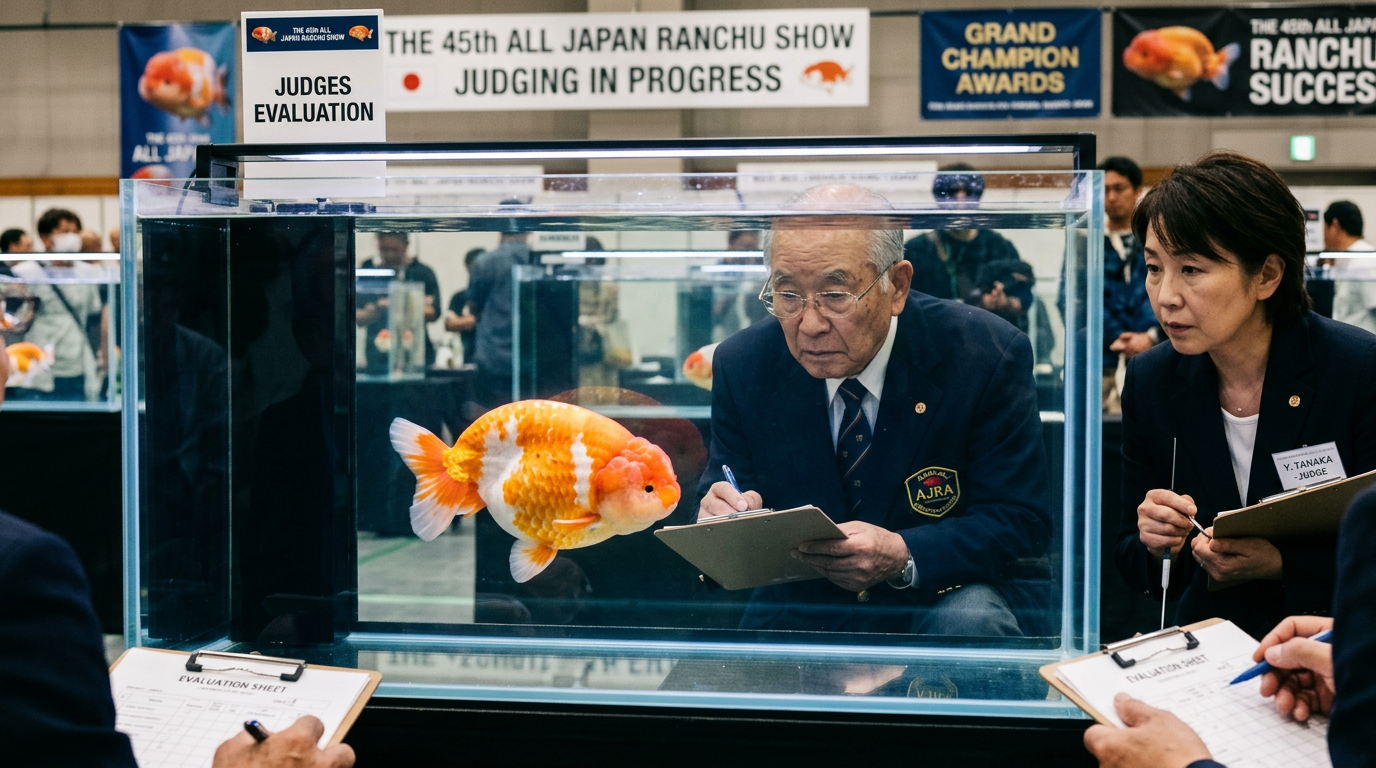
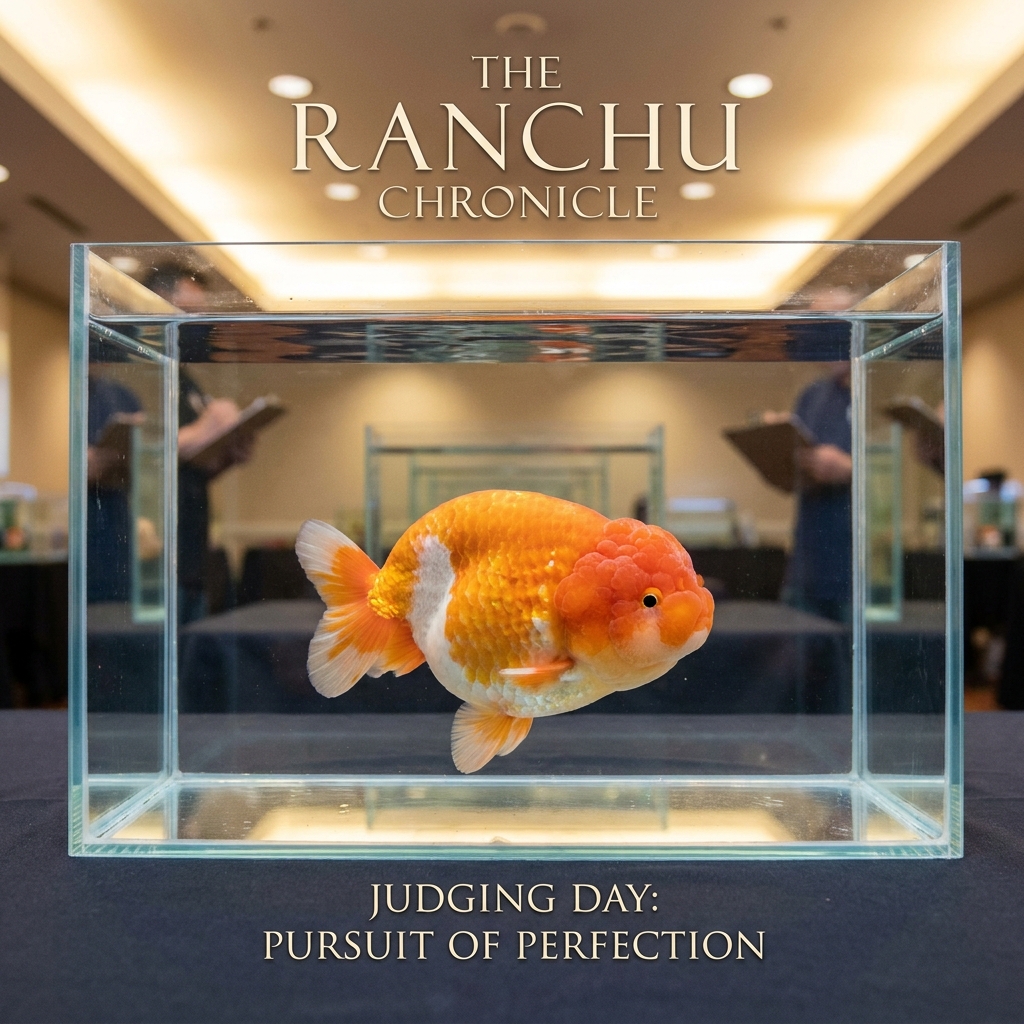
The evaluation is done by trained judges at the major shows (the All Japan Ranchu Show, the regional shows, the international shows). The judges score each Ranchu against the standard, and the Ranchu with the highest score is the show winner. The Ranchu that is bred for the show is the Ranchu that is bred to win the show, and the breeding program is the program that produces the show winners.
The body evaluation
The body of the Ranchu is the most visually distinctive trait, and the body evaluation is the most important part of the conformation. The body traits:
The back. The back should be smooth, rounded, and free of any dips, bumps, or surface irregularities. The back should be wider at the head and narrower at the tail, forming a smooth arc. The back that has a dip, a bump, or a surface irregularity is culled, regardless of the other traits.
The depth. The body should be deep, with the depth roughly 2/3 of the body length. The shallow-bodied Ranchu is culled, because the shallow body is a sign of poor growth or poor conformation.
The width. The body should be wide, with the width roughly 3/4 of the depth. The narrow-bodied Ranchu is culled, because the narrow body is a sign of poor conformation.
The caudal peduncle. The caudal peduncle (the area between the body and the tail) should be short and rounded, not long and narrow. The long, narrow caudal peduncle is culled, because the long peduncle is a sign of poor Ranchu conformation.
The caudal fin. The caudal fin should be short, split into two lobes (ideally 25% of the body length), and held in an upright position when the fish is swimming. The long, drooping, or asymmetric caudal fin is culled.
The head evaluation
The head of the Ranchu is the second most distinctive trait, and the head evaluation is the second most important part of the conformation. The head traits:
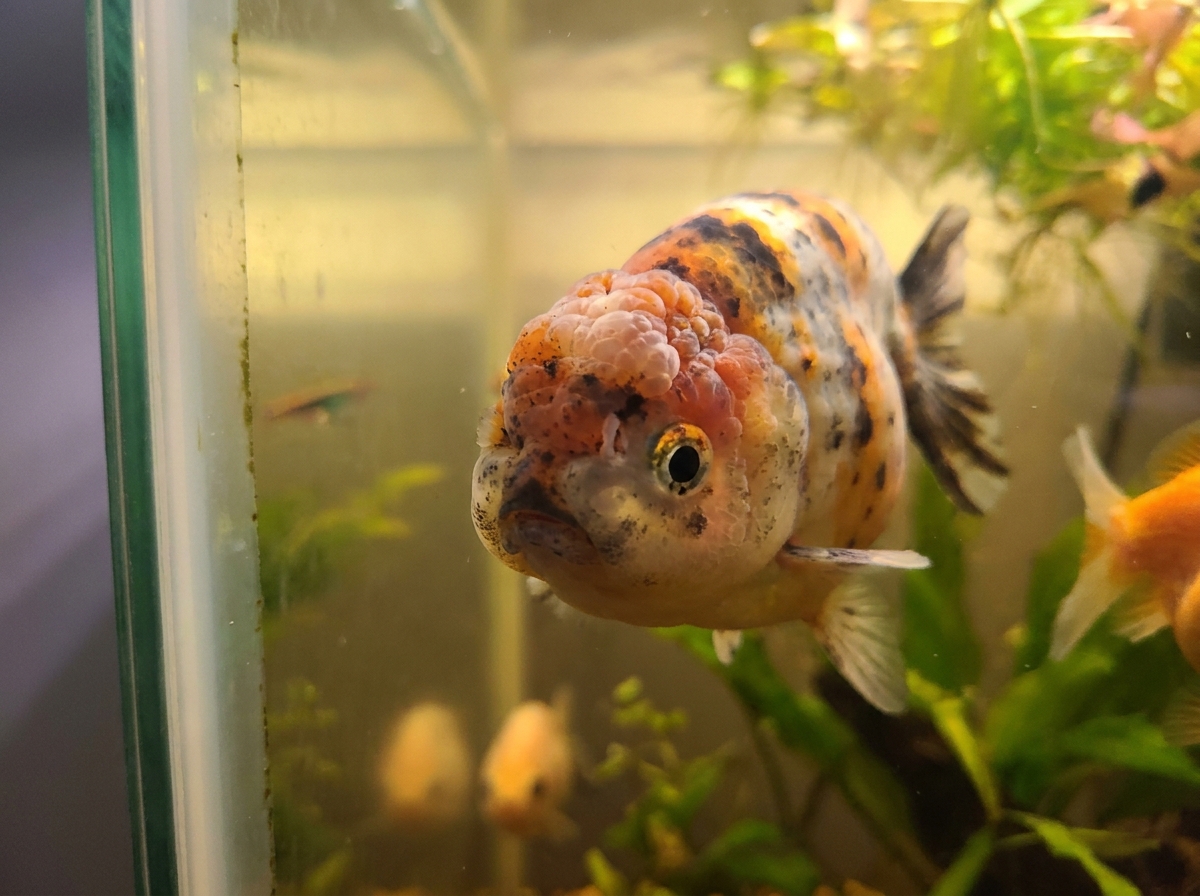
The head shape. The head should be wide and square, with the cheeks full and the eyes small and centered. The narrow, pointed, or asymmetric head is culled, because the head shape is a sign of the Ranchu lineage.
The wen. The wen (the raspberry-like growth on the top of the head) should be well-developed but not excessive. The wen that is too small is a sign of poor Ranchu lineage. The wen that is too large is a sign of the wen overgrowth, which can obscure the eyes and impair the vision. The ideal wen is full, well-defined, and symmetric, and the wen should not extend over the eyes or the gill covers.
The eyes. The eyes should be small, centered, and of equal size. The large, asymmetric, or protruding eyes are culled, because the eyes are a sign of poor Ranchu conformation.
The mouth. The mouth should be small and centered, with the lower jaw slightly shorter than the upper. The mouth that is large, asymmetric, or with the jaw malocclusion is culled.
The deportment evaluation
The deportment is the way the Ranchu carries itself in the water, and the deportment is the trait that is most often overlooked by the new Ranchu breeder. The deportment traits:
The swimming motion. The Ranchu should swim with a smooth, graceful, horizontal motion. The Ranchu that swims with the head up, with the tail dragging, or with an unsteady motion is culled, because the swimming motion is a sign of the Ranchu's physical balance and the Ranchu's overall health.
The level of the back when swimming. The Ranchu that swims with the back level (parallel to the water surface) is the ideal Ranchu. The Ranchu that swims with the head up (the back is angled upward) is culled, because the head-up swimming is a sign of the swim bladder issue or the body conformation issue. The Ranchu that swims with the head down (the back is angled downward) is also culled, for the same reasons.
The ability to maintain position. The Ranchu should be able to maintain its position in the water column, with the fish neither sinking nor floating uncontrollably. The Ranchu that sinks, that floats, or that cannot maintain the position is culled, because the inability to maintain position is a sign of the swim bladder issue.
The culling decisions
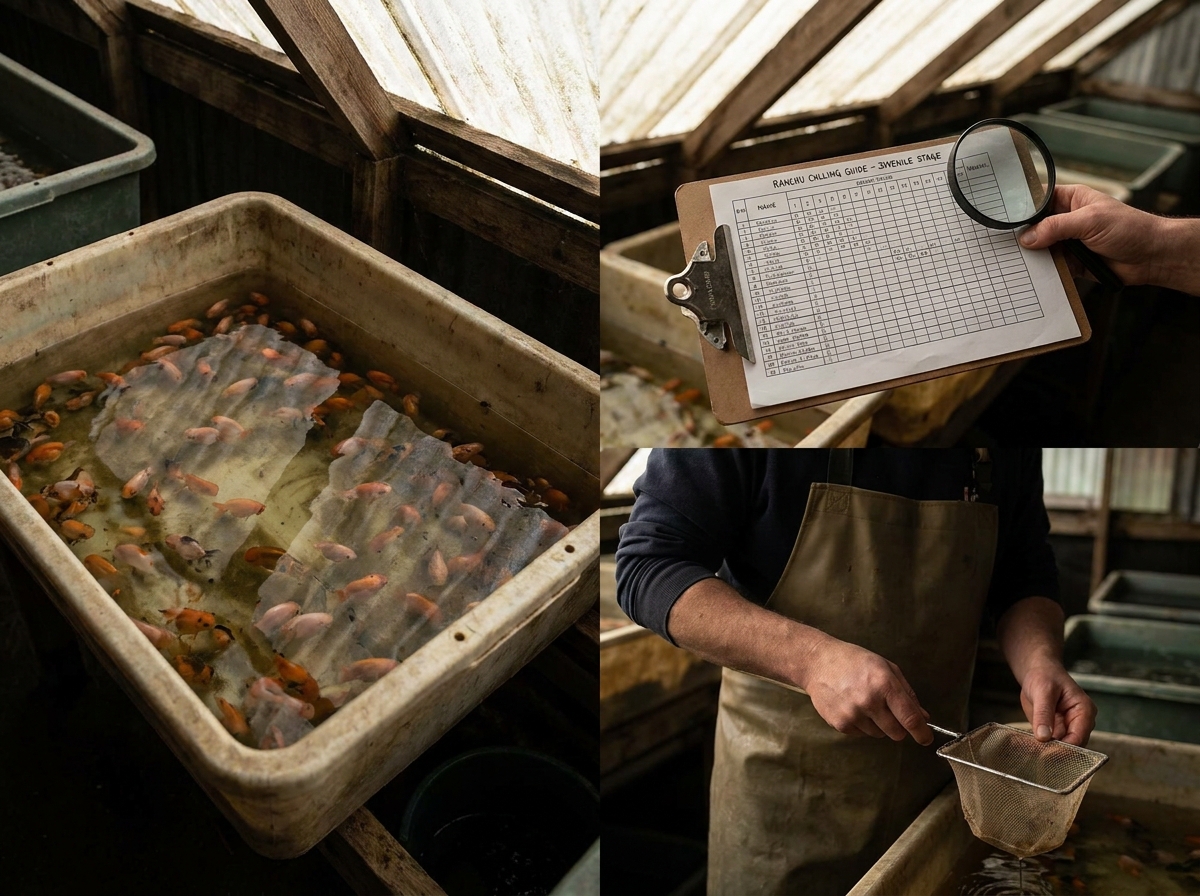
The culling at the juvenile stage (2-3 months): the Ranchu that is clearly off-standard (the fish with the dip in the back, the fish with the narrow body, the fish with the asymmetric head) is culled at this stage. The culling rate is typically 30-50% at this stage.
The culling at the sub-adult stage (6-12 months): the Ranchu that does not meet the standard in the body, the head, the wen, or the deportment is culled at this stage. The culling rate is 30-50% of those that remain, for a cumulative culling rate of 60-75%.
The culling at the adult stage (1-2 years): the Ranchu that does not meet the show standard is culled. The culling rate is 20-30% of those that remain, for a cumulative culling rate of 75-85%.
The culling at the show-eligible stage (2-3 years): the Ranchu that does not win or place in the show is sold as a pet, and the Ranchu that does not have the potential to show is culled. The culling rate is 30-50% of those that remain, for a cumulative culling rate of 90-95%.
The breeding strategy
The breeding strategy for the Ranchu: select the parents that meet the show standard, breed the parents, and produce the offspring that meet the show standard. The breeding program is a multi-year program, with the breeder maintaining a small number of high-quality breeding stock and producing 200-500 fry per year, with the culling producing 10-20 show-quality Ranchus per year.
The breeding pair selection: the male and the female should both meet the show standard, with the male and the female complementing each other in the traits that are weak. The male that has a slightly weak back should be bred to a female that has a strong back, and the offspring should be selected for the strong back.
The breeding season: the Ranchu breeds in the spring, with the spawning triggered by the warming water. The spawning produces the eggs, the eggs hatch in 4-7 days, and the fry are raised for 6-12 months before the first culling.
The realistic expectations
The new Ranchu breeder should expect: 1-2 years of learning the standard, 1-2 years of producing the first show-quality Ranchus, 3-5 years of producing the consistent show-quality Ranchus, and 5-10 years of producing the show-winning Ranchus. The Ranchu breeding is a long-term commitment, and the breeder who expects the immediate show wins is the breeder who is disappointed. The breeder who commits to the long-term learning and the long-term culling is the breeder who produces the show winners.
The one-page summary
The Ranchu is the most difficult fancy goldfish to breed to the standard. The standard includes the body, the head, the wen, the deportment, and the overall picture. The evaluation is done at the major shows by the trained judges. The culling is done at multiple stages, with a cumulative culling rate of 90-95%. The breeding program is a multi-year program that requires a long-term commitment. The breeder who runs the program is the breeder who produces the show winners. The program is the work. The program is what makes the difference.