Pyoderma in dogs: the chlorhexidine protocol that clears it for good
Canine pyoderma (bacterial skin infection) is one of the most common reasons dogs see a dermatologist. And one of the most common reasons pyoderma becomes chronic is that owners treat it with oral antibiotics alone and skip the topical work, or do the topical work inconsistently.
Topical therapy is not optional. Done correctly, it is what actually clears the infection and prevents recurrence.
What pyoderma looks like
- Surface pyoderma: hot spots, moist reddened patches, often acute
- Superficial pyoderma: papules, pustules, crusts, circular hair loss (the classic "epidermal collarettes")
- Deep pyoderma: haemorrhagic bullae, ulcers, draining tracts, deeper tissue involvement
If you see epidermal collarettes (the donut-shaped scaly lesions), it is almost certainly pyoderma until proven otherwise.
Why topical matters more than people think
A 2014 study by the University of Pennsylvania showed that topical chlorhexidine alone resolved 70% of superficial pyoderma cases — no oral antibiotic needed. Adding the right shampoo protocol to oral antibiotics also reduces treatment time and prevents recurrence.
The reason: dogs carry bacteria deep in hair follicles and skin folds. Oral antibiotics reach the bloodstream, but topical therapy reaches the surface where most of the bacterial load lives.
The chlorhexidine protocol
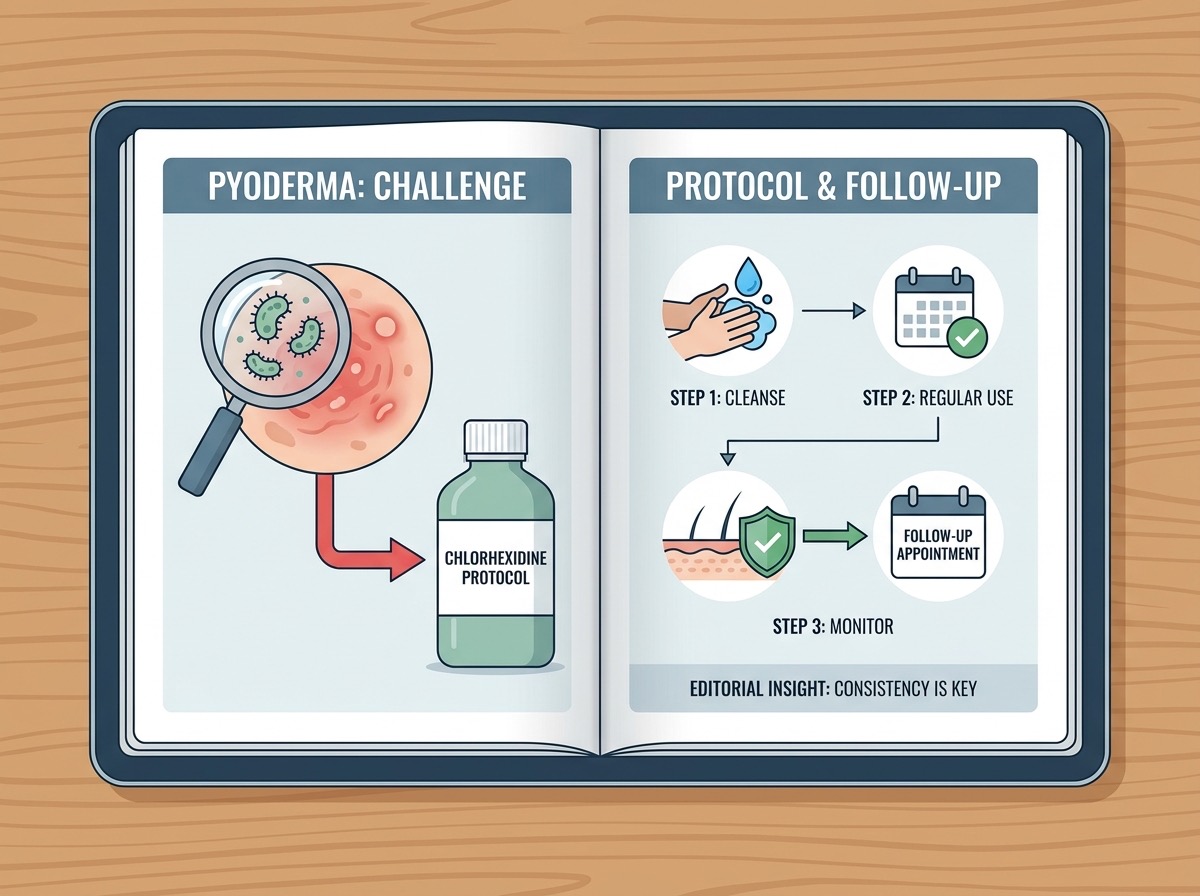
Step 1: Choose the right concentration
For canine pyoderma:
- Chlorhexidine 3–4% shampoo for the active treatment phase
- Chlorhexidine 2% + miconazole shampoo if there is concurrent yeast (often the case with allergies)
- Chlorhexidine 2% mousse or wipes for spot treatment on non-shaved areas
Do not use human chlorhexidine wash (different formulation, often with alcohol that stings).
Step 2: Bathing technique
Frequency during active infection: 3x weekly for 2 weeks, then 2x weekly for 2 weeks, then 1x weekly for 4 weeks. Total 8 weeks.
The technique:
- Wet the coat thoroughly with lukewarm water.
- Apply shampoo. The contact time matters most: lather in, then wait 10 minutes before rinsing. Set a timer. Most owners rinse after 60 seconds — that is essentially no contact time.
- Rinse thoroughly. Chlorhexidine residue can be drying if not fully rinsed.
- Towel dry. Do not blow-dry (heat inflames pyoderma lesions).
- Apply any leave-in conditioner or topical mousse if prescribed.
Step 3: Spot treatment with mousse or wipes
For localised lesions (one hot spot, one patch), a chlorhexidine mousse applied every 12 hours for 14 days works well. For generalised pyoderma, the bath is more efficient.
What about oral antibiotics?
Oral antibiotics are still indicated for:
- Deep pyoderma (always)
- Superficial pyoderma that fails topical-only therapy after 4 weeks
- Generalised superficial pyoderma with >5 body regions affected
If oral antibiotics are prescribed:
- First-line choices: cephalexin, amoxicillin-clavulanate. Both are effective against Staphylococcus pseudintermedius, the most common cause of canine pyoderma.
- Avoid: fluoroquinolones as first-line (reserve for resistant cases), and never use human-formulated fluoroquinolones at sub-therapeutic doses.
- Duration: 3–4 weeks for superficial, 6–8 weeks for deep, with treatment continuing for 2 weeks past clinical resolution. Stopping at "the spots cleared" is the most common cause of recurrence.
The underlying cause question
Pyoderma in an adult dog is almost always secondary to something else:
- Atopic dermatitis (most common)
- Food allergy
- Hypothyroidism (especially in golden retrievers, doberman pinschers)
- Demodicosis (especially in puppies and adolescents)
- Anatomic factors (skin folds in bulldogs, pugs, shar peis)
- Immunosuppression (chronic steroid use, endocrine disease)
If your dog has had pyoderma more than twice in 12 months, the vet should be working up the underlying cause, not just treating each infection.
Common mistakes
- Bathing once a week — frequency too low for active infection
- Lathering and immediately rinsing — zero contact time = zero benefit
- Stopping antibiotics at first clinical improvement — relapse guaranteed
- Skipping the topical during antibiotic course — antibiotic does the heavy lifting, but recurrence is more likely without topical
- Not drying the skin folds — moisture in skin folds is a perfect bacterial growth medium
When to see the vet
- Hot spot that is rapidly expanding
- Multiple lesions appearing over days
- Lesions that smell foul or have discharge
- Dog is lethargic, off food, or has fever
- Any deep pyoderma signs (draining tracts, ulcers)
A printable home checklist for the 8-week protocol
| Week | Bathing | Antibiotic | Spot mousse | Notes |
|---|---|---|---|---|
| 1 | 3x | Yes | 2x daily | Set 10-min timer |
| 2 | 3x | Yes | 2x daily | Recheck if not improving |
| 3 | 2x | Yes | 1x daily | Most lesions should be fading |
| 4 | 2x | Yes | Stop | Vet recheck |
| 5 | 1x | Stop (if vet confirms) | Stop | Maintain gains |
| 6 | 1x | — | Stop | Monitor |
| 7 | 1x | — | Stop | Monitor |
| 8 | 1x | — | Stop | Discharge if clear |
Bottom line
Pyoderma is highly treatable. The failure mode is almost always either (a) incomplete topical contact time, (b) stopping antibiotic too early, or (c) not addressing the underlying allergy or endocrine cause. Hit all three and recurrence drops dramatically. Skip any one and the cycle continues.
---
About the author: [Dr. Hannah Kim](../Hannah%20Kim.md), DVM, Cert. VD, is a Seoul National University-trained veterinarian and University of Toronto dermatology residency graduate, with 11 years of practice. She is currently the director of Pacific Pet Dermatology in Vancouver.