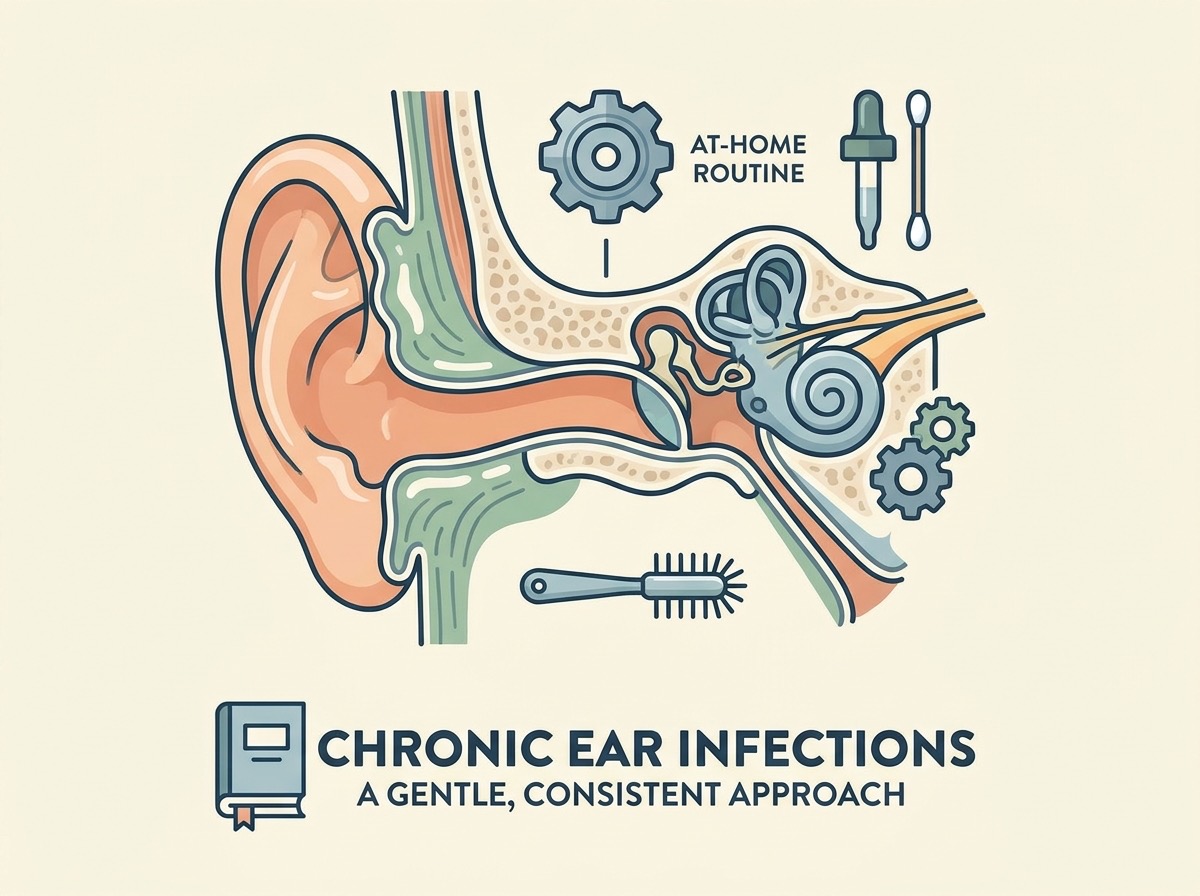

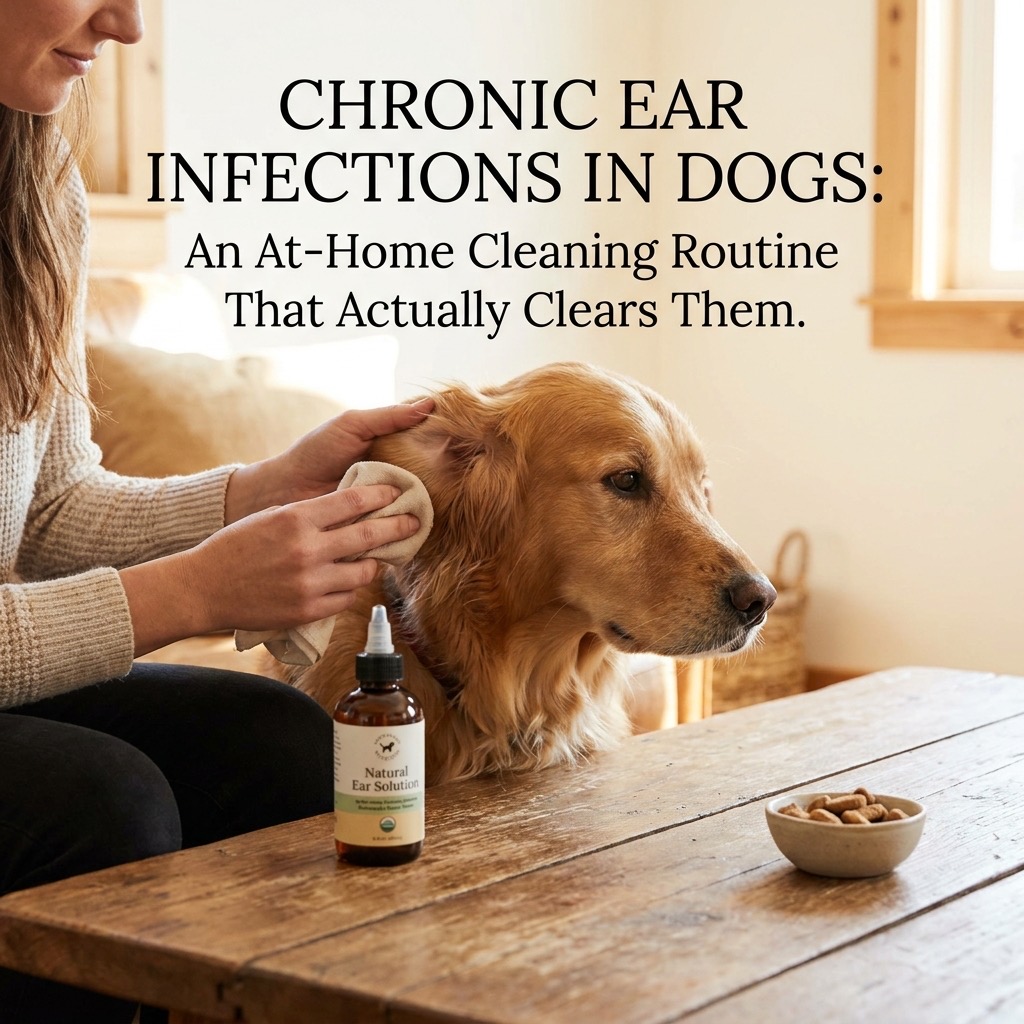
Chronic ear infections in dogs: an at-home cleaning routine that actually clears them
If your dog has had more than two ear infections in the past year, something is going on beyond bad luck. Chronic or recurrent otitis externa almost always has an underlying primary cause (allergy, anatomy, endocrine disease) plus perpetuating factors (bacteria, yeast, biofilm, hyperplasia) that keep the cycle going. Treating only the infection without addressing the underlying cause is why you keep coming back to the vet.
Here is the layered home routine I walk owners through.
Step 1: Get a proper diagnosis first
Before any home routine, the vet should:
- Do an otoscopic exam (look down the ear canal with the appropriate scope)
- Take a swab cytology (look under the microscope for yeast, bacteria, inflammatory cells)
- Rule out ear mites if relevant (less common in adult dogs but possible)
- Identify primary causes: allergy (most common), hypothyroidism, foreign body, mass
You cannot treat effectively if you don't know what you're treating. A "red ear" might be yeast, bacteria, or both — and the medication differs.
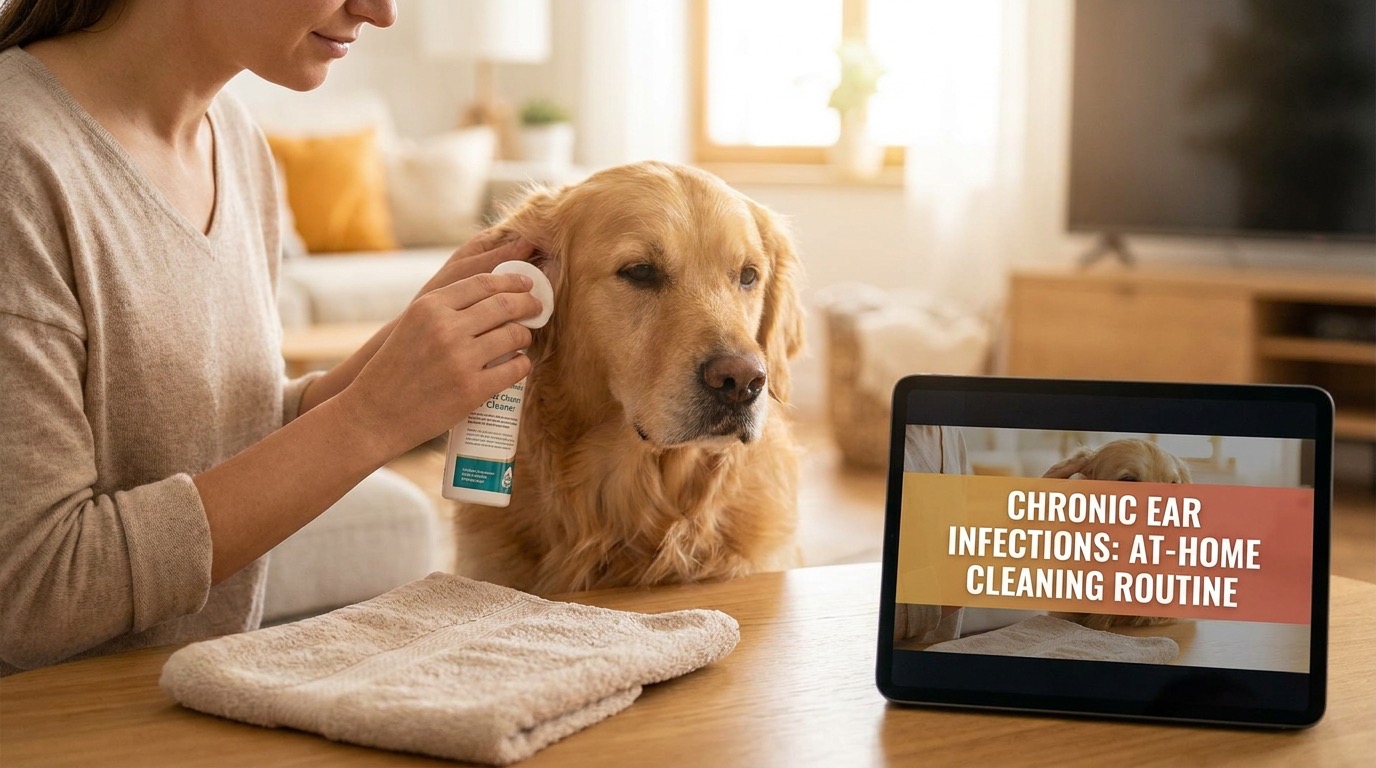
Step 2: Choose the right cleaner
Not all ear cleaners are the same. Match the cleaner to the problem:
| Cleaner type | Active ingredients | Best for |
|---|---|---|
| Drying / ceruminolytic | Salicylic acid, lactic acid, sodium lactate | Routine maintenance, waxy ears |
| Antimicrobial (yeast) | Acetic acid (vinegar), ketoconazole | Yeast overgrowth (Malassezia) |
| Antimicrobial (bacteria) | Chlorhexidine, Tris-EDTA | Bacterial overgrowth |
| Biofilm-disrupting | Tris-EDTA, N-acetylcysteine | Chronic, treatment-resistant infections |
For most dogs with chronic otitis, a chlorhexidine + Tris-EDTA combo cleaner (e.g., Dechra Epi-Otic Advanced, Virbac Epi-Soothe) hits yeast, bacteria, and biofilm together.
Step 3: The cleaning technique
Frequency depends on stage:
| Stage | Cleaning frequency |
|---|---|
| Active infection | 1–2x daily until recheck |
| First 2 weeks after infection clears | Daily |
| Maintenance (chronic allergy dogs) | 2–3x weekly |
The technique:
- Lift the ear flap (pinna) gently.
- Fill the canal with cleaner — until you see liquid at the canal opening. Don't be shy.
- Massage the base of the ear for 30 seconds. You'll hear a "squishy" sound — that means the cleaner is reaching the horizontal canal.
- Let the dog shake — that's normal, that's how they clear the canal.
- Wipe the outer canal with cotton balls or gauze. Do not use cotton swabs (Q-tips) deep in the canal — you push debris further in and risk damaging the eardrum.
- Allow 15 minutes before applying any topical medication (so the cleaner doesn't dilute it).
Step 4: Topical medication if prescribed
If your vet prescribed a topical antibiotic/steroid/antifungal combination (e.g., Otomax, Surolan, Posatex), apply AFTER cleaning:
- Clean first (15-minute gap).
- Apply the prescribed number of drops into the canal.
- Massage the base again to distribute.
- Don't let the dog shake it out immediately — distract with a treat.
Never use leftover ear medication from a previous infection without re-checking with the vet. Using the wrong agent (e.g., steroid for a bacterial infection that needs antibiotic only) can worsen things.
Step 5: Address the underlying primary cause
The single most common cause of recurrent ear infection is atopic dermatitis (environmental allergy). Second is food allergy. Third is anatomical (narrow canals, stenotic canals in breeds like Shar Peis).
If the underlying cause is atopic dermatitis
- Long-term management may include:
- Allergen-specific immunotherapy (ASIT) — the only disease-modifying treatment
- Apoquel (oclacitinib) or Cytopoint (lokivetmab) for symptomatic relief
- Regular ear maintenance cleaning (Step 3 above)
- Treating secondary infections promptly
If the underlying cause is food allergy
- 8-week elimination diet trial with novel or hydrolyzed protein
- No treats, no flavoured medications, no table food during the trial
- Rechallenge after 8 weeks to confirm
If the underlying cause is anatomical
- Shar Peis, pugs, bulldogs, and other stenotic-breed dogs may need surgical intervention (e.g., total ear canal ablation in end-stage disease) or lifelong maintenance
Step 6: Home monitoring
Twice weekly, look at the ears. The four things to watch for:
- Colour — pale pink = healthy. Red, dark pink, or purple = inflammation.
- Smell — yeasty / sweet / "Fritos" = yeast overgrowth. Foul / rotten = bacterial.
- Discharge — brown waxy = yeast. Yellow/green purulent = bacterial. Black granular = *Otodectes* (mites).
- Pain response — a dog that yelps when you touch the ear or pinna has pain and probably needs a vet visit, not just cleaning.
A weekly home routine for a chronic-allergy dog
| Day | Action |
|---|---|
| Monday | Clean with chlorhexidine/Tris-EDTA |
| Wednesday | Visual check, clean if needed |
| Friday | Clean |
| Weekend | Visual check only |
This 2–3x weekly schedule keeps the biofilm from re-establishing while not over-drying the canal.
Common mistakes
- Cleaning too aggressively — daily cleaning in a healthy ear damages the cerumen layer that protects the canal
- Stopping cleaning after one good week — the infection is suppressed, not cleared
- Using vinegar in a damaged ear — if the eardrum is ruptured, vinegar in the middle ear causes severe pain and possible vestibular damage
- Reusing old medication — bacterial resistance patterns change; what's in the bottle may no longer be effective
When to see the vet urgently
- Sudden head tilt or loss of balance (middle/inner ear involvement)
- Severe pain on ear touch
- Discharge becomes foul-smelling and copious
- The ear canal appears swollen shut
- Hearing changes
Bottom line
Chronic ear infections are solvable, but only when you address both the infection AND the underlying cause. The home routine (right cleaner, right frequency, right technique) controls the perpetuating factors; the underlying allergy or anatomy needs separate long-term management. Both layers matter. Skip one and the cycle continues.
---
About the author: [Dr. Hannah Kim](../Hannah%20Kim.md), DVM, Cert. VD, is a Seoul National University-trained veterinarian and University of Toronto dermatology residency graduate, with 11 years of practice. She is currently the director of Pacific Pet Dermatology in Vancouver.