
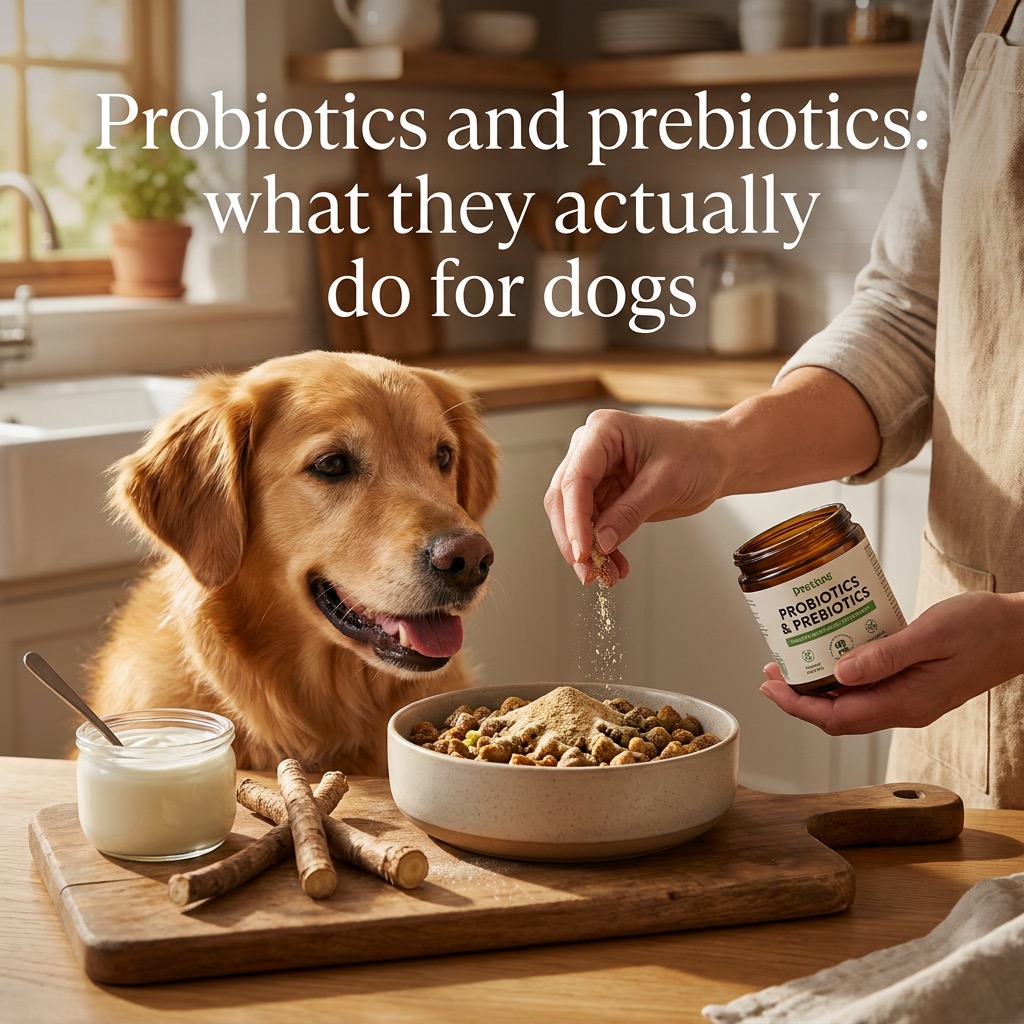
Probiotics and prebiotics: what they actually do for dogs
Walk down any pet store aisle and you'll see a wall of "gut health" products for dogs. The evidence behind them varies wildly. Some are genuinely useful in specific clinical situations. Others are flavourful powders that pass through a healthy dog doing nothing.
Let's separate the science from the marketing.
What the canine gut microbiome actually does
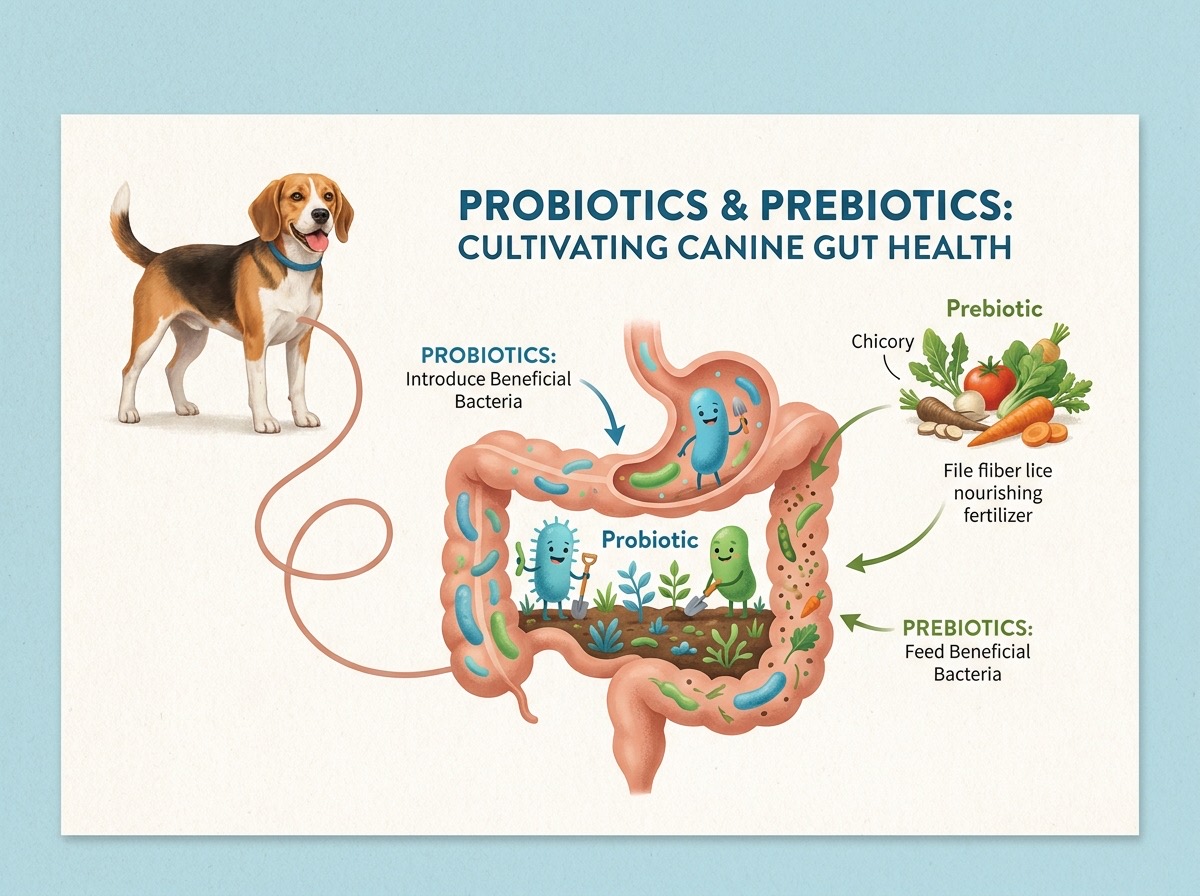
The canine gut is home to roughly 1,000 bacterial species. They are not freeloaders. They:
- ferment fibre into short-chain fatty acids (SCFAs) that feed colon cells
- synthesise some B vitamins and vitamin K
- compete with pathogenic bacteria for resources
- modulate the immune system via the gut-associated lymphoid tissue (GALT)
- communicate with the brain via the vagus nerve (the "gut-brain axis")
When this community is disrupted — by antibiotics, sudden diet changes, stress, or illness — the result is loose stool, gas, reduced appetite, and a weakened immune response.
Probiotics: live microorganisms with proven benefits
A probiotic is a defined, live microbial strain delivered in adequate doses. The key word is "defined strain". Generic "probiotic blends" without strain identification are almost impossible to evaluate.
The strains with the strongest evidence in dogs:
| Strain | Evidence strength | Best evidence for |
|---|---|---|
| Enterococcus faecium NCIMB 10415 | Strong | Acute diarrhoea, antibiotic-associated diarrhoea |
| Lactobacillus rhamnosus GG | Moderate | Stress-related loose stool, travel diarrhoea |
| Bacillus coagulans | Moderate | Chronic soft stool, post-antibiotic recovery |
| Bifidobacterium animalis AHC7 | Moderate | Stress-related GI signs in working dogs |
| Lactobacillus acidophilus | Weak–moderate | Generic "gut support", inconsistent results |
For an otherwise healthy dog on a balanced diet, daily probiotics are not necessary. They shine in three specific situations:
- During and after a course of antibiotics — antibiotics do not discriminate between pathogens and commensals. A probiotic started on the same day as the antibiotic and continued for 7–14 days afterwards reduces the duration of post-antibiotic diarrhoea.
- Acute stress events — boarding, travel, shows, moving house. The gut responds to stress within hours.
- Chronic intermittent diarrhoea that has ruled out parasites, IBD, and food allergy — a 30-day probiotic trial is a reasonable empirical step.
Prebiotics: the food that feeds the good bugs
A prebiotic is a non-digestible ingredient that selectively stimulates beneficial gut bacteria. The most evidence-backed prebiotics for dogs are:
- FOS (fructo-oligosaccharides) — supports Bifidobacteria
- MOS (mannan-oligosaccharides) — binds certain pathogens, supports Lactobacilli
- Beet pulp — moderate FOS content, well tolerated
- Psyllium husk — both fermentable fibre and bulking fibre
- Inulin / chicory root — strong prebiotic, can cause gas if overdosed
Most complete commercial diets already contain some prebiotic fibre (often beet pulp). Adding more on top is rarely beneficial for a healthy dog.
Synbiotics: the practical middle ground
A synbiotic combines a probiotic with a prebiotic that feeds it. For most owners, a synbiotic product is the easiest entry point because the formulation has already been matched. Look for:
- named strain(s) on the label, not just "probiotic blend"
- guaranteed CFU count at expiration, not just at manufacture
- third-party quality certification (NASC, USP, or equivalent)
- species-appropriate formulation, not a human product repackaged for pets
A label-reading checklist
When evaluating a canine probiotic product, ask:
- Which strain(s) and how many CFU per dose at expiry? If the label says "1 billion CFU at manufacture", assume 30–50% loss by expiry.
- Does it need refrigeration? Some strains do; many do not. Either is fine if the label guarantees potency.
- Is it a canine formulation? Human products often use strains not validated for canine gut.
- Is there a quality seal? NASC (US) or equivalent third-party certification means the manufacturer has been audited.
When probiotics are NOT the answer
Do not reach for a probiotic when:
- the dog has blood in the stool — this is a vet visit, not a supplement decision
- the dog has chronic vomiting — workup first
- the dog is on a prescription diet for a medical condition — adding supplements can interfere
- the dog is otherwise healthy with normal stool — you are solving a problem that does not exist
Bottom line
Probiotics are useful tools, not magic. Use them in the three specific situations where the evidence is strong: antibiotic recovery, acute stress, and chronic soft stool after medical causes are ruled out. For an otherwise healthy dog on a balanced diet, save your money and focus on what actually moves the needle: a consistent, complete diet and gradual diet transitions.
---
About the author: [Sarah Chen](../Sarah%20Chen.md) is a registered animal nutritionist (DAN) with a Master of Veterinary Medicine from the University of Melbourne. She served as canine nutrition consultant at RSPCA Australia for 12 years.