
Pet insurance: how to choose a plan that won't fail you when you need it
Most pet owners either buy a policy in a panic after a $4,000 emergency, or skip insurance entirely because "it never pays out". Both reactions miss the actual mechanics of how these products work and where the gaps are. After 26 years of seeing owners choose between treatment and finances, here is the practical framework I share.
The three product types
- Accident-only plans — cover accidental injury (broken bones, ingested toys, bite wounds). Cheapest. Excludes illness entirely.
- Accident + illness plans — cover both. The mainstream product. Excludes pre-existing and wellness.
- Comprehensive / wellness-included plans — cover accidents, illness, and routine care (vaccines, dentals, exams). Most expensive, often with annual caps.
For most owners, plan 2 is the right balance. Plan 1 leaves you exposed to the most common expensive category (illness). Plan 3 is only worth it if you would otherwise skip routine care due to cost.
The four numbers that actually matter
When comparing plans, ignore the marketing copy. Look at these four numbers, in this order:
| Number | What it controls | What "good" looks like |
|---|---|---|
| Annual deductible | How much you pay out-of-pocket before insurance starts paying | $250–$500 per year |
| Reimbursement rate | The % of covered costs the insurer pays after deductible | 80–90% |
| Annual maximum | The cap on what the insurer will pay per year | Unlimited or $15,000+ |
| Lifetime maximum | The cap across the pet's life | Unlimited preferred |
The single biggest hidden gap is the annual maximum. A $5,000/year cap sounds reasonable until your dog needs a $7,000 surgery plus chemo. Look for "unlimited" or a very high cap.
Pre-existing conditions: the deal-breaker
Insurers will not cover any condition that showed signs before the policy started. This is enforced strictly. Two practical implications:
- Enrol pets young and healthy. A policy started at 8 weeks will cover conditions that appear at 4 years. A policy started at 6 years with a history of intermittent diarrhoea will not cover that diarrhoea at 7.
- Don't cancel. Even a one-month lapse in coverage can reclassify conditions as pre-existing when you restart.
The exact definition of "pre-existing" varies by insurer. Read the policy wording carefully — some count "any condition the vet has noted", others require "any condition for which the pet has shown signs or received treatment". The latter is friendlier.
What's typically excluded
Standard exclusions across most plans:
- Pre-existing conditions
- Cosmetic procedures (ear cropping, tail docking, declawing in cats)
- Breeding and whelping
- Behaviour training
- Diet foods (unless prescribed for a covered condition)
- Grooming and nail trimming
- Conditions preventable by vaccine (in some plans)
Some plans offer wellness add-ons that bundle vaccinations, dental cleanings, and annual exams. Worth it for owners who would otherwise skip preventive care.
Waiting periods
Every plan has waiting periods. Typical:
- Accident: 24–48 hours
- Illness: 14–30 days
- Orthopaedic: 6–12 months (for hip dysplasia, cruciate disease)
The orthopaedic waiting period is the sneaky one. A cruciate ligament tear at month 4 may not be covered because the plan considers cruciate disease a "developmental" condition. Read this carefully if you have a large-breed puppy.
A comparison checklist
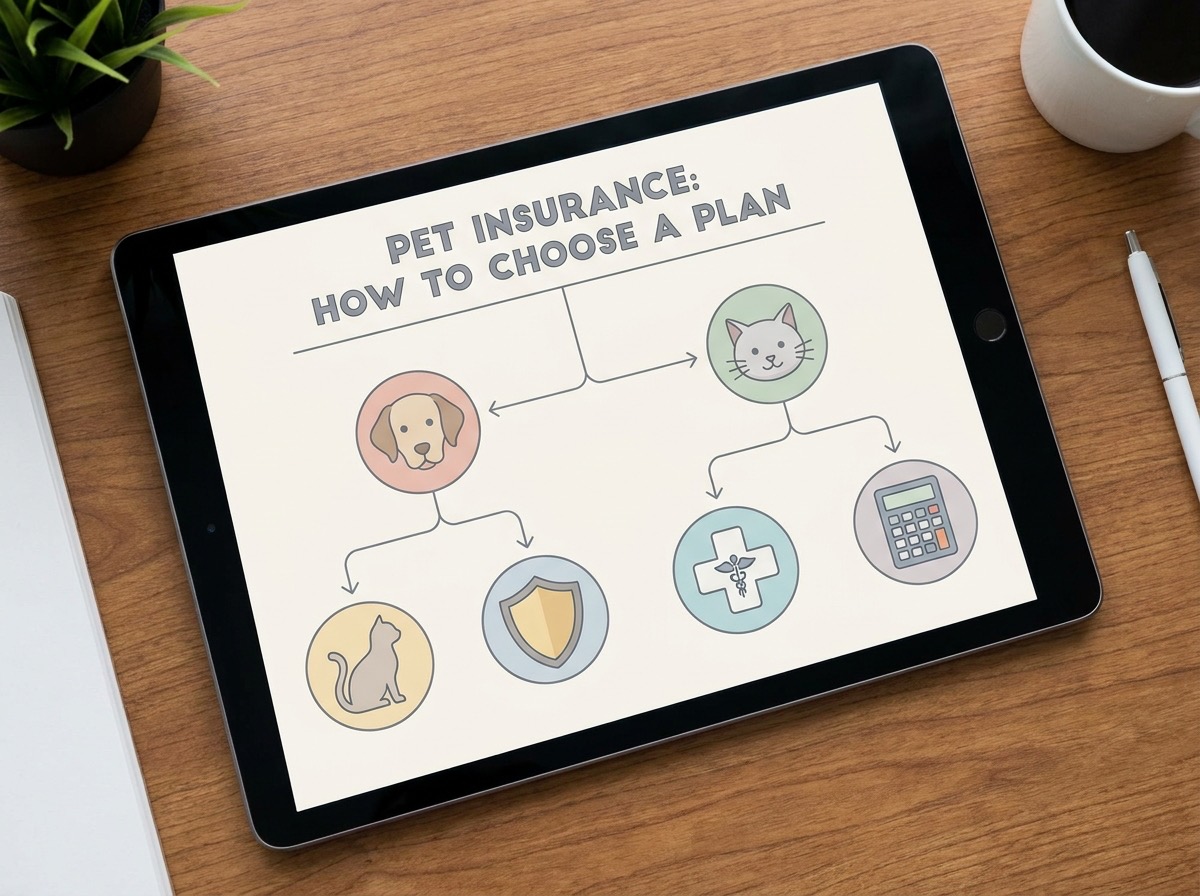
Before signing a policy, write down:
- Annual deductible: _____
- Reimbursement rate: _____
- Annual maximum: _____
- Lifetime maximum: _____
- Accident waiting period: _____
- Illness waiting period: _____
- Orthopaedic waiting period: _____
- Are wellness visits covered? _____
- Are prescription diets covered? _____
- Is the exam fee covered (most policies cover treatment but not the exam itself)? _____
If you cannot answer all ten with specific numbers, the comparison isn't done.
Direct vet-pay vs reimbursement models
There are two claim models:
- Reimbursement (most common): you pay the vet, then submit a claim and get reimbursed. You need access to the full amount up front. Reimbursement typically takes 5–14 days.
- Direct pay (less common): the insurer pays the vet directly. Usually limited to large insurers and major hospital chains. Less paperwork, faster, but fewer plans offer it.
For most owners, reimbursement works — but it means you need either a credit line or savings to cover a $3,000–$10,000 emergency while waiting for the claim. A dedicated "pet emergency fund" of $2,000–$3,000 is the realistic complement to insurance.
When insurance is probably not worth it
- Young healthy pet of a low-cost-breed mix: out-of-pocket lifetime cost over 12–14 years is often $8,000–$15,000. A $600/year premium × 12 years = $7,200. The math can come out close.
- Owner with $5,000+ readily accessible in savings: self-insurance works if you're disciplined.
- Pets over 10 years old: premiums are high, exclusions grow, and pre-existing conditions are likely.
When insurance is probably worth it
- Puppies and kittens of any breed: anything can happen in year 1 (foreign body, accidental poisoning), and premiums are lowest.
- Large breed dogs: orthopaedic conditions are common and expensive ($4,000–$8,000 per cruciate repair).
- Purebred cats with breed-predisposed conditions: HCM in Maine Coons, PKD in Persians, etc.
- Owners who would face hard financial choices otherwise: don't be that person choosing between treatment and rent.
Bottom line
Pet insurance is a tool, not a guarantee. The right plan at the right age can save you from impossible decisions. The wrong plan — bought in a panic, with low caps and big exclusions — gives you the feeling of coverage without the substance. Take 30 minutes, fill in the comparison checklist above, and you'll have a much clearer picture than the comparison sites give you.
---
About the author: [Dr. James Morrison](../James%20Morrison.md), DVM, is a Cornell-trained veterinarian and founder of Bayview Animal Hospital in San Francisco, with 26 years of clinical practice.