

Moving house with cats: the 3-3-3 rule and how to keep your cat from disappearing into the closet
Cats are territorial animals. They map their world through scent and routine, and they rely on the predictability of their territory for their sense of safety. Moving to a new home takes that away — suddenly the cat is in a place that smells different, looks different, and has all the wrong noises. The cat's response is to hide, to refuse food, to eliminate outside the litter box, to disappear into the closet for days. Some cats adjust. Some cats develop long-term stress behaviours. Some cats run.
The 3-3-3 rule is the framework that gives the cat the time and the structure to adjust. It's not a rule the cat has to learn — it's a rule the owner has to follow. The owner who understands the rule has a cat that adjusts in three months. The owner who doesn't has a cat that hides for weeks, eliminates on the carpet, and tries to escape every time the door opens.
The 3-3-3 rule explained
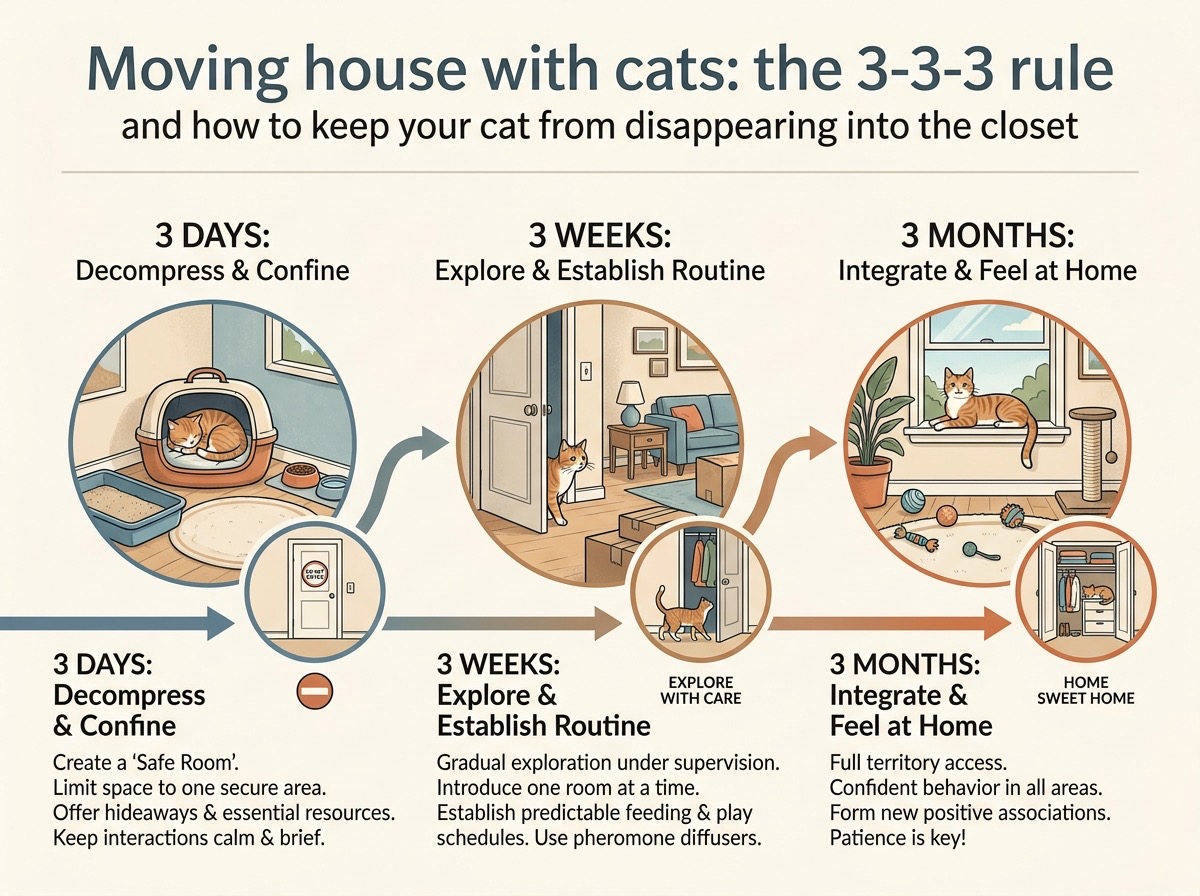
The 3-3-3 rule describes the cat's adjustment timeline:
The first 3 days: decompression
The cat arrives in the new home. The cat is overwhelmed. The cat's response is to hide, refuse food, refuse the litter box, and avoid the owner. The cat is not sick. The cat is not unhappy. The cat is processing the new environment.
The owner's job: provide a small, safe space for the cat. Don't expect the cat to be friendly. Don't force interaction. Let the cat hide. Give the cat time.
The first 3 weeks: settling in
The cat begins to emerge from hiding. The cat explores the new home, learns the layout, identifies the resources (food, water, litter box, beds), and starts to develop a routine. The cat may be skittish, may run when approached, may eliminate outside the litter box. The cat is adjusting.
The owner's job: gradually expand the cat's access to the home, introduce new rooms slowly, maintain the routine, reinforce positive associations.
The first 3 months: feeling at home
The cat has adjusted. The cat explores the home confidently, uses the litter box reliably, eats well, interacts with the owner, and develops a routine. The cat is "at home". The stress behaviours have resolved. The 3-3-3 timeline is complete.
The owner's job: continue the routine, gradually introduce any other pets, monitor for residual stress behaviours, and celebrate the small wins.
The 3-3-3 rule is not rigid. Some cats adjust faster. Some cats take longer, particularly in multi-cat households or for cats with a history of stress. But the rule gives the owner a framework: when to worry and when not to.
Before the move: the preparation
The preparation begins before the moving day.
Veterinary preparation
- Vet visit in the 2-4 weeks before the move: confirm the cat is up to date on vaccinations, has a current health certificate (required in some jurisdictions), and has a microchip with current contact information
- Update the microchip: register the new address and phone number with the microchip company
- Prescription medication refill: ensure the cat has at least a 1-month supply of any medications
- Sedation (in some cases): a mild sedative or anti-anxiety medication (gabapentin) from the vet can help the cat tolerate the travel. Not for all cats; discuss with the vet
Carrier preparation
- Re-acclimate the cat to the carrier in the weeks before the move. The carrier should not be a stranger
- Use the carrier training protocol (carrier is a good place, treats inside, calm acceptance)
- Test the carrier: the cat should enter willingly, eat inside, and tolerate the carrier being moved
Identification
- Breakaway collar with ID tag: even indoor cats should wear a collar with ID during a move. The tag should have the new address (if known) and a phone number
- Microchip registration: current contact info with the microchip company
- Photos: current photos of the cat in case of escape during the move
The "moving day" supplies
- Carrier with bedding from the old home: the bedding smells like the old home, which is comforting
- Small towel or blanket: to drape over the carrier for the move (the cat sees less, feels more secure)
- Feliway spray: sprayed in the carrier 15 minutes before the cat enters
- Water and small meals: for the travel day
- Litter box in a small carrier or bag: in case the cat needs to relieve during the travel
- Treats: for positive reinforcement during the move
Moving day: the protocol
The cat stays confined until the movers are done
The cat should be in a small, secure room while the movers are packing and loading. Options:
- A spare bedroom with the door closed and a "do not enter" sign
- A bathroom (less ideal — slippery surfaces, no hiding spots)
- A secure carrier if no room is available
The room should have:
- Food and water bowls
- A litter box
- A bed or hiding spot (a cardboard box is ideal)
- The cat's carrier (open, with bedding)
- A radio playing softly (the sound is comforting)
The cat is NOT allowed out of the room during the moving chaos. The risk is too high that the cat will bolt out the door during the heavy traffic of movers and boxes.
The transport
- Place the cat in the carrier, in the small secure room, after the movers are done with that room (or as the very last step)
- Drape the carrier with a towel or blanket
- Transport the cat in the car to the new home
- The cat should not travel with the movers — the cat travels with the owner
At the new home
- The cat arrives FIRST at the new home, before the furniture. The empty house is less overwhelming for the cat
- The cat goes directly to the prepared safe room: same setup as the old home — food, water, litter box, bed, carrier, Feliway
- The door to the safe room is closed. The cat stays in the room for the first 3-7 days
The first 3 days: decompression
The safe room setup
The safe room is the cat's home for the first 3-7 days. The room should be:
- Small (not the master bedroom — too big)
- Quiet (away from the main living area)
- Secure (door that closes fully, no windows the cat can escape through)
- Comfortable (familiar bedding, hiding spots)
What to expect
- Hiding: the cat may hide for 24-72 hours. Hiding is normal. The cat is not sick. The cat is processing the new environment
- Refusing food: the cat may not eat for 1-2 days. This is normal. The owner can offer smelly food (tuna, baby food chicken) to entice eating
- Refusing the litter box: the cat may eliminate outside the litter box. This is often because the cat doesn't yet recognise the litter box in the new environment, or because the cat is too stressed to make the trip to the box
- Vocalisation: the cat may meow more than usual, particularly at night. This is normal. The cat is calling out in the unfamiliar space
What to do
- Visit the cat often. Sit in the room, talk softly, offer treats
- Don't force interaction. Let the cat come to the owner
- Don't open the door to the safe room. The cat is not ready to explore the home
- Maintain the routine: feed at the same times, scoop the litter at the same times
- Monitor food and water intake. Contact the vet if the cat doesn't eat for more than 48 hours
The first 3 weeks: settling in
The expansion
After 3-7 days (depending on the cat's adjustment), the cat begins to explore beyond the safe room. The expansion is gradual:
- Day 3-7: cat stays in safe room, owner visits frequently
- Day 7-10: open the door to one adjacent room. The cat explores at its own pace
- Day 10-14: open the door to two rooms. The cat starts to define its territory
- Day 14-21: the cat has access to most of the home. The cat may still retreat to the safe room for sleeping
The challenges
- Litter box issues: the cat may eliminate outside the box. The owner should place additional litter boxes in the expanded area. The boxes should be in different rooms (the cat may not want to go back to the safe room to eliminate)
- Hiding: the cat may find new hiding spots in the new rooms. The owner should leave the hiding spots accessible (don't block them, don't force the cat out)
- Hiding from the owner: the cat may still be skittish around the owner. The owner should approach calmly, offer treats, and let the cat come to them
The routine reinforcement
The routine is the most important tool. The cat that has a consistent routine (feed at the same time, scoop at the same time, play at the same time) adjusts faster than the cat with a disrupted routine.
The other pets
If the new home has other pets (a dog, other cats), the introduction is separate from the cat's adjustment to the home. The new cat should be fully settled in the home before meeting the other pets. The introduction protocol is:
- First 1-2 weeks: cats are separated (new cat in safe room, other pets in the rest of the home)
- Week 2-3: scent introduction (swap bedding, allow sniffing under the door)
- Week 3-4: visual introduction (baby gate or carrier)
- Week 4+: supervised contact
This protocol is similar to the new-pet introduction protocol covered elsewhere in this guide.
The first 3 months: feeling at home
The signs of adjustment
By month 3, the cat should be:
- Eating and drinking normally
- Using the litter box reliably
- Exploring the home confidently
- Interacting with the owner (greeting, petting, playing)
- Sleeping in open areas rather than hiding spots
- Using the resources (cat trees, scratching posts, toys) confidently
The residual stress behaviours
Some cats have residual stress behaviours for 1-3 months after a move:
- Skittishness: the cat may still run when approached
- Vocalisation: the cat may still meow more than usual
- Litter box issues: occasional mistakes, particularly if the litter box location was changed
- Overgrooming: a stress behaviour that may persist
The behaviours usually resolve by month 3. If the behaviours persist beyond month 3, the owner should consult a behaviourist.
The long-term strategies
For the cat that has fully adjusted, the long-term strategies:
- Maintain the routine: keep the feeding, cleaning, and play schedule consistent
- Maintain the resources: the litter box, food bowl, water bowl, beds, and scratching posts should be in the same locations
- Environmental enrichment: especially important in a new home. Cat trees, window perches, toys, and play sessions help the cat establish territory
- Continue the supervised outdoor access (if applicable): if the cat previously had outdoor access, re-introduce it slowly in the new home
The "cat escaped" scenario
A cat that escapes during a move is at high risk of being lost. The new home is unfamiliar, the cat doesn't know the territory, and the cat can travel miles before stopping. The prevention is essential:
- All doors and windows closed during the move
- Cat in a secure room when doors are opening
- Microchip and tag updated
- Cat carrier used for all transport
If the cat escapes:
- Search immediately, starting from the new home
- Put out the cat's litter box and bedding outside the home — the familiar scent may attract the cat back
- Notify local shelters and vet clinics
- Post flyers in the neighbourhood
- Use social media to spread the word
Most escaped cats are found within 1-2 miles of the home within 48 hours. Some cats hide in the new neighbourhood and are found weeks later.
The "multi-cat" move
A multi-cat move is more complex than a single-cat move. The cats should be moved together but housed in separate rooms initially. The reasons:
- The cats share the new environment, but each cat needs its own safe space
- The cats may have different adjustment timelines (one cat may adjust in days, the other in weeks)
- The cats' relationship may be strained initially by the move
The protocol:
- Each cat has its own safe room (different rooms)
- The cats are introduced gradually following the new-cat introduction protocol
- The cats' resources are distributed throughout the home using the N+1 rule
The "long-distance" move
A long-distance move (more than 2 hours of travel) requires additional considerations:
- Sedation or anti-anxiety medication: from the vet, given 1-2 hours before travel
- Carrier secured in the car: seatbelt or carrier strap, not loose
- Water offered every 2-3 hours: not during the drive (the cat may vomit), but at rest stops
- Litter box opportunity at every rest stop: bring a small portable litter box (a small cardboard box with litter) for the cat to use
- Temperature control: the car should be cool (60-72°F) for the cat. Air conditioning on, windows cracked for ventilation
- No feeding 2-3 hours before travel: reduces the risk of motion sickness
- Avoid sedatives for cats with respiratory issues: sedation can suppress breathing
For very long moves (8+ hours), consider a shorter travel or an overnight stop.
The bottom line
Moving is one of the most stressful events in a cat's life. The 3-3-3 rule gives the owner the framework to support the cat's adjustment: 3 days to decompress, 3 weeks to settle in, 3 months to feel at home. The preparation begins before the move (vet visit, carrier training, microchip update). The moving day requires strict confinement of the cat. The first week requires a safe room and patience. The first 3 weeks require gradual expansion and routine reinforcement. The first 3 months require monitoring for residual stress and maintaining the routine. The cat that has the 3-3-3 protocol has a smoother adjustment. The cat that doesn't may develop stress behaviours that persist for years. The owner who invests in the protocol has a cat that adjusts. The owner who doesn't has a cat that hides under the bed and eliminates on the carpet. The cat deserves the protocol.
---
About the author: [Elena Rossi](../Elena%20Rossi.md) holds an MSc in Applied Animal Behaviour from the University of Lincoln, is a Certified Clinical Animal Behaviourist (CCAB) with 14 years of feline behaviour consulting, and is the author of three books on feline behaviour.