
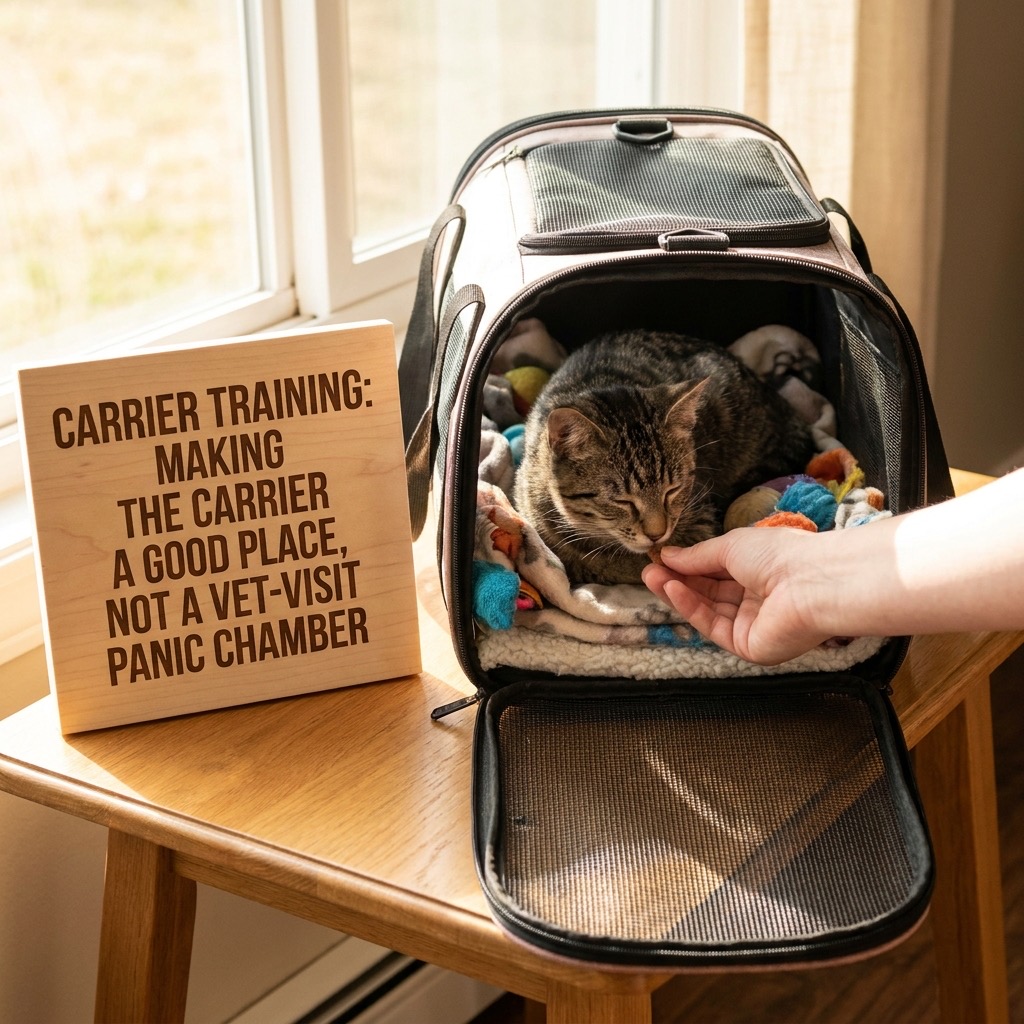
Carrier training: making the carrier a good place, not a vet-visit panic chamber
The cat that vanishes when the carrier appears. The cat that screams, drools, and soils itself in the car. The cat that has to be dumped, rolled in a towel, and forced into the carrier at the vet's office. The owner who cancels the annual checkup because it's not worth the trauma to the cat or the family.
This is the most common behaviour problem in cat ownership, and it's entirely preventable. The carrier doesn't have to be a source of fear. The carrier can be a bed, a hiding spot, a place where good things happen. The training takes 2-4 weeks. The result is a cat that walks into the carrier on its own, calmly accepts the car ride, and arrives at the vet in a reasonable emotional state.
The protocol below is the one I use with every client, and the one that turns carrier-phobic cats into carrier-friendly cats.
Why cats fear the carrier
The fear is learned, not innate. The cat isn't born afraid of the carrier. The cat becomes afraid through repeated negative experiences:
- The carrier appears only when the cat is going to the vet
- The cat is chased, caught, and shoved into the carrier
- The car ride is loud, fast, and disorienting
- The vet visit involves unfamiliar people, smells, and procedures
- The cat is sick or in pain during the vet visit
The cat learns: carrier = capture, car = motion sickness, vet = pain. The cat's fear is a rational response to a consistent pattern of negative outcomes.
The training breaks the pattern. The carrier appears at other times. The cat enters the carrier voluntarily. The car ride is short, calm, and ends somewhere good. The vet visit is preceded by handling training and counter-conditioning. The pattern reverses: carrier = good things, car = manageable, vet = tolerable.
The carrier: the right one matters
Not all carriers are equal. The right carrier:
- Top-loading: a carrier that opens from the top (as well as the front) is far easier than a front-only carrier. The vet can examine the cat in the carrier by removing the top, which is much less stressful than dragging the cat out
- Sturdy: the carrier should be solid, not collapsible. A nervous cat can push through a soft-sided carrier
- Easy to clean: the carrier should have a removable bottom tray for cleaning
- The right size: the cat should be able to stand up and turn around. A carrier that is too small is uncomfortable. A carrier that is too large allows the cat to slide around
- Cover-able: the carrier should be coverable with a towel or blanket. The dark, enclosed space is calming
The best carrier style for most cats: a hard-sided, top-loading carrier, sized to the cat (cat can stand and turn), with a removable tray and a place to drape a towel.
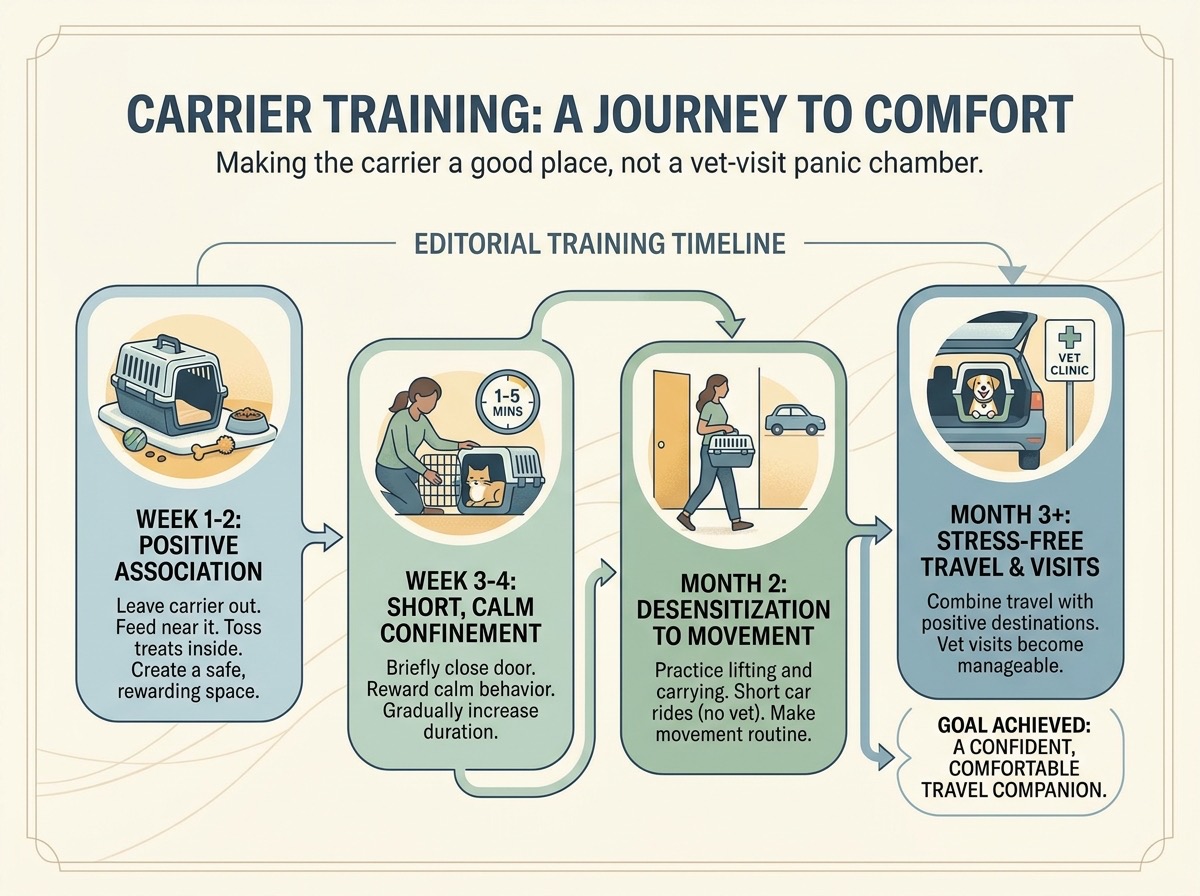
The training: the 4-week protocol
The full carrier training takes 2-4 weeks. The owner can do the training in short sessions (5-10 minutes) once or twice per day. The cat's progress is the indicator — when the cat is comfortable at each step, the owner moves to the next step.
Week 1: the carrier in the room
The owner places the carrier in the room where the cat spends most of its time. The carrier door is open. The owner does nothing to encourage the cat to enter. The cat investigates the carrier on its own.
The owner's job:
- Place the carrier in a quiet corner of the room, not in a high-traffic area
- Leave the door open
- Add a soft towel or blanket inside (the cat's own blanket if possible)
- Ignore the carrier — don't point, don't encourage, don't push
The cat's response: most cats investigate the new object within 1-3 days. The cat may sniff, rub, sit next to, or even enter the carrier. The owner rewards any voluntary approach with calm praise (no treats at this stage — the goal is desensitisation, not active conditioning).
Week 2: treats and meals in the carrier
The owner begins to associate the carrier with good things:
- Place a small bowl of treats in the carrier, near the door
- Move the treats further into the carrier over days
- Place the cat's regular meal in the carrier, near the door, then progressively further in
- The cat eats in the carrier
The goal: the cat enters the carrier to eat, on its own, calmly. The cat associates the carrier with food.
The owner's job:
- Feed the cat in or near the carrier for 1-2 meals per day
- Move the food bowl progressively into the carrier
- Watch for any signs of stress (refusal to enter, vocalisation, hiding)
- Move back a step if the cat shows stress
Week 3: closing the door
Once the cat is comfortably entering the carrier to eat, the owner begins to close the door:
- The cat enters the carrier for a meal
- The owner closes the door while the cat eats
- The owner opens the door after 1-2 minutes
- The owner progresses to longer door-closed periods (2 minutes, 5 minutes, 10 minutes, 30 minutes)
The owner's job:
- Close the door calmly, without fuss
- Stay near the carrier (don't walk away)
- Open the door before the cat shows signs of distress
- Reward calm behaviour with calm praise
- Don't open the door if the cat is vocalising or pawing at the door (this rewards the behaviour)
- Open the door when the cat is calm (this rewards the calm)
The goal: the cat is comfortable in the closed carrier for 30 minutes. The cat is not distressed, not vocalising, not drooling. The cat is calm.
Week 4: the car ride
Once the cat is calm in the closed carrier, the owner begins to move the carrier:
- Pick up the carrier (with the cat inside) and walk around the house
- Take the carrier to the car
- Place the carrier in the car (don't drive yet)
- Sit in the car with the cat for 5-10 minutes
- Take short drives around the block (5 minutes)
- Progress to longer drives
The owner's job:
- Make the car a calm place (no music, no sudden movements)
- Take the cat to a positive destination for the first few car rides — a treat at the destination, a few minutes in a different room of the house
- Avoid the vet as the first destination
- Bring a towel to drape over the carrier if the cat is anxious (the dark, enclosed space is calming)
- Use a synthetic pheromone spray (Feliway) in the carrier 15 minutes before the cat enters
The goal: the cat is calm in the car for 30-minute drives. The cat arrives at the destination calm, not panicked.
The "short session" rule
The training is most effective in short, frequent sessions. A 5-minute training session twice a day is better than a 30-minute session once a week. The cat learns better in short bursts, and the owner is more likely to be consistent.
The "Feliway" and other aids
A few products that support the training:
Feliway (synthetic facial pheromone)
A synthetic version of the cat's facial pheromone (F3 fraction). Sprayed in the carrier 15 minutes before the cat enters, the pheromone signals safety and reduces anxiety. Effective for most cats, particularly during the car ride.
Treats in the carrier
The cat learns: carrier = treats. High-value treats (freeze-dried chicken, freeze-dried fish, Temptations) are particularly effective.
Thundershirt for cats
A compression garment that applies gentle pressure. Effective for some cats, particularly for the car ride. The cat needs to be conditioned to wearing the shirt (start a week before the trip).
Gabapentin (vet-prescribed)
For severely anxious cats, the vet can prescribe a single dose of gabapentin (50-100 mg per cat) given 1-2 hours before the carrier training, car ride, or vet visit. The gabapentin reduces anxiety and makes the training easier.
The vet visit: building on the carrier training
The carrier training is the foundation. The vet visit is the next layer.
The pre-visit handling
The owner should handle the cat in ways that mimic the vet:
- Touch the cat's paws (vet checks paws)
- Touch the cat's ears (vet checks ears)
- Open the cat's mouth (vet checks teeth)
- Lift the cat's tail (vet checks the perineal area)
- Hold the cat on its side (vet examines the abdomen)
These are uncomfortable for the cat. The owner should pair the handling with treats, so the cat learns: handling = treats.
The owner should do this handling once a day for 1-2 weeks before the vet visit. The cat is more comfortable being handled, and the vet visit is less stressful.
The waiting room
The waiting room is often the most stressful part of the vet visit. Strange animals, strange smells, strange sounds. The owner's job:
- Cover the carrier with a towel
- Place the carrier on an elevated surface (the cat feels safer off the ground)
- Speak to the cat in a calm voice
- Don't allow dogs to approach the carrier
- Ask the vet staff to move the cat directly into an exam room if possible
The exam room
The exam room is the next layer of stress. The owner:
- Keeps the cat in the carrier until the vet is ready
- Allows the cat to exit the carrier on its own (for a top-loading carrier, the vet can examine the cat in the carrier)
- Provides treats during the exam (the vet may offer them)
- Speaks calmly and reassures the cat
The home
The cat is returned home. The owner:
- Opens the carrier in a quiet room
- Allows the cat to exit on its own
- Doesn't force interaction
- Watches for signs of stress (hiding, refusing food, etc.)
Most cats recover from a vet visit within a few hours. Some cats need a day to decompress. The owner should not be alarmed by post-vet hiding.
The "single cat household" caveat
Single-cat households often have the most carrier-phobic cats. The cat has limited experience with the carrier (only vet visits), and the carrier is a clear signal of "vet visit coming".
Multi-cat households sometimes have less carrier-phobic cats because the carrier is occasionally used for non-vet reasons (separation, transport to a friend's house, etc.). The single-cat household has fewer opportunities to dilute the vet association.
The owner of a single cat needs to be more proactive about carrier training. The carrier should be a regular feature in the cat's life, not a once-a-year signal of doom.
The "other species" caveat
The training principles apply to dogs and small mammals (rabbits, guinea pigs, ferrets) as well:
- Dogs: usually easier to train, but the principles of gradual desensitisation apply
- Rabbits: very stress-sensitive. Carrier training is essential. The rabbit that is chase-caught and stuffed into a carrier can go into GI stasis from the stress alone
- Ferrets: usually easy to train. Most ferrets enter carriers willingly
- Guinea pigs: similar to rabbits, very stress-sensitive. Carrier training is essential
The mistakes that undo the training
A few well-intentioned but counterproductive actions:
"Just shove the cat in"
The cat is scared, the vet appointment is in 10 minutes, the owner shoves the cat into the carrier. The cat is now more afraid. The training is set back by weeks.
If the cat isn't trained and the vet appointment is mandatory, the owner should use a towel-wrap technique (the burrito wrap) or a top-loading carrier that the cat can be lowered into. The forced entry is a last resort, not a routine.
"Only get the carrier out for the vet"
The carrier appears once a year. The cat learns: carrier = vet. The carrier is a fear signal.
The fix: get the carrier out regularly, not just for the vet. The cat should see the carrier weekly, ideally daily.
"Don't feed in the carrier, the cat will think it's a food bowl"
The owner is misinterpreting the principle. The cat doesn't think the carrier is a food bowl. The cat learns that the carrier is associated with food. The cat is willing to enter the carrier. The owner's concern is unfounded.
"Leave the carrier in the garage"
The carrier in the garage is invisible to the cat. The cat doesn't get to learn that the carrier is a normal part of the household. The carrier should be in the cat's living space, not stored away.
"The cat will never learn"
The cat is smart. The cat learns quickly. The training is straightforward. The owner's job is to be consistent. The cat will learn.
The "older cat" caveat
Older cats can be carrier trained, but the training takes longer. The cat has years of fear association to overcome. The owner should be patient and consistent. The training may take 6-8 weeks rather than 4.
For an older cat with a strong carrier phobia, gabapentin from the vet can support the training. The medication reduces the anxiety and allows the cat to experience the carrier without the panic.
The "multiple cats" caveat
In a multi-cat household, the owner trains each cat individually. The cats may interfere with each other's training (one cat's panic triggers another cat's panic). The training should be done in a separate room with one cat at a time.
The bottom line
Carrier training is the most useful training the average cat owner can do. The cat that walks into the carrier on its own, that rides in the car calmly, and that tolerates the vet visit is a cat that gets regular veterinary care. The cat that fights the carrier gets emergency care only. The protocol is 4 weeks, short daily sessions, gradual progression, and consistency. The tools are the right carrier, treats, Feliway, and patience. The result is a cat that has a low-stress relationship with the carrier, the car, and the vet. The owner who invests 2-4 weeks of training has years of low-stress vet visits. The owner who skips the training has years of carrier-phobic cat, emergency-only vet visits, and avoidable suffering. The training is straightforward. The result is significant. The cat is worth it.
---
About the author: [Elena Rossi](../Elena%20Rossi.md) holds an MSc in Applied Animal Behaviour from the University of Lincoln, is a Certified Clinical Animal Behaviourist (CCAB) with 14 years of feline behaviour consulting, and is the author of three books on feline behaviour.