
Marker-assisted selection in ornamental fish breeding: a practical guide for serious hobbyists
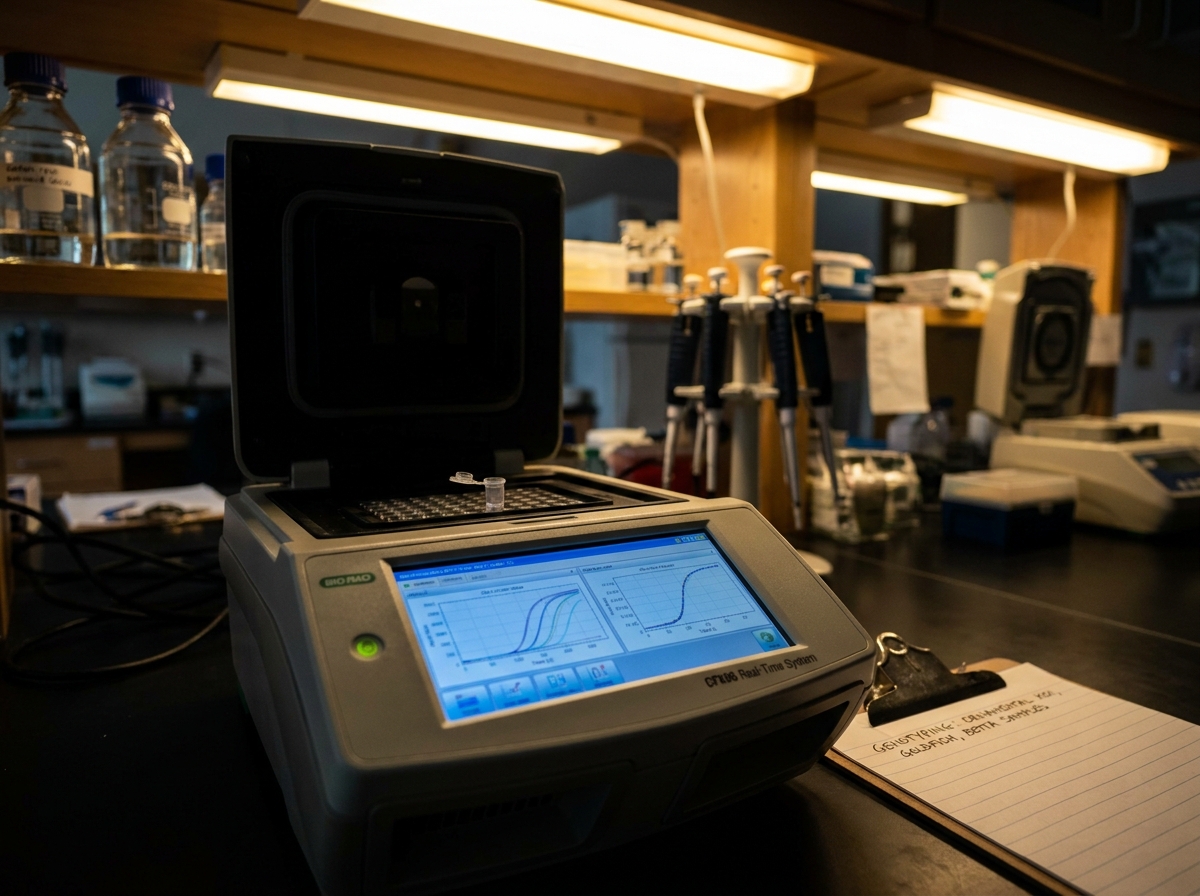
Marker-assisted selection, or MAS, is the breeding technique that uses DNA markers to predict a fish's trait expression before the fish has had time to grow into the trait. In food-fish aquaculture, MAS has been used for two decades to select for disease resistance, growth rate, and flesh quality. In ornamental fish, the technique is newer but is now practical for the serious hobbyist or small commercial breeder, particularly for koi, guppies, bettas, and discus. The cost of genotyping has fallen to the point where a single fish can be screened for a panel of relevant markers for $20-50, and the time savings — selecting a fish at 2 months rather than 18 months — changes the economics of a breeding program entirely. In this article I will walk through what MAS actually does at the genetic level, the markers that are currently useful in ornamental fish, the breeding program structure that makes MAS worth the cost, and the limits of the technique that even the most enthusiastic adopter needs to understand.
What MAS actually does
Every trait a fish expresses — color pattern, fin length, scale type, growth rate, disease resistance — has a genetic component. For some traits, the genetic component is straightforward: a single gene with a clear dominant/recessive pattern, and a small number of markers that predict the gene's state reliably. For other traits, the genetic component is complex: many genes, each contributing a small effect, and the environment playing a major role in the final phenotype. MAS works best in the first category, where a marker or a small panel of markers can predict the trait with high accuracy. In the second category, MAS provides a probabilistic advantage — the fish with the right marker profile is more likely to express the trait, but the prediction is not certain.
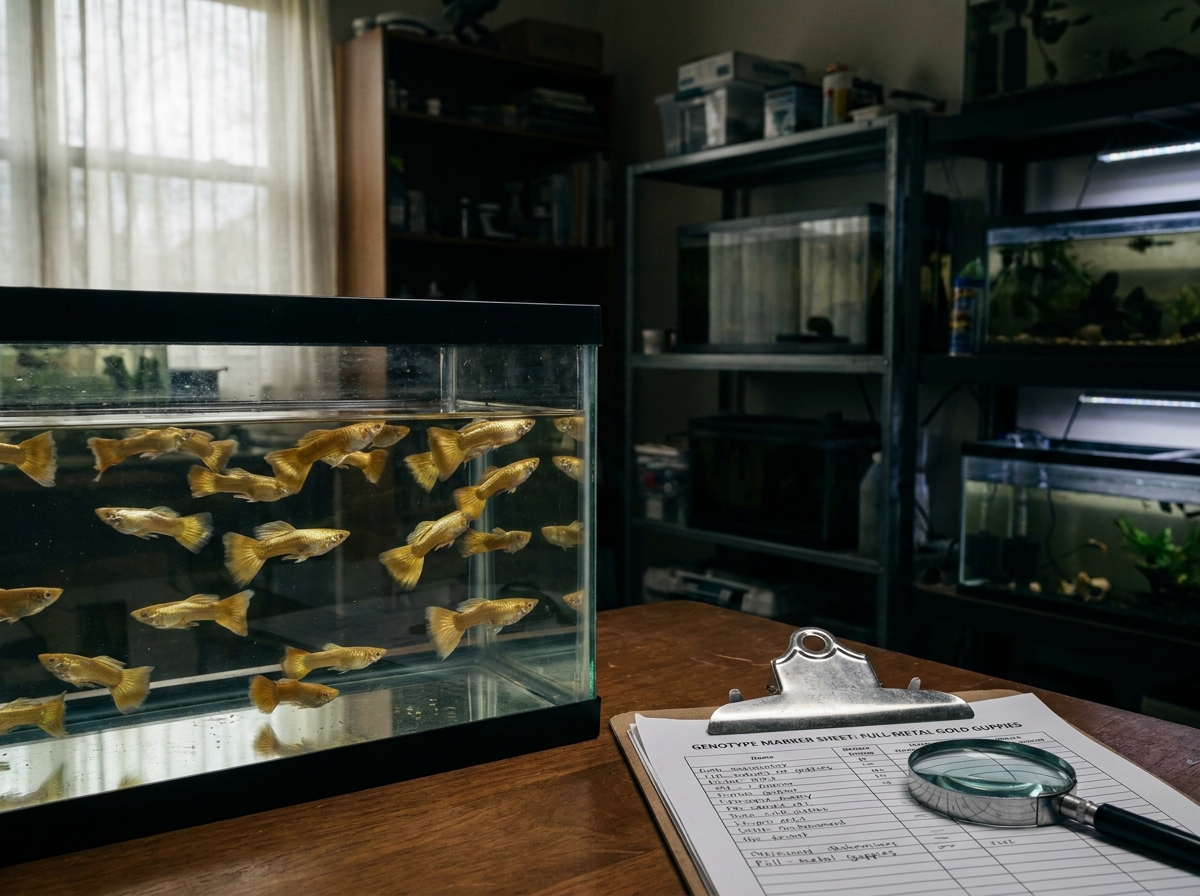
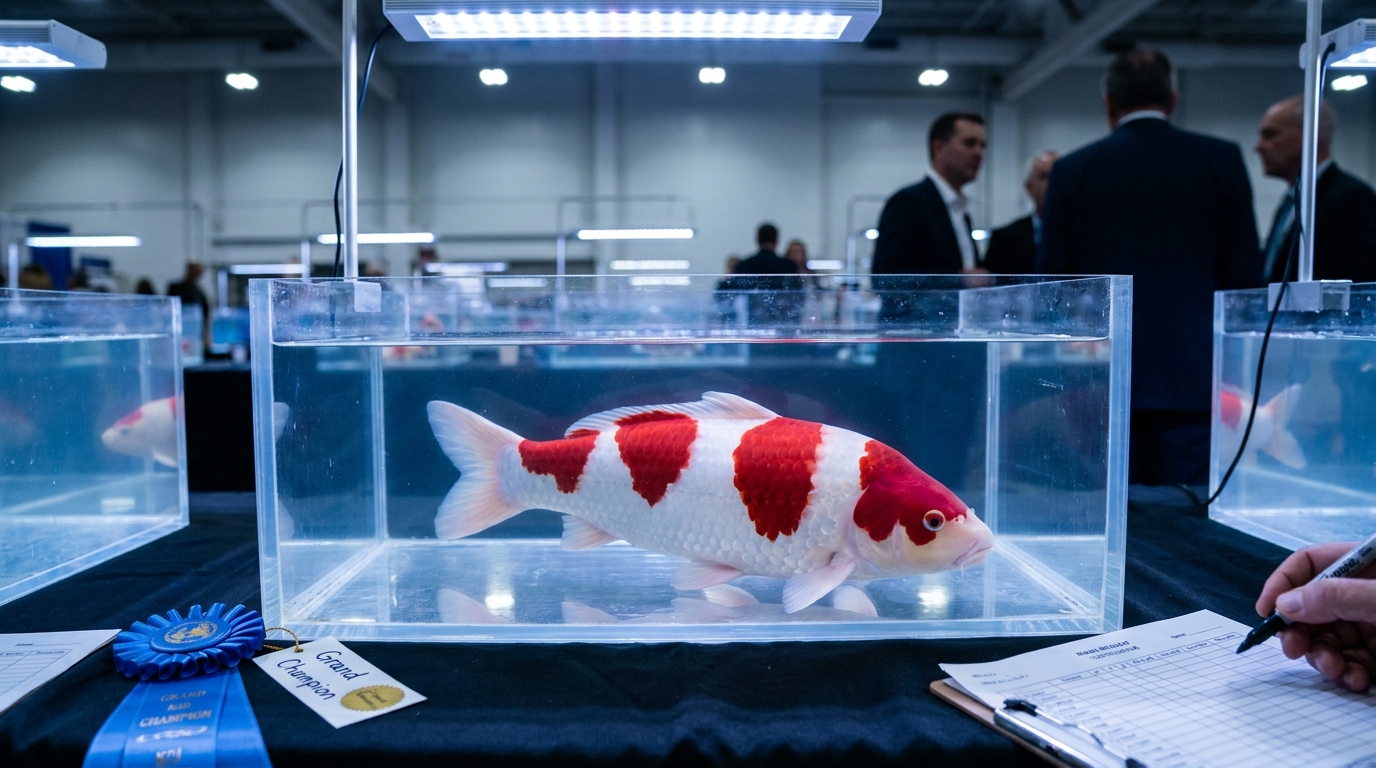
The most common use of MAS in ornamental fish is for simple dominant-recessive traits. The "metal" trait in guppies (the bright metallic gold or silver coloration) is controlled by a small number of genes with major effects, and a panel of 3-4 markers can predict whether a fish will express the metal phenotype with over 90% accuracy. The "Kohaku" white-with-red pattern in koi is more complex — the white base is a recessive trait, the red pattern is a polygenic trait — but markers exist for the white base that allow a breeder to identify a homozygous white-base fish at 2 months of age rather than at 2 years. For discus, MAS panels for the "blue" and "red" base colors are now commercially available.
The markers that are currently useful
The marker panels that are commercially available for ornamental fish fall into three categories. The first is color and pattern markers: the white-base marker in koi, the metal-color markers in guppies, the red-spectrum markers in discus, the marble-pattern markers in bettas. The second is body-shape markers: the short-body (balloon) markers in guppies and bettas, the long-fin markers in guppies and bettas, the humphead markers in flowerhorn cichlids. The third is disease-resistance markers: the IHN (infectious hematopoietic necrosis) resistance markers in koi, the columnaris resistance markers in discus, the velvet resistance markers in guppies and bettas.
The first two categories are the most reliable. The color and pattern markers typically have very high predictive accuracy, because the genetic architecture is simple. The body-shape markers are more variable, because body shape is influenced by both genetics and environment (the same fish raised in different volumes will develop different final body shapes), but the markers still provide useful predictive information. The disease-resistance markers are the most variable, because disease resistance is a complex trait with many genetic and environmental components, but even a 60-70% predictive accuracy is commercially valuable for a breeder who can use MAS to eliminate the most susceptible fish from the breeding pool.
The breeding program structure that makes MAS worth it
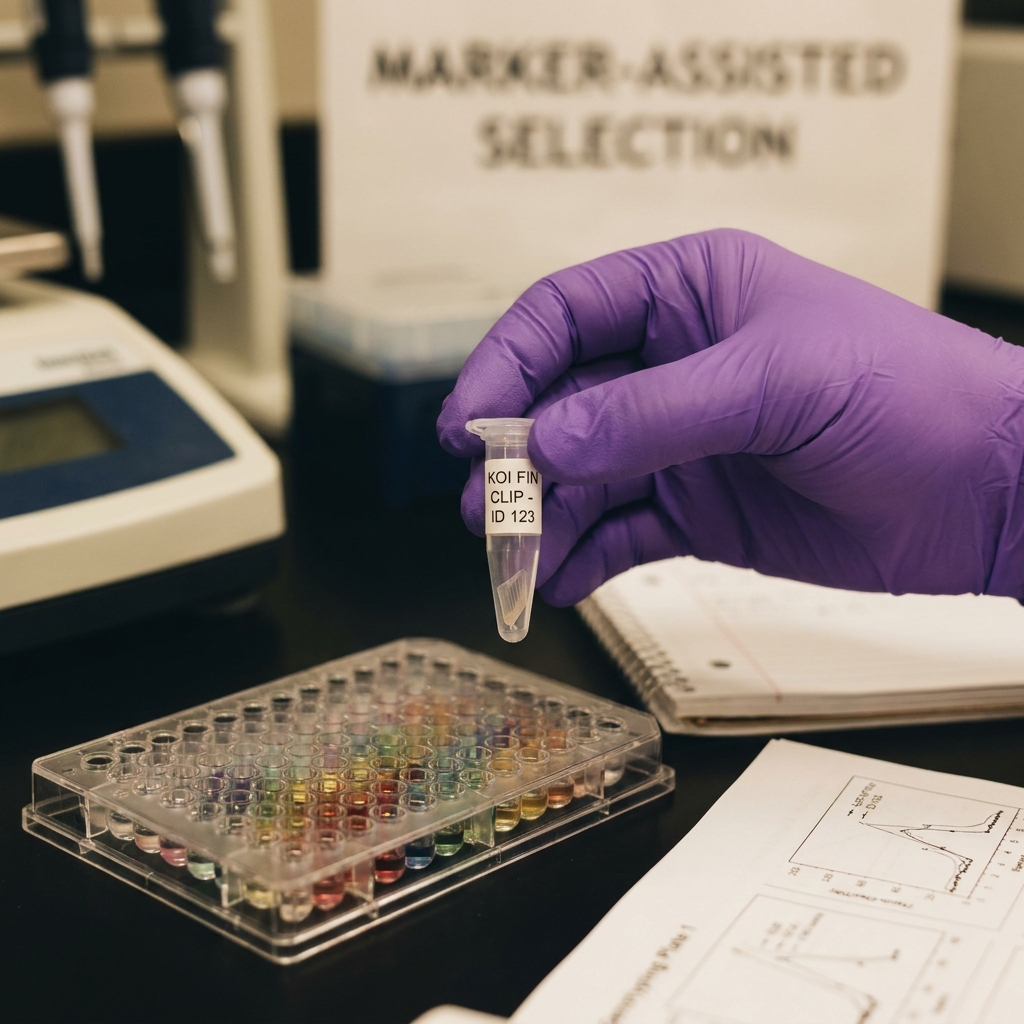
MAS pays off when the breeder is making a choice between two or more fish that are otherwise equally good candidates, and the marker panel will resolve the choice. The setup: a breeding program with 50-200 juvenile fish per generation, each fish individually tagged (PIT tag, fin clip pattern, or visible implant elastomer), each fish with a known pedigree, and each fish with a record of the traits that the breeder is selecting for. At 2-3 months of age, the breeder collects a small fin clip from each fish (a 2-3 mm square of caudal fin, the fish recovers within a week), sends the clips to a genotyping lab, and receives the marker results in 2-4 weeks. The breeder then has, for each fish, a panel of marker genotypes that predict the fish's trait expression.
The selection decision: the fish with the most desirable marker profile is kept for breeding. The fish with the least desirable profile is culled. The fish in between is kept if there is space, or culled if the breeding program needs to focus on the top candidates. The time savings are dramatic. A koi breeder who would otherwise need to grow a candidate to 2-3 years to assess the white-base color can cull the non-white-base fish at 3 months. The feed, water, space, and time saved on the culled fish is significant, and the breeder can run more generations per decade.
The limits of MAS
The first limit is that MAS predicts genetic potential, not guaranteed expression. A fish with the right marker profile for a bright red coloration will express bright red only if the diet, water, light, and social environment support red color expression. A koi with the right marker profile for a clean white base will still develop a yellowish white base if the water is high in tannins or the diet is high in yellow pigments. The fix: manage the environment to support the genetics, not just the genetics alone.
The second limit is that MAS works best for traits with simple genetic architecture. The complex traits — overall body conformation, fin development, the fine details of a koi pattern — are still hard to predict from markers, and a marker panel for "best in show" does not exist. The breeder who relies on MAS for these traits will be disappointed. The fix: use MAS for the simple traits (color base, fin length, disease resistance) and visual selection for the complex traits (pattern detail, body conformation, deportment).
The third limit is cost. A single genotyping panel for one fish is $20-50. A breeding program with 100 juvenile fish, all genotyped, costs $2000-5000 per generation. The cost is recoverable in a commercial breeding program that produces fish for sale, but it is hard to recover in a hobbyist program that produces a few fish per year. The fix: target MAS at the most consequential choice in the program, not at every fish. For a small program, this might mean genotyping only the 10-20 candidate fish at the end of the grow-out, not the entire cohort.
The lab selection
The genotyping lab matters more than the marker panel. A breeder who sends fin clips to a lab that uses a poorly validated marker panel will get results that do not match the fish's actual phenotype. The lab's published validation data — the number of fish tested, the correlation between the marker and the trait, the false positive and false negative rates — is the data to evaluate. The major aquaculture genotyping labs (the university-affiliated labs and the larger commercial labs) have validated panels for the most common ornamental fish species. The smaller labs often resell the same markers but with less internal validation. A serious breeder should ask the lab for the validation paper or the in-house validation data before committing.
A practical example: breeding Kohaku koi
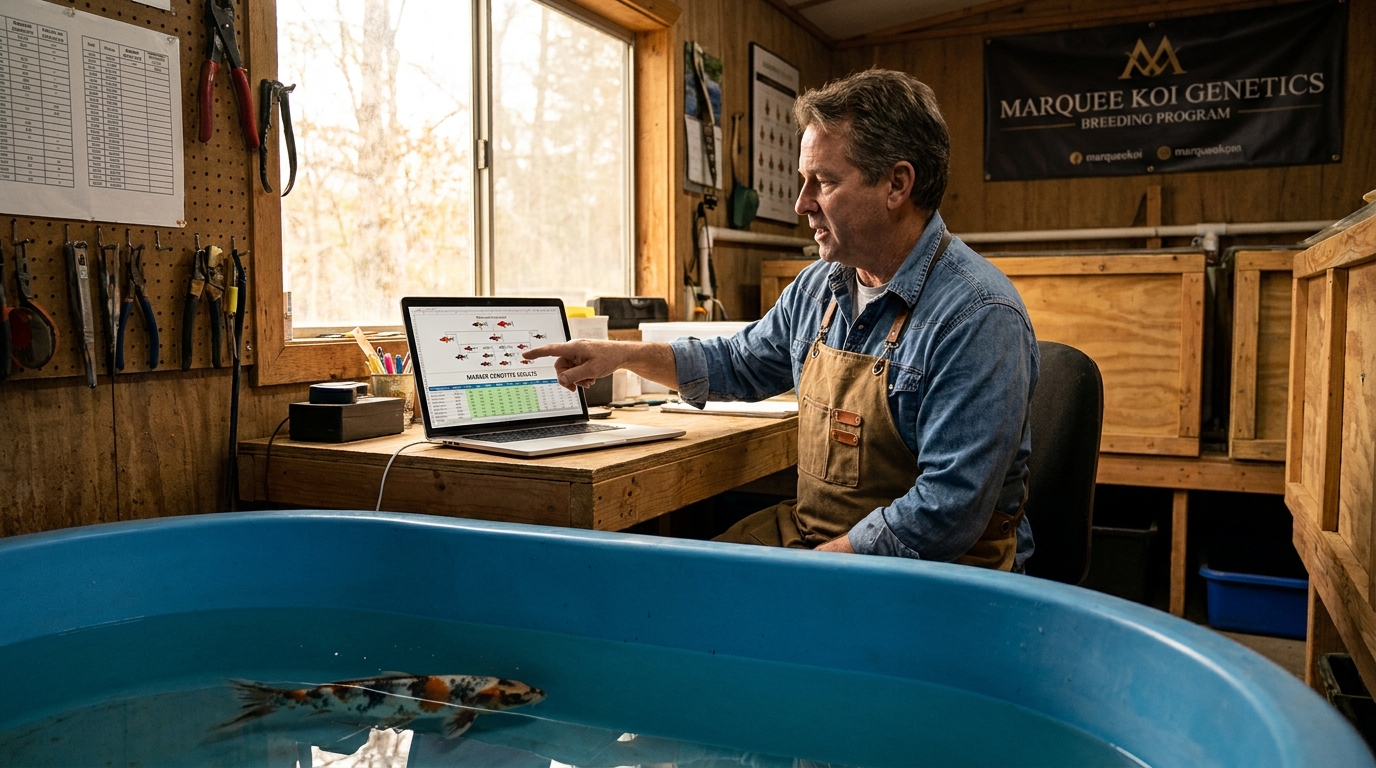
A koi breeder wants to improve the white base of a Kohaku line. The trait is controlled by a small number of genes, with the white base being a recessive. The breeder has 50 juvenile Kohaku, 2 months old, from a cross of two known parents. Without MAS, the breeder grows all 50 to 18-24 months to see which express the cleanest white base, then keeps the best 5-10 for breeding. With MAS, the breeder fin-clips all 50 at 2 months, sends for the white-base marker panel, and at 3 months has a list of which fish are homozygous for the white base, which are heterozygous, and which do not carry the allele at all. The homozygous fish are kept. The heterozygous fish are kept if there is space. The non-carriers are culled. The breeder keeps 15-20 fish for grow-out and selects the final 5-10 at 18 months from a pool of 15-20 rather than 50. The savings in feed, water, space, and labor over 16 months of grow-out are substantial, and the genetic progress in the line is faster because the breeder has identified the high-potential fish earlier.
The honest summary
MAS is a real tool with real applications in ornamental fish breeding. It is not a magic wand. It does not eliminate the need for visual selection, careful husbandry, or patience. For the simple dominant-recessive traits — the most common targets in ornamental fish — it is highly predictive and commercially valuable. For the complex traits that breeders care most about — overall quality, deportment, fine pattern detail — it is not yet useful. The cost has fallen enough that a serious breeding program can justify it, and the time savings on a multi-year grow-out cycle are large. Used correctly, MAS is a force multiplier. Used as a substitute for breeding skill, it is a waste of money.