

F1 to F4 selection goals: planning a breeding program that actually progresses
A breeding program is not a list of fish you kept alive through spawning. It is a written plan with measurable selection criteria, documented parentage, and an honest culling schedule. If you cannot describe what your F4 fish will look like differently from your F1 fish in three concrete traits, you do not yet have a program — you have a hatchery.
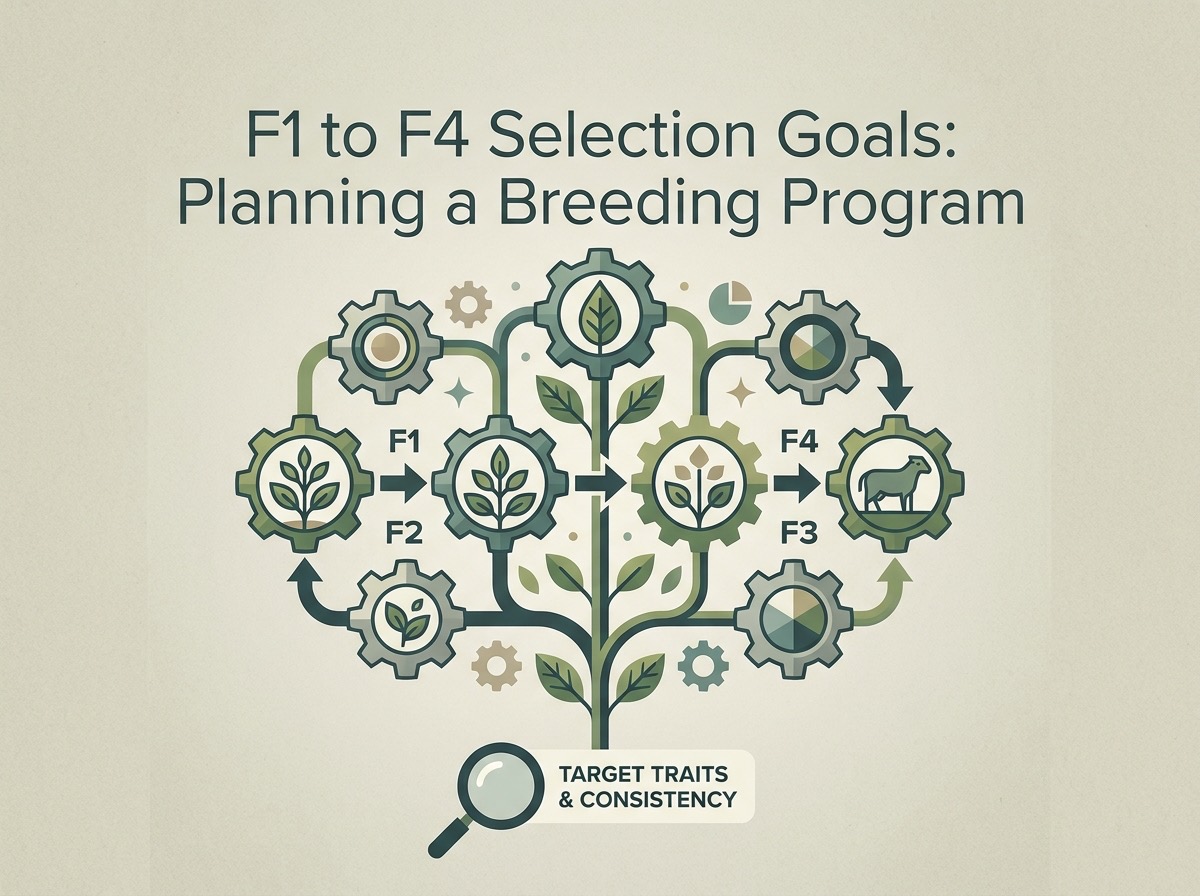
This guide walks through how I plan a four-generation ornamental fish program, from the F1 founder cross all the way to a recognisable, culled F4 line.
Why four generations is the practical horizon
- F1: the founder cross. Maximum heterozygosity, maximum variability.
- F2: where the trait segregation becomes visible.
- F3: where you can begin reliable selection on multiple traits at once.
- F4: the first generation where the line starts to breed true for the type you want.
Going further (F5–F8) is where professional koi and goldfish breeders operate. For the home breeder, four generations is realistic, time-bounded, and enough to produce a visible improvement.
Step 1: Define the breeding goal in writing
Before you spawn a single pair, write down three things:
- The trait you are selecting for (e.g., "Kohaku-style white ground with no shimis, with red concentrated in three or fewer well-defined steps").
- The traits you are selecting against (e.g., "open mouth, weak pectorals, swim bladder tilts").
- The culling ratio you will tolerate (e.g., "I will cull 70% of fry at 30 days, 50% of survivors at 90 days, 30% of survivors at 6 months").
If you cannot write these down, you will not follow through when the culling day arrives.
Step 2: Choose founders with different strengths
The single biggest mistake I see is choosing two fish that look the same. If you cross two visually similar parents, you collapse genetic variance and you cannot make progress.
Instead, choose founders that complement each other:
| Trait | Sire | Dam |
|---|---|---|
| Body conformation | Strong | Average |
| Colour density | Average | Strong |
| Finnage | Strong | Strong |
| Health history | Average | Strong |
You are stacking strengths in F1, then splitting them in F2, then re-stacking in F3 and F4.
Step 3: F1 — keep all, measure everything
F1 fish are genetically diverse. Cull only on lethal defects (severe deformities, swim bladder issues that prevent feeding). Tag every fish. Photograph every fish at the same age (30, 60, 90, 180 days) under the same light.
You are building a reference library, not selecting winners yet.
Step 4: F2 — first visible selection
By F2, trait segregation is visible. Pick the 10–20% of fish that best match your written goal. Discard the rest. Spawn those F2 fish in pairs, not in groups — you need to know which parent contributes what.
This is also the first generation where line breeding starts to make sense: spawn the best F2 male back to the best F2 female from a different sibling family, not to a sibling.
Step 5: F3 — multi-trait selection
F3 is where amateur programs usually collapse because they cannot run multiple selection criteria at once. Pick the top 5% on a weighted index:
- 40% conformation
- 30% colour/pattern
- 15% finnage
- 10% size at 6 months
- 5% behaviour (feeding response, school behaviour)
Do not optimise for more than five traits. The math stops working beyond that.
Step 6: F4 — line consolidation
F4 should produce fish that recognisably resemble your written goal. You should be able to hand a stranger three F4 juveniles and have them group two of them together as "the same type". If they cannot, your selection pressure was too soft.
From F4 onwards, you are maintaining the line, not improving it. New outcrosses every 3–4 generations are essential to avoid inbreeding depression.
A practical four-generation timeline
| Generation | Age at first spawn | Culling rounds | Expected survivors |
|---|---|---|---|
| F1 | 12–18 months | 1 (lethal defects only) | 90%+ |
| F2 | 10–14 months | 2 (30 days, 90 days) | 15–25% |
| F3 | 10–14 months | 3 (30, 90, 180 days) | 5–10% |
| F4 | 10–14 months | 4 (30, 90, 180, 365 days) | 2–5% |
Common failure modes
- No written goal: every generation drifts.
- Weak culling: you keep fish out of sentiment, not for the program.
- No record keeping: you cannot trace which parent produced which F2.
- Closed line breeding past F4: inbreeding depression appears as reduced fertility, smaller fish, and sudden deformities.
Bottom line
A breeding program is a four-to-eight year project, not a spawning event. The difference between a breeder with a line and a breeder with a pond full of fish is six things: a written goal, founder pairing, tag-and-photograph discipline, ruthless culling, accurate records, and an outcross every 3–4 generations. Skip any one and you stall.
---
About the author: [Liu Wei](../Liu%20Wei.md) is a doctoral supervisor in ornamental fish genetics and breeding at the Ocean University of China. He has bred three nationally approved ornamental fish strains over 30 years of research.