
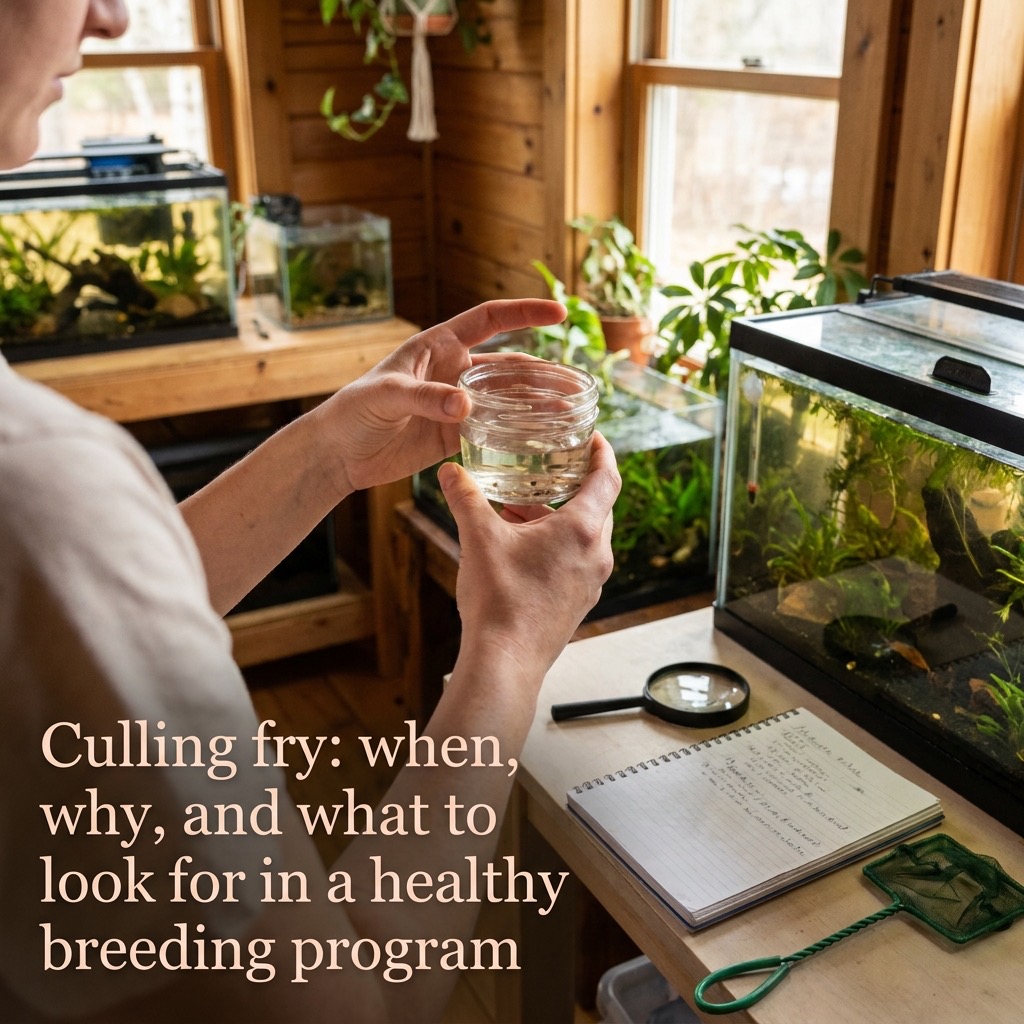
Culling fry: when, why, and what to look for in a healthy breeding program
Culling is the practice of removing fish from a breeding program based on specific criteria. The word is uncomfortable in English, but in fish breeding, culling is a standard, professional practice that determines the long-term quality of a line. Done correctly and humanely, culling is what separates a serious breeding program from a hobbyist's accidental spawn.
This is what culling is, when it's done, what to look for, and how to do it humanely.
Why culling is part of breeding
A single spawn of egg-laying fish can produce anywhere from 50 (a small cichlid spawn) to 5,000+ (a large danio or tetra spawn) fry. The breeder cannot raise all of them. The limitations are:
- Tank space: 1,000 fry need 100+ gallons of rearing space with appropriate filtration
- Food supply: 1,000 fry need thousands of live food organisms daily
- Time: water changes, monitoring, sorting, and feeding for 1,000 fry is a full-time job
- Cost: the food, equipment, and electricity for 1,000 fry can be $1,000+ per month
- Market: most breeders cannot sell or rehome 1,000 fry of a single species
Even with a smaller spawn of 100-200 fry, the breeder cannot keep all of them long-term. The decision is which fry to keep, and the decision is made by selection criteria.
The selection criteria serve three purposes:
1. Quality improvement
Every spawn produces a range of phenotypes. Some fry display the desired traits (colour, fin shape, body conformation) more strongly than others. By selecting for the best, the breeder improves the line over generations. This is the principle of selective breeding, and it's how the fancy guppy, the betta splendens, and the koi breeds have been developed.
Without culling, the line gradually dilutes. The "best" fish are kept by other breeders, the "average" fish are sold, and the breeder's line becomes average. A breeding program that doesn't cull is a breeding program in decline.
2. Health improvement
Some fry are weaker than others. They may have swim bladder issues, deformities, slow growth, or genetic conditions. Keeping these fish in the breeding program perpetuates the weaknesses. Removing them improves the long-term health of the line.
3. Resource allocation
The breeder has finite resources (tank space, food, time). Allocating those resources to the best fish produces the best outcomes. The culled fish are not "wasted" — they may be sold as pet-quality fish, fed to other fish, or used as feeders for predatory species.
The ethical framework
Culling is uncomfortable, and any breeder who feels nothing about it is missing something. The ethical framework that supports culling:
- Purpose: culling is done for the improvement of the line and the welfare of the fish. It is not done for convenience, novelty, or amusement
- Method: the method of culling must be humane. Acceptable methods are species-appropriate and cause no prolonged suffering
- Proportion: only the necessary number of fish are culled. Mass culling without selection is not ethical
- Documentation: the selection criteria and the culling process are documented. The breeder is accountable for the decisions
- Humane endpoint: any fish that is suffering, deformed, or has a poor quality of life is humanely euthanised regardless of selection criteria
Most Western aquarium hobbyists and breeders operate within a framework of "cull to a manageable number" rather than "cull all fish that don't meet the show standard". The selection criteria are usually based on clear culling categories (deformed, weak, poor colour) rather than on minor variations.
For breeders in countries or communities where the practice is different, the considerations are different. The information below is based on the most widely accepted practices in modern ornamental fish breeding.
When culling happens
The culling process occurs at several stages, each with its own criteria.
Stage 1: egg culling (24-72 hours post-spawn)
Within 24-72 hours of spawning, the breeder examines the eggs:
- Fertilised eggs: clear, often with a visible developing embryo, no fungus
- Unfertilised eggs: white, opaque, often develop fungus within 24 hours
- Dead eggs: white, opaque, may already be fungused
The breeder removes unfertilised and fungused eggs to prevent the fungus from spreading to healthy eggs. Many breeders use a fungicide (methylene blue, methyl green) in the egg tank to prevent fungal spread.
This is the most common and least controversial form of culling. The eggs are not yet fish — they are eggs. Removing the unfertilised and dead eggs is standard practice and is the primary method of managing a spawn's initial numbers.
Stage 2: early fry culling (1-3 weeks post-hatch)
In the first 1-3 weeks, the breeder culls:
- Fry that fail to inflate the swim bladder: these fry are called "belly sliders". They cannot swim normally and will not thrive
- Fry with severe deformities: bent spine, missing fins, malformed jaw
- Fry that are clearly weaker: smaller, slower to feed, lethargic
The breeder removes these fry early to focus resources on the healthy ones. The culled fry are typically humanely euthanised.
Stage 3: juvenile culling (4-8 weeks post-hatch)
At 4-8 weeks, the fry have grown enough to display more obvious differences:
- Slow growers: the smallest fry of a cohort, often 50% smaller than the average
- Deformed fish: bent spines, fin deformities, swim bladder issues that weren't apparent at hatching
- Wrong colour or pattern: in colour-bred lines, fry that don't display the desired colour/pattern
- Wrong body shape: in body-bred lines, fry with poor body conformation
The breeder selects the best 10-20% of the cohort and culls the rest. The selection depends on the breeder's goals: colour, fins, body shape, or a combination.
Stage 4: grow-out culling (2-6 months)
At 2-6 months, the juveniles are sexable and the breeder can select for both phenotype and sex. This is the stage where:
- Males and females are separated: breeding programs need specific sex ratios
- The best males and females are kept for breeding: the breeder selects for the traits they want to perpetuate
- Pet-quality fish are sold: the rest are sold as aquarium fish, not for breeding
- Culls are sold, given away, or humanely euthanised
The number kept for breeding depends on the breeder's program. A small program might keep 1 male and 2-3 females. A larger program might keep 10-20 fish per line.
What to look for in selection
The selection criteria depend on the species and the breeding goals. The most common criteria:
Body conformation
- Spine: straight, no curvature
- Body depth: appropriate for the species, not too thin or too deep
- Body length: proportional, not stunted or elongated
- Bilateral symmetry: the left and right sides should match
Fins
- Dorsal fin: full, erect, no missing rays
- Caudal fin: full spread, no missing rays, no curling
- Anal fin: well-formed, no deformities
- Pectoral fins: equal size, no deformities
In betta breeding, fin quality is a primary selection criterion. The ideal is a half-moon, full spread, no curling or asymmetry.
In guppy breeding, the caudal fin size and shape are primary criteria. The ideal is a large, symmetrical, colour-saturated tail.
In cichlid breeding, the dorsal fin length and body shape are primary criteria.
Colour
- Saturation: deep, intense colour, not pale
- Pattern: clear, well-defined pattern (in patterned breeds)
- Coverage: full coverage, no bare patches
- Consistency: the colour should match the breed standard
In koi breeding, colour pattern is the primary selection criterion. The ideal is a koi with deep, saturated colour in a clear, balanced pattern.
In discus breeding, body colour and pattern are primary criteria.
Size and growth
- Above-average size at each stage: the largest fry tend to be the strongest growers
- Proportional growth: not just long, but properly proportioned
- Healthy weight: not emaciated, not obese
Behaviour
- Active: swimming, exploring, feeding
- Alert: responsive to stimuli, not lethargic
- Social (in social species): interacting with the cohort, not isolated
- Not aggressive: in community species, not picking fights
The culling method: humane practice
The method of culling must be humane. The most widely accepted methods for fry and small fish:
Method 1: clove oil (eugenol) overdose
The standard method for euthanising small fish. Clove oil is an anaesthetic; at sufficient dose, it induces deep anaesthesia followed by death.
The protocol:
- Tank water in a small container (matching temperature and pH of the source tank)
- Clove oil at 30-50 ppm (about 5-8 drops per litre, depending on the concentration of the clove oil)
- Stir to mix (clove oil doesn't dissolve in water; it disperses as droplets)
- Add the fish
- The fish becomes sedated within minutes, then anaesthetised, then dies
- Leave the fish in the solution for at least 30 minutes after the last opercular (gill) movement to confirm death
Clove oil is available in pure form from chemical suppliers. The "clove oil" sold in some aquarium shops may be diluted. Use pharmaceutical-grade eugenol for predictable results.
Method 2: MS-222 (tricaine methanesulfonate)
A pharmaceutical-grade fish anaesthetic. Used in research and commercial aquaculture. More predictable than clove oil but requires a veterinary or research supplier.
Method 3: rapid cooling (for tropical fry)
Some breeders use rapid cooling for tropical fry — placing the fry in cold water (near 0°C) induces rapid cessation of metabolism. This method is debated; the consensus is that it is acceptable for fry less than a few weeks old but is not appropriate for larger fish.
Method 4: decapitation (for larger fish)
For larger fish that cannot be humanely euthanised by other means, sharp decapitation is acceptable. The cut must be rapid and complete. This method requires practice and is not for beginners.
What is NOT humane
- Flushing live fish down the toilet: slow death, often survives for hours
- Freezing live fish in a home freezer: slow, painful, not acceptable
- Suffocation (removing from water): slow, painful
- Slow poisoning (ammonia, alcohol): causes suffering
The breeder's responsibility is to use a method that produces a quick, painless death.
The culling decision: a breeder's framework
A working framework for culling decisions:
Deformed or weak fish (cull always)
Any fish with a deformity or chronic health issue is culled. The reasoning:
- The fish is unlikely to thrive
- The condition may have a genetic component, perpetuating it in the line
- The fish would suffer if kept alive
- Resources are better spent on healthy fish
Healthy but not show-quality (sell as pet quality)
A healthy fish that doesn't meet the breeding standard is sold as a pet-quality fish. The fish has a good life as an aquarium fish but is not used for breeding.
Top-quality fish (keep for breeding)
The best fish, by the breeder's criteria, are kept for breeding. These are the future of the line.
The documentation: a breeding program, not a hobby
A serious breeding program documents:
- Spawn logs: parents, date, number of eggs, hatch rate
- Selection criteria: what the breeder is selecting for, by stage
- Culling records: number culled at each stage, reason
- Growth data: size at each stage, identification of slow growers
- Photographs: standardised photos at each stage for comparison
The documentation allows the breeder to evaluate the program over time. A line that consistently produces good fish is a line worth continuing. A line that produces mediocre fish despite careful culling may need new blood (a new breeding pair from a different line).
The culling conversation with the household
A practical consideration: if the breeder is in a household with non-breeders, the culling practice may be uncomfortable for them. The conversation is important:
- Explain what culling is and why it's done
- Explain the humane methods
- Invite the household members to participate in the selection (the cull or keep decision) so they understand
- Respect the household members who don't want to participate
For households with children, the conversation is more nuanced. Some breeders involve children in the observation and selection (under supervision), teaching the principles of breeding and welfare. Others prefer to keep the culling process away from children until they're old enough to understand.
The culling as a percentage: a typical program
In a typical fancy guppy breeding program:
- Spawn: 50-100 fry
- Egg cull: 10-20% removed (unfertilised, fungused)
- Early fry cull: 10-20% removed (deformed, weak)
- Juvenile cull: 40-60% removed (wrong colour, slow growers, deformities)
- Grow-out cull: 50% removed (sexed, only top-quality kept)
- Final kept for breeding: 5-10% of the original spawn
In a typical betta breeding program:
- Spawn: 200-500 fry
- Egg cull: 10-30% removed
- Early fry cull: 20-30% removed
- Juvenile cull: 50-70% removed (wrong fin type, slow growers)
- Grow-out cull: 50% removed
- Final kept for breeding: 1-2% of the original spawn
The numbers vary widely by species, breeder, and program goals. The principle is consistent: a serious breeding program culls the majority of the spawn and keeps only the best.
When not to cull
A few situations where culling is not appropriate:
The breeder is not committed to the program
A breeder who breeds a fish on a whim and then doesn't cull ends up with hundreds of mediocre fish. The better decision is to not breed at all, or to breed only species that don't require heavy culling (livebearers with manageable spawns).
The species is endangered
For endangered species, the priority is the population, not the quality of the line. Heavy culling is inappropriate. Each fish matters.
The breeder doesn't have a market for pet-quality fish
A breeder who breeds 500 guppies and has no market for the culls ends up with 500 guppies they can't sell or rehome. The culling must be matched to the market. If the market is small, the spawn must be small.
The household cannot tolerate culling
If the household is uncomfortable with culling, the breeder should not breed species that require heavy culling. Choose species with small spawns (livebearers, dwarf cichlids) that can be kept without culling.
The bottom line
Culling is the operation that determines the long-term quality of a fish breeding line. It is done for the improvement of the line, the health of the fish, and the welfare of the cohort. The method is humane, the criteria are documented, and the decisions are made thoughtfully. The breeder who culls is the breeder who improves the line. The breeder who doesn't cull is the breeder whose line averages out. For the hobbyist, culling is a choice. For the serious breeder, culling is a discipline. The two approaches are valid — they just produce different outcomes.
---
About the author: [Liu Wei](../Liu%20Wei.md) is a PhD in Aquaculture from Shanghai Ocean University with 16 years of ornamental fish breeding research, and is the convenor of the World Aquaculture Society's Genetics and Breeding Committee.