
Home fish room: the minimum hardware for a serious ornamental fish breeder
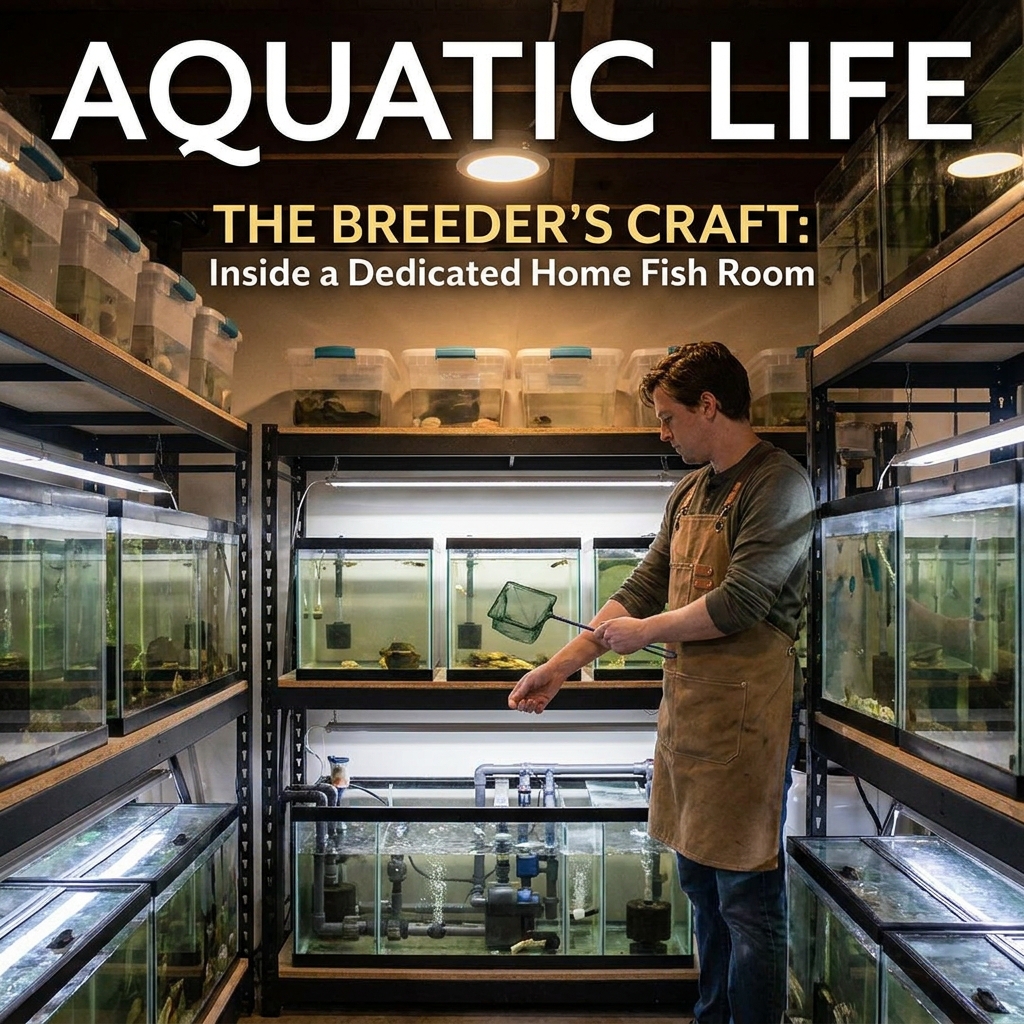
A home fish room for a serious breeder is not a collection of aquariums. It is a small-scale aquaculture facility, and the hardware has to support the kind of water management that an aquaculture facility does. A breeder running 8-20 tanks in a basement, garage, or dedicated room needs three infrastructure elements that the hobbyist with one or two display tanks does not: a water source that does not vary in chemistry, a bulk water-change system that can move large volumes of water in and out of multiple tanks without manual labor, and a filtration and heating system that can be centrally managed. In this article I will walk through the minimum hardware to do all three, the order in which to acquire it, the cost ranges a breeder should plan for, and the mistakes I see most often in home fish rooms that are not built to handle scale.
The principle: control the water
The single principle that governs a serious fish room is control of the water. Every other consideration — tank size, filtration, flow, heating, lighting — is downstream of water control. A fish room where the water varies in temperature by 5°F between morning and evening is a fish room where the fish are stressed and the breeder is losing stock. A fish room where the water varies in pH by 0.5 between water changes is a fish room where the fish are in a constant state of adaptation. A fish room where the breeder spends 6 hours a week on water changes is a fish room that does not have enough tanks to be worth the labor.
The water control has three components: the source water, the bulk water management, and the central filtration. Each component has minimum specifications, and each component is an investment that scales with the number of tanks. The beginner who starts with two tanks and plans to expand to ten is the breeder who should buy the central system for the ten-tank scale from the beginning, because retrofitting is more expensive than installing the right system the first time.
Component 1: the source water
The water that comes out of the tap in most North American homes is suitable for most freshwater fish, with dechlorination. For a fish room that is breeding sensitive species (discus, wild-caught cichlids, certain tetras), the source water is the constraint. Discus breeders use RO/DI (reverse osmosis / deionization) water with mineral additives, because the local tap water is too hard, too alkaline, or too high in dissolved solids. Marine breeders use RO/DI water mixed with a reef salt mix, because tap water contains nitrate, phosphate, and other compounds that cause algae issues in a reef tank.
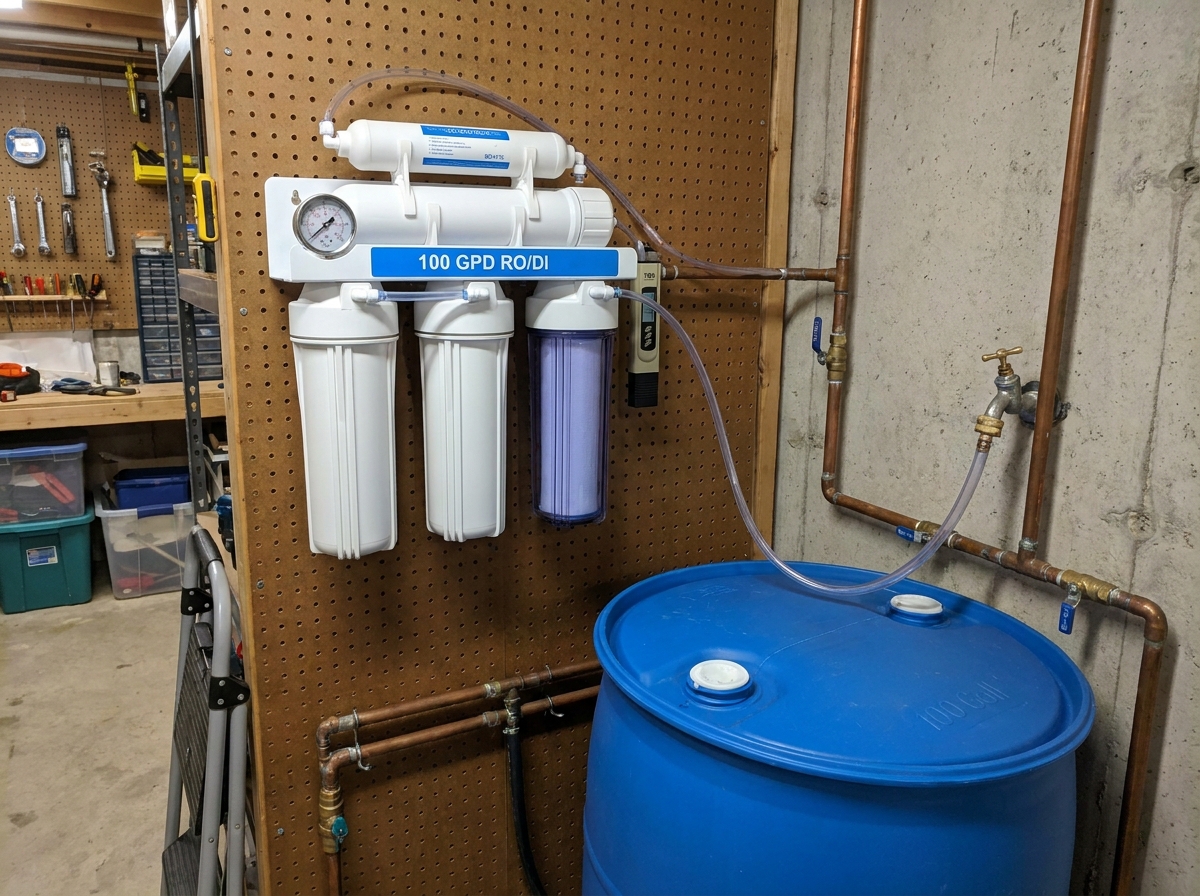
The minimum hardware for a serious fish room: a 100-150 GPD (gallons per day) RO/DI unit with a pressure gauge, a TDS (total dissolved solids) meter on the output, and a 100-gallon storage barrel for the RO water. The cost is $250-500 for the unit, $100-200 for the storage, and $30-50 per year in filter replacements. The cost is recovered in 2-3 years through reduced fish losses and improved breeding outcomes.
The water storage has to be food-grade, opaque (to prevent algae growth), and large enough to hold 2-3 weeks of water change volume. For a 10-tank fish room with 50 gallons per tank, that is 500 gallons of water change per week, or roughly 100 gallons of RO water per day. The 100-gallon storage barrel holds one day's worth; a 300-gallon storage tank holds three days and is the right size for a serious fish room.
Component 2: the bulk water change system
The manual water change — hauling buckets, siphoning, refilling — is the most time-consuming part of fish room maintenance. A 10-tank fish room with 50 gallons per tank at 50% weekly water changes is 250 gallons of water per week, or roughly 30 minutes of manual labor per tank, or 5 hours of manual labor per week. The breeder who wants to spend time on breeding and observation, not on water changes, installs a bulk water change system.
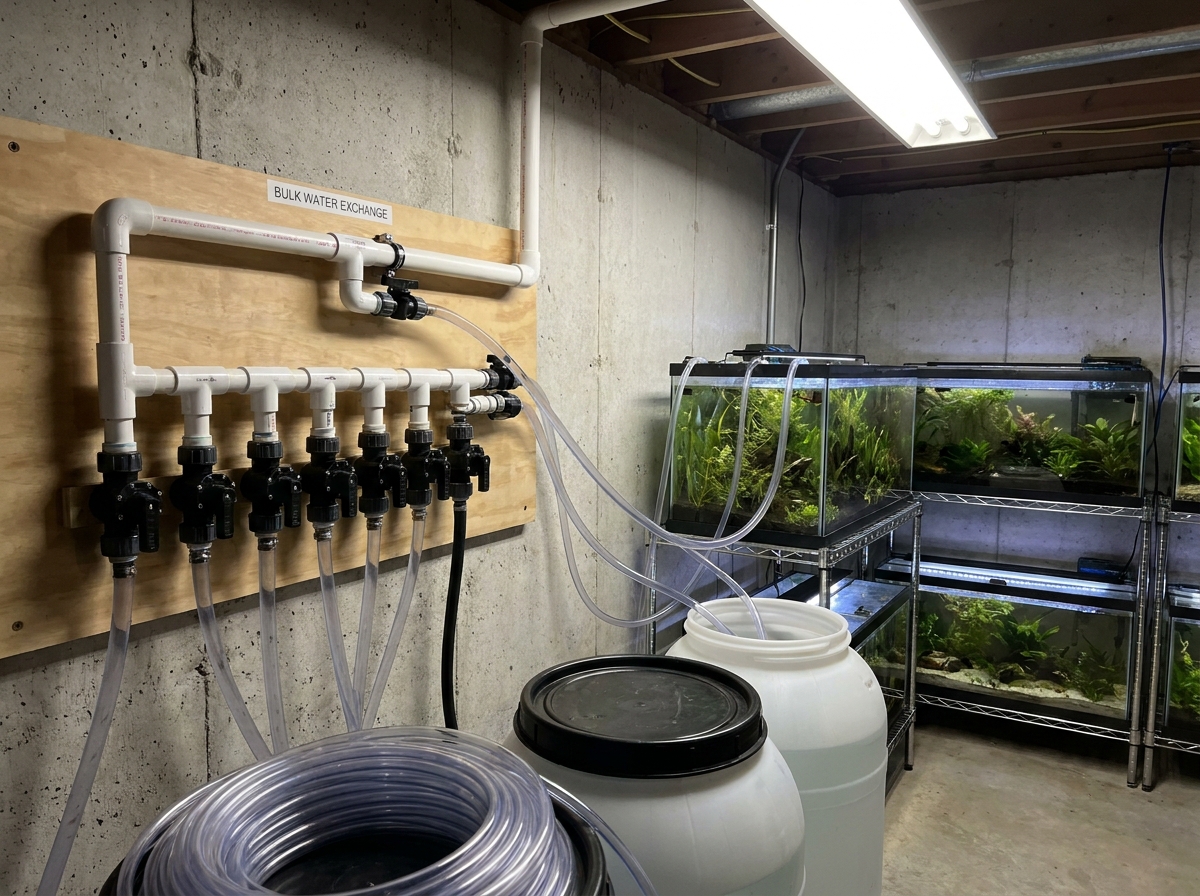
The minimum bulk water change system: a 300-gallon reservoir of treated water at the same temperature and parameters as the tanks, a pump with a manifold that delivers water to each tank through a hose, a drain system that drains each tank into a floor drain or a wastewater container, and a thermometer and TDS meter on the reservoir to verify the parameters before each change. The cost is $400-800 for the reservoir, pump, and plumbing, plus $50-100 in fittings and hoses.
The plumbing is the part that most home fish rooms get wrong. The breeder who runs a single 50-foot hose from the reservoir to each tank, and back, has a system that works but takes time. The breeder who runs a permanent PVC manifold with quick-connect fittings at each tank, and a permanent drain line, has a system that can change 50% of the water in a 10-tank room in 20 minutes. The PVC manifold costs $200-400 in parts and a day of plumbing work. The labor savings are 4-5 hours per week.
The hot water integration is the part that most home fish rooms forget. The water change water has to be the same temperature as the tank water (within 1-2°F). The breeder who is using 50% cold tap water and 50% boiling water from a kettle is a breeder who is making a small mistake every week. The right setup: a hot water line plumbed to the reservoir, with a thermostatic mixing valve that delivers water at the target temperature (78°F for tropical, 72°F for temperate, 25°C for marine). The cost is $200-300 for the mixing valve and plumbing. The benefit is consistent water change temperature.
Component 3: the central filtration
A serious fish room with 8-20 tanks has too many tanks to filter individually, and the filters that are rated for a single display tank are not designed for the constant bioload of a breeding setup. The central filtration is what handles the bioload across the system, and it is the third piece of infrastructure.
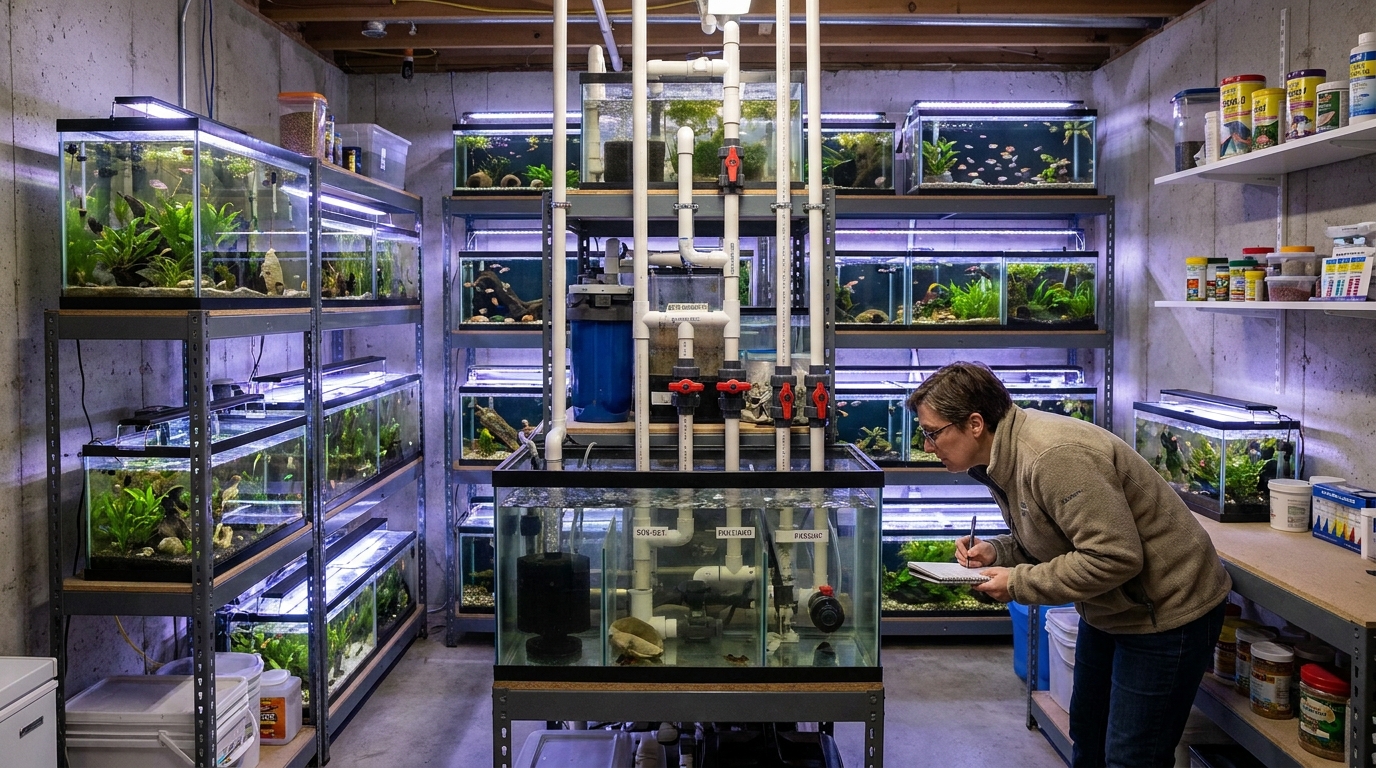
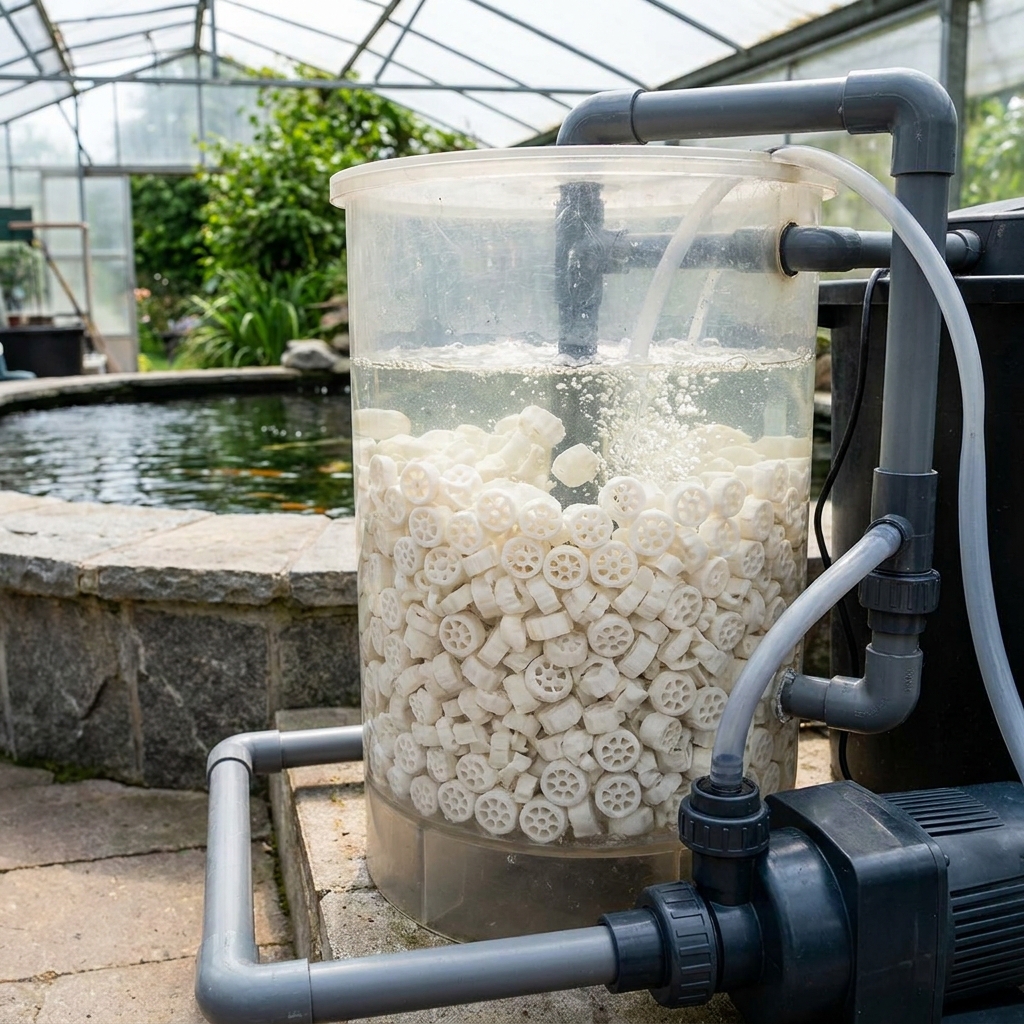
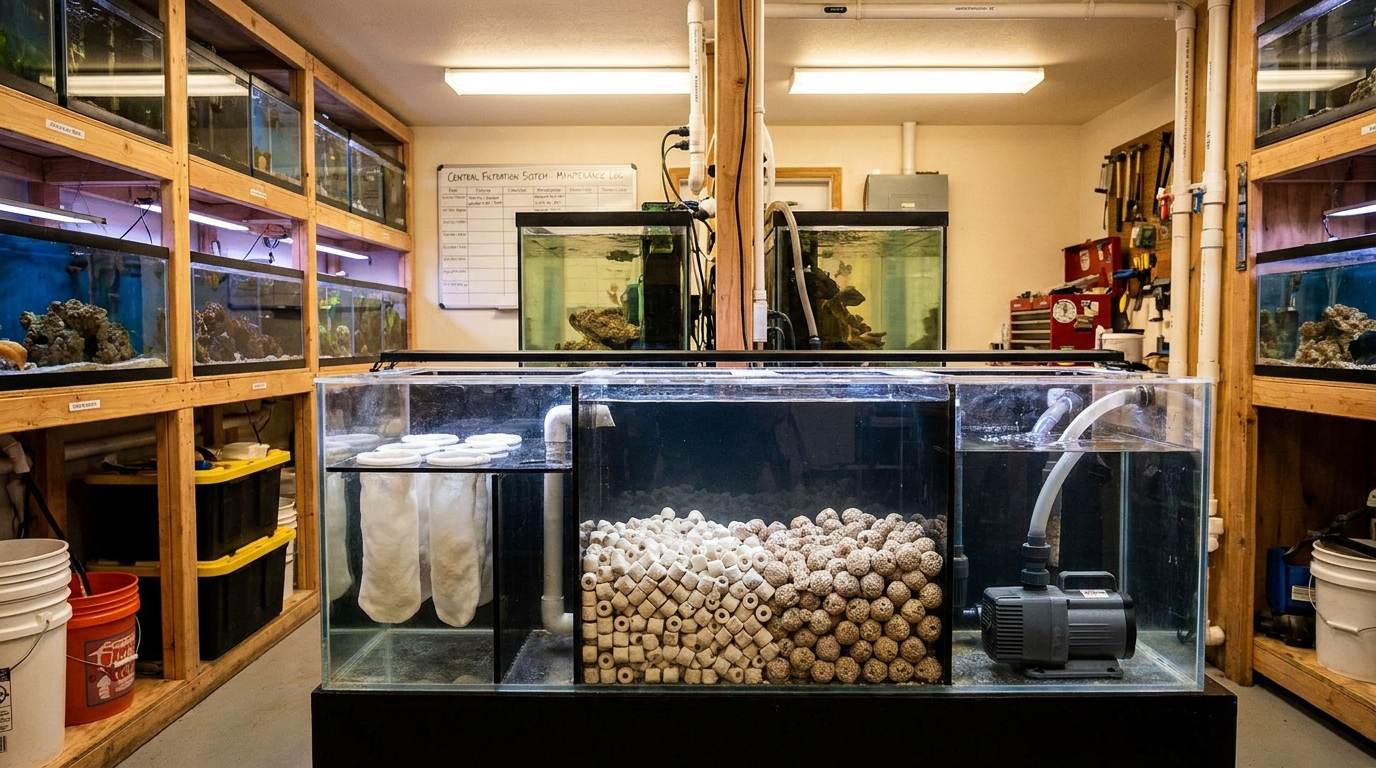
The minimum central filtration: a sump or a series of sumps, with mechanical filtration (filter socks or sponges), biological filtration (ceramic media or K1 fluidized media), and a return pump that delivers filtered water back to the tanks. The sump is the most common central filtration choice for freshwater fish rooms. The sump is a container (typically 50-100 gallons) located below the tanks, connected to the tanks via a drain line and a return line. The water drains from the tanks by gravity, passes through the sump filtration, and is pumped back up to the tanks.
The sump system works for a fish room where the tanks are on a single level (a basement, a garage, a single floor of a house). The fish room with tanks on multiple levels needs a separate filtration system per level, or a more complex pumping system. The cost of a sump system for 10 tanks is $500-1000 for the sump, $300-500 for the pump, and $200-300 in plumbing and fittings. The cost is recoverable in 1-2 years through reduced filter replacement and improved water quality.
The heating for the central system is usually a single large titanium heater in the sump, sized for the total water volume of the system. A 10-tank room with 500 gallons of total water volume needs a 1000-watt titanium heater in the sump, with a digital controller. The cost is $200-300. The benefit is consistent temperature across all tanks, with a single point of control.
The order of acquisition
A serious breeder does not buy the entire fish room infrastructure at once. The order that makes the most sense:
Phase 1 (the first 2 tanks): manual water changes, individual sponge filters, individual heaters. Cost: $500-1000 for the tanks, filters, and basic equipment.
Phase 2 (4-6 tanks): a single shared RO unit, a 100-gallon storage barrel, basic plumbing for manual water changes. Cost: $500-1000 for the upgrade.
Phase 3 (8-10 tanks): the central sump system, the bulk water change plumbing, the hot water mixing valve, the central heating. Cost: $2000-3500 for the upgrade.
Phase 4 (10-20 tanks): a second sump, expanded manifold, additional storage, possibly a quarantine rack and a fry-rearing rack. Cost: $3000-5000 for the expansion.
The phases can be accelerated or compressed, but the order of priority is the same: water source, bulk water change, central filtration, expansion. The breeder who buys the central filtration before the bulk water change is a breeder who is changing water manually across 10 tanks. The breeder who buys the bulk water change before the central filtration is a breeder who is changing water faster but still running individual filters.
The mistakes
The first is the undersized sump. A sump that is rated for 50 gallons of total water volume cannot handle 500 gallons of tank water. The undersized sump is the sump that cannot process the bioload, and the fish room with the undersized sump is a fish room with chronic ammonia and nitrite issues. The fix is to size the sump for 1.5-2x the total tank volume. The second is the unheated water change. The water change water that is 5°F cooler than the tank water shocks the fish and stresses them for 4-6 hours after the change. The fix is the hot water mixing valve and the thermometer on the reservoir. The third is the unfiltered central return. The return line from the sump to the tanks has to be filtered to prevent debris from clogging the tank filters. The fix is a sponge pre-filter on the return pump, replaced monthly.
The honest summary
A serious home fish room is an infrastructure project, not an aquarium purchase. The water source, the bulk water change, and the central filtration are the three investments that make the difference between a fish room and a collection of tanks. The order of acquisition matters: water source first, bulk water change second, central filtration third. The total investment for a 10-tank fish room is $4000-8000, spread over 2-3 years. The benefit is a fish room that can be maintained in 5-10 hours per week, that produces consistent water quality, and that supports a breeding program that scales.