
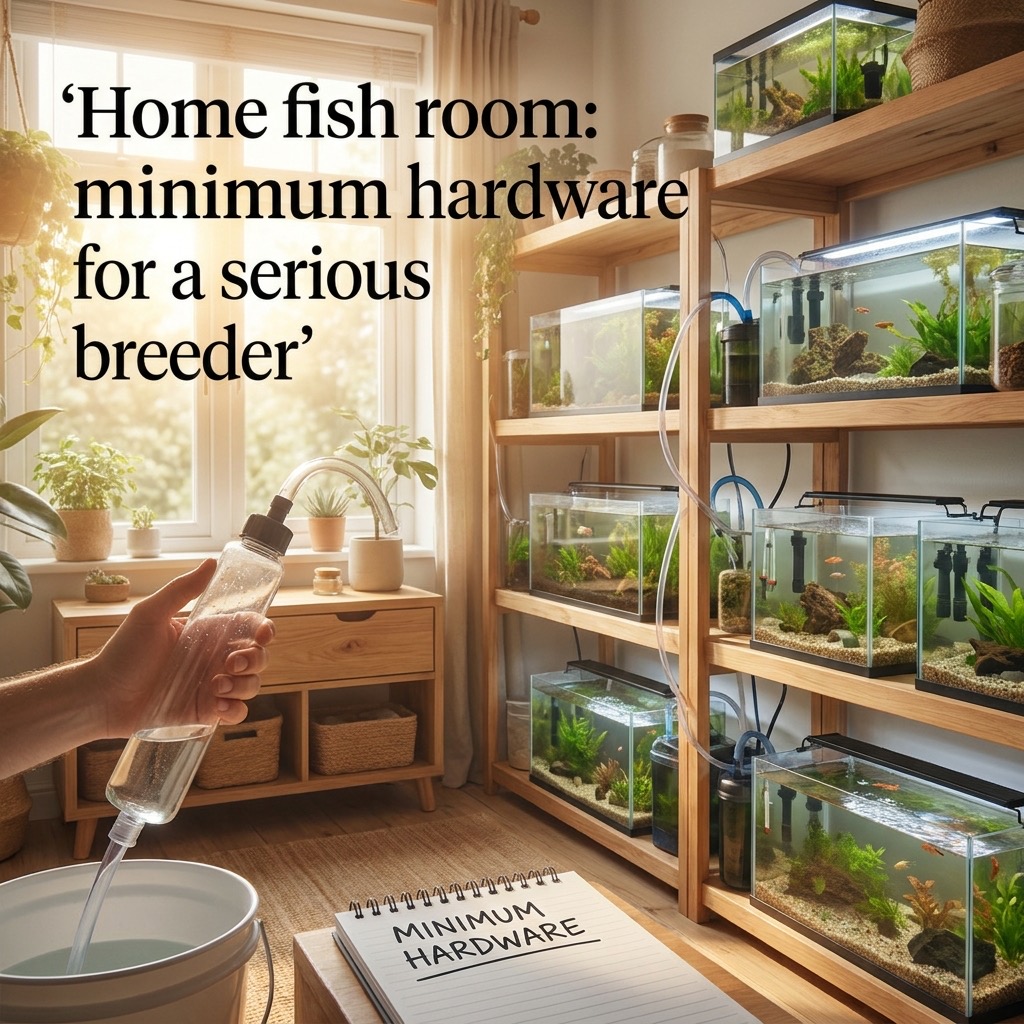
Home fish room: minimum hardware for a serious breeder
A home fish room is the workspace for a serious fish breeder. The room contains the tanks, the filtration, the water management, the feeding, the breeding setups, and the grow-out. A well-designed fish room is a system — the tanks are interchangeable, the water is consistent, the maintenance is centralised, and the breeder can manage dozens of tanks in the time it would take a hobbyist to manage three.
This is the minimum hardware setup for a serious breeder. It's the foundation that allows the breeder to expand without rebuilding, to maintain multiple species without compromising water quality, and to produce healthy fish consistently.
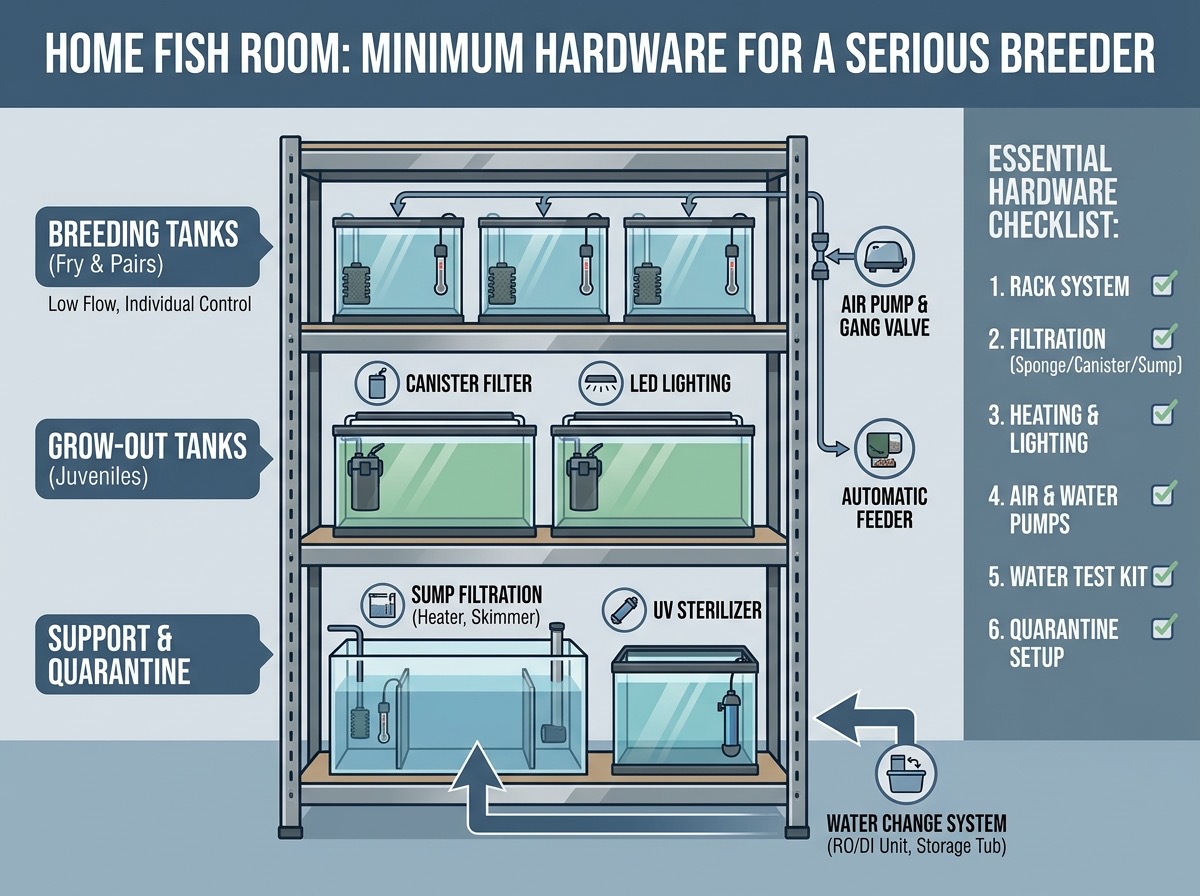
The principle: a system, not a collection
A hobbyist's tanks are a collection. Each tank is its own ecosystem, with its own filter, its own water, its own maintenance. The tanks are independent. The hobbyist maintains each tank separately.
A breeder's tanks are a system. The tanks share a common water source, a common filtration, a common maintenance schedule. The tanks are interchangeable — a tank can be moved, swapped, or repurposed without disrupting the system. The breeder maintains the system, not the individual tanks.
The system approach is what allows a breeder to manage 10, 20, or 50+ tanks without scaling the maintenance time proportionally. The system is the multiplier. The hobbyist with 10 tanks spends 10x the time of the hobbyist with 1 tank. The breeder with 10 tanks spends 2-3x the time of the hobbyist with 1 tank.
The minimum hardware: the foundation
The minimum hardware setup for a serious breeder includes the following components.
The rack system
The rack system is the structural foundation of the fish room. The rack holds the tanks, the filtration, the plumbing, and the lighting. The rack is typically:
- Material: metal (steel or aluminium) or heavy-duty plastic. Wood is less common because it can warp in humid conditions
- Size: 4-6 shelves, each holding one or two tanks. A typical 10-tank rack is 8 feet long, 2 feet deep, 6 feet tall
- Tank size per shelf: depends on the rack. Standard sizes are 10-gallon, 20-gallon (long), and 20-gallon (high)
- Adjustability: shelves should be adjustable to accommodate different tank heights
The rack is placed against a wall, in a location with access to water, drain, and electrical. The wall behind the rack is often covered with plastic or FRP (fibreglass-reinforced panel) for moisture protection.
The tank inventory
The tank inventory depends on the species and the breeding program. A typical setup:
- 10-20 grow-out tanks (10-20 gallons each): for raising fry to juvenile size
- 5-10 breeding tanks (10-20 gallons each): for spawning pairs or trios
- 2-4 conditioning tanks (20-40 gallons each): for conditioning adults before breeding
- 2-4 isolation/quarantine tanks (10 gallons each): for new fish or sick fish
- 1-2 holding tanks (40-100 gallons each): for the main breeding stock
Total: 20-40 tanks, ranging from 10 to 100 gallons. The total water volume is typically 300-800 gallons.
The central filtration
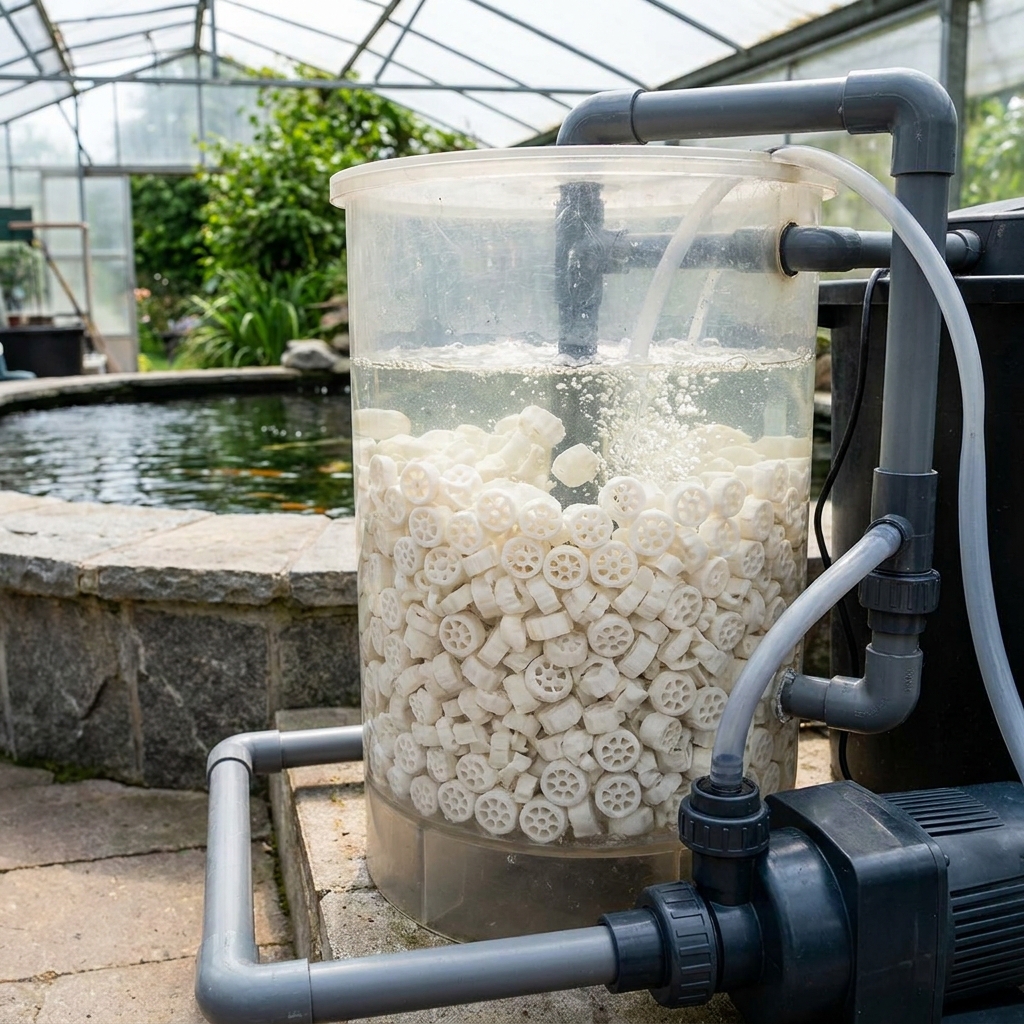
The central filtration is the heart of the system. Water flows from all tanks through a central filter, then back to the tanks. The central filter is shared across the entire system.
The standard setup:
- Sump tank (40-100 gallons): the central reservoir. Holds the filter media, the pump, and the heater
- Mechanical filtration: filter floss or sponge to remove particulate
- Biological filtration: ceramic media (K1, K3, Matrix, Siporax) or mature bioballs to process ammonia
- Optional chemical filtration: Purigen (removes organics), carbon (removes medications, smells)
- Return pump: moves water from the sump back to the tanks
- Heater: keeps the sump at the target temperature
- Auto top-off (ATO): replaces evaporated water with freshwater
The sump is typically placed below the rack, in the lowest position. The water drains from the tanks by gravity, into the sump, and is pumped back up to the tanks.
The plumbing
The plumbing connects the tanks to the central filter. The standard setup:
- Drain lines: 1-1.5 inch PVC or flexible hose. Each tank has a drain that flows by gravity to the sump
- Return line: 1-1.5 inch PVC. The return pump pushes water from the sump to a manifold that distributes water to each tank
- Ball valves on each tank: allow the flow to each tank to be adjusted or shut off
The plumbing is the part of the system that requires the most care. Leaks are common. The plumbing should be pressure-tested before fish are added.
The water source
The water source is the freshwater that replaces evaporation and the water used for water changes. The standard:
- Tap water: treated with a dechlorinator (Seachem Prime, API Tap Water Conditioner)
- RO/DI water: if the source water is unsuitable (high nitrate, high TDS)
- Aged water: tap water that's been aerated for 24-48 hours to remove chlorine
The water source is connected to the fish room via a dedicated tap or a water tank. The ATO (auto top-off) system automatically replaces evaporation. Water changes are done manually, with a Python siphon or a water-change pump.
The water change system
The water change system is the most labour-intensive part of fish room maintenance. A breeder with 20-40 tanks does 20-40 water changes per week. The standard approaches:
- Python siphon: a hose that connects to a sink, allowing water to be drained and replaced without buckets
- Water-change pump: a dedicated pump (e.g., a pond pump) that pulls water from a large container
- Centralised water change: a large container of pre-treated water is connected to the system, allowing all tanks to be topped up or partially changed at once
The Python siphon is the most popular for small fish rooms. The water-change pump is more efficient for larger rooms. The centralised system is the most efficient but requires more infrastructure.
The lighting
The lighting depends on the species. Most freshwater breeding tanks don't require planted-tank-level lighting. The standard:
- LED shop lights: cheap, efficient, suitable for most breeding setups
- Adjustable intensity: dimmer switches or adjustable LED panels for species that prefer lower light
- Timer: lights on a timer for a consistent photoperiod (10-12 hours)
Some breeders add planted-tank lighting for tanks with live plants. The lighting depends on the plant species.
The temperature control
The temperature control is critical. Most tropical breeding tanks are kept at 76-80°F (24-27°C). The standard:
- Centralised heating: a single large heater in the sump heats all the water in the system. Each tank doesn't need its own heater
- Chiller: if the room gets too hot (summer, warm climate), a chiller on the sump keeps the temperature stable
- Backup heater: in case the central heater fails, a backup heater in the sump or in a critical tank prevents the temperature from dropping
A heater failure in a centralised system can affect all the tanks. The breeder should have a backup heater and a temperature alarm.
The "minimum" configuration
For a beginner serious breeder, the minimum configuration is:
- One rack with 4-5 shelves, holding 8-10 tanks
- A sump (40 gallons) with central filtration
- A return pump rated for the total water volume (5-10x turnover per hour)
- A heater in the sump (200-300W)
- An ATO for the sump
- Plumbing connecting all tanks to the sump
- A Python siphon for water changes
- A water source (dechlorinated tap or RO/DI)
- Lighting (LED shop lights on a timer)
- A quarantine tank (separate from the main system)
The total cost for this minimum configuration:
- Rack: $200-500
- 10 tanks (10-20 gallons): $300-800
- Sump and filtration: $300-600
- Pump, heater, ATO: $200-400
- Plumbing: $200-400
- Lighting: $100-200
- Total: $1,300-2,900
This is the minimum. A more elaborate setup with multiple racks, chiller, and centralised water change can cost $5,000-10,000.
The "expansion" path
A serious breeder starts with the minimum configuration and expands as the program grows:
- Stage 1: 1 rack, 8-10 tanks, central sump, basic plumbing. The minimum to start breeding
- Stage 2: 2 racks, 15-20 tanks, larger sump, water-change pump. The system supports a small breeding program
- Stage 3: 3-4 racks, 30-40 tanks, multiple sumps (one per species or water type), chiller, centralised water change. A full breeding facility
- Stage 4: A dedicated fish room with climate control, automatic water changes, quarantine room, breeding room, grow-out room. A professional-grade facility
The expansion is modular. Each stage adds capability without requiring a complete rebuild.
The "species" considerations
Different species have different requirements. The hardware setup varies.
Livebearers (guppies, mollies, platies, swordtails)
- Easy to breed, no special water requirements
- Tanks of 10-20 gallons for breeding
- Fry can be raised in the same tank or separated
- The minimum hardware works well for livebearers
Egg layers (tetras, barbs, danios, cichlids)
- Most require specific water parameters (pH, hardness)
- Many require specific breeding setups (planted tank, flat stone, cave)
- Some require soft, acidic water for spawning
- The hardware may need to include RO/DI water and remineralisation
Cichlids (African cichlids, South American cichlids, Central American cichlids)
- Larger tanks (40+ gallons) for adult pairs
- Aggressive species need plenty of space and hiding spots
- Some require hard, alkaline water (African); some require soft, acidic water (South American discus, apistogramma)
- The hardware may need to support multiple water types (multiple sumps)
Marine fish (clownfish, gobies, dottybacks)
- Requires saltwater mixing station
- Requires protein skimmer
- Requires live rock and live sand
- The hardware is significantly more expensive than freshwater
Koi and goldfish (coldwater)
- Larger tanks or ponds
- Lower temperature than tropical
- More water volume per fish
- Often housed in outdoor ponds rather than indoor fish rooms
The "water quality" monitoring
A serious breeder monitors water quality consistently:
- Temperature: at least daily, ideally continuous
- pH: weekly
- Ammonia, nitrite: weekly, or more often in new tanks
- Nitrate: weekly
- GH, KH: weekly for sensitive species
The monitoring data is logged. Trends are tracked. The breeder spots problems before they become crises.
The "test kit" inventory:
- API Freshwater Master Test Kit (pH, ammonia, nitrite, nitrate)
- API GH and KH test kit
- Thermometer (digital, accurate to 0.1°C)
- TDS meter (for RO/DI monitoring)
- Optional: Hanna digital meters for pH, ammonia (more accurate than test kits)
The "feed" inventory
A serious breeder keeps multiple feed options:
- Dry foods: high-quality tropical flake, pellet, and granule
- Frozen foods: bloodworms, Mysis shrimp, brine shrimp, daphnia
- Live foods: brine shrimp nauplii (for fry), blackworms, white worms, vinegar eels, infusoria
- Specialty foods: depending on the species (algae wafers for algae-grazers, carnivore pellets for predators)
The live food cultures are an essential part of a serious breeding program. The breeder maintains:
- Brine shrimp hatchery (eggs, salt, hatchery container)
- Infusoria culture (for fry that require infusoria as first food)
- Optional: microworm culture, vinegar eel culture, daphnia culture
The live foods are particularly important for fry. Most fry require live food for the first 1-2 weeks of life. The breeder who doesn't have a live food culture can't raise most species.
The "quarantine" protocol
Every new fish entering the system is quarantined for 2-4 weeks in a separate tank. The quarantine tank is:
- A separate 10-20 gallon tank, with its own filter, heater, and lighting
- Not connected to the central system (separate water, separate filtration)
- Used for new acquisitions, sick fish, or fish being treated
The quarantine prevents the introduction of disease to the main system. The breeder who skips quarantine is gambling with the entire fish room.
The "record keeping" system
A serious breeder keeps records:
- Tank log: what's in each tank, breeding status, water change schedule
- Breeding log: pairings, spawn dates, fry counts, growth rates
- Health log: treatments, diseases, deaths
- Water quality log: test results, trends
The records can be on paper, in a spreadsheet, or in a dedicated breeding management software (e.g., SpawnLog, Aquarium Manager). The medium doesn't matter. The discipline of recording does.
The "time" commitment
A serious breeder's fish room is a part-time job:
- Daily: 30-60 minutes for feeding, observation, water top-off
- Weekly: 2-4 hours for water changes, testing, record keeping
- Monthly: 4-8 hours for deep cleaning, filter maintenance, equipment checks
- As needed: breeding setups, fry transfers, treatments
For a fish room with 20-40 tanks, the breeder spends 5-10 hours per week on maintenance. This is on top of the breeding work (selecting pairs, conditioning, raising fry, selling).
The "common mistakes" of new breeders
A few mistakes that new fish room builders make:
The "single tank" start
The new breeder starts with one tank, breeds the fish, fills the tank with fry, runs out of space, and ends up with overcrowded tanks. The fix: plan the system before starting. Have the grow-out tanks ready before breeding.
The "no sump" start
The new breeder uses individual filters on each tank. The maintenance time scales with the number of tanks. The fix: install a central sump. The maintenance time doesn't scale with the number of tanks.
The "no quarantine" start
The new breeder adds new fish directly to the main system. A disease outbreak kills half the fish. The fix: quarantine every new fish.
The "no record" start
The new breeder doesn't keep records. The breeding program is guesswork. The fix: record every pairing, every spawn, every death.
The "no live food" start
The new breeder tries to raise fry on dry food. The fry don't survive. The fix: set up the live food cultures before breeding.
The bottom line
A home fish room is a system, not a collection. The minimum hardware — rack, tanks, central sump, plumbing, water source, lighting, temperature control — supports a serious breeding program. The system approach is what allows the breeder to scale without scaling the maintenance time. The investment is $1,300-2,900 for the minimum configuration, and the time commitment is 5-10 hours per week. The result is a breeding program that produces healthy fish consistently, supports multiple species, and grows as the breeder's expertise grows. The hobbyist with three tanks produces a few fry per month. The breeder with a system produces dozens of fry per week. The system is the difference.
---
About the author: [Liu Wei](../Liu%20Wei.md) is a PhD in Aquaculture from Shanghai Ocean University with 16 years of ornamental fish breeding research, and is the convenor of the World Aquaculture Society's Genetics and Breeding Committee.