
Albinism genetics in ornamental fish: how the albino line is built and what to watch out for
The albino ornamental fish is a fixture in the hobby. Albino corydoras, albino Oscars, albino koi, albino bettas, albino discus, albino guppies — these are all established lines. The contrast between the white body and the red eyes is striking, and the price premium for an albino over a wild-type of the same species is often 30-100%.
The genetics behind the albino trait are well understood at a basic level, but the practical breeding program is more complex than it appears. The albino gene is recessive, the breeding produces a high proportion of culls, and some albino lines have associated health issues that need to be managed. This is the genetics, the breeding strategy, and the health considerations.
The basic genetics of albinism
Albinism is the absence of melanin pigment in the skin, scales, and eyes. The trait is caused by mutations in genes involved in melanin synthesis.
The melanin synthesis pathway
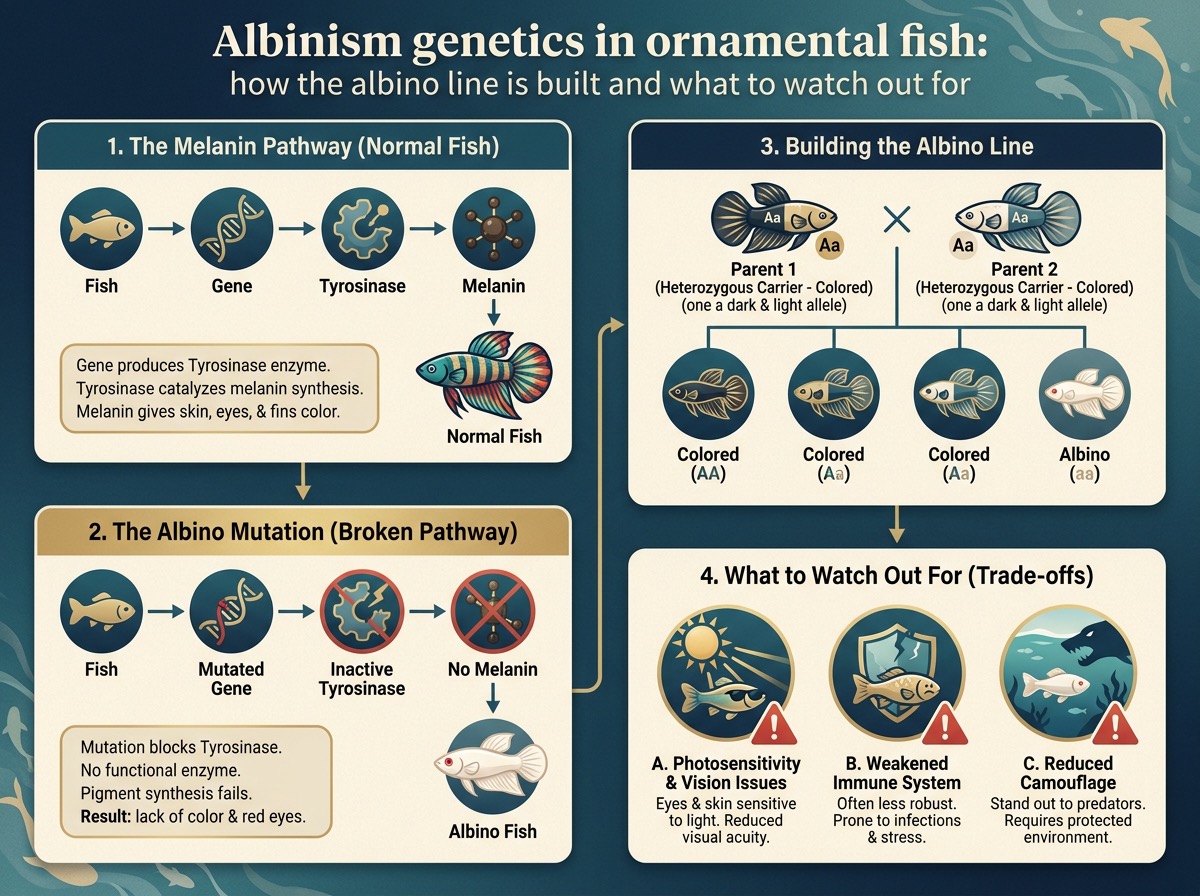
The melanin synthesis pathway starts with the amino acid tyrosine:
- Tyrosine → DOPA → Dopaquinone → Melanin
The enzymes involved:
- Tyrosinase (TYR gene): the rate-limiting enzyme. Mutations in TYR cause the most common form of albinism in fish (oculocutaneous albinism type 1, OCA1)
- TYRP1: a related enzyme. Mutations cause OCA3
- SLC45A2: a membrane transporter. Mutations cause OCA4
In fish, the most common albinism mutation is in the TYR gene. The mutation is recessive — the fish must inherit two copies of the mutation (one from each parent) to display the albino phenotype.
The recessive inheritance
The albino allele is typically designated a, and the wild-type allele is A. The genotypes:
- AA: homozygous wild-type. Normal pigmentation
- Aa: heterozygous. Normal pigmentation (the A allele is dominant over a)
- aa: homozygous albino. Albino phenotype
The breeding outcomes:
- AA × AA: all offspring AA (normal pigmentation)
- AA × aa: all offspring Aa (carriers, normal pigmentation)
- Aa × Aa: 25% AA, 50% Aa, 25% aa
- AA × Aa: 50% AA, 50% Aa
- Aa × aa: 50% Aa, 50% aa
- aa × aa: all offspring aa (albino)
The "albino line" is established by breeding aa × aa to produce 100% albino offspring. But the line must have been developed first, which requires the work described below.
Establishing the albino line
The starting point: a single albino fish
Almost all commercial albino lines start with a single spontaneous albino individual. The albino appears in a spawn of wild-type fish due to a spontaneous mutation, or is discovered in a tank of related fish. The albino is a rare, lucky find.
The breeding strategy: backcrossing
The single albino is bred back to a related wild-type fish:
- Pair the albino (aa) with a related wild-type (AA). The mating is between unrelated individuals of the same species (or closely related species, depending on the program)
- The offspring are 100% Aa (carriers). They are visually wild-type but carry one albino allele
- Cross the F1 carriers (Aa × Aa). The offspring are 25% AA, 50% Aa, 25% aa
- Select the aa offspring (the albinos) and breed them together (aa × aa). All offspring are albino
At this point, the albino line is established. The line is maintained by breeding albinos to albinos.
The "founder effect"
A line established from a single albino has a narrow genetic foundation. All the offspring are descended from one albino and the wild-type parent used to establish the line. The genetic diversity is limited.
The narrow foundation causes:
- Inbreeding depression: fertility declines, growth rate slows, vitality reduces
- Health issues: recessive genetic conditions emerge
- Variability: the line is more variable in the early generations, then stabilises
To maintain genetic diversity, the breeder should:
- Cross the albino with multiple unrelated wild-types during the line establishment
- Maintain records of the wild-type founders
- Avoid breeding close relatives in the early generations
The carrier identification
A challenge: the albino line is maintained by aa × aa breeding. But the breeder may want to identify AA and Aa carriers in the wild-type population for outcrossing.
The identification methods:
- Test cross: cross the suspected carrier with a known aa. If any offspring are albino (aa), the suspected carrier is Aa (50% chance)
- Genetic testing: PCR-based testing for the specific TYR mutation. Reliable but requires lab access
- Pedigree tracking: if the breeder has complete records, the genotype can be inferred from the ancestry
The species-specific considerations
Different species of ornamental fish have different albino lines, with different characteristics and challenges.
Albino corydoras (Corydoras aeneus, C. paleatus)
The most common albino in the hobby. Albino bronze corydoras and albino peppered corydoras are widely available. The albino gene is a TYR mutation.
- Line history: established in the 1950s-1960s, one of the oldest ornamental albino lines
- Health: generally robust, but some lines have reduced vitality due to inbreeding
- Breeding: similar to wild-type. Trigger spawning with water changes, temperature shifts
Albino Oscars (Astronotus ocellatus)
A common albino in the cichlid hobby. Albino Oscars grow to the same size as wild-type but lack the dark pigment.
- Line history: established in the 1970s-1980s
- Health: vision issues are common. Albino Oscars may have reduced vision and may be more easily startled
- Breeding: similar to wild-type. Albino Oscars can be paired and bred
Albino koi (Cyprinus rubrofuscus)
Albino koi are striking but rare in the hobby. The most common "albino" koi are actually "white" koi with reduced (not absent) pigmentation. True albino koi have red eyes.
- Line history: established in Japan in the mid-20th century
- Health: true albino koi have higher sun sensitivity and reduced vitality
- Breeding: requires careful outcrossing to maintain the line
Albino discus (Symphysodon discus)
The most challenging albino to breed. Discus are slow to mature and difficult to spawn.
- Line history: established in the 1990s-2000s, multiple lines
- Health: similar to wild-type but more sensitive to light
- Breeding: requires mature pairs, often 2-3 years to spawn reliably
Albino bettas (Betta splendens)
Albino bettas exist but are rare. The albino mutation in bettas is sometimes associated with health issues.
- Line history: less common than other albino lines, established in the 2000s
- Health: vision issues are common. Albino bettas may have reduced vision and sensitivity to bright light
- Breeding: similar to wild-type. Albino males can be used for breeding
Albino guppies (Poecilia reticulata)
Albino guppies are well-established. The albino gene in guppies is a TYR mutation.
- Line history: established decades ago
- Health: generally robust, similar to wild-type
- Breeding: standard guppy breeding applies
The "albino health issues" misconception
A common misconception: albino fish are inherently unhealthy. The misconception comes from a few sources:
- Reduced melanin: melanin is a pigment that also has protective functions (UV protection, antioxidant). Albinos lack this protection. The impact is small in indoor aquarium conditions
- Vision issues: the iris of the eye has melanin. Albinos have reduced iris pigmentation, which can lead to photophobia (sensitivity to bright light). The fish may be more easily startled by sudden light changes
- Founder effects: many albino lines were established from a small genetic foundation. The inbreeding causes health issues that are confounded with albinism. The health issues are not caused by the albino gene itself, but by the narrow genetic background of the line
For well-managed albino lines with adequate genetic diversity, the health is similar to wild-type. The albino gene itself is not a health problem.
The reality: most albino lines in the hobby are reasonably healthy if the breeder has maintained genetic diversity. The exceptions are extreme cases (the albino is a single individual, bred repeatedly to its own offspring) where inbreeding depression is severe.
The "breeding for the albino" protocol
For a breeder establishing or maintaining an albino line:
Step 1: identify the albino gene
- Confirm the albino is a true albino (no melanin, red eyes) and not a leucistic variant (white but with normal eyes)
- Identify the species and the line (if known)
- Test cross to confirm the recessive inheritance
Step 2: choose the wild-type partner
- Use a wild-type that is unrelated to the albino (different source, different line)
- The wild-type should be healthy, fertile, and free of genetic issues
- The wild-type's genetic background adds diversity to the future line
Step 3: produce the F1 carriers
- Breed the albino (aa) with the wild-type (AA)
- All F1 offspring are Aa (carriers)
- Raise the F1 to maturity, select healthy individuals
Step 4: cross the F1 carriers
- Cross F1 carriers (Aa × Aa)
- 25% of offspring are albino (aa)
- 50% are Aa carriers
- 25% are AA wild-type
- Cull or outcross the AA individuals
Step 5: establish the albino line
- Select the albino (aa) offspring and breed them together
- All subsequent generations are aa (albino)
- Maintain the line with adequate outcrossing
Step 6: outcross periodically
- Every 3-5 generations, outcross the albino line to a different wild-type
- The outcross adds genetic diversity
- After the outcross, the F1 are carriers (Aa). Cross the carriers to produce the next generation of albinos
The "albinism and other colour mutations" combination
In species with multiple colour mutations (koi, guppies, bettas), the albino gene can be combined with other colour genes. The combinations:
- Albino + albino: aa × aa = 100% albino. Used to maintain the albino line
- Albino + non-albino colour gene: e.g., albino guppy + tuxedo guppy = albino tuxedo guppy (if the tuxedo gene is compatible with the albino background)
- Albino + lethal gene: some colour genes are lethal in homozygous state. Combining with albino can produce lethal combinations
The breeder should understand the genetics of each colour gene in the species before combining them with albino.
The "albino as a marker"
A practical use of the albino gene: as a genetic marker. In breeding programs that involve multiple species or strains, the albino gene can be used to:
- Identify hybrids: if a fish is the offspring of a cross between an albino strain and a wild-type, the albino gene can confirm the hybrid status
- Track lineages: the albino gene can be used to track which fish came from which line in a complex breeding program
The marker use is rare in ornamental fish but is common in research genetics.
The health management of albino lines
For a healthy albino line:
Genetic diversity
- Maintain an outcrossing schedule (every 3-5 generations)
- Track pedigrees to avoid inbreeding
- Maintain a separate wild-type line for outcrossing
- Cull individuals with visible genetic defects
Environmental considerations
- Dimmer lighting: albinos are more sensitive to bright light. Provide shaded areas and avoid excessively bright tank lighting
- Stable water parameters: the albino's stress response is sometimes heightened. Stable parameters reduce stress
- Reduced UV exposure: if the fish is in a planted tank with strong lighting, the lighting should be reduced. Albinos have less UV protection than wild-type
Health monitoring
- Watch for vision issues: albinos may bump into objects or have difficulty finding food
- Watch for skin issues: albinos lack protective melanin. Skin infections and parasites may show up faster
- Watch for fertility: albinos sometimes have reduced fertility. Track the breeding success rate
The "culling" consideration
The breeding program for an albino line produces a high proportion of non-albino fish:
- F1 (Aa × Aa): 25% albino, 75% non-albino
- Backcross (aa × AA): 0% albino, 100% carriers
- Aa × aa: 50% albino, 50% carriers
- aa × aa: 100% albino
The non-albino fish (AA and Aa) are not for sale as albino. They are typically sold as carriers (Aa) or culled. The breeder should be prepared to cull or rehome the 75% non-albino fish in the F1 cross.
The culling decisions are the same as for any breeding program (covered in the culling fry article):
- AA individuals: culled or sold as wild-type
- Aa individuals: culled or sold as carriers (often with full disclosure)
- aa individuals: kept for breeding
The economic reality
The albino lines in the hobby are profitable:
- Albino corydoras: 2-5x the price of wild-type
- Albino Oscars: 2-4x the price of wild-type
- Albino koi: 5-10x the price of standard white koi
- Albino guppies: 2-3x the price of wild-type
- Albino discus: 3-5x the price of wild-type
The price premium reflects the increased cost of breeding (the culling, the line maintenance, the smaller spawns). For a breeder with the time and the space, the albino lines are a viable commercial project.
The bottom line
Albinism is a recessive trait caused by mutations in melanin synthesis genes (most commonly TYR). The breeding program follows a standard recessive pattern: cross the albino with a wild-type, produce carriers, cross carriers, select the albinos, and breed albinos. The line is maintained with periodic outcrossing to preserve genetic diversity. The health concerns are overstated — most albino lines are healthy if the genetic diversity is maintained. The challenges are practical: the breeding produces a high proportion of non-albino offspring, the albino lines require more space and time than wild-type lines, and the albinos are more sensitive to bright light than wild-type. The breeder who understands the genetics and applies the protocol has a stable, healthy albino line. The breeder who just breeds albinos to albinos without outcrossing has a line that declines in health over generations. The genetics are simple. The breeding program is more complex than it appears. The line that is well-managed is a viable commercial project. The line that is poorly managed is a welfare problem.
---
About the author: [Liu Wei](../Liu%20Wei.md) is a PhD in Aquaculture from Shanghai Ocean University with 16 years of ornamental fish breeding research, and is the convenor of the World Aquaculture Society's Genetics and Breeding Committee.