
Line breeding vs inbreeding: a practical guide for the serious ornamental fish breeder
The most powerful tool in the serious breeder's toolkit is also the most dangerous. The tool is the concentration of genes from a specific ancestor, and the danger is the concentration of deleterious recessive genes that the ancestor carried. The two practices that concentrate genes are line breeding and inbreeding, and the two are not the same, despite the common misuse of the terms as synonyms. Line breeding is a managed practice that concentrates the genes of a specific superior ancestor while maintaining genetic diversity across the rest of the genome. Inbreeding is an unmanaged or tightly-managed practice that concentrates genes from any relative, often with unintended consequences. The breeder who understands the difference is the breeder who produces a line that is healthy, vigorous, and consistent. The breeder who does not understand the difference is the breeder who produces a line that is inbred, deformed, and infertile. In this article I will walk through the genetic basis, the practical protocols, the inbreeding coefficient that measures the genetic concentration, the signs of inbreeding depression, and the strategies for maintaining a healthy line.
The genetic basis
Every animal has two copies of every gene (one from each parent). When two animals are bred, the offspring gets one copy of each gene from each parent. The two copies may be identical (homozygous) or different (heterozygous). The inbreeding coefficient (F) is the probability that the two copies of any given gene in the offspring are identical by descent — meaning they both came from the same ancestor.
A coefficient of 0 means the two copies are inherited from unrelated ancestors. A coefficient of 1 (the theoretical maximum) means the two copies are the same gene, inherited from the same individual (which only happens with extreme inbreeding like self-fertilization in plants, or full sibling mating for many generations in animals). A coefficient of 0.25 (the offspring of a full sibling mating) is already considered high. A coefficient of 0.5 (the offspring of a parent-offspring mating) is very high. A coefficient above 0.6 over multiple generations is associated with inbreeding depression in most species.
The coefficient is what matters. The coefficient is the predictor of inbreeding depression, and the coefficient is what the breeder should track. A line-breeding program that maintains the coefficient below 0.2-0.3 over 5-10 generations is a line-breeding program that produces healthy, vigorous fish. An inbreeding program that allows the coefficient to climb above 0.4-0.5 is an inbreeding program that produces inbreeding depression.
Line breeding vs inbreeding
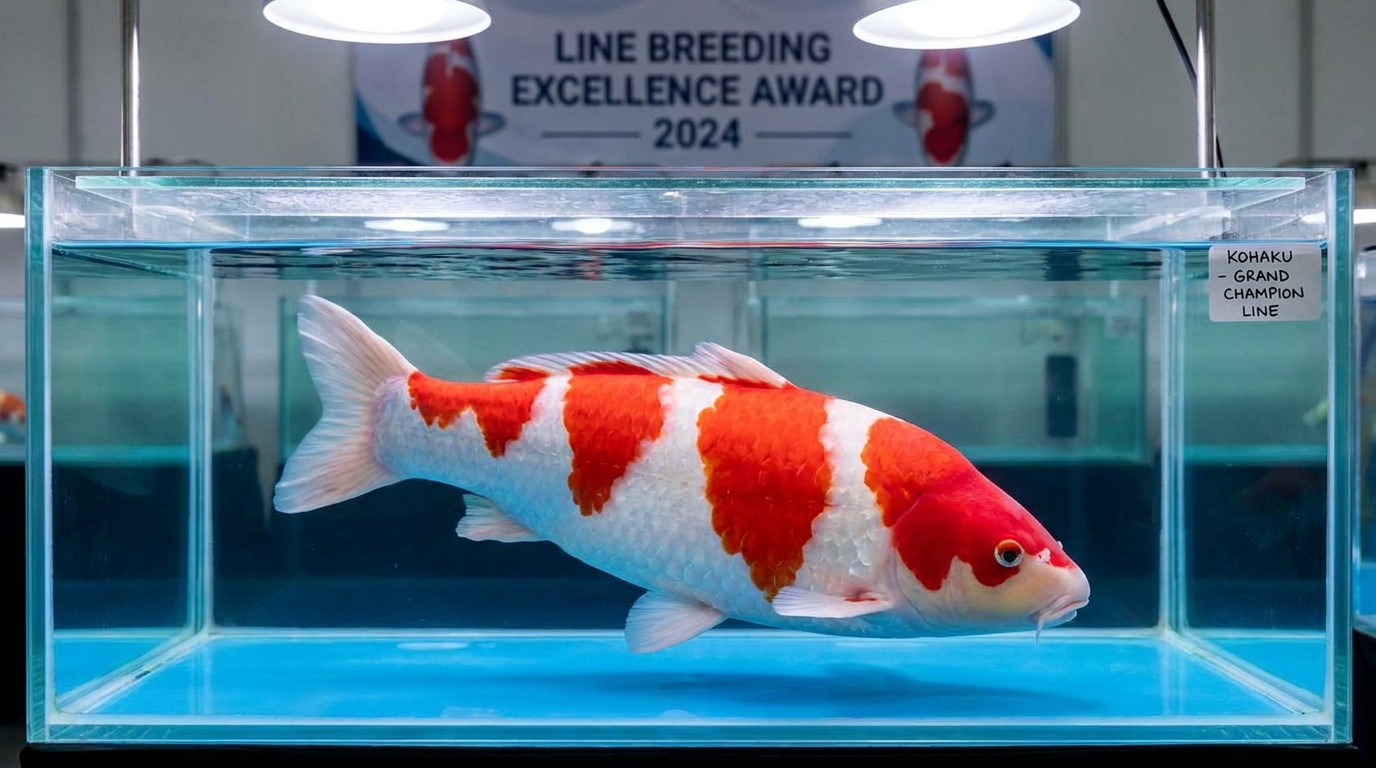
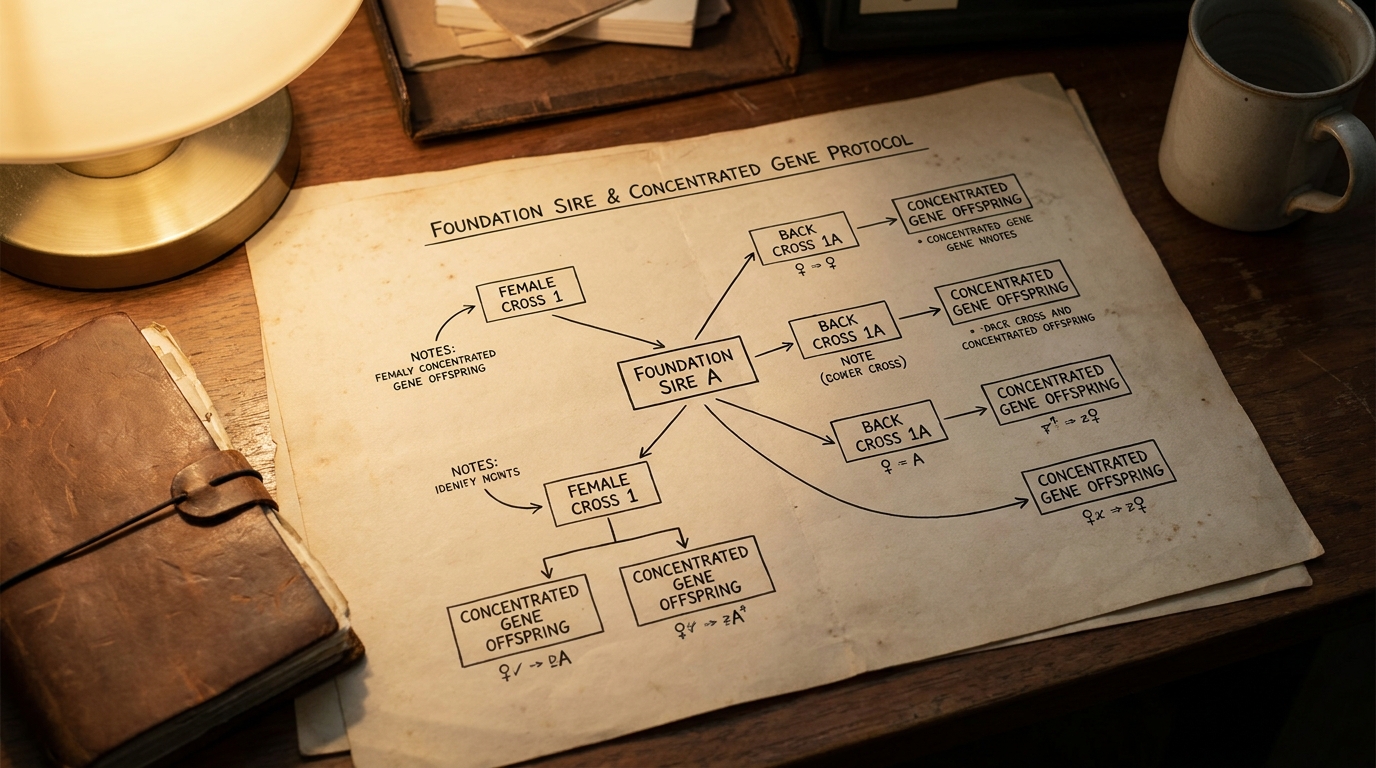
Line breeding is a structured breeding program that concentrates the genes of a specific superior ancestor. The classic line-breeding protocol: a superior male (the "foundation sire") is bred to multiple females, and the daughters are bred back to the foundation sire, and the best offspring are bred back to the foundation sire again, and so on for 3-4 generations. The result is a line in which the foundation sire's genes are concentrated (his coefficient of relationship to the line is 0.7-0.8 after 4 generations of line breeding), but the rest of the genome retains genetic diversity from the multiple founding females.
Inbreeding is a less structured practice that concentrates genes from any relative. The classic inbreeding protocol: brother-sister mating, parent-offspring mating, or grandparent-grandchild mating, for multiple generations, with the goal of producing homozygous offspring. The result is a line in which many different ancestors' genes are concentrated, and the rest of the genome is depleted of genetic diversity.
The difference in outcomes: the line-bred line retains diversity across most of the genome, with the concentration focused on the specific ancestor the breeder wants to propagate. The inbred line loses diversity across the entire genome, with the concentration distributed across all the relatives in the pedigree. The line-bred line is healthier, more vigorous, and more resistant to inbreeding depression. The inbred line is more prone to inbreeding depression, even at a similar coefficient, because the concentration is spread across more deleterious recessives.
The inbreeding coefficient to track
The inbreeding coefficient is calculated from the pedigree. The formula: for each ancestor, calculate the probability that both copies of any gene in the offspring came from that ancestor. The coefficient is the sum of these probabilities across all common ancestors.
Most koi and goldfish breeders do not have a pedigree program, and most ornamental fish breeders do not have the records to calculate the inbreeding coefficient. The practical alternative: track the coefficient manually using a simple spreadsheet. The minimum information needed: the identity of every individual in the breeding program, the parents of every individual, and the relationship of every mating.
The coefficient thresholds to remember:
- F < 0.1: low inbreeding, equivalent to mating unrelated fish. No significant inbreeding depression.
- F = 0.1-0.2: moderate inbreeding, equivalent to mating first cousins. Mild inbreeding depression may appear in some traits.
- F = 0.2-0.3: high inbreeding, equivalent to mating half-siblings. Moderate inbreeding depression likely.
- F = 0.3-0.4: very high inbreeding, equivalent to mating full siblings. Significant inbreeding depression likely.
- F > 0.4: extreme inbreeding. Severe inbreeding depression almost certain.
The line-breeding program should maintain the coefficient below 0.2-0.3 across the line, with the best offspring produced from matings that are 2-3 generations removed from the foundation animal. The matings that are too close (parent-offspring, full sibling) should be used sparingly, and only when the offspring are needed for a specific reason (e.g., to recover a recessive trait).
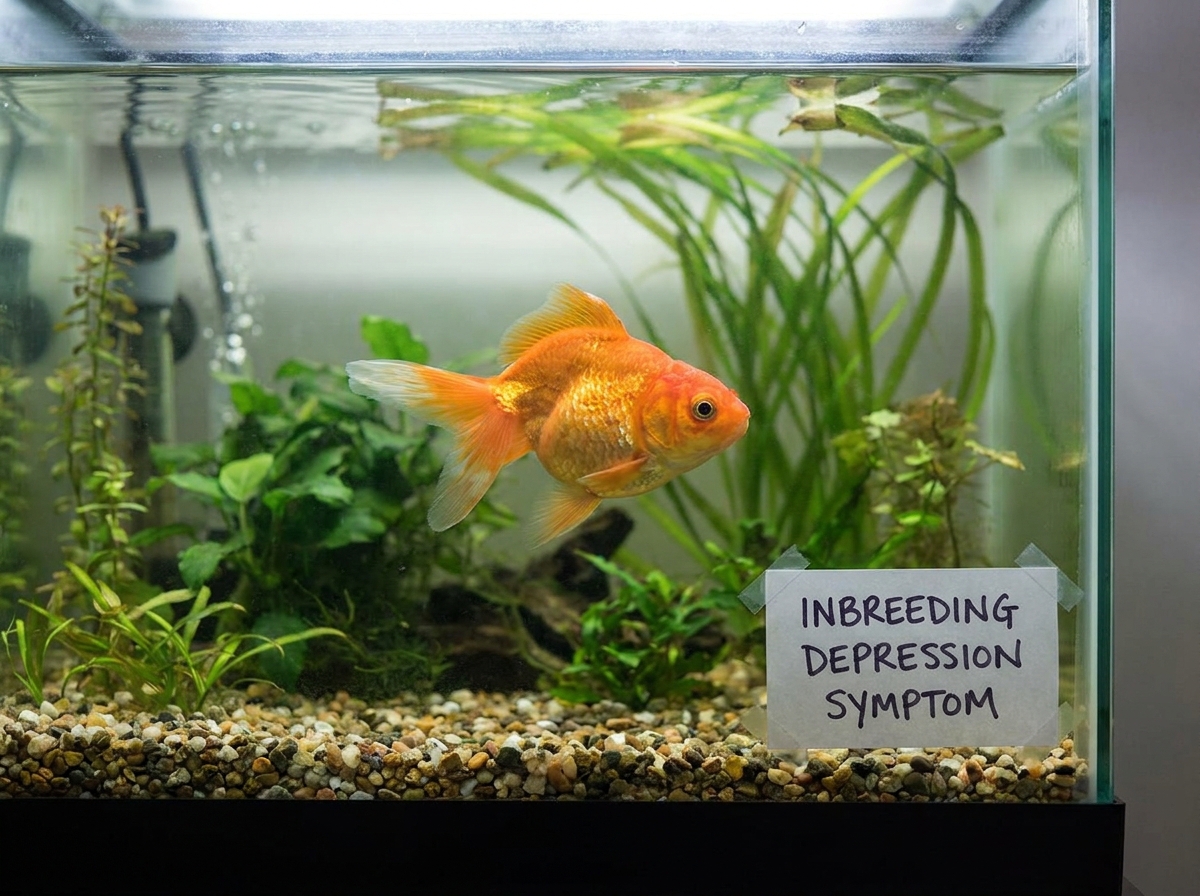
The signs of inbreeding depression
The first sign is reduced fertility. The line that is becoming inbred produces fewer eggs per female, lower fertilization rates, lower hatch rates, and lower survival of fry. The breeder who notices a sudden drop in fertility without an obvious environmental cause is the breeder who is seeing the first sign of inbreeding depression.
The second sign is reduced growth rate. The fish that are inbred grow more slowly, reach smaller adult sizes, and have less uniform growth than the fish that are outbred. The koi or goldfish that is "smaller than the parents at the same age" is a koi or goldfish that is showing the effect of inbreeding.
The third sign is increased deformity rate. The inbred line produces more skeletal deformities (curved spine, missing fins, malformed gill covers), more color defects (irregular patterns, faded colors), and more disease susceptibility. The breeder who sees a sudden increase in deformity rate is the breeder who is seeing inbreeding depression.
The fourth sign is reduced disease resistance. The inbred line has a less diverse immune system, and the inbred fish are more susceptible to common pathogens. The line that is suddenly having disease outbreaks despite good husbandry is the line that has lost immune diversity.
The outcrossing strategy
The outcrossing strategy is the safety valve of the line-breeding program. The outcrossing is the introduction of an unrelated individual into the line, to restore genetic diversity. The outcross is not a complete restart of the line; the outcross is a single introduction that increases the diversity of the next generation without losing the line's specific characteristics.
The outcross protocol: identify an unrelated individual that has the desired characteristics (color, pattern, body shape, finnage) but is not closely related to the line. The unrelated individual is bred to a member of the line. The offspring are 50% outcrossed. The offspring are bred back to the line in the next generation, producing 25% outcrossed offspring. The line is now 25% outcrossed, with the original line's characteristics still dominant.
The outcross should be done every 3-5 generations, or whenever the inbreeding coefficient climbs above 0.25, or whenever the signs of inbreeding depression appear. The outcross is the safety valve. The outcross is what keeps the line healthy for the long term.
The outcross is also the point at which the breeder's record-keeping is essential. The breeder who does not have the pedigree cannot identify the unrelated individual, cannot calculate the coefficient, and cannot make the outcross. The pedigree is the infrastructure that makes the line-breeding program work.
The honest summary
Line breeding is a powerful tool for concentrating the genes of a superior ancestor, with the goal of producing a consistent line that has the ancestor's characteristics. Inbreeding is a less structured practice that concentrates genes from any relative, with a higher risk of inbreeding depression. The inbreeding coefficient is what the breeder should track, and the threshold of 0.2-0.3 is the practical upper limit. The signs of inbreeding depression are the early warning that the line needs an outcross. The outcross is the safety valve that keeps the line healthy for the long term. The breeder who runs the protocol is the breeder who produces a line that is consistent, healthy, and vigorous. The breeder who does not run the protocol is the breeder who produces a line that is inbred and progressively weaker.
The single sentence to remember
Line breeding is a structured practice that concentrates the genes of a specific ancestor while maintaining diversity. Inbreeding is an unstructured practice that concentrates genes from any relative. The difference is the diversity. The diversity is the safety. The safety is the long-term health of the line. The breeder who understands the difference is the breeder who builds a line that lasts.