
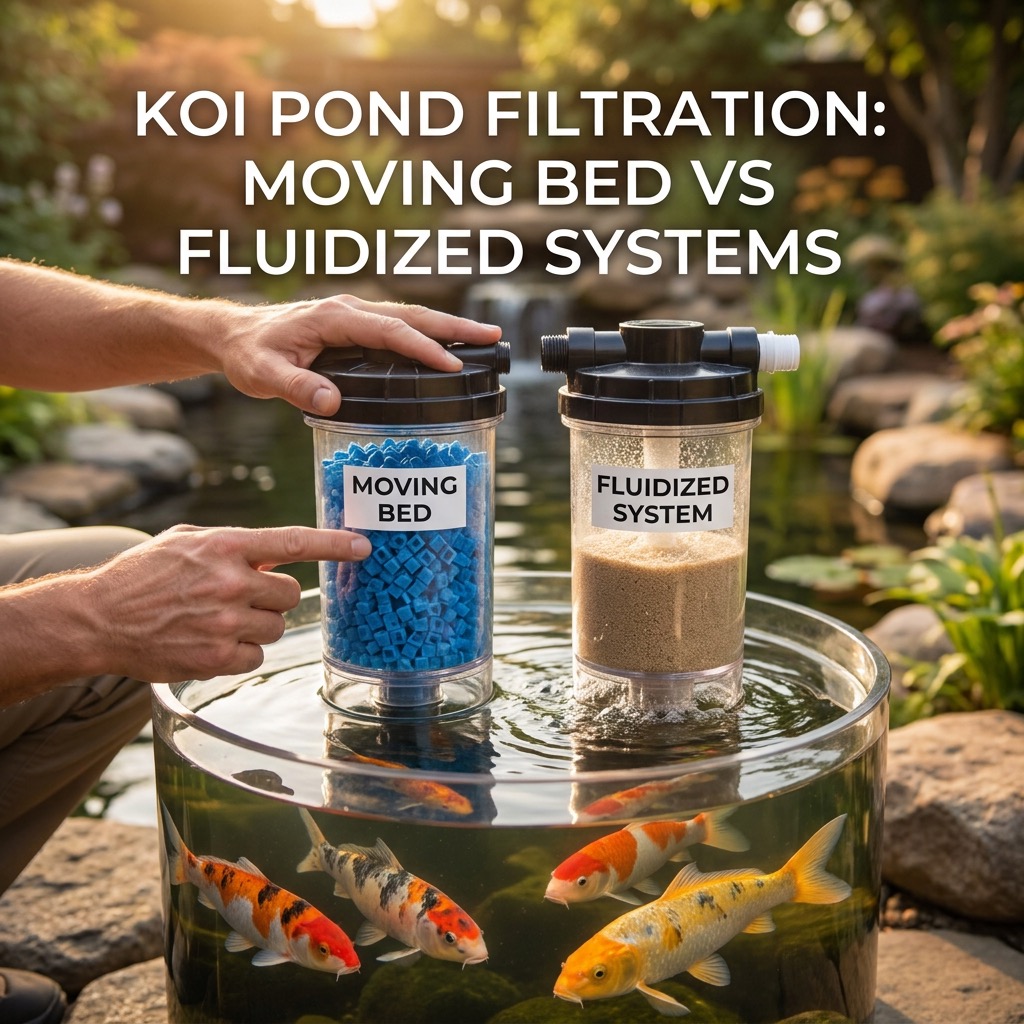
Koi pond filtration: moving bed vs fluidized bed
Walk into any modern koi filtration equipment room and you'll see one of two setups: a bank of moving bed filters (MBBR — moving bed biofilm reactor) or a tall fluidized bed filter tower. They look completely different and they work through different mechanisms. Picking the wrong one for your pond's volume and stocking density is the most common long-term mistake I see in hobbyist koi setups.
The problem both are solving
Koi produce ammonia through their gills and waste. Ammonia at 0.02 mg/L is enough to damage koi gills chronically. The job of biological filtration is to host the bacteria that convert:
$$\text{NH}_3 \text{ (ammonia)} \rightarrow \text{NO}_2^- \text{ (nitrite)} \rightarrow \text{NO}_3^- \text{ (nitrate)}$$
The conversion rate depends on surface area for bacteria to colonise. Both moving bed and fluidized bed systems maximise surface area — they just do it differently.
Moving bed filters (MBBR)
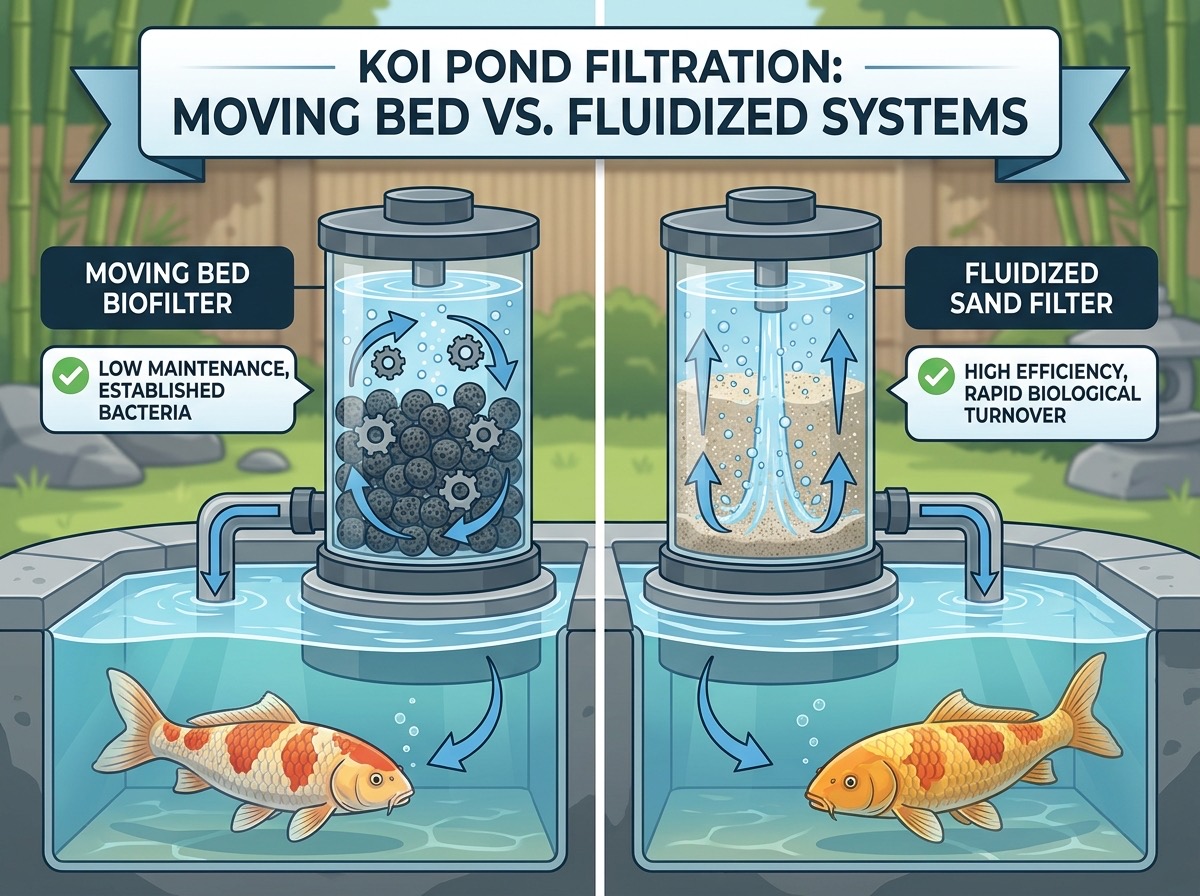
A moving bed filter is a chamber filled with small plastic media (typically K1, K3, or Hel-X) suspended in water by air from an air pump or by flow. The media tumble constantly, which:
- prevents channeling (water finding a single path through)
- exposes all surfaces to oxygen and ammonia
- self-cleans — dead biofilm sloughs off
Pros
- Tolerates variable flow — if your pump output drops, the filter still works
- Easy to expand — add more media for higher stocking
- Cheap media replacement
- Excellent for high stocking densities (5+ kg of koi per 1,000 L)
Cons
- Requires an air pump running 24/7 (power dependency)
- Air pumps are noisy if not properly insulated
- Media can clog if not rinsed periodically (every 6–12 months)
Fluidized bed filters
A fluidized bed filter is a tall, narrow chamber filled with fine sand or plastic beads. Water is pumped UP through the bed at a precise flow rate, lifting the media into a "fluidized" suspended state. The bacteria colonise the immense surface area of the fine media.
Pros
- Very high surface area in a small footprint — best for space-limited installations
- No air pump needed (water pump does the work)
- Quiet operation
Cons
- Very flow-sensitive — if flow drops, the bed collapses and partially dies
- Cannot tolerate variable stocking — sized for a specific load
- Bed replacement every 5–7 years (sand degrades)
- Pump failure = filter failure within hours
Side-by-side comparison
| Parameter | Moving bed (MBBR) | Fluidized bed |
|---|---|---|
| Surface area per m³ | 800–1,200 m² | 2,000–3,000 m² |
| Stocking tolerance | High (overstock OK briefly) | Low (sized to load) |
| Power dependency | Air pump + water pump | Water pump only |
| Noise | Moderate (air pump) | Low |
| Maintenance | Annual media rinse | Annual pump service, 5–7 yr media change |
| Failure mode | Slow, recoverable | Fast, catastrophic |
| Best for | Variable loads, hobbyist ponds | Stable loads, technical installations |
Which one your pond actually needs
Choose moving bed if:
- your stocking varies seasonally (spring/fall additions)
- you want forgiving, low-tech operation
- you are at hobbyist level with 1,000–10,000 L pond
- you have reliable power for the air pump
Choose fluidized bed if:
- you have a stable, well-planned stocking density
- space is tight
- you want quiet operation (e.g., pond near living area)
- you have a backup power plan (battery on the pump) — critical
In my own koi room I run both: a fluidized bed as the primary bio-filter for quiet operation, plus a moving bed as a safety net for variable load (when I add new fish or when summer feeding peaks). This is over-engineered for most hobbyists but it shows the systems are complementary, not competitors.
Practical sizing
A rough rule of thumb:
- Moving bed: 1 L of media per 50 L of pond volume minimum; double for high stocking
- Fluidized bed: sized by manufacturer curves; typically 5–10% of pond volume in the bed itself
For a 5,000 L koi pond with 8 koi at ~3 kg each (24 kg total), a 100 L moving bed is the minimum, comfortable sizing is 200 L.
Common mistakes
- Using only a fluidized bed without backup power — one power outage and you can lose the bed in 6–12 hours
- Using only a moving bed without pre-filter — solids clog the media within months; always run a mechanical pre-filter (settlement chamber or vortex) before the bio-filter
- Over-sizing the bio-filter relative to the pump — water needs to contact the bacteria long enough. Too much flow = water passes through before conversion completes.
Bottom line
For most hobbyist koi keepers, a moving bed filter is the more forgiving choice. A fluidized bed gives you quieter operation and smaller footprint, but it punishes mistakes quickly. If in doubt, go moving bed — it is harder to kill, and "harder to kill" is the property you want in a filter that has to run for 15+ years without intervention.
---
About the author: [Kenji Tanaka](../Kenji%20Tanaka.md) is a ZNA-certified koi judge with 25 years of freshwater ornamental fish research. He has served on the judging panel of the All Japan Nishikigoi Show on multiple occasions.