

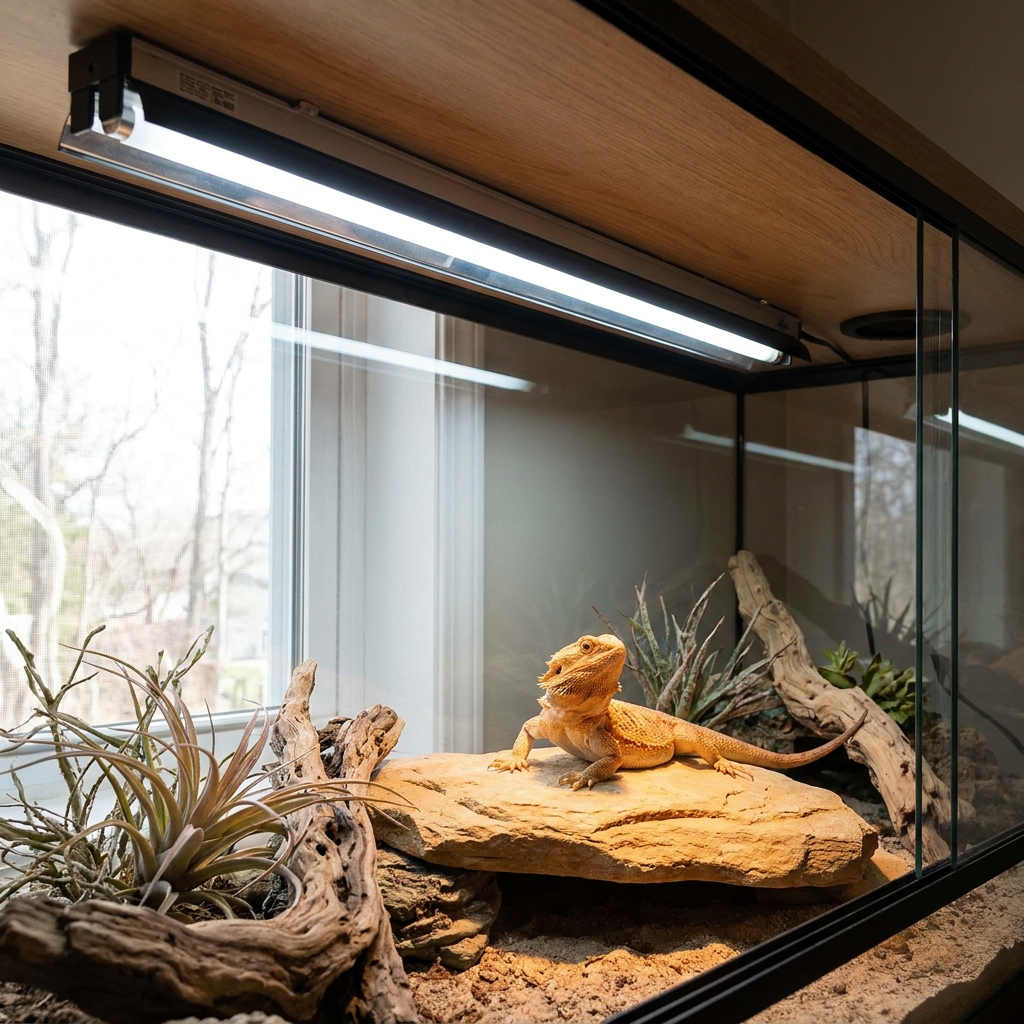
UVB bulb types: fluorescent vs mercury vapor vs LED
Walk into any reptile section and you will see three broad families of bulb labelled "UVB": slim fluorescent tubes in a 2–5 % or 10–14 % strength, large screw-in mercury vapor bulbs, and increasingly the new hybrid LED-UVB bars. They look interchangeable on the shelf. They are not. They deliver different wavelengths, different coverage patterns, different output curves over their lifespan, and they fail in different ways — sometimes while still glowing a normal-looking white.
The right choice depends on three things: the species' Ferguson Zone, the enclosure height and ventilation, and whether the bulb is the primary heat source or secondary to a separate basking lamp. This guide sorts the three families against those variables, with the brand and model numbers I actually install.
**Quick rule**: diurnal baskers from open habitats (bearded dragons, uromastyx, Horsfield tortoises) → **T5 HO 12 % or mercury vapor**. Crepuscular or forest-edge species (crested geckos, leachianus, panther chameleons in screened setups) → **T5 HO 5–6 % or Arcadia ShadeDweller**. Nocturnal snakes and leopard geckos → **low-output T5 HO 2–5 % or no UVB at all, full dietary D3**. The brand matters less than the zone, the distance, and the verified output with a Solarmeter 6.5.
Why "a UVB bulb" is not a thing
Reptile UVB is graded against the Ferguson Zone system, which links a species' wild behaviour to a target UVI (UV Index) range at the basking surface. The zones are:
- Zone 1 (UVI 0.0–1.0) — crepuscular and shade-dwelling species: leopard geckos, crested geckos, forest geckos, some chameleons. Full shade or occasional sunbeam.
- Zone 2 (UVI 1.0–3.0) — partial sun / filtered sun: ball pythons (debated), corn snakes, blue-tongued skinks in woodland, panther chameleons.
- Zone 3 (UVI 3.0–6.0) — open or partial sun baskers: bearded dragons, uromastyx, Horsfield and Hermann's tortoises, frilled lizards.
- Zone 4 (UVI 4.0–9.0) — open desert full-sun baskers: some monitor species in true arid habitat.
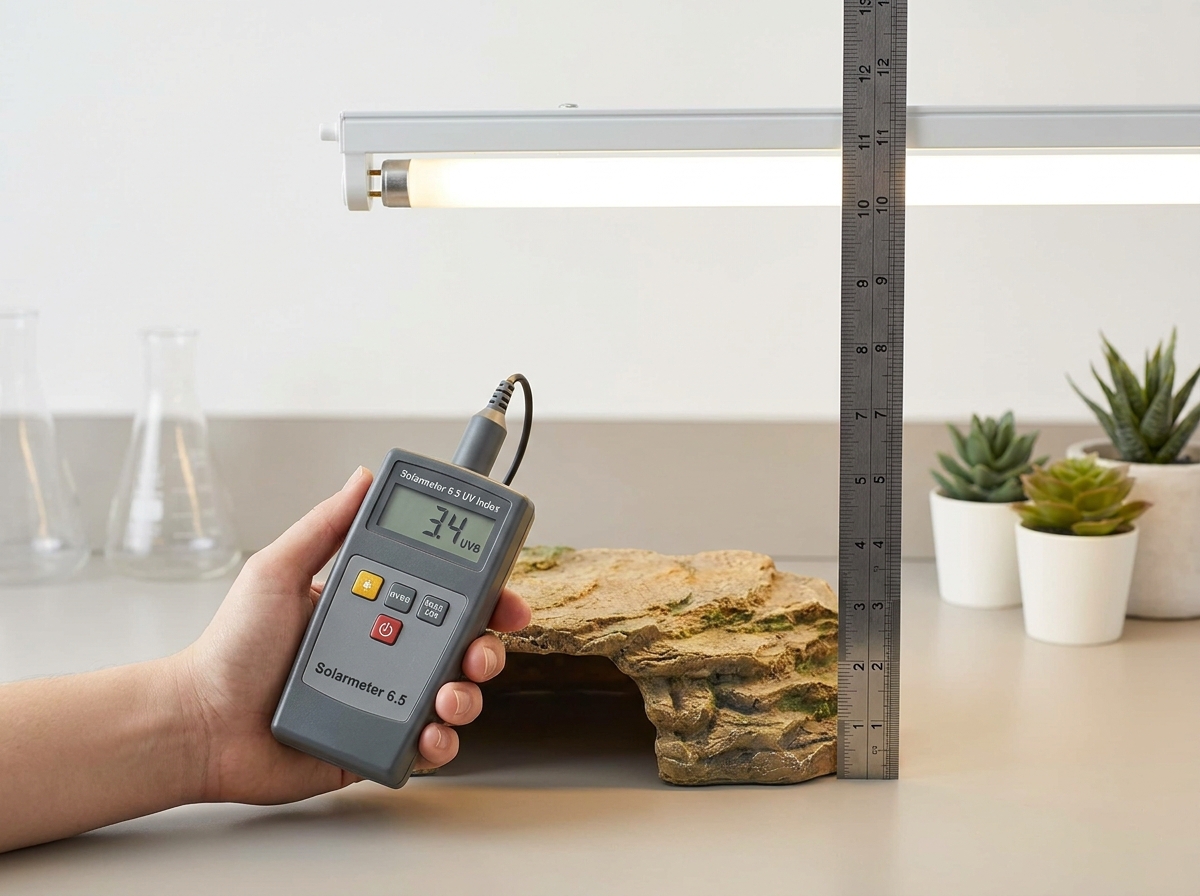
The bulb's job is to deliver a target UVI at the basking surface, not at the bulb, and not in mid-air. A bulb that emits 12 % UVB at the tube surface is delivering maybe UVI 1.0 at 45 cm and UVI 4.5 at 25 cm. Without a Solarmeter 6.5 ($170–220), you are guessing. I have tested client setups with brand-new "Zone 3" tubes mounted 50 cm above the basking spot that delivered UVI 0.6 at the surface. The bearded dragon was receiving Zone 1. Two years later: metabolic bone disease.
The take-home is that the type of bulb is downstream of the zone and the geometry. The wrong zone on a T5 HO is the same problem as the wrong zone on a mercury vapor.
Fluorescent T5 HO tubes: the default workhorse
The T5 HO (high-output, 5/8-inch diameter) tube is the most-installed UVB source in modern reptile keeping for good reason: high output, even coverage, predictable decay, low heat, and a wide range of zone-rated strengths.
What you actually buy:
- Arcadia T5 6 % Forest (24 W for 60 cm / 39 W for 90 cm / 54 W for 120 cm) — Zone 1–2. Forest-edge and partial-sun species.
- Arcadia T5 12 % Dragon (39 W for 90 cm / 54 W for 120 cm) — Zone 3. The strongest true desert-zone tube on the consumer market. My default for bearded dragons, uromastyx, and arid tortoises.
- Arcadia T5 14 % Dragon — slightly higher output than the 12 %, same 12-month lifespan, useful in very tall enclosures (90+ cm) where the tube has to throw further.
- Arcadia ShadeDweller 7 % (18 W for 55 cm) — Zone 1. For leopard geckos, crested geckos, and other crepuscular species.
- Zoo Med ReptiSun 5.0 T5 HO — Zone 1–2. Acceptable alternative; output is roughly 70–80 % of the Arcadia 6 % at the same distance.
- Zoo Med ReptiSun 10.0 T5 HO — Zone 2–3. The long-standing 10.0 sits between Arcadia's 6 % and 12 % in real output.
- Avoid T8 tubes unless you have a legacy fixture — output is 50–60 % of a T5 HO at the same distance, and most T8 fixtures are too long for modern 60 cm enclosures.
- Avoid compact fluorescent coil UVB bulbs — narrow cone, severe UVI drop-off 15 cm from the coil, associated with photo-kerato-conjunctivitis and dysecdysis in chameleons. The technology has not aged well.
Mounting geometry for a Zone 3 bearded dragon in a 60 cm tall PVC enclosure:
- Arcadia T5 12 % 54 W tube, mounted inside the enclosure on the ceiling.
- Reflector: the Arcadia or Zoo Med branded reflector (without it, output drops by 30 %).
- Distance from tube face to basking surface: 25–35 cm. This delivers UVI 4.0–6.0.
- Never mount the tube on top of a fine aluminium screen. Fine mesh blocks 35–50 % of UVB. Mount inside, or use a wide-bar mesh that blocks <20 %.
Lifespan and replacement:
T5 HO tubes drop to ~60 % of new output by month 12 while still glowing a normal-looking white. Mark the install date on the tube end with a permanent marker and replace every 12 months on the dot for a Zone 3 species. Zone 1–2 species on a 6 % tube can stretch to 14–15 months. Verify with a Solarmeter 6.5 if you are extending the cycle.
Cost:
- Arcadia T5 12 % 54 W tube: ~$45–55.
- Branded reflector: ~$25.
- Replacement cycle: 1 per year for a single adult dragon.
- 10-year cost: ~$800. Compare that to a single vet visit for early MBD ($300–600) and the bulb pays for itself.
Mercury vapor bulbs: UVB and heat in one
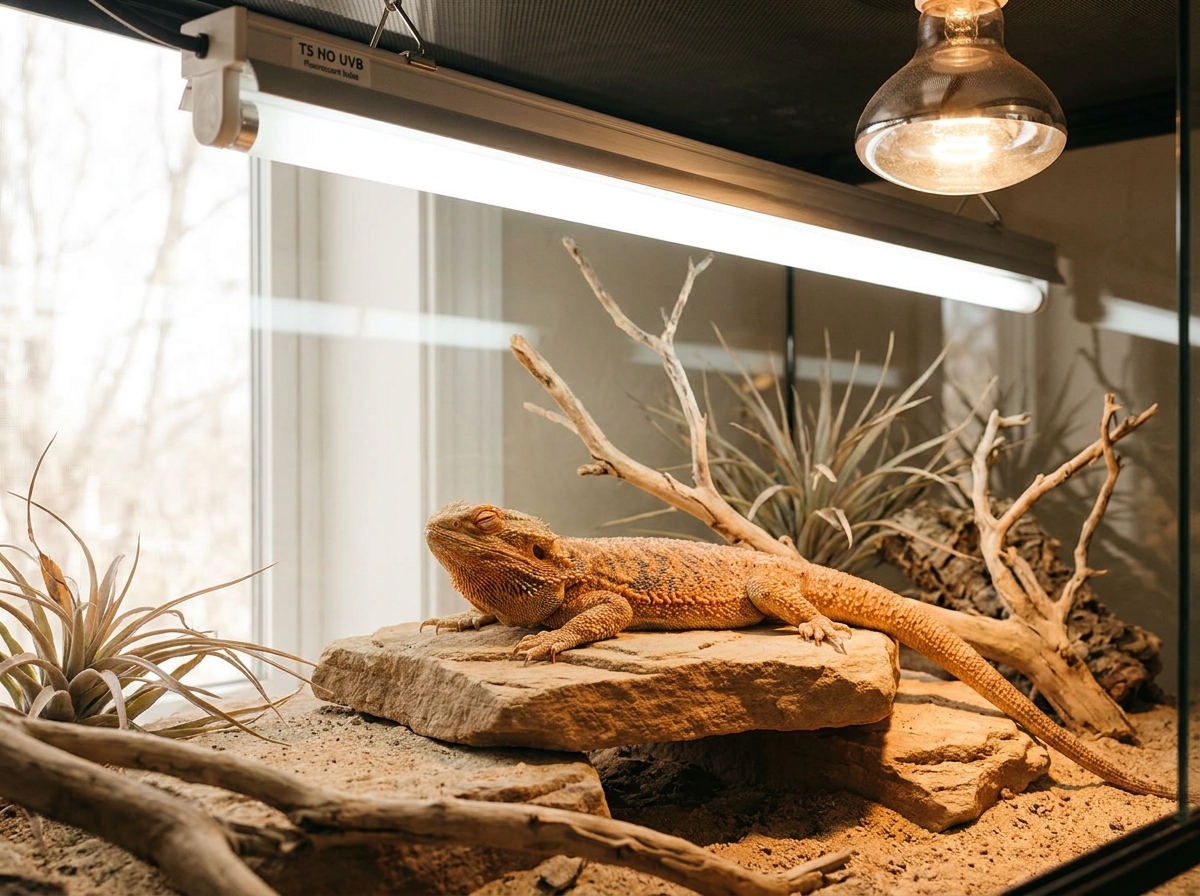
A mercury vapor bulb (MVB) is a high-intensity discharge lamp that delivers UVB, UVA, and a large amount of infrared from a single point source. Two products dominate the market:
- Arcadia 160 W D3 Basking Solar Flood — combined UVB and basking heat.
- Zoo Med Powersun 160 W — the long-standing MVB, available in 100 W and 160 W.
Where MVBs work well:
- Large enclosures (150 × 60 × 60 cm and up) where a single point source can cover a wide basking zone.
- Owners who want a single-bulb solution for a large, open-habitat species.
- Setups where a separate UVB tube is not feasible (for example, a custom wooden enclosure without a ceiling fixture).
Where MVBs are the wrong choice:
- Small enclosures under 100 cm tall — the bulb has to be far enough away to avoid burns, which puts the basking surface at UVI 1.0 or below.
- Multi-animal enclosures — the UVB cone is narrow (15–20° useful output) and uneven.
- Owners unwilling to replace the bulb every 6–9 months. MVBs decay faster than T5 tubes and have a higher burn-out failure rate.
Mounting and safety:
- Use a porcelain socket rated for the wattage. A plastic socket on a 160 W MVB will eventually melt.
- Mount the bulb at the manufacturer-recommended distance (typically 30–40 cm from the basking surface for a 160 W) and confirm with a Solarmeter.
- A wire-cage guard around the bulb is mandatory. MVBs run surface-hot and will burn any reptile that climbs onto the fixture.
- Replace every 6–9 months. A 12-month-old MVB can have the visible output unchanged but the UVB output down to 20 % of new.
Cost: $35–55 per bulb, replaced twice a year. 10-year cost: $700–1,100. Comparable to a T5 setup once you factor in ballast life.
The new wave: LED-UVB hybrid fixtures
The newest category — and the one with the most marketing confusion — is the LED bar with integrated UVB, exemplified by the Arcadia JungleDawn-LED + UV, the Reptile Systems Zone 3 LED-UV, and a handful of Chinese OEM fixtures appearing on Amazon and AliExpress under various brand names.
These fixtures use separate LED chips for visible light and a slim T5-style UVB element in the same housing. The appeal is one fixture doing the work of three (LED + UVB + UVA), with cleaner cable management and a single timer.
Honest assessment as of mid-2026:
- Output: the reputable branded units (Arcadia, Reptile Systems) deliver real Zone 2–3 UVB at 25–30 cm. Generic OEM units often have no measured UVB output at all — the "UVB" element is sometimes a 395 nm near-UV violet chip, not UVB. If the spec sheet does not list a UVI or 290–315 nm output, do not buy it.
- Coverage: better than a fluorescent tube, narrower than a mercury vapor. The LED array lights the entire enclosure while the UVB element covers the basking zone.
- Lifespan: the LED chips run 25,000+ hours. The UVB element follows T5 HO decay curves — 12-month replacement for the UVB module, regardless of how bright the LEDs still look.
- Cost: $200–400 for a 90–120 cm Arcadia or Reptile Systems unit. Higher upfront, lower ongoing cost.
Where I currently use LED-UVB hybrids:
- Tall bioactive enclosures where a single ceiling fixture is preferred.
- Planted vivaria where the LED light supports live plants and the reptile.
- Owners upgrading from T8 or compact fluorescent who want one fixture for the next decade.
Where I still use a separate T5 tube and LED:
- Anything where I want independent control of the photoperiod. A combined unit ties UVB to LED; if you want 14 hours of plant-friendly light and 12 hours of UVB during summer, you need two fixtures.

Choosing the right bulb for the species
A practical lookup, ordered by the species I most often see mis-lit:
- Bearded dragon (Pogona vitticeps) — Zone 3, 120 × 60 × 60 cm enclosure, basking surface 40–42 °C, 30–40 % day humidity climbing to 50–60 % at night. Best: Arcadia T5 12 % Dragon 54 W inside the enclosure, 25–35 cm from basking surface. Alternative: Zoo Med Powersun 160 W MVB at 35 cm, Solarmeter-verified. Worst: 5.0 tube on a mesh top, or 10.0 tube on fine mesh at 50 cm.
- Leopard gecko (Eublepharis macularius) — Zone 1, 90 × 45 × 30 cm, warm end 32 °C, cool end 22 °C, 30–40 % humidity with a humid hide. Best: Arcadia ShadeDweller 7 % 18 W inside, 15–20 cm from the warm-end surface. Alternative: no UVB at all with calcium + D3 at every feed (Repashy CalciumPlus). Worst: 10.0 tube — overshoots Zone 1 by 3–5×, drives the gecko into a hide.
- Crested gecko (Correlophus ciliatus) — Zone 1, 45 × 45 × 60 cm bioactive, 22–26 °C, 60–80 % humidity. Best: Arcadia ShadeDweller 7 % at 15–20 cm above upper perches, or a new LED-UVB hybrid in a planted vivarium. Worst: 12 % or 10.0 tube — overshoots the zone and overheats the canopy.
- Hermann's or Russian tortoise (Testudo hermanni / Agrionemys horsfieldii) — Zone 3, 150 × 60 × 60 cm indoor enclosure or 2 × 1 m tortoise table, basking 35–38 °C, ambient 24–28 °C, 30–50 % humidity. Best: Arcadia T5 12 % Dragon 54 W for the full length of the enclosure plus a separate halogen flood. Alternative: Arcadia 160 W D3 MVB. Worst: a single coiled UVB bulb, or a T8 10.0 on a 60 cm fixture over a 2 m table.
- Ball python (Python regius) — Zone 1–2, 120 × 60 × 60 cm PVC, ambient 27–29 °C, basking 32–34 °C, 60–70 % humidity. Best: Arcadia T5 6 % Forest or ShadeDweller 7 % at 25–30 cm. Alternative: no UVB with calcium + D3 at every feed. Worst: 10.0 or 12 % tube — the python hides from it and feeds less, with no metabolic upside.
The two rules that prevent 90 % of UVB failures
Across the roughly 1,200 reptile setups I have audited in the last decade, the same two errors cause almost every chronic UVB-related disease case I see:
Rule 1: verify with a Solarmeter 6.5, not with the bulb label. A 12 % Arcadia at 60 cm in a tall enclosure is a 6 % bulb in practice. A brand-new 5.0 tube with a damaged reflector can be a 1 % tube. Spend $200 on a meter. Verify every new install. Re-verify every 6 months. The cost is less than a single emergency vet visit and the data drives every other decision in the enclosure.
Rule 2: replace on schedule, not on appearance. T5 HO tubes every 12 months, MVBs every 6–9 months, LED-UVB UVB modules every 12 months. Mark the install date on the bulb end with a permanent marker. The reptile cannot tell you the UVB is at 40 % of new — it just shows up in two years with a soft jaw and tremors.
Get those two right and the choice between T5 HO, mercury vapor, and LED-UVB becomes a question of enclosure geometry and budget, not animal welfare. Choose the wrong family and no amount of replacement will save the animal from the wrong zone.
**Final pairing**: pick the family that matches your enclosure and budget, set the distance to hit the correct UVI for the species' Ferguson Zone, verify with a Solarmeter 6.5, replace on schedule, and dust insects with plain calcium at most feedings (calcium + D3 once a week for adults of diurnal species under verified UVB; every feeding for nocturnal species without UVB). The bulb is one third of the calcium-and-D3 system. The other two thirds are diet and the Solarmeter-confirmed output at the basking surface.