

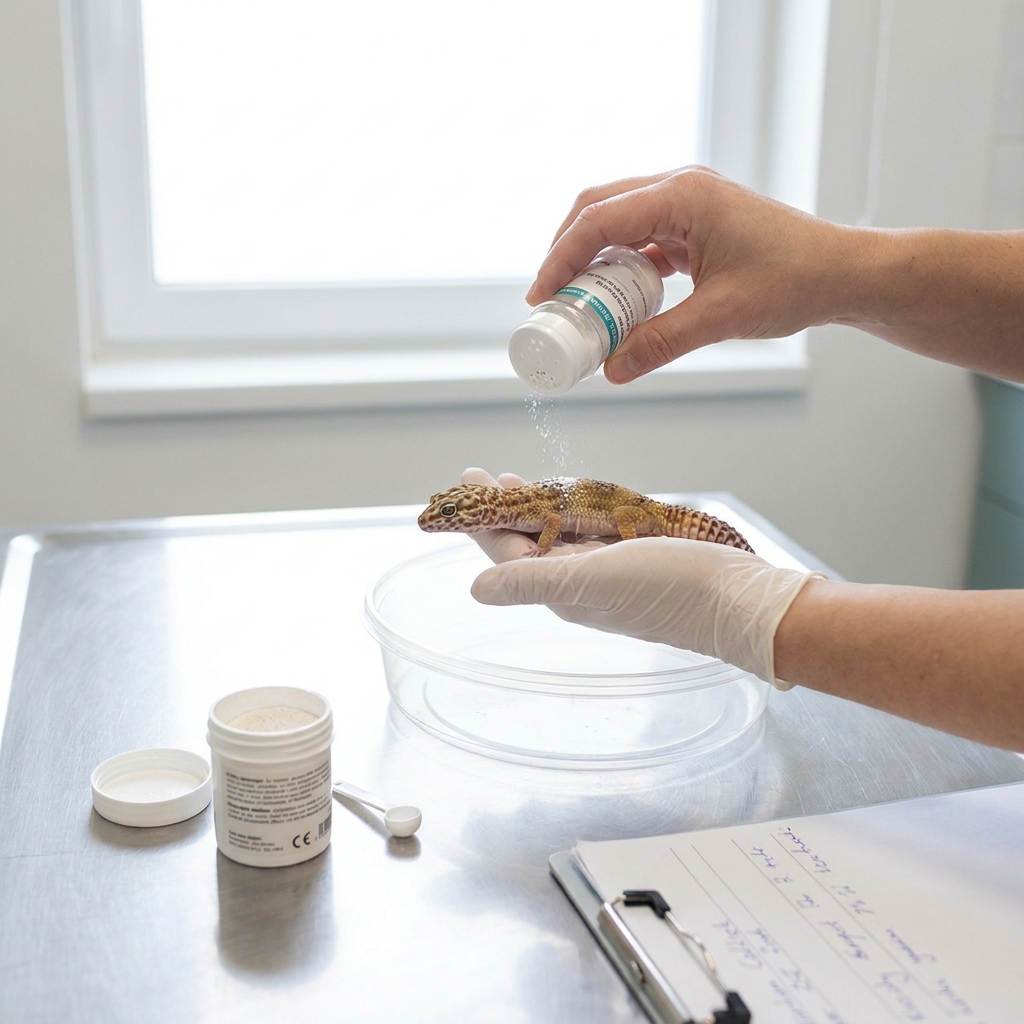
Calcium and vitamin D3: the right pairing for reptiles
The most common single error in reptile supplementation is treating calcium and vitamin D3 as independent knobs. A keeper dusts insects with calcium three times a week, sprinkles a multivitamin once a week, runs a UVB tube, and assumes the box is ticked. Then a juvenile bearded dragon presents at nine months with a soft jaw, a curved spine, and tremors on handling — full metabolic bone disease (MBD) — and the owner is confused, because they were "doing everything right."
The reason is that calcium and D3 are a coupled system, not a checklist. Calcium absorption in the small intestine requires 1,25-dihydroxyvitamin D3, the active form of cholecalciferol. Without enough D3, dietary calcium passes through the gut largely unabsorbed, the blood-ionised calcium drops, the parathyroid hormone rises, and bone is resorbed to keep the serum level up. That is MBD. It is a calcium availability problem, not (usually) a calcium intake problem.
**Pairing rule**: every reptile needs three coordinated inputs — dietary calcium in a usable form, vitamin D3 either from a dietary source or from cutaneous synthesis under UVB, and a calcium-to-phosphorus ratio above 1.5:1 in the total diet. Skewing any one of the three breaks the system.
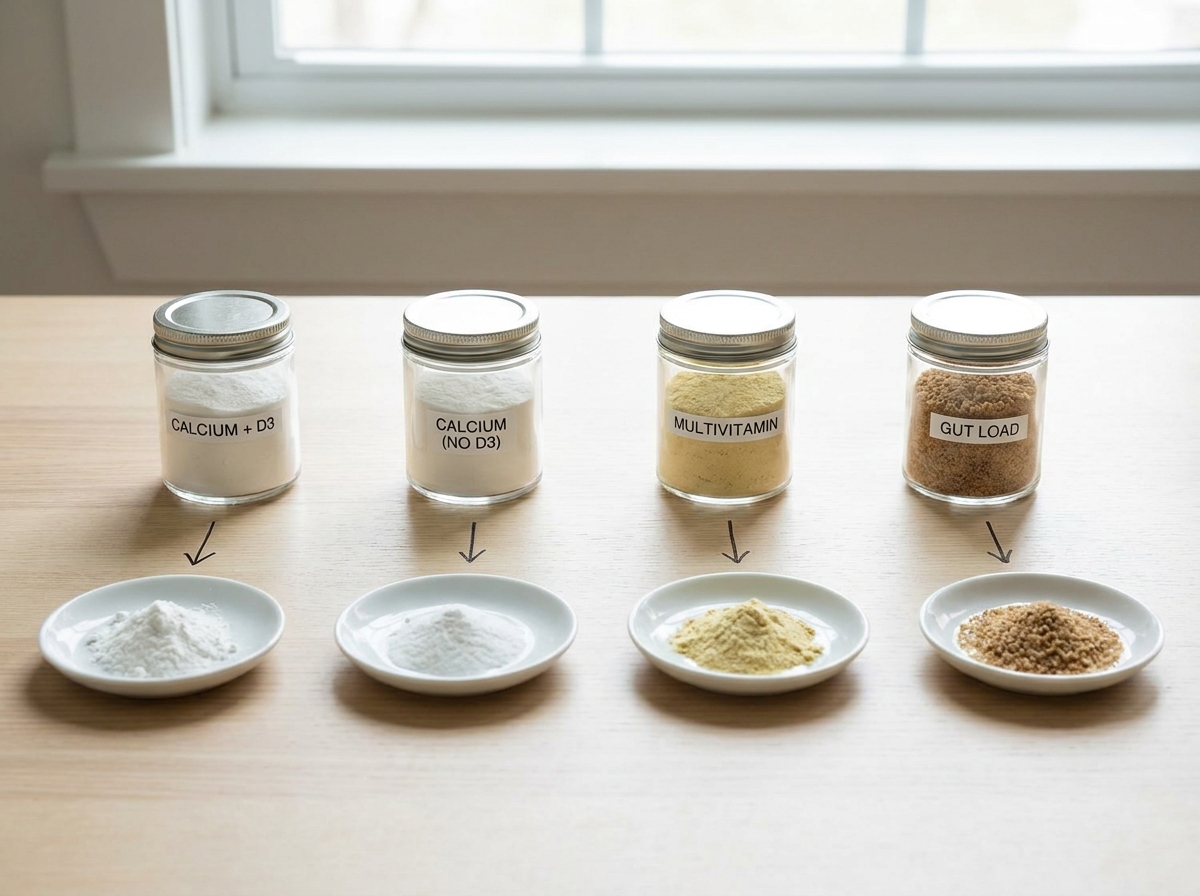
The two D3 pathways: dietary versus UVB-driven
Reptiles obtain vitamin D3 through one of two routes, and the route determines how you supplement.
Dietary D3 (cholecalciferol in powder form). Absorbed in the small intestine, stored in the liver and fat, and converted to the active form in the kidney. Useful for nocturnal species that do not bask under meaningful UVB (leopard geckos, crested geckos, ball pythons, most snakes), and as a partial supplement for diurnal species when UVB is not yet verified with a Solarmeter 6.5. The downside: dietary D3 is fat-soluble and accumulates. Chronic oversupplementation causes hypervitaminosis D — soft-tissue mineralisation, particularly in the great vessels, kidney, and gastric mucosa. I see this roughly twice a year in leopard geckos fed calcium-with-D3 at every feed for years.
UVB-driven cutaneous synthesis. 7-dehydrocholesterol in the skin converts to previtamin D3 when struck by UVB in the 290–315 nm range, then isomerises to cholecalciferol. The body regulates this conversion: prolonged UVB exposure produces inert photoproducts rather than toxic D3, so synthesis-driven D3 is self-limiting. This is the gold-standard route for diurnal basking species (bearded dragons, tortoises, blue-tongued skinks, uromastyx) and the route that should be the primary source for any animal housed with a working UVB system.
The two routes are not equivalent. A diurnal basking species kept under correct UVB at Ferguson Zone 2–3 needs only a maintenance dose of dietary D3, or none at all, depending on the species. A nocturnal gecko with no UVB needs all of its D3 from diet. The supplementation schedule is built on this distinction, not on a generic "twice a week" rule.
Choosing the right calcium powder
Calcium powders are not interchangeable. Three things matter: the calcium salt, the inclusion of D3, and the inclusion of other vitamins and minerals.
- Calcium carbonate — highest elemental calcium (40 % Ca by weight), slow-release, neutral pH. The workhorse of reptile supplementation. Plain calcium carbonate should be the default dust used at most feedings.
- Calcium gluconate — lower elemental calcium (9 %), more water-soluble, useful in sick or dehydrated animals. Overkill for routine use.
- Calcium citrate — 21 % Ca, well absorbed, often marketed as "more bioavailable." Marginal benefit over carbonate for most reptiles at typical doses.
- Avoid calcium lactate for routine use — very low Ca content (13 %), expensive per gram of calcium delivered.
The D3 question is where most keepers go wrong. Reputable products:
- Plain calcium (no D3) — Zoo Med Repti Calcium without D3, Arcadia EarthPro CalciumPro Mg, Repashy SuperCal NoD. Used at most insect feedings for diurnal species under verified UVB.
- Calcium with D3 — Zoo Med Repti Calcium with D3, Repashy CalciumPlus, Arcadia EarthPro CalciumPro Mg + D3. Used at one feeding per week for adults of diurnal species, and at every feeding for nocturnal species without UVB.
- All-in-one multivitamin — Repashy CalciumPlus (calcium + D3 + multivitamin in one), Arcadia EarthPro-A (multivitamin without D3, paired with a separate D3 product), Zoo Med Reptivite with or without D3. All-in-ones simplify schedules but reduce fine control. Acceptable for beginners; I prefer separate products for animals with a known issue.
A practical schedule for a leopard gecko (no UVB, nocturnal): dust every feed with calcium + D3 (Repashy CalciumPlus or plain calcium + a D3 rotation), one feed per week with a multivitamin-only dust, gut-load insects 24 h prior with Repashy Bug Burger or Arcadia InsectFuel.
For a bearded dragon under correct UVB: dust most insect feeds with plain calcium, one feed per week with calcium + D3, one feed per week with a multivitamin, gut-load with the same diets.
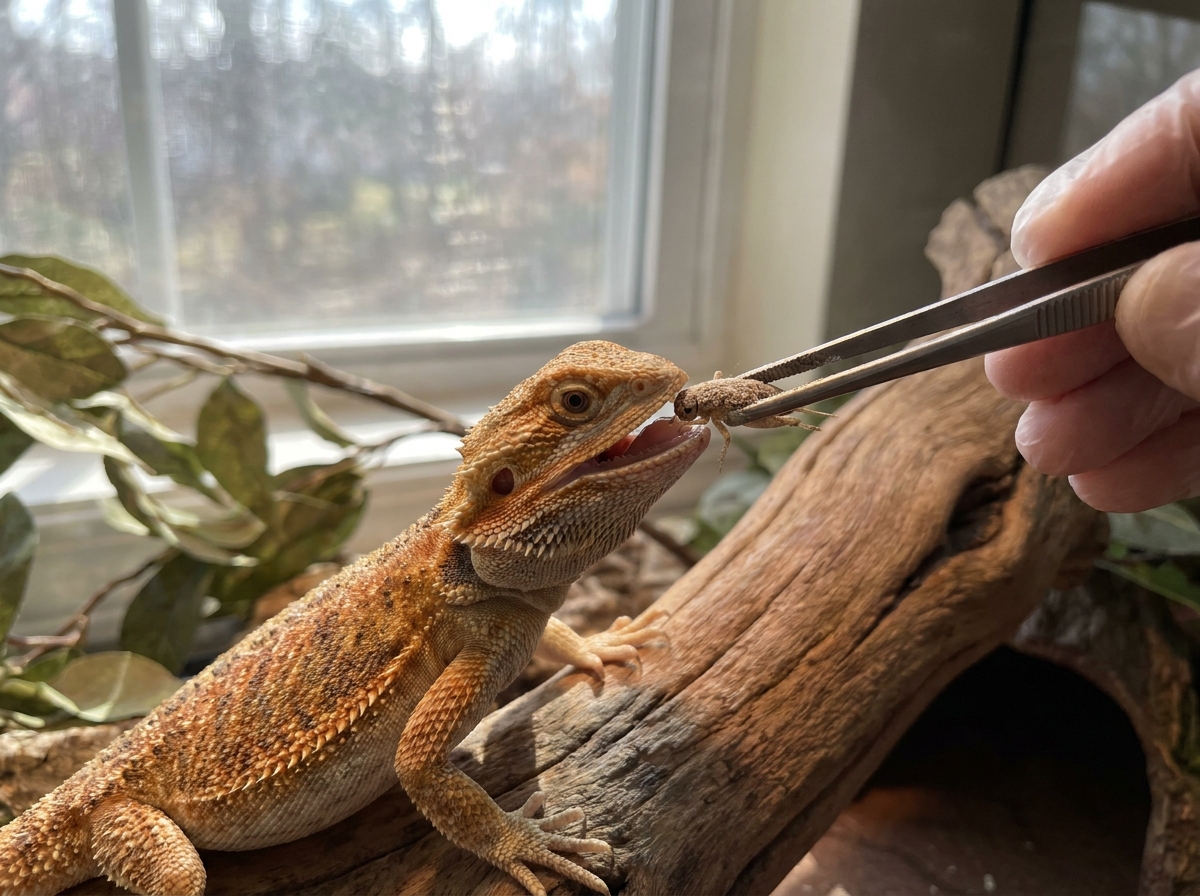
Ca:P ratio — the silent partner
Calcium-to-phosphorus ratio is the third input the system needs, and the one most keepers never measure. Vitamin D3 controls how much calcium is absorbed, but phosphorus binds calcium in the gut into insoluble calcium phosphate. If the total diet has more phosphorus than calcium, no amount of dusting will fix it — the calcium supplement binds to the dietary phosphorus and is excreted.
The rule:
- Total diet Ca:P above 1.5:1, ideally 2:1. Higher is fine; lower is the problem.
- High-phosphorus foods to limit: insects (especially mealworms and waxworms, Ca:P around 0.3:1 by dry weight even after dusting), bananas, grapes, lean muscle meat. Dusting shifts the ratio of the insect but not the total meal if the salad or other feeders are also low.
- High-calcium foods to favour: collard, mustard, turnip, and dandelion greens (Ca:P 3:1 to 5:1), squashes, figs, papaya, calcium-fortified whole prey (most feeder rodents are Ca:P around 1.4:1 unfed; gut-loaded or pre-killed with calcium-enhanced diets are better).
The practical effect: a leopard gecko fed only mealworms and dusted with calcium is still calcium-deficient. The mealworm chitin and inherent phosphorus load overwhelms the dusting at typical application rates (a 2019 Journal of Herpetological Medicine and Surgery study found standard "shake-and-bake" dusting adds roughly 15–25 mg of calcium per gram of insect — useful but not a free pass). Crickets and dubia roaches have a better starting Ca:P than mealworms; silkworms and black soldier fly larvae are the best of the common feeders at 1.5:1 to 2:1 unfed.
UVB half of the pairing — making sure D3 is actually being made
A calcium schedule built on UVB-driven D3 synthesis assumes the UVB is delivering. Three failure modes I see in practice:
- Tube mounted outside fine mesh. A standard aluminium screen top blocks 35–50 % of UVB. The dragon sits under a "UVB" lamp that is delivering Ferguson Zone 1 (UVI 1.0–2.0) at the basking surface. Solution: mount the T5 HO tube *inside* the enclosure, or replace fine mesh with a wide-arc hardware-cloth top.
- Wrong tube strength. A 5.0 / 6.5 tube is fine for a crested gecko at 30 cm; it is insufficient for a bearded dragon at 30 cm. For diurnal Zone 3 species I run Arcadia T5 12 % Dragon (or 14 % in tall enclosures), Zoo Med ReptiSun T5 HO 10.0, or Arcana T5 12 % Desert. Tube length matched to enclosure: 39 W for 90 cm enclosures, 54 W for 120 cm.
- Old tube still in use. T5 HO UVB output drops to roughly 60 % of new at 12 months, before the visible spectrum shows any change. Mark the install date on the tube end with a permanent marker; replace at 12 months. A Solarmeter 6.5 confirms the actual UVI at the basking surface; for a bearded dragon I want 4.0–6.0 there.
The pairing rule in action: a bearded dragon under a 12-month-old T5 tube at UVI 2.5 should be moved to dietary D3 at every insect feed until the UVB is corrected, then back to once weekly. A leopard gecko with no UVB at all stays on dietary D3 at every feed permanently.
Species-specific schedules at a glance
| Species | UVB | Plain Ca | Ca + D3 | Multivitamin |
|---|---|---|---|---|
| Bearded dragon (adult) | T5 HO 12 %, Zone 3 | most feeds | once / week | once / week |
| Bearded dragon (juvenile) | T5 HO 12 %, Zone 3 | most feeds | twice / week | once / week |
| Leopard gecko (no UVB) | none / ShadeDweller 7 % | — | every feed | once / week |
| Crested gecko (Pangea / Repashy) | none / ShadeDweller 7 % | — | (in diet) | (in diet) |
| Ball python (whole prey) | none | — | rare / none | once / month |
| Hermann's / Russian tortoise | T5 HO 12 %, Zone 3 | daily (cuttlefish) | twice / month | twice / month |
| Blue-tongued skink (mixed diet) | T5 HO 12 %, Zone 3 | 2–3× / week | once / week | once / week |
| Chameleon (Veiled, Panther) | T5 HO 6 %, Zone 3 | most feeds | once / week | once / week |
Pangea and Repashy complete crested-gecko diets already contain calcium, D3, and a multivitamin at the correct ratio. Do not dust on top — it is the most common crested-gecko oversupplementation error I see.
When things go wrong: MBD and hypervitaminosis D
Metabolic bone disease is the system running below par for months. Early signs: softened mandible and maxilla, reluctance to open the mouth wide, slight curvature of the spine, fine tremors in the toes after handling. Late signs: fibrous osteodystrophy, pathological fractures of long bones, prolapsed cloaca from pelvic deformity, seizures from hypocalcaemia. Treatment: calcium glubionate orally (50–100 mg/kg elemental calcium per day), calcitonin in severe cases, full husbandry audit, UVB correction. Early cases recover well; late cases carry lifelong deformity.
Hypervitaminosis D is the opposite failure: too much dietary D3, almost always from chronic every-feeding calcium-with-D3 in a nocturnal species. Signs: lethargy, weight loss, polyuria, soft-tissue mineralisation on radiograph as vascular and renal calcification. Bloodwork shows hypercalcaemia. Treatment: stop all D3, switch to plain calcium, supportive fluids, dietary calcium held at 1.5–2× maintenance while serum Ca normalises. Prevention beats treatment — follow the species schedule and do not dust "just in case."
The bottom line
Calcium and D3 are one coupled system, not two products. Get the UVB right for diurnal species, use plain calcium carbonate for most feedings, respect the Ca:P ratio of the total diet — not just the dusting — and follow a species-specific schedule. The bearded dragon stops trembling, the leopard gecko keeps its jaw, the crested gecko thrives on its complete diet without being dusted into hypervitaminosis. That is the pairing.
---
About the author: [Amelia Sterling](../Amelia%20Sterling.md) is an MSc in Reptile Medicine from the Royal Veterinary College, London, with 14 years of reptile practice. She has served as visiting veterinarian at the London Zoo reptile house.