
Hermann's and Russian tortoise indoor husbandry: the Mediterranean setup keepers get wrong
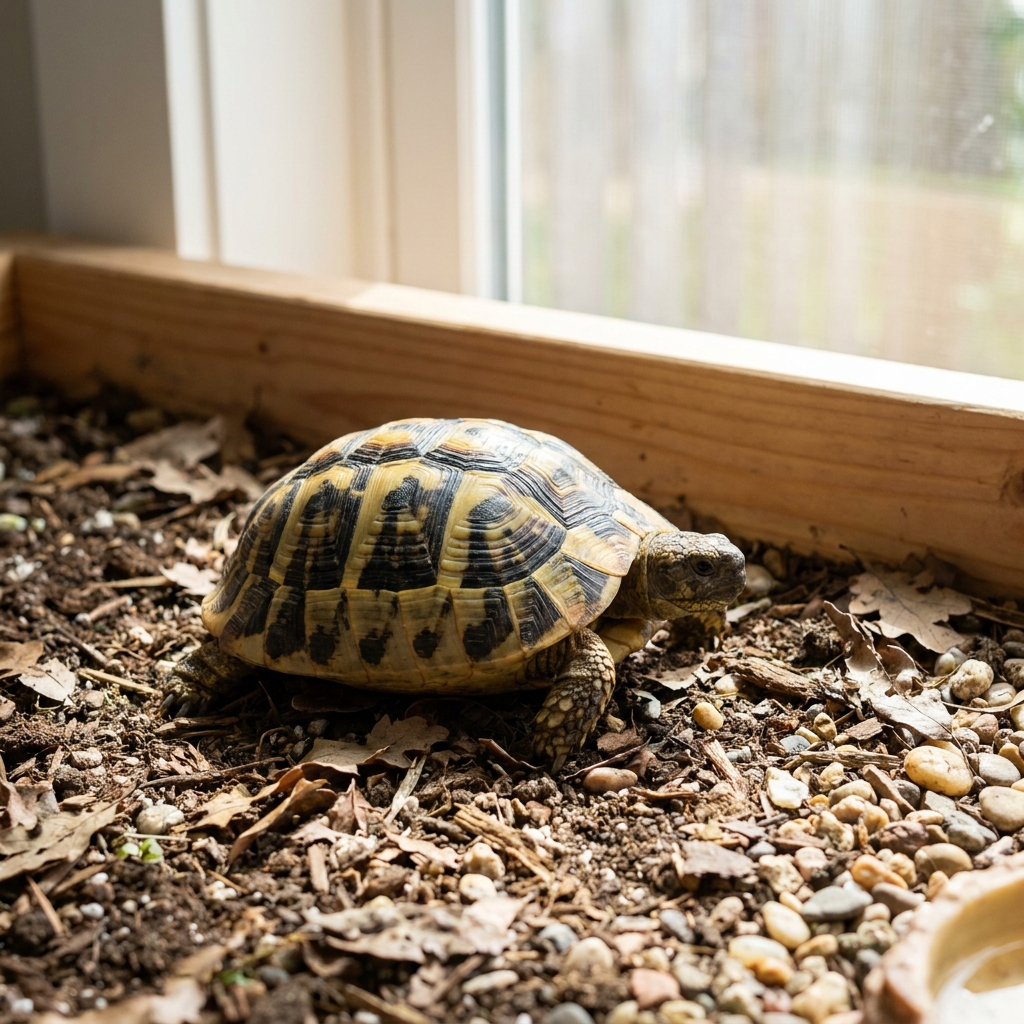
Most of the indoor Hermann's (Testudo hermanni) and Russian (Testudo horsfieldii) setups I am called to assess have the same defect: they are too warm, too humid, and too enclosed. The tortoise has lived, the appetite is fine, the shell looks acceptable — and the keeper is reassured. Then year seven or eight arrives, and the tortoise presents with bladder stones, smooth-beak overgrown jaw, or a pyramiding back that has crept up over time. By then the husbandry has been locked in for years and the corrective work is harder.
Both species are Mediterranean steppe tortoises. They evolved under a regime of hot, bone-dry summers, cool wet autumns, and real winter cold. The indoor setup has to honour all three seasons, not just the one most pet retailers sell lamps for.
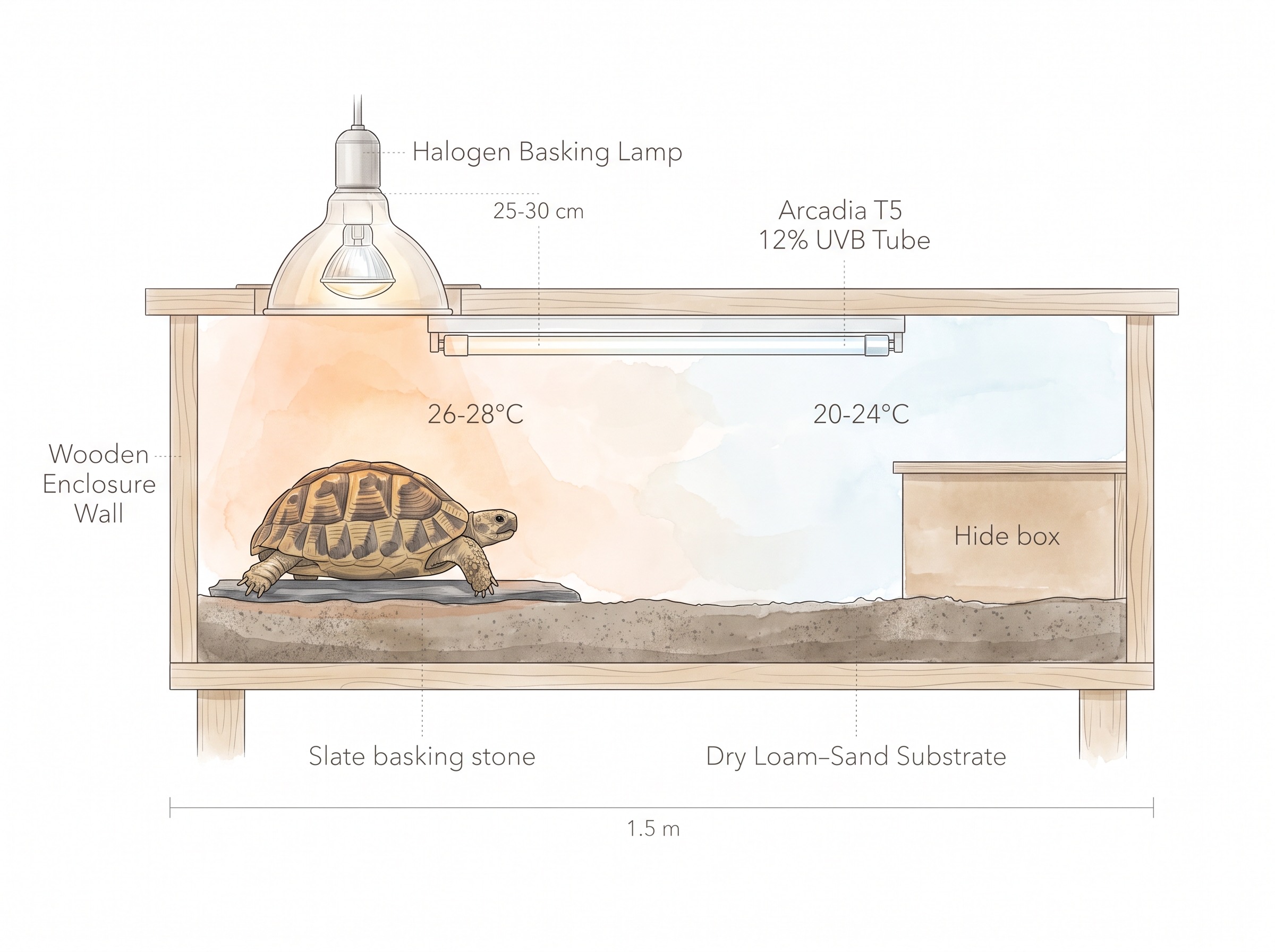
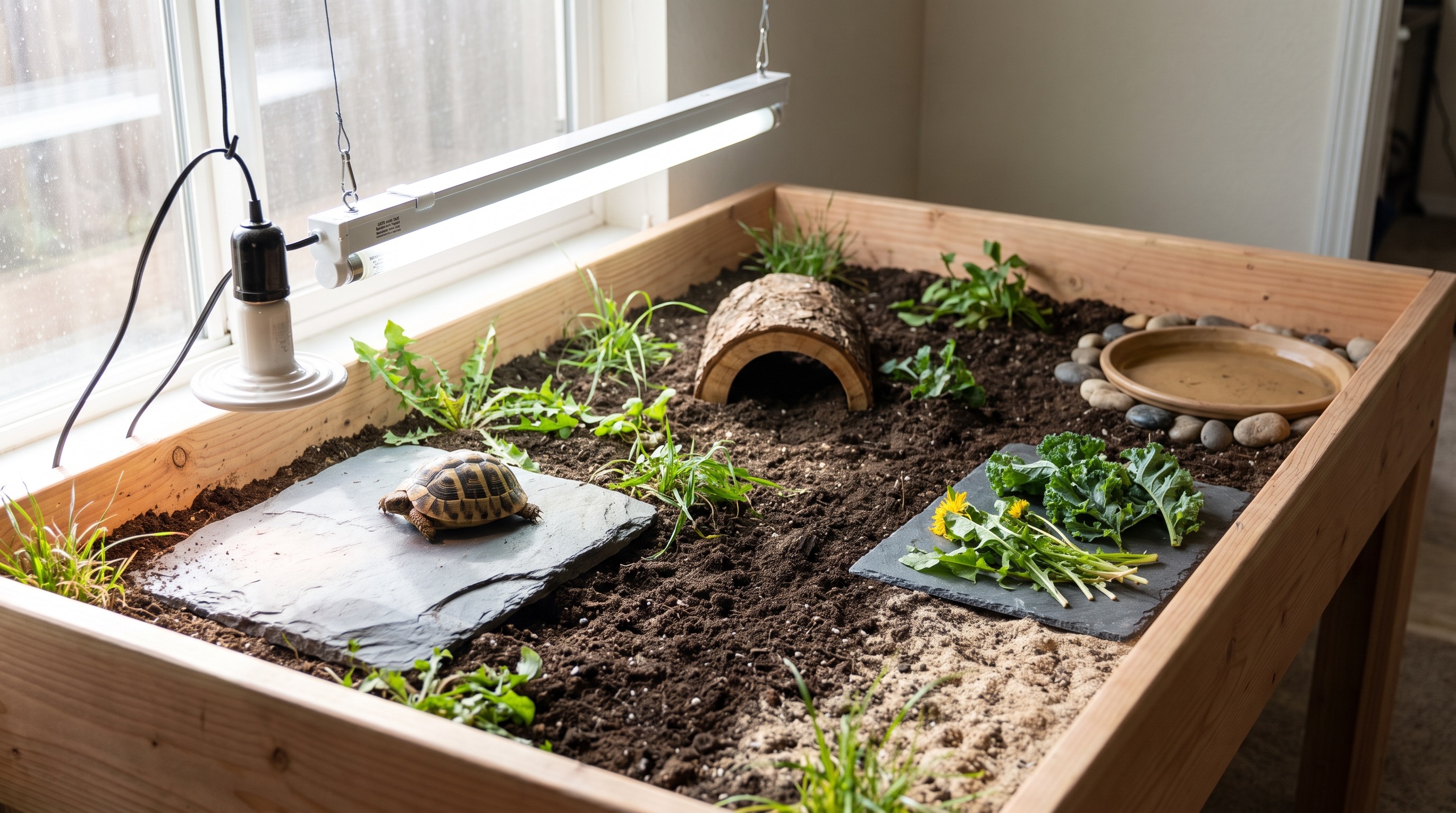
**Target parameters** for an indoor Hermann's or Russian adult enclosure: open-top tortoise table (or equivalent floor pen) of at least 1.2 m × 0.6 m floor space for a single adult, 1.8 m × 0.9 m preferred; ambient 20–24 °C cool end, 26–28 °C warm end, basking hotspot 32–35 °C; night drop to 14–18 °C year-round (15 °C is fine); humidity 30–50 % ambient with a humid hide at 65–75 %; substrate depth 10–15 cm of dry loam-and-sand mix; UVB from an Arcadia T5 12 % or Zoo Med Reptisun 10.0 mounted 30–40 cm above the shell.
Open top, not closed vivarium
I am not a fan of closed glass vivariums for these two species. The heat gradient, the air exchange, and the humidity control are all easier in an open-top tortoise table, a wooden floor pen, or a converted rabbit run. A 120 cm rabbit cage from a pet chain — one of the Ferplast Rabbit 120, MidWest Wabbitat, or Pawhut 120 cm models — modified by removing the front grille and lining the base with vinyl flooring, makes an inexpensive and well-ventilated adult enclosure.
If the keeper insists on a vivarium, a Vivexotic Viva+ Large (115 cm × 49 cm) is the smallest acceptable size and the front glass must be left partially open or fitted with a mesh panel. Anything smaller fails the floor-space rule below.
Apartment dwellers often ask about vertical height. There is no useful height for these tortoises. They climb badly, fall badly, and do not bask from above at any great distance. A 40 cm wall is plenty. Spend the budget on floor area, not on a tall display.
The 10× floor-space rule
For Mediterranean tortoises the working rule is 10× the straight-carapace length in floor length, and 5× the carapace length in floor width. A 20 cm SCL adult — the size most captive Hermann's reach — needs a 2 m × 1 m floor at the upper end of the rule, or 1.2 m × 0.6 m as a bare minimum for a single tortoise. Two tortoises need at least double, ideally 1.5×, and frankly I prefer to house these species solo. Russian tortoises in particular are aggressive in confined space; I have seen limb wounds from males pursuing females in 1 m × 0.5 m pens.
For hatchlings and juveniles up to about 8 cm SCL, a 90 cm × 45 cm enclosure is appropriate for the first 12–18 months, then upgrade. Keeping an adult in a juvenile-sized enclosure causes the inactivity, the overfeeding response, and the shell deformities that drive half my consultations.
Heating and UVB: a two-bulb system
The lighting rig is two separate bulbs mounted on a single wooden or wire frame, both on a timer.
1. Basking flood. A 50–75 W halogen flood — Arcadia Halogen Basking Spot, Exo Terra Intense Basking Spot, or ProRep Halogen Flood — clamped or suspended 25–30 cm above a flat slate or limestone basking stone. Basking surface temperature at the stone: 32–35 °C for an adult, 35–38 °C for a hatchling. Ambient probe temperature 20 cm off the floor at the warm end: 26–28 °C. Cool end ambient: 20–24 °C. Night: off, and let the room fall to 14–18 °C. A Habistat Pulse Proportional or Microclimate Evo Connected thermostat on the basking lamp prevents overheating in summer.
2. UVB T5 tube. A 12 % UVB T5 fluorescent, length matched to the enclosure width, mounted inside a reflector (Arcadia ProT5 or Zoo Med Reptisun T5 HO fixture) at 30–40 cm above the shell. For Hermann's and Russian I use the Arcadia T5 12 % Desert or the Zoo Med Reptisun T5 HO 10.0. Mount the tube so the tortoise can reach within 30 cm of it under the basking zone but cannot get closer than 20 cm. Replace the tube every 12 months — UVB output drops well before visible light does, and the tortoise will not look ill until the metabolic bone disease is established.
Both bulbs on a 12–14 hour photoperiod, year-round. In the UK and northern Europe I drop to 10 hours in deep winter and stop feeding two weeks before the natural brumation cool-down.
Substrate: dry, deep, diggable
These species dig. Russian tortoises in particular dig burrows 60–100 cm deep in the wild to escape summer heat and winter cold. The substrate has to be deep enough to support that behaviour indoors.
My standard mix: 60 % dry topsoil (B&Q farmyard topsoil, sieved) and 40 % children's play sand (the rounded-grain type, not sharp builder's sand). Depth 10–15 cm. Spot-clean faeces daily, turn the substrate weekly, and replace fully every 6–9 months. I do not use coco coir, orchid bark, or any of the moisture-retaining substrates marketed for tropical species — these are too humid for a steppe tortoise and contribute to shell rot and respiratory infections.
A small section of the enclosure — about a 20 cm × 20 cm corner — can be kept slightly more humid with sphagnum moss underneath, providing a humidity of 60–70 % for a hatchling or a tortoise preparing to shed scutes. Adult Hermann's and Russian rarely need this once they are past three years old.
Diet, calcium, and the slow-growth mistake
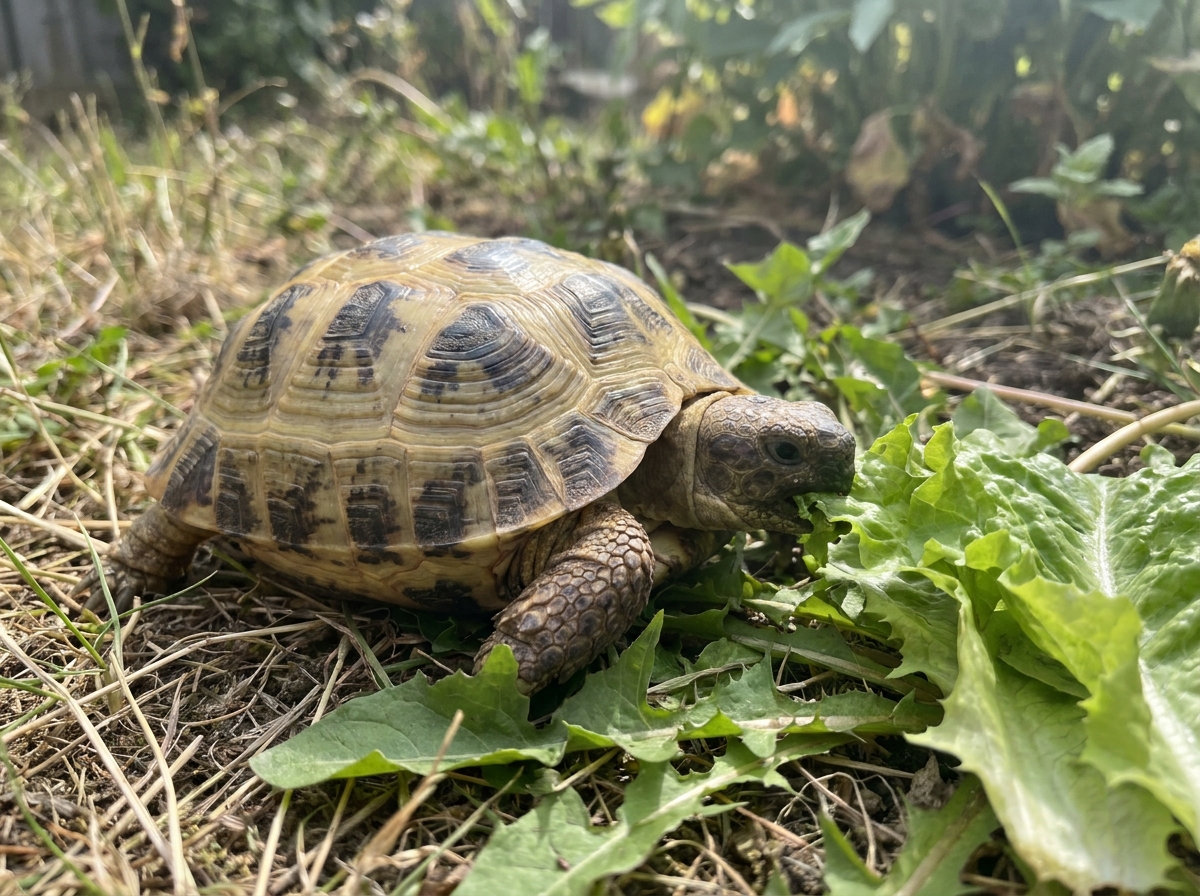
Mediterranean tortoises are weed-eaters, not fruit-eers, and not vegetable-salad-eaters. The dietary staples are weeds: dandelion (leaf and flower), plantain (the lawn weed, not the banana), sow thistle, hawksbit, clover, mallow. Ark Grasses and Komodo Weed Mix are good commercial dried backups. Tortoise Table's online plant database is the single best resource I refer owners to for identifying safe wild-collected greens.
Spring greens, kale, and spinach are acceptable in small rotation but not as staples — the goitrogens and oxalates add up. Fruit is an occasional treat (a small piece of strawberry or apple twice a month in summer is enough). Commercial pellets (Tortoise Diet by Komodo, Tortoise Blend by Arcadia) can be soaked and offered twice a week as a calcium-fortified supplement but should not exceed 30 % of the weekly intake.
Calcium: a small cuttlebone left in the enclosure 24/7 is non-negotiable. The tortoise self-regulates intake. Dusting with Arcadia EarthPro-Calcium or Zoo Med Repti Calcium with D3 twice a week for juveniles, once a week for adults, is the working protocol. I do not use "with D3" at every feed — D3 overdoses are real, and the UVB tube is producing D3 endogenously. Once a week D3-dusted, six days plain calcium, is the pattern I follow.
A common owner mistake is overfeeding. The growth rate that produces a smooth, even scute pattern is slow — about 1–2 mm of SCL growth per month for the first three years. A tortoise that visibly grows 5 mm a month is being power-fed and will pyramid. Weigh monthly for the first two years, then quarterly.
Brumation prep indoors
A properly-managed indoor brumation is not optional for these species. Skipping it year after year correlates with reproductive failure in females, irregular shedding, and a gradual decline in immune function. The tortoise is built to cool down for 8–12 weeks in winter, and the keeper's job is to manage the cool-down safely.
The protocol I use:
- From late October, reduce the photoperiod by 30 minutes per week and stop feeding two weeks before the cool-down begins. Water remains available.
- Drop the basking lamp entirely. The room ambient falls to 10–15 °C over 7–10 days. Do not rush.
- Hold at 5–8 °C for 8–10 weeks in a darkened quiet room — a Wine Guardian wine-cellar cooling unit, an Inkbird ITC-308 thermostat, and a sturdy wooden box with 15 cm of substrate work well.
- A weekly weigh-in during brumation: weight loss over 1 % per month is acceptable, over 2 % is a sign to bring the tortoise up.
- Bring up gradually: a 25 °C shallow soak, then a low-intensity basking session, then a small meal of weeds.
Do not brumate a tortoise that is underweight, has signs of respiratory infection, or has not had a vet check in the past 12 months. And do not brumate hatchlings under three years old — they do not have the body reserves.
The first-year vet visit
Every Hermann's or Russian kept indoors long-term should see an exotics vet at least annually. The check I run: a faecal parasite screen (Hexamita, Oxyuris, and various flagellates that often look asymptomatic), a beak inspection (overgrowth is the first sign of a soft-food diet), a digital weight, and a calcium-status blood panel every second year. An exotics vet registered with the RAVA in the UK, the ARAV in North America, or the ECZM in continental Europe will know the protocol.
The tortoise that gets the right indoor setup, the right seasonal rhythm, and the right annual check will live 50+ years. The one that gets the warm vivarium and the iceberg-lettuce diet will live 8–12. The species is the same in both cases. The keeper is the variable.