

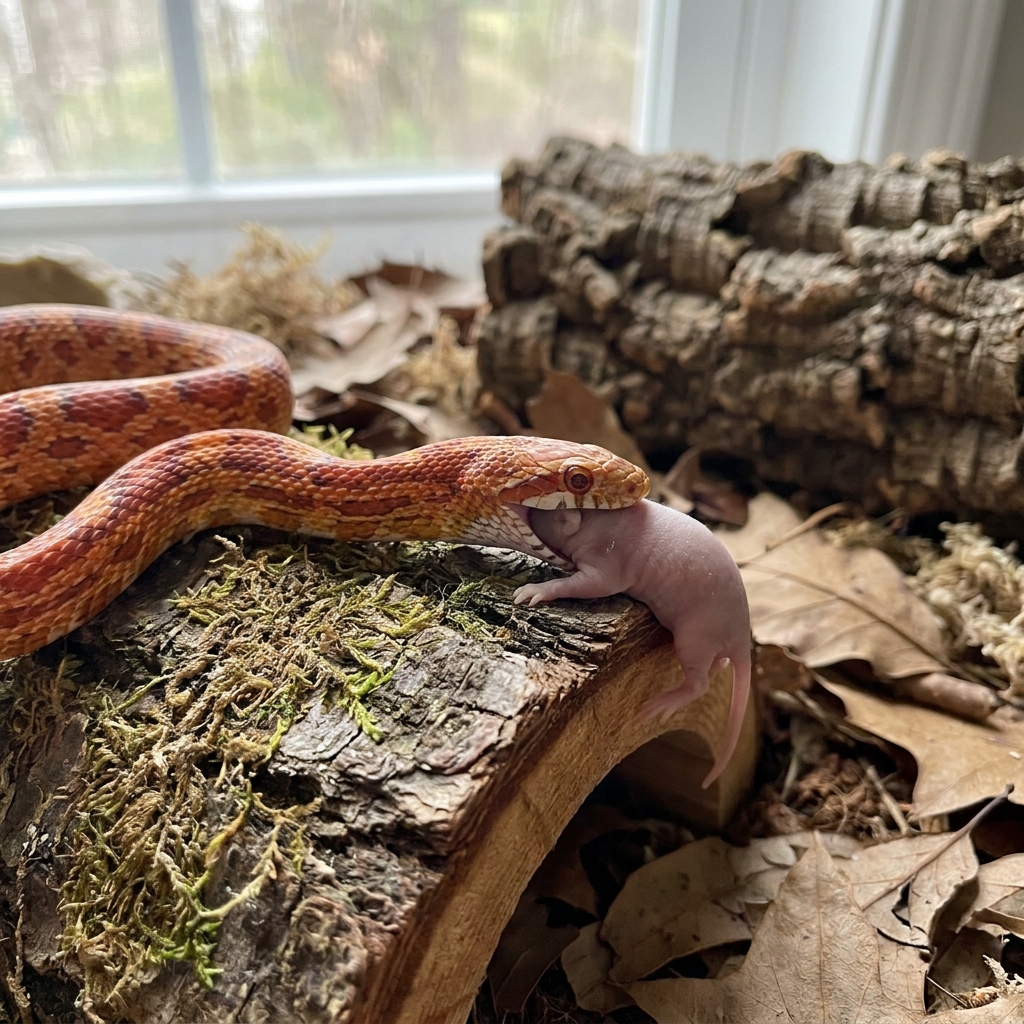
Corn snake: how to size feeder prey
Of all the husbandry calls I get about corn snakes (Pantherophis guttatus), the feeder-prey question is both the easiest to fix and the one most often gotten wrong. Corn snakes are forgiving by species — that is why they have been a beginner staple for forty years — but forgiving does not mean indestructible. Two patterns dominate my inbox: a 30 g hatchling being offered an adult mouse, and a 700 g healthy adult being fed two weanling rats every five days. Both ends of the spectrum lead to the same outcomes — regurgitation, obesity, fatty liver disease, and a snake that dies at four instead of fifteen.
The fix is not complicated. It is a prey-size rule, an age-stage chart, and a feeding-frequency table. Memorise those three and you will out-feed 90 % of hobbyists.
**Target parameters**: prey girth 1× to 1.5× the snake's mid-body width (never wider than the thickest part of the body); prey weight 10–15 % of the snake's body weight per meal for juveniles, 5–10 % for adults; ambient 23–25 °C cool side, 28–30 °C warm side, basking hotspot 30–32 °C, humidity 40–60 %; thaw frozen prey to 35–38 °C surface temperature before offering; feeding frequency every 5–7 days for hatchlings, every 7–10 days for juveniles, every 10–14 days for adults.
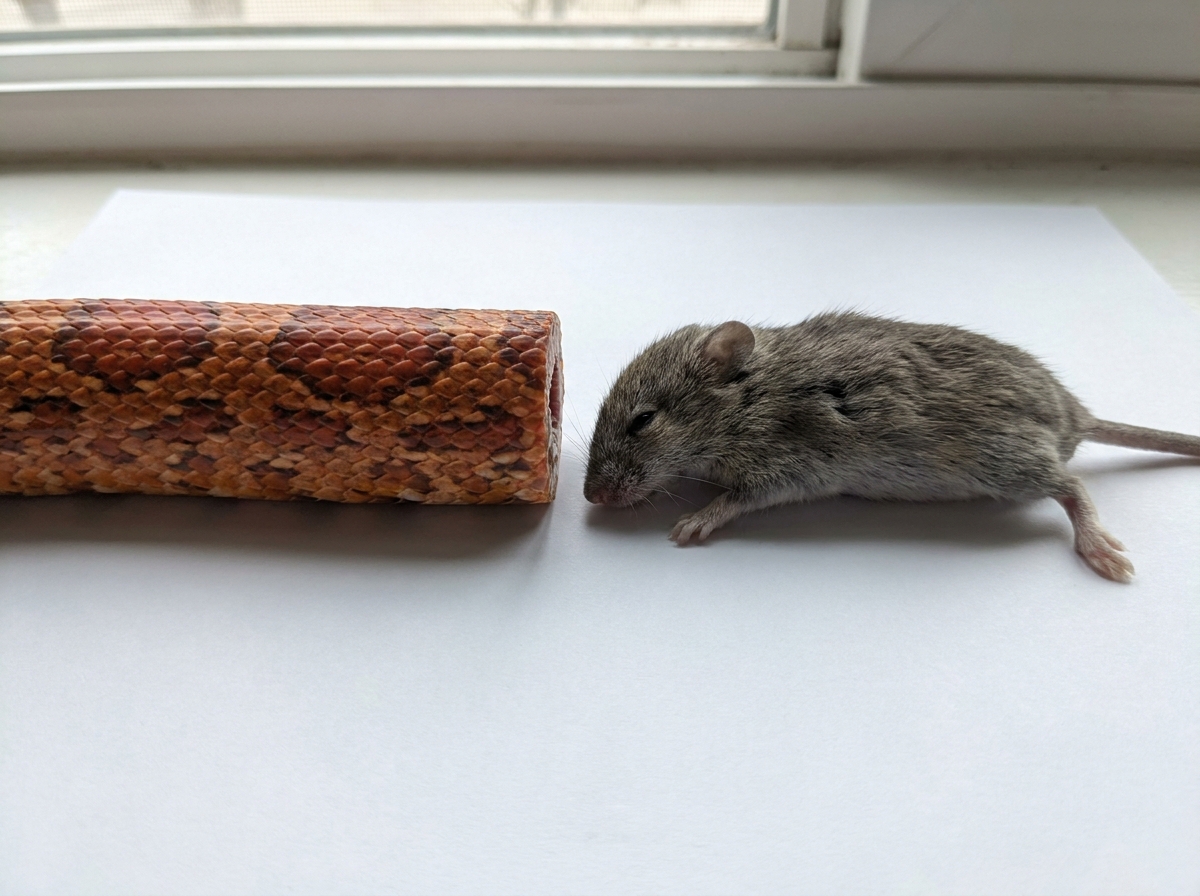
The prey-size rule: 1× to 1.5× mid-body girth
The only rule that matters: the prey item, at its widest point, should be no larger than 1× to 1.5× the snake's mid-body width. Not the neck, not the head — the mid-body, which is the thickest part of a healthy corn snake. A prey item that leaves a visible lump larger than the snake's own body is too large. A prey item that fits in like a small sausage is right. One that disappears without a visible bulge is acceptable for maintenance but may under-condition a growing juvenile.
I weigh the prey, not just eyeball it, for the first year. A 30 g hatchling on its first feed wants a 2–4 g pinky mouse — yes, two to four grams. Most pet-store "small pinkies" run 2.5–3.5 g, which is correct. A 10 g mouse offered to a 30 g snake is a meal, not a snack, and the snake will refuse or regurgitate within 48 hours.
The two leading frozen-feeder suppliers in North America — Layne Labs and RodentPro — list prey weights in grams on bulk packs, and that is the number to read. Pet-store "small" and "medium" labels are inconsistent across chains. Buy a £10 kitchen scale, weigh every prey item the first six months, and you will build a calibrated eye that does not need the scale again.
If you are sourcing in the UK or EU, ProRep, Swell Reptiles, and Monkfield Nutrition are comparable — always read the gram weight, never the verbal size category.
The age-stage chart: pinkies to small rats
Corn snakes graduate through six recognisable prey stages. The progression is not linear — at the adult stage the snake plateaus on a single prey size for years. The mistake keepers make is moving the snake up the prey chart faster than its body justifies, usually because the bigger prey "looks more impressive."
| Snake weight | Age (approx.) | Prey type | Prey weight | Prey example (Layne Labs / RodentPro) |
|---|---|---|---|---|
| 20–35 g | 0–3 months | Pinkie mouse | 1.5–3 g | LL "Premium Pinkie" 1–3 g |
| 35–80 g | 3–6 months | Fuzzy mouse | 3–6 g | LL "Small Fuzzy" 3–5 g |
| 80–150 g | 6–12 months | Hopper mouse | 6–12 g | LL "Small Hopper" 7–10 g |
| 150–350 g | 1–2 years | Adult mouse / weanling rat | 12–20 g | LL "Small Adult Mouse" 14–18 g |
| 350–700 g | 2–3 years | Adult mouse / small rat | 18–30 g | LL "Weanling Rat" 25–35 g (cut to one) |
| 700 g + | 3 years + | Small rat | 30–50 g | LL "Small Rat" 35–50 g |
A note on the last two rows. Many adult corn snakes never need to leave adult mice. A 600 g adult fed one 18 g adult mouse every 10 days is in better body condition than the same snake fed a 45 g small rat every 14 days. Small rats are useful for snakes over 800 g, or for fast-growing females in breeding season. For the pet-only corn snake, adult mice are a complete and correct diet for life.
Rats are not "better" than mice for corn snakes. They are larger, more caloric, and only necessary once the snake is large enough to need them. I see more obese corn snakes on small-rat diets than on any other single husbandry error.
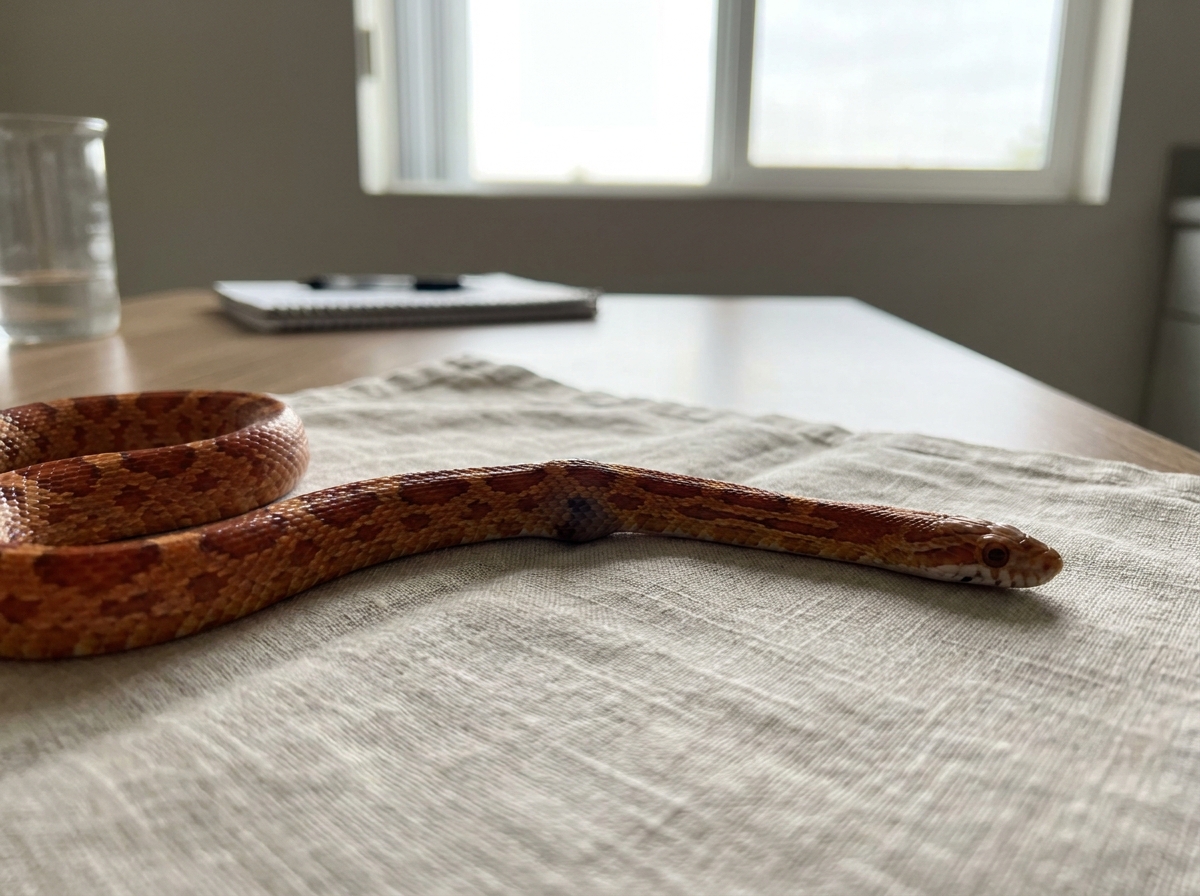
Feeding frequency: the part keepers ignore
Prey size is half the equation. Frequency is the other half, and the half most often overdone. A captive corn snake burns a fraction of the calories a wild corn snake burns hunting through barn-lofts and corn-cribs in the southeastern United States. They do not need to eat as often as the keeper enjoys feeding them.
| Stage | Body weight | Prey size | Frequency | Notes |
|---|---|---|---|---|
| Hatchling (feeding response established) | 20–50 g | 2–4 g pinkie | Every 5–7 days | Skip 24 h after a regurgitation; skip 48 h after a shed |
| Juvenile | 50–250 g | 5–12 g fuzzy / hopper | Every 7–10 days | Watch for visible weight gain, not growth in length |
| Sub-adult | 250–500 g | 12–20 g adult mouse | Every 10–14 days | Cut to one prey item per feed |
| Adult (maintenance) | 500 g + | 15–20 g adult mouse | Every 10–14 days | Increase to 14 days if snake is overweight |
| Breeding female (season) | 500 g + | 20–30 g small rat | Every 7–10 days | Only during active follicular development |
The single most useful tool is a body-condition check. A corn snake at correct weight has a rounded but not bulged mid-body, a clean taper from body to tail, and no rolls of fat around the vent or the chin. A snake that has a soft mid-body, a fat chin, and visible "gutter" fat along the ventral scales is overweight — drop one prey size, extend the interval to 14 days, and reassess in two months.
Power-feeding — prey every 3–5 days at any life stage — does not produce a larger, healthier snake. It produces a fat snake with a shortened lifespan, a propensity to regurgitate, and fatty-liver disease that often presents only at necropsy.

Safe feeding practice: thaw, offer, and the 48-hour rule
Three practical points that prevent the two emergencies I see most often — regurgitation and refusal.
Thaw frozen prey correctly. Move the prey item from freezer to fridge 12–24 hours before feeding, then to a sealed bag in warm (35–38 °C) water for 20–30 minutes before offering. Surface temperature should feel slightly warmer than your palm, not hot. Never microwave — uneven heating fractures bones internally and the snake can be burned by a hot spot.
Feed in the enclosure, not in a separate tub. The old "feed in a separate container to prevent aggression" advice is wrong for corn snakes. Moving the snake to feed causes stress, increases regurgitation risk, and does not prevent feeding response — corn snakes use chemoreception, not visual targeting, and a hand that smells like a mouse will trigger a strike regardless of where the snake is fed. Drop the prey in front of the hide, leave the room, check back in 15 minutes.
Respect the 48-hour rule. After a feed, do not handle the snake for 48 hours. Digestion takes 36–72 hours; handling during peak digestion is the most common cause of regurgitation. If the snake refuses a feed, wait 5 days and offer again. A healthy adult corn snake can refuse food for 2–3 months during the cool season without harm — the animal is in a mild brumation-style fast, not starving.
When to escalate to a reptile vet
Most feeding issues resolve with corrected prey size and frequency. Some signs mean a vet visit, not a longer wait:
- Regurgitation more than once in a 30-day period, or regurgitation where the prey is fully undigested — suggests parasites, husbandry temperature too low for digestion, or a foreign body. A fresh faecal sample rules out Ophiascaris and Cryptosporidium (latter is test-and-isolate, no cure in corn snakes).
- Sustained refusal in a juvenile losing visible body condition — underweight hatchlings do not have adult reserves. If a 30 g hatchling refuses three consecutive feeds and the body weight drops to 25 g, that is a vet visit, not patience.
- Visible bulge in the mid-body that does not reduce after 5 days, with no faecal output — possible impaction, possible substrate ingestion, possible obstruction. A vet visit, not a longer wait.
- Tremors, head-tilt, or stargazing after a feed — a sign the prey was vitamin-B1 (thiamine) deficient. Raw fish and some frozen-thawed prey batches can carry thiaminase. A vet will administer thiamine and rehydrate; do not feed again until cleared.
A corn snake is the easiest snake in the world to feed correctly. Pick prey 1× to 1.5× the mid-body, weigh it the first year, feed on the schedule above, and leave the snake alone for 48 hours after every meal. That is the entire system. Everything else is refinement.