

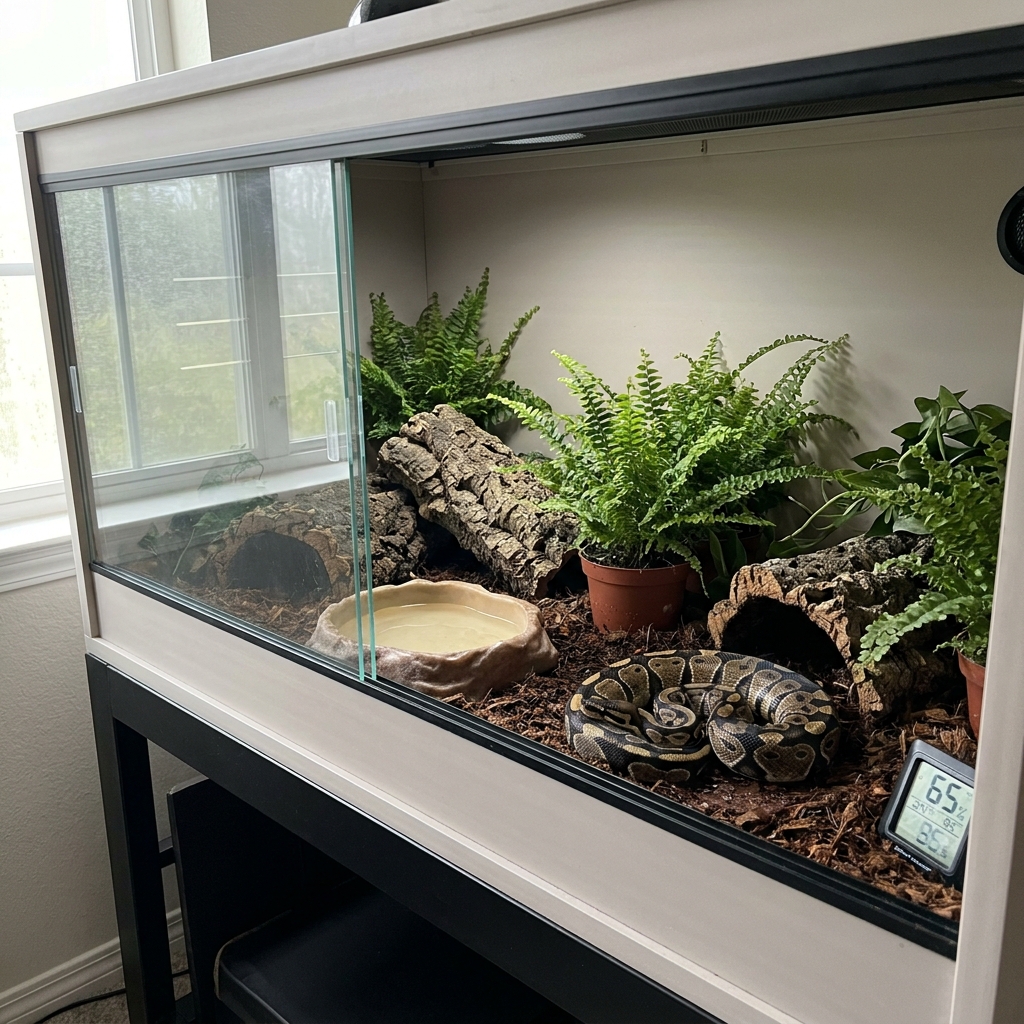
Ball python humidity and shedding management
The most common husbandry mistake I see with ball pythons (Python regius) is not the temperature, the enclosure, or the prey size — it is the chronic low humidity that the keeper never noticed until the animal turned up in shed with retained eye-caps and a constriction band halfway down the body. A ball python kept at 40 % relative humidity for months is not "fine until shed day". The dysecdysis you see is the visible result of damage that started weeks earlier.
The fix is not "spray more often." It is a two-tier humidity system: a steady ambient baseline and a deliberate, time-limited spike timed to the shedding cycle. Done correctly, a ball python sheds in one piece, every time, without intervention.
**Target parameters**: ambient humidity 55–65 % year-round, cool-side substrate surface reading; shed-cycle spike 75–85 % for 5–7 days from "blue belly" through completed shed; ambient temperature 27–29 °C warm side, 24–26 °C cool side, basking hotspot 31–33 °C; humidity measured with a calibrated digital probe hygrometer (not the adhesive analogue disc).
Why ball pythons need two humidity tiers, not one
Ball pythons are native to the savanna and forest-edge habitats of West and Central Africa, not the rainforest interior. The popular "ball python = tropical" assumption is wrong, and it sets keepers up to over-correct with constantly wet enclosures that cause respiratory infection instead. The animal's natural year ranges from roughly 50 % RH in the dry season to 80–90 % during the late-summer rains, and it sheds during the humid window, not the dry one.
Translating that to captivity means:
- Baseline ambient humidity: 55–65 % RH. High enough that the skin stays elastic and hydrated, low enough that the enclosure is not damp at the substrate surface.
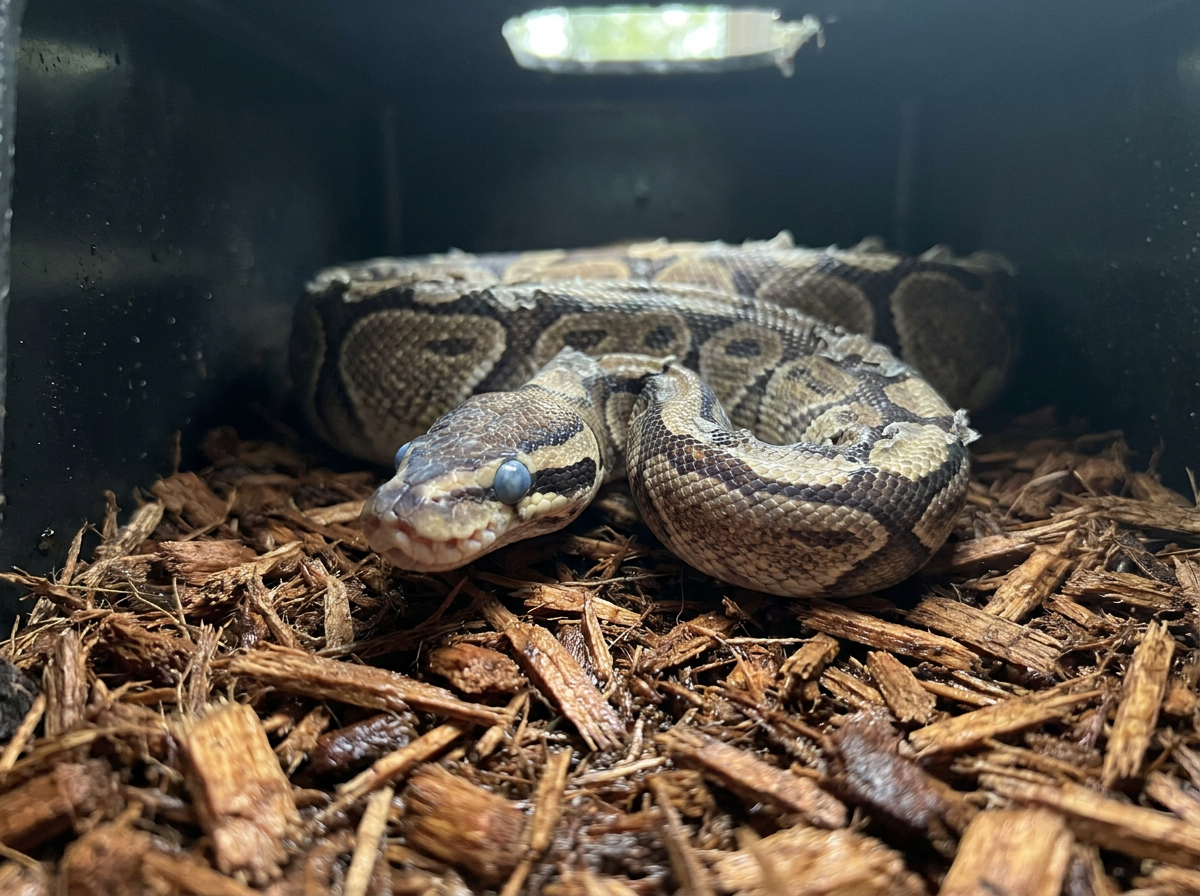
- Shed-cycle spike: 75–85 % RH for 5–7 days. Triggered when you see the ventral scales pink up and the belly take on a milky cast ("going opaque" or "blue belly").
- Hard drop back to baseline within 24 hours of completed shed. A moist enclosure left at high humidity after the shed invites scale rot and respiratory infection.
The 55–65 % baseline is also the humidity at which the enclosure should feel — when you put your hand into the cool end, the substrate should be slightly cool and faintly damp, never crunchy-dry and never visibly wet.
Reading humidity correctly: probe placement matters
Most "humidity is too low" diagnoses are actually probe-placement errors. A digital hygrometer taped to the wall at the warm end, under a heat source, will read 10–15 % below the cool-side substrate surface where the snake actually spends 80 % of its day. That is the opposite of useful.
The setup I run:
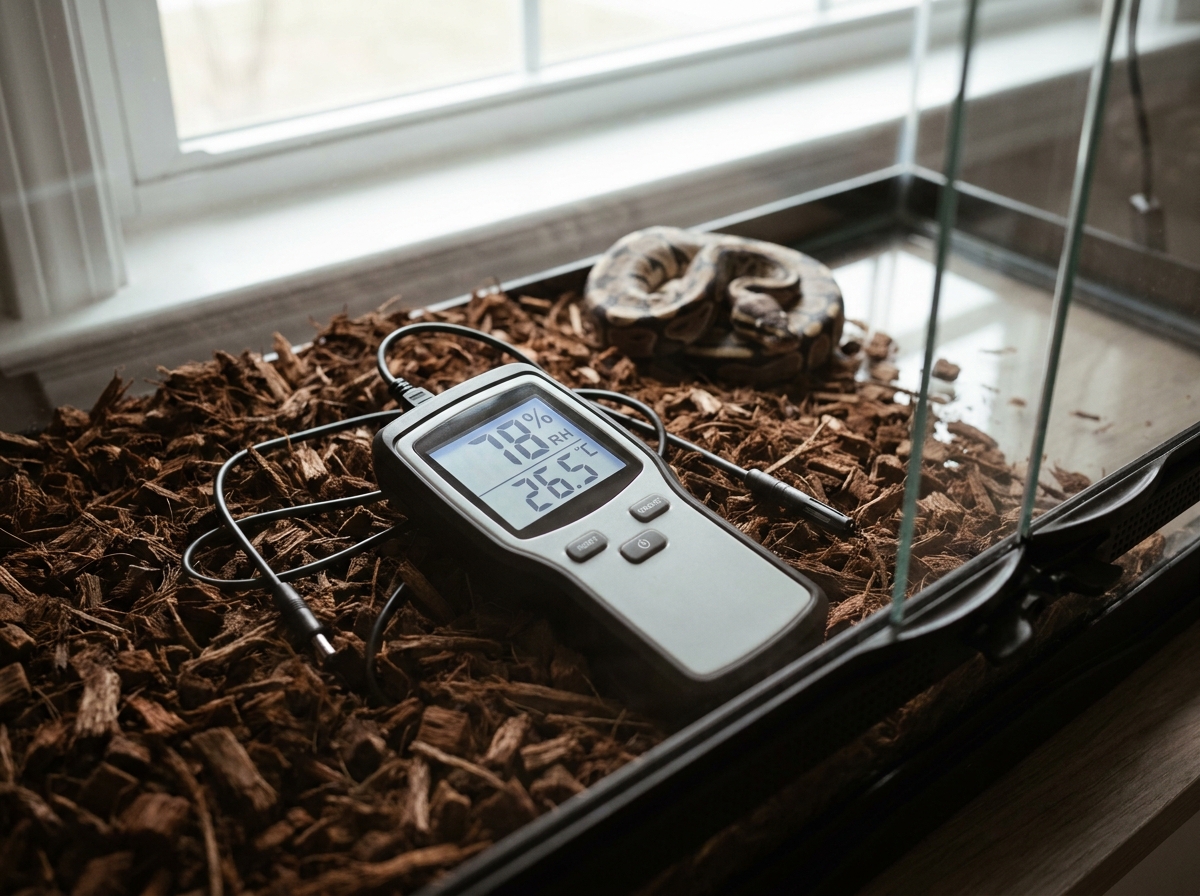
- Primary probe: digital combination thermometer-hygrometer with a wired remote probe (Zoo Med Digital Combo, Exo Terra Thermometer/Hygrometer with probe, or Govee H5179 Bluetooth if you want data logging). Probe tip placed on the cool-side substrate surface, 2 cm in from the wall.
- Secondary spot-check: a second hygrometer at the warm end, 15 cm above the substrate, to confirm the gradient. Should read within 5 % of the cool-side reading.
- No adhesive analogue discs. They drift 10–20 % within six months and there is no way to recalibrate them.
Calibrate any new digital hygrometer against a saturated-salt test before you trust it. Seal the probe in a zip-lock bag with a tablespoon of table salt dampened with a few drops of water; after 8 hours the reading should be 75 %. If yours reads 70 % or 80 %, that is your correction offset.
Substrate and enclosure setup that holds humidity without going wet
Substrate is the humidity reservoir. Pick wrong and you will be misting twice a day to chase a number that refuses to stay put.
- Best substrate for a 55–65 % baseline: cypress mulch (Zoo Med Forest Floor, ReptiChip, or Galapagos Cypress). Holds 4–6× its dry weight in water, releases it slowly, resists mould. A 5–7 cm layer across the entire floor.
- Acceptable: coco fibre (Eco Earth) mixed 60/40 with cypress, or organic topsoil (no perlite, no fertiliser) mixed 50/50 with cypress.
- Avoid: aspen shavings (moulds fast above 65 %), reptile bark nuggets (too chunky, dries out), paper towel (only for quarantine or sick snakes — holds no reservoir), and sand of any kind (impaction risk, does not hold humidity).
To raise humidity without spraying, pour 250–500 ml of room-temperature water into the corners of the substrate — not under the heat source. The water wicks down and re-evaporates over 2–3 days, holding a steady 60 % without surface wetness.
For the shed spike, add a humid hide: a small plastic container with an entrance hole, filled with damp sphagnum moss (New Zealand sphagnum, not decorative sheet moss). Mist the moss once when you spot the blue belly. The snake will use it on its own; do not force it inside.
The enclosure itself matters. PVC (Animal Plastics, Kages, Custom Reptile Habitats) holds humidity 10–15 % better than glass in a climate-controlled home. If you are running glass, cover 50–70 % of the screen top with HVAC tape or aluminium foil to cut ventilation. Ball pythons do not need the airflow anoles do.
The shedding cycle: timeline and what to watch for
A healthy ball python sheds every 4–6 weeks as a juvenile, every 6–10 weeks as an adult. The visible cycle runs about 10–14 days from the first sign to completed shed:
| Stage | Days | What you see | Humidity target |
|---|---|---|---|
| 1. Pre-shed (early) | 1–4 | Dull skin, ventral pink flush | 65–70 % |
| 2. Blue / opaque | 4–7 | Belly and eye-caps milky blue, snake hides more, may refuse a meal | 75–85 % |
| 3. Clear-up | 7–9 | Eyes clear, skin still dull | 75–85 % |
| 4. Shed window | 9–12 | Active rubbing on rough surfaces, normal behaviour returns | 75–85 % |
| 5. Completed shed | 12–14 | Single piece, eye-caps included | Drop back to 55–65 % within 24 h |
Refusing a meal during the blue stage is normal — do not panic, do not force-feed. Offer again 48 hours after the completed shed.
When the snake is in the shed window, add rough surfaces at body height: a flat piece of slate, a cork-bark round, a rough-textured rock (cleaned, no sharp edges). These give the snake leverage for a clean shed and reduce the retained-shed rate to near zero.
When shed goes wrong: troubleshooting and safe intervention
Even with good husbandry, a stuck shed happens — usually because the ambient humidity was below 50 % for a few days during the blue stage, or the snake is dehydrated from a recent illness. The rule is intervention, not panic, and never peel dry shed.
- Retained eye-caps: do not pull with tweezers. Place the snake in a damp towel (wrung-out cotton tea towel, room temperature) inside a sealed tub for 20–30 minutes. The caps often release on their own. If they do not, a reptile vet removes them — eye-cap retention left untreated can constrict the spectacle and damage the cornea.
- Retained shed on the body or tail tip: a single session in the damp-towel tub usually releases 80–90 % of the stuck shed. For tail-tip constriction bands, soak the tail alone in shallow room-temperature water for 10 minutes, then gently roll the shed off with a damp cloth. Never force.
- Multiple bad sheds in a row: the husbandry is wrong, not the snake. Audit humidity, substrate moisture, hides (snake needs a humid hide on the cool side at all times), and check for mites (Ophionyssus natricis — black specks in the water bowl, around the eye, and on the scales). Mites dehydrate the snake and cause chronic dysecdysis.
A shed that comes off in pieces is not a "dry shed" personality trait. It is a data point. Fix the environment and the next shed comes off whole.

When to escalate to a reptile vet
Most humidity and shed issues resolve with a corrected environment, but some signs mean a vet visit, not more misting:
- Retained eye-caps that do not release after a damp-towel session — corneal damage risk.
- Wheezing, open-mouth breathing, or mucus around the glottis — respiratory infection, which can start from chronic high humidity (>80 % sustained) or chronic low humidity.
- Visible constriction bands on tail or digits with swelling distal to the band — circulation compromise, time-sensitive.
- Prolonged anorexia beyond one shed cycle without weight loss is usually fine; prolonged anorexia with visible weight loss is not.
A reptile-experienced vet is worth finding before you need one. The Association of Reptilian and Amphibian Veterinarians (ARAV) directory lists members by region. In an emergency, an experienced general small-animal vet who is comfortable with snakes will do for triage.
The bottom line
Ball python humidity is not a number you chase. It is a two-tier rhythm — a steady 55–65 % baseline that holds the animal hydrated year-round, and a deliberate 75–85 % spike timed to the visible shedding cycle. Get the substrate right (cypress-based, 5–7 cm deep), get the probe placement right (cool-side substrate surface), and get the shed-spike trigger right (the blue belly, not the calendar). The shed comes off in one piece. The snake stays hydrated. You stop reaching for the spray bottle three times a day.
That is the entire system.