

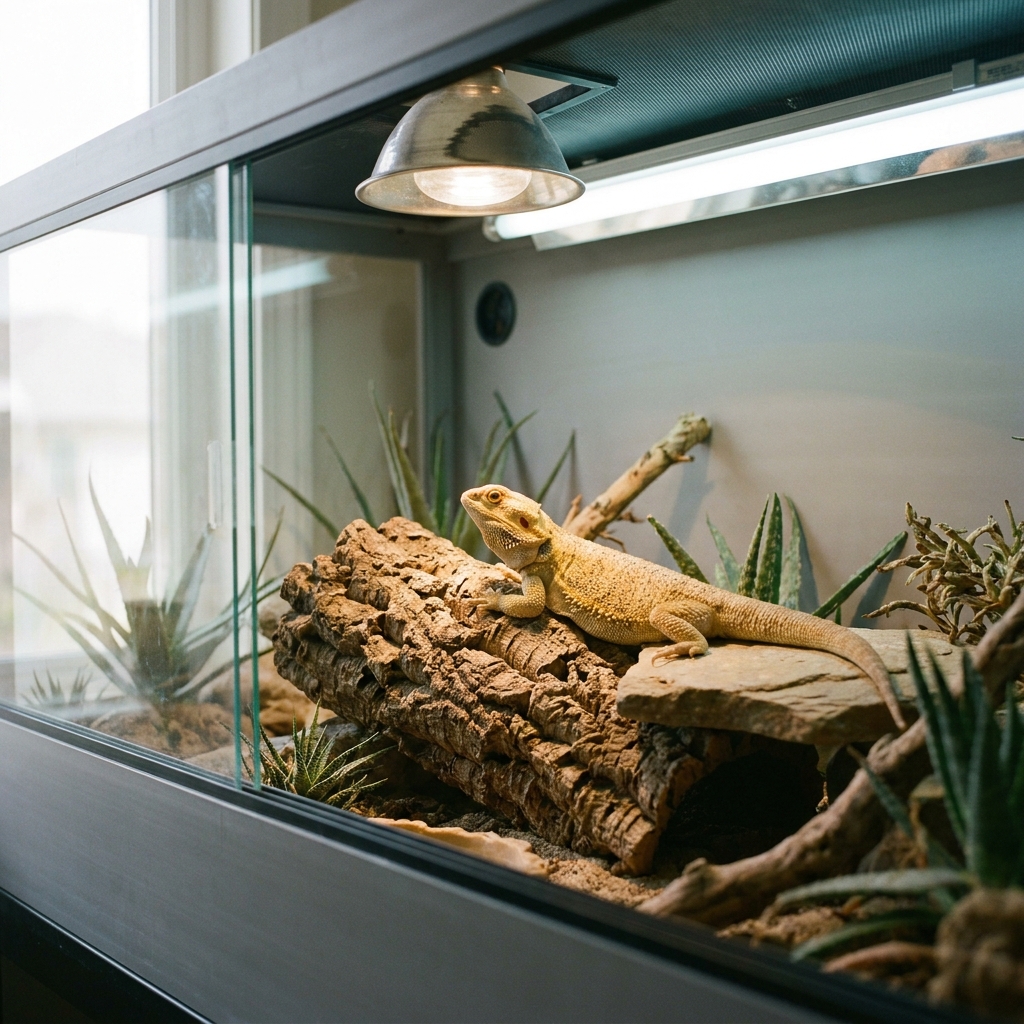
Bearded dragon: UVB and the temperature gradient
The inland bearded dragon (Pogona vitticeps) is the most popular pet lizard in the world, and the one I most often see in my clinic for two interrelated problems: metabolic bone disease from inadequate UVB, and chronic gut stasis from a basking spot that is 5 °C too cool. These are not separate issues. The animal cannot metabolise calcium without UVB-driven vitamin D3, and cannot synthesise D3 without the basking behaviour triggered by correct infrared heat.
This guide covers the two-parameter system I run on every dragon I treat: a thermal gradient between 42 °C and 24 °C, and a UVB source at Ferguson Zone 3 at the basking surface. Everything else is fine-tuning around these numbers.
**Target parameters**: basking surface 40–42 °C, warm-side ambient 32–35 °C, cool-side ambient 24–26 °C, night drop to 18–21 °C; humidity 30–40 % day, climbing to 50–60 % overnight; UVB at basking surface UVI 4.0–6.0 (Ferguson Zone 3); photoperiod 12–14 hours on, 10–12 off. Every number below explains why it is in the list.
Enclosure: size first, then orientation
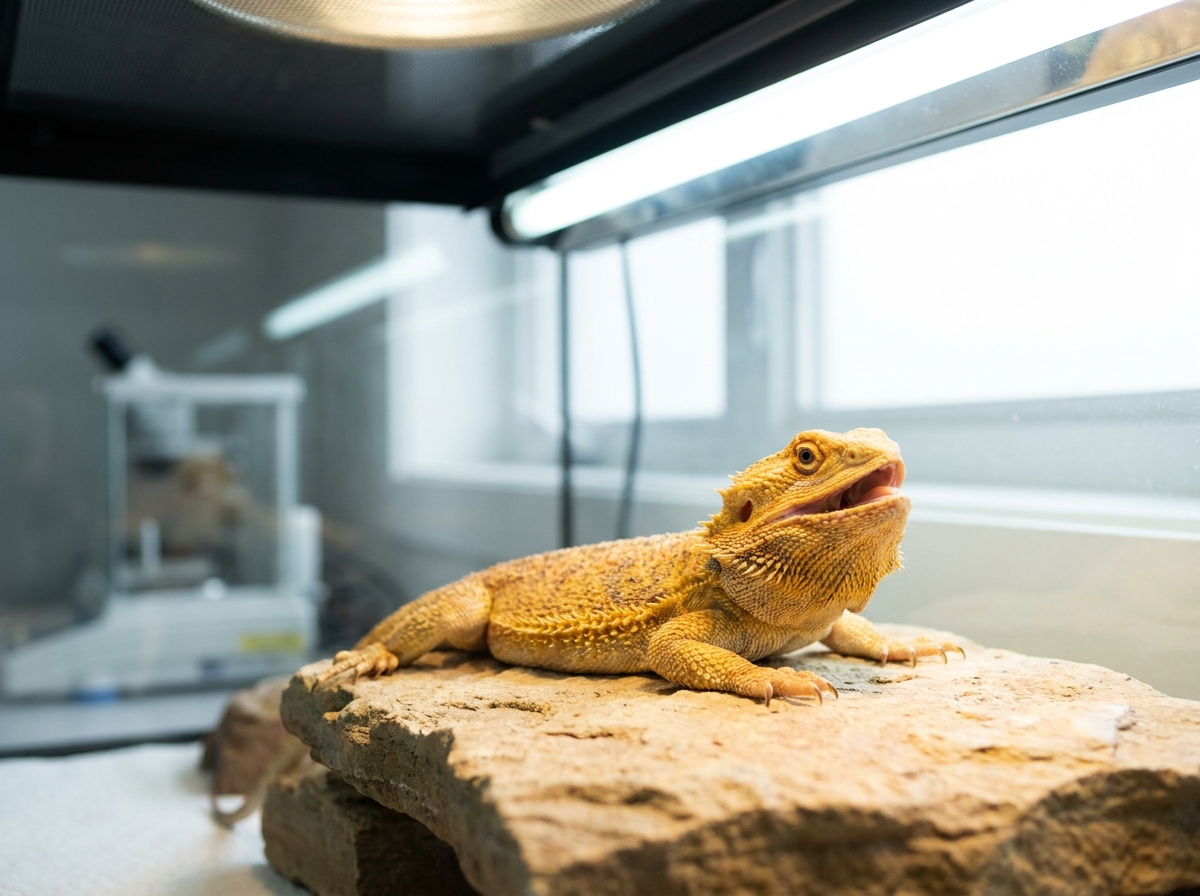
Bearded dragons are semi-arboreal baskers. The enclosure must be long enough for a real thermal gradient and tall enough for the UVB source to sit at a usable distance from the basking surface.
- Adult minimum: 120 × 60 × 60 cm (4 × 2 × 2 ft) — not negotiable for an animal that reaches 50–60 cm total length.
- Juvenile (under 100 g): 90 × 45 × 45 cm works for the first 6 months, then upgrade.
- Front-opening glass or PVC: Exo Terra large-XT (ReptiZoo, Dubia Roaches equivalents), or a custom PVC build from Kages or Custom Reptile Habitats. PVC holds heat better in cool homes.
- Solid top preferred: keeps the UVB tube at a fixed distance and holds night humidity. If you must use a screen top, mount the UVB inside — fine mesh blocks 35–50 % of UVB.
Floor space matters more than height. A 120 × 60 × 60 enclosure gives a real gradient; a 60 × 60 × 120 tall enclosure does not.
The temperature gradient: three zones, not one
A bearded dragon does not live at one temperature. It moves between a basking zone (hot), a warm zone (mid), and a cool zone (cold) over the course of the day. Your job is to build the gradient and let the dragon thermoregulate.
Zone 1 — Basking surface: 40–42 °C for adults, 42–43 °C for juveniles under 100 g. Surface temperature of the rock or branch under the heat source, measured with an infrared thermometer gun (Zerodrop, Etekcity, Fluke — anything with stated ±2 % accuracy). Air temperature at the basking spot is irrelevant; the dragon flattens against the surface to absorb infrared-B and -C.
Zone 2 — Warm-side ambient: 32–35 °C. Digital probe thermometer at body height on the warm side, halfway between basking and cool.
Zone 3 — Cool-side ambient: 24–26 °C. Same method, cool end. If your cool side reads above 28 °C, the gradient is too short and the dragon will pant, refuse food, bury itself.
Night drop: 18–21 °C. Heat lamps off. A CHE or low-wattage heat mat can hold 18 °C in winter homes that drop below 15 °C; below that the dragon becomes lethargic and gut transit slows.
A thermostat on the basking source is not optional. A halogen flood plugged directly into mains will run 60–80 °C at the surface and burn the ventral abdomen within hours. Use a dimming thermostat (HabiStat or Inkbird) with the probe taped to the basking surface.
Heat source: halogen flood, not ceramic, not heat mat
For two decades the standard advice was a ceramic heat emitter (CHE) or a heat mat. Both are wrong for a bearded dragon.
- Halogen flood (50–75 W for a 120 cm enclosure) — infrared-A, -B, and -C in the same ratios as sun. Use a dimming thermostat and a porcelain socket rated for the wattage.
- CHE — infrared-C only. Acceptable as supplementary night-time heat in cold rooms, but should never be the primary basking source.
- Heat mat — useless as a primary heat source for a basking species. Acceptable as a night-time backup in winter homes below 15 °C, regulated to 22 °C.
Adjust the thermostat in 1 °C steps over a week until the surface reads 41 °C with a fresh halogen bulb. Replace halogen bulbs every 6–9 months — output drops well before visible light does.
UVB: Ferguson Zone 3, not "a UVB bulb"
This is the most common setup failure I see. Owners buy a UVB bulb, mount it on top of a fine mesh screen, and assume the dragon is covered. UVB through a fine aluminium screen is reduced by 35–50 %. The dragon basks under a "UVB" lamp that is delivering Zone 1 output — equivalent to deep shade.
Bearded dragons in central Australia sit in full sun for hours. They are Ferguson Zone 3 animals: UVI 4.0–6.0 at the basking surface. A pet dragon kept at Zone 1 (UVI 1.0–2.0) for two years will develop MBD — soft jaw, trembling limbs, curved spine — often presented as "the dragon is just lazy".
The correct UVB setup:
- Type: T5 HO fluorescent tube — not a coil, not a compact fluorescent.
- Strength and brand: Arcadia T5 12 % Dragon (or 14 %) — strongest desert-zone tube on the market, 39 W for 90 cm, 54 W for 120 cm. Zoo Med ReptiSun 10.0 T5 HO is the equivalent. Avoid 5.0 / ShadeDweller tubes — those are Zone 1 for crepuscular geckos.
- Mount: inside the enclosure, 25–35 cm from the basking surface, with a reflector (without a reflector, output drops by 30 %).
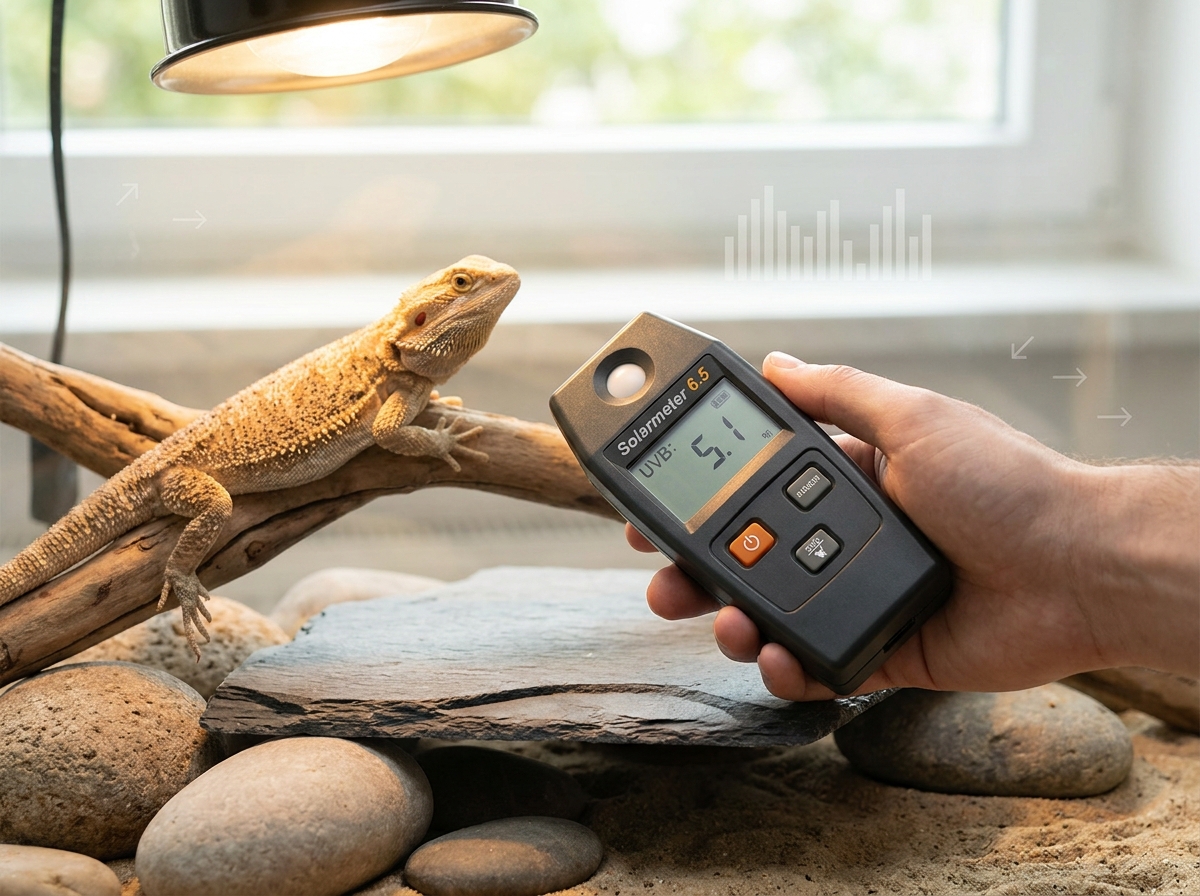
- Distance rule: at 30 cm from a 12 % Arcadia, the surface reads UVI ~4.5; at 45 cm, ~2.5. A Solarmeter 6.5 confirms it; the cost pays for itself in vet bills avoided.
- Photoperiod: 12 on / 12 off in winter, 14 / 10 in summer. No UVB at night. Link to a simple timer.
- Replacement: every 12 months. T5 HO output drops to ~60 % of new by month 12 while the visible spectrum looks unchanged. Mark the install date on the bulb end with a permanent marker.
A mercury vapor bulb (Arcadia 160 W D3, Zoo Med Powersun 160 W) is a valid alternative — UVB and heat from one source. It works well in enclosures 150 × 60 × 60 or bigger, but runs very hot, has a narrow UVB cone (centre directly over the basking spot), and decays faster than T5 tubes. Replace every 6–9 months.
Humidity: low, but not zero
Inland bearded dragons come from arid Australia, but not from a true sand desert — they live in spinifex grasslands where overnight humidity climbs into the 50–60 % range as temperature drops.
- Day ambient: 30–40 %.
- Night ambient: can climb to 50–60 %. Normal and healthy.
- Shed box: a small moss box on the cool side helps with stuck shed on toes and tail tips.
- Misting: do not mist during the day — it raises humidity under the basking lamp and promotes bacterial growth in the substrate. Run a cool-mist humidifier on a hygrostat set to 55 % for an hour before lights-off if needed.
A dragon kept at 60–70 % humidity year-round will develop respiratory infections; at 20 % year-round, stuck sheds and chronic dehydration. The 30–40 % day target with a night climb is the middle path.
Diet, calcium, and why UVB matters
UVB is not just about calcium metabolism — it is also about appetite and behaviour. A dragon with chronic low-grade UVB deficiency becomes a picky, slow-feeding animal that gains weight on fat rather than bone. MBD is the end-stage diagnosis; the years before it show up as "a dragon that doesn't eat well".
Standard "dust with calcium + D3 twice a week" advice only works if the dragon is also receiving usable UVB. If the UVB is wrong, oral D3 is poorly metabolised. Get UVB right and you can drop D3 supplementation to once a week for adults.
Adult (over 18 months): insects 2–3 times per week (dubia roaches, black soldier fly larvae, crickets, occasional mealworms), salads daily (collard, mustard, turnip, dandelion greens; small squash, bell pepper, carrot; never iceberg, never spinach, never avocado), plain calcium at every insect feeding, calcium with D3 once per week, multivitamin (Repashy Calcium Plus or Arcadia EarthPro-A) once per week.
Juvenile (under 12 months): insects daily (5–10 small dubia or equivalent), salads offered daily and eaten inconsistently (normal up to 12 months), calcium at every feeding, D3 twice a week.
When to escalate to a reptile vet
A bearded dragon will hide illness for 2–4 weeks before symptoms show. By the time you notice, the issue is established.
Book an appointment within 24–48 hours for:
- Tremors, soft or swollen jaw, curved spine, "rubbery" limbs — metabolic bone disease.
- Sudden weight loss, prominent hip bones, deflated fat pads on the head — dehydration or parasites.
- Open-mouth breathing at rest, mucus bubbles from the nose, audible wheeze — respiratory infection.
- Regurgitation, undigested insects in stool, or stool that smells of rotting food — gut stasis or parasites.
- Swollen joints, limping, or a tail that drags — possible gout, MBD, or fracture.
- Prolonged anorexia — more than 2 weeks in adults, more than 1 week in juveniles (brumation mimics anorexia; a vet visit confirms which).
A first wellness visit within the first month of ownership, with a fresh stool sample for parasitology, is cheap insurance. Captive dragons carry Coccidia, Pinworms, and Isospora at rates I would estimate above 60 % — most subclinical until the dragon is stressed, when they bloom.
The two-variable checklist
Get these two right and the rest of the husbandry chain works:
- Basking surface reads 40–42 °C with an IR thermometer, controlled by a dimming thermostat, from a halogen flood (not a CHE, not a heat mat).
- UVB at the basking surface reads UVI 4.0–6.0 (Ferguson Zone 3) from a T5 HO tube mounted inside the enclosure — Arcadia 12 % Dragon, Zoo Med ReptiSun 10.0, or an equivalent — replaced every 12 months.
Everything else — substrate, decor, salad rotation, supplementation — is fine-tuning around these two numbers.
---
About the author: [Amelia Sterling](../Amelia%20Sterling.md) is an MSc in Reptile Medicine from the Royal Veterinary College, London, with 14 years of reptile practice. She has served as visiting veterinarian at the London Zoo reptile house.