

Leopard gecko care: a complete keeper's guide
The leopard gecko (Eublepharis macularius) is the most commonly kept pet reptile in the world, and also the species I see most often in my clinic for preventable illness. They are not "easy". They are small, quiet, and tolerate a narrow band of mistakes better than, say, a chameleon — but the cost of that tolerance is decades of subclinical damage that shows up as metabolic bone disease, fatty liver, or chronic parasitism in year six or seven.
This is the husbandry protocol I run on every leopard gecko in my care, and what I recommend to clients who want a gecko that lives 18–22 years instead of 5–8.
**Target parameters**: warm-side floor 32 °C, cool-side floor 24 °C, night drop to 20 °C; ambient humidity 30–40 %, humid hide 70–80 %; UVB output at basking surface UVI 1.0–2.0 (Ferguson Zone 1–2); photoperiod 12 hours on, 12 off. The rest of this guide explains why each of those numbers matters.
Enclosure size and orientation
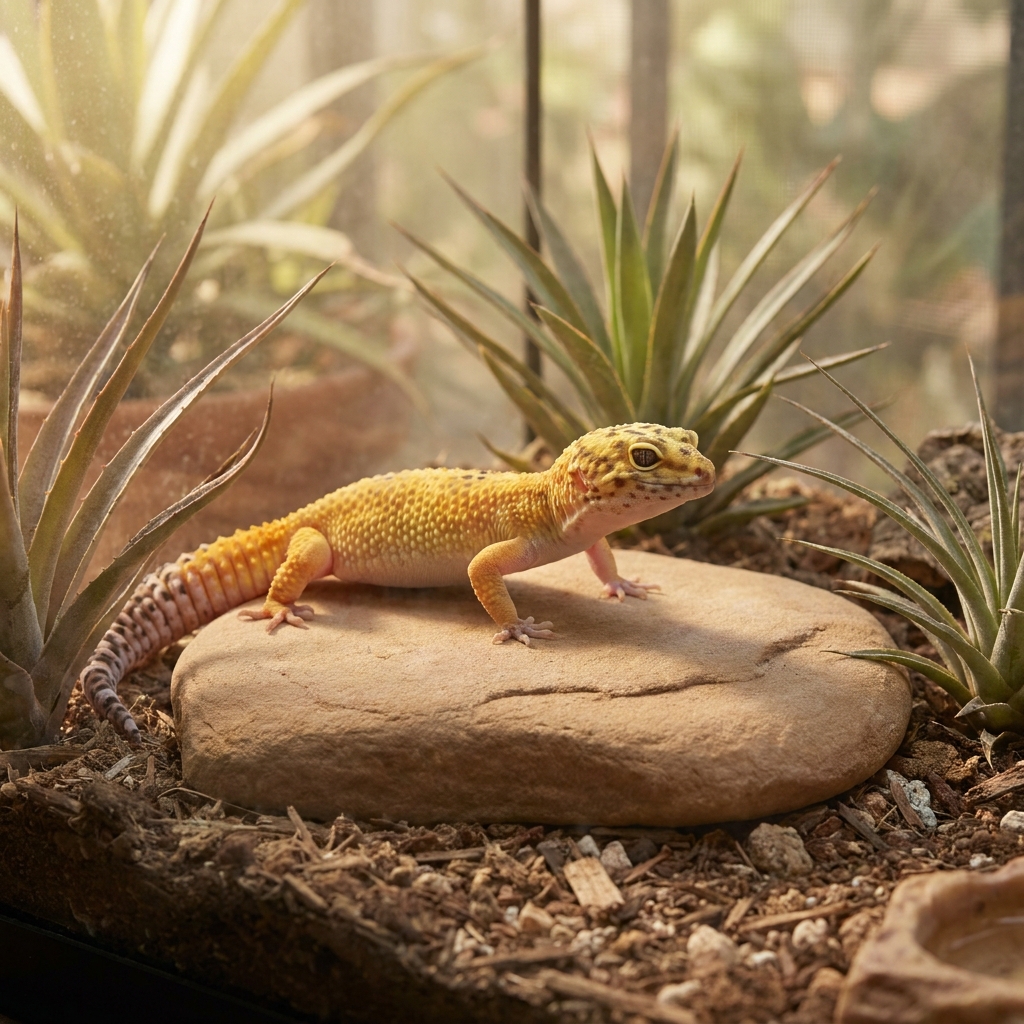
Leopard geckos are terrestrial. The enclosure should be long and low, not tall.
- Adult minimum: 90 × 45 × 45 cm (36 × 18 × 18 in). Bigger is better.
- Juvenile (under 20 g): 60 × 30 × 30 cm is acceptable for the first 6–9 months, then upgrade.
- Floor space per gecko: add at least 50 % floor area per additional animal — and do not house two males together. Ever. Cohabitation works only for sibling females raised together, and even then it carries risk.
Glass terrariums (Exo Terra 36 × 18 × 18, ReptiZoo, or similar) work fine. Wooden PVC enclosures (Custom Reptile Habitats, Kages) hold heat better in cold homes. Screen-top enclosures in air-conditioned rooms will struggle to hold temperature — you will be running the heat mat 24/7.
Heating: undertank heat mat is not enough on its own
For 25 years the standard advice was a heat mat covering one-third of the floor, regulated by a thermostat. That advice is incomplete. A heat mat produces only infrared-C (deep heat), not the infrared-B that penetrates muscle and aids digestion the way sun does. Modern best practice is either:
- Overhead halogen flood (50 W, with a dimming thermostat such as the HabiStat or Inkbird) — provides infrared-A and B like the sun, plus visible light cues.
- Halogen + heat mat combination — halogen for daytime basking, heat mat on a thermostat set to 28 °C as night-time backup.
Either way, the floor temperature on the warm side should read 32 °C with an infrared thermometer gun (Zerodrop, Etekcity, or Fluke — anything above £20 works). Air temperature is a poor proxy; the gecko lives on the floor.
A thermostat is not optional. A heat mat plugged directly into mains will hit 45–50 °C and burn the ventral abdomen.
UVB: still required, even though they are crepuscular
Leopard geckos are crepuscular, not nocturnal, and they do bask briefly at dusk in the wild. They synthesise vitamin D3 from UVB. Skipping UVB does not kill them in year one — it manifests as MBD in years three to five, often as a soft jaw, tremors, or a kinked spine that appears "out of nowhere".
The right UVB setup for leopard geckos:
- Type: T5 HO fluorescent tube — Arcadia ShadeDweller 7 % (recommended) or Zoo Med ReptiSun 5.0.
- Strength: 7 % / 5.0 — these are "shade dweller" output tubes, Ferguson Zone 1–2, UVI 1.0–2.0 at basking distance.
- Distance: 25–30 cm from basking surface, with a mesh or fine-slot reflector.
- Photoperiod: linked to the room's day/night cycle, 12 hours on, 12 off. No UVB at night.
- Replacement: every 12 months. Output drops well before the visible light does.
Mount the tube inside the enclosure, not on top of a fine mesh lid — fine mesh blocks up to 40 % of UVB output.
Substrate: the most controversial choice in leopard gecko keeping
You will find three camps online. Here is what the evidence actually supports.
For juveniles under 25 g: paper towels or slate tile. Period. Loose substrate in a small gecko that is still establishing feeding response is a known impaction risk.
For adults over 40 g: a 70/30 mix of organic topsoil (no perlite, no fertiliser) and playsand, at a depth of 5–8 cm, allows natural digging behaviour and supports healthy nail wear. Bioactive setups with leaf litter and clean-up crew isopods work well in experienced hands.
Avoid:
- Calcium sand (causes severe impaction — binds in the gut)
- Walnut shell (sharp, causes perforations)
- Reptile carpet alone (harbours bacteria in the fibres; can catch teeth)
- Pine or cedar shavings (aromatic oils, hepatotoxic)
Slate tile is the easiest substrate for a first-time keeper — it conducts heat beautifully, looks clean, and is zero-risk for impaction.
Three hides, always
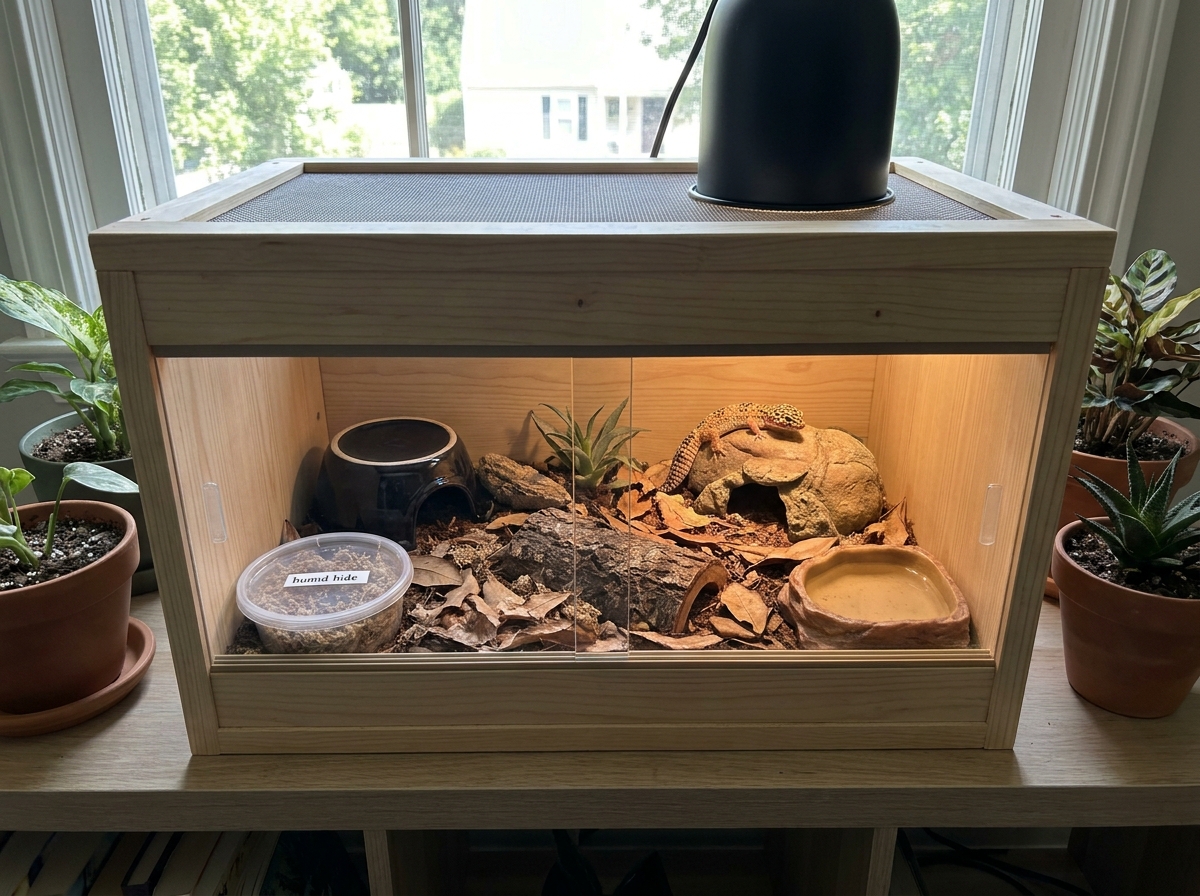
A leopard gecko enclosure must contain at minimum:
- Warm hide — on the warm side, directly above the heat source. Dry. Where the gecko digests.
- Cool hide — on the cool side. Dry. Where the gecko retreats from heat.
- Humid hide — between warm and cool, filled with damp sphagnum moss or moist coco coir. Humidity inside should be 70–80 %. This is where the gecko goes to shed.
A humid hide is not optional. Without one, sheds come off in pieces — stuck shed on toes constricts blood flow and causes toe loss; stuck shed over the eye caps causes permanent vision damage. Mist the moss every 2–3 days; replace the moss weekly to prevent mould.
Diet: insects only, never fruit or veg
Leopard geckos are insectivores. They are also notoriously good at refusing food they do not need, which leads owners to "treat" them with fruit, meal, or pinkie mice. None of those are part of a correct diet.
Staple feeders (rotate 3+ for nutritional balance):
- Dubia roaches (Blaptica dubia) — best calcium:phosphorus ratio of any feeder, around 1:1.5 after gut-loading
- Black soldier fly larvae (Calcigrubs, Phoenix worms) — naturally high in calcium
- Crickets — widely available, gut-loadable, but smell and bite
- Mealworms — high in fat, useful as a treat or for underweight geckos
- Silkworms — excellent nutrition but expensive
Gut-load all feeders for 24–48 hours before feeding. Use a commercial gut-load (Repashy Bug Burger, Arcadia InsectFuel) or a dry mix of organic oats, alfalfa, and carrot. Hydrate with water crystals or carrot slices.
Dust schedule for adults:
- Plain calcium carbonate (no D3) — at every feeding
- Calcium with D3 — once per week
- Multivitamin (Repashy Calcium Plus or similar) — once per week
For juveniles: calcium at every feeding, D3 twice a week.
Feeder size rule: no longer than the width of the gecko's head, no wider than the space between the eyes.
Frequency: juveniles feed daily (5–10 insects), sub-adults every other day, healthy adults 2–3 times per week. A fat tail is the storage organ — a moderately thick tail base is healthy. A gecko with a tail thicker than its neck is overweight; a gecko with a tail thinner than its neck is underfed.
Shedding and stuck shed
Healthy adult leopard geckos shed every 3–6 weeks. Juveniles shed more often. The whole shed should come off in one piece, often eaten by the gecko immediately after.
If shed sticks:
- Toes: highest risk. Soak the gecko in shallow lukewarm water (1 cm depth, 10 minutes) and gently tease the shed off with a damp cotton bud. If the shed has been on for more than 24 hours and the toe is swollen or discoloured — vet visit, possible tissue loss.
- Eye caps: a closed, opaque eye that has not cleared after two sheds is likely retained eye cap. Do not pick at it. Vet visit for safe removal.
- General patchy shed: raise ambient humidity to 50 % for 48 hours and check the humid hide. Add a damp paper towel inside the humid hide if it dries too fast.
When to escalate to a reptile vet
Leopard geckos hide illness until they cannot. By the time symptoms are visible, the issue is usually 2–4 weeks advanced.
Book a reptile vet appointment within 24–48 hours if you see:
- Tail thinning below neck-width, or a sudden drop in appetite lasting more than 2 weeks
- Tremors, soft jaw, kinked spine, gaping mouth — signs of metabolic bone disease
- Regurgitation or undigested insects in faeces
- Mucus bubbles from the nose, audible wheeze, open-mouth breathing — respiratory infection
- Swollen or blackened toes, retained shed for >24 hours
- Visible parasites in fresh stool (look like rice grains or thin white threads)
- Lumps in the abdomen or cloacal prolapse
A first wellness visit within the first month of ownership — with a fresh stool sample for parasitology — is cheap insurance. Most captive leopard geckos carry Coccidia, Pinworms, or Cryptosporidium; only a vet can tell you which, and which to treat.
A 30-second daily check
If you do nothing else, do this: eyes clear and alert with no sunken appearance; tail as thick as or thicker than the neck; faeces a solid dark pellet with a white urate cap (runny or yellow = problem); all three hides occupied at some point in the day; sheds coming off in one piece.
Get the temperatures, the hides, the UVB, and the diet right — and you have a small, hardy, personable lizard that will outlive most of your other pets.
---
About the author: [Amelia Sterling](../Amelia%20Sterling.md) is an MSc in Reptile Medicine from the Royal Veterinary College, London, with 14 years of reptile practice. She has served as visiting veterinarian at the London Zoo reptile house.