

Stuck shed in geckos: how to help safely (and when to stop helping)
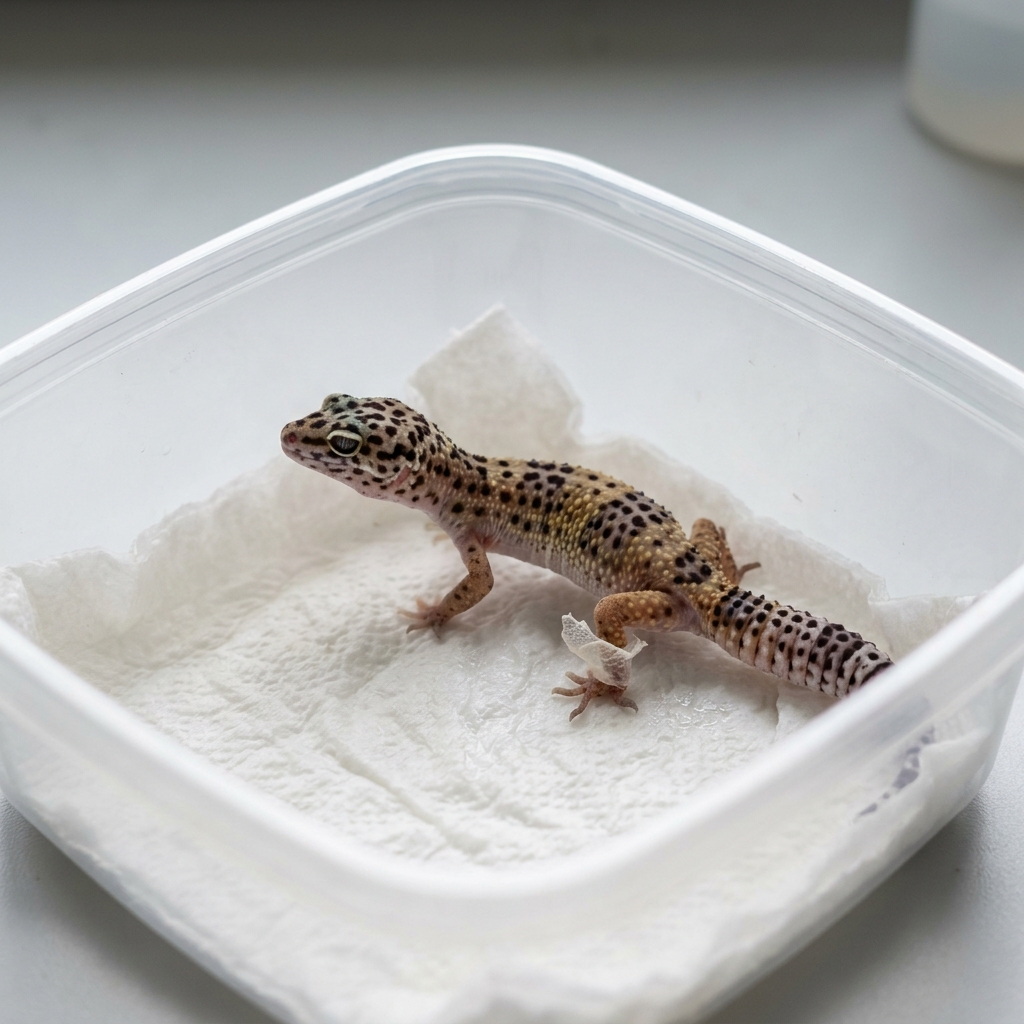
A healthy gecko sheds its skin in one piece, usually overnight, and eats it before you ever see the evidence. A gecko walking around with papery grey patches stuck to its toes, eye caps, mouth line, or vent is showing you a husbandry problem. The stuck shed itself is the symptom, not the disease. Pulling it off without fixing the underlying humidity and hydration is how keepers turn a one-week fix into a six-week recovery.
This guide walks through what causes dysecdysis in leopard, crested, and other common pet geckos, the safe in-enclosure interventions, and the moments to hand the case to a reptile vet.
Why geckos get stuck shed in the first place
Dysecdysis — the medical term for abnormal shedding — is almost always one of three things, in roughly this order of frequency:
- Low ambient humidity during the shed window. Leopard geckos need 40–50 % ambient humidity with a localised 70–80 % humid hide during the 5–7 day shed window. Crested geckos need 60–75 % ambient year-round. If either is kept in a dry room with no humid retreat, the keratin separates incompletely.
- Dehydration. Often secondary to (1) but not always. Geckos on a dry insect-only diet with no fresh water source (mist droplets count) and no moisture in the gut-loading of feeders will arrive at a shed already underhydrated.
- Surface texture. A bare-glass or smooth-plastic enclosure gives the gecko nothing to push against. Without a rough surface to rub against, even a well-hydrated gecko can lose patches at the toes, eye caps, and tail tip. Vitamin A deficiency, mites, and systemic illness cause 5 % of cases — start with the husbandry.
The species-specific risk zones
Not all stuck shed is equal. Some locations cause real damage within hours; others can wait.
Toes (all species, especially leopard geckos). This is the emergency zone. Each toe is wrapped in five tiny constricting bands of keratin. If even one band stays in place across two sheds, it acts as a tourniquet — the toe swells, the blood supply is cut off, and the distal phalanx dies. By the time a keeper notices a black, dry, mummified toe, the damage has been done for days. Leopard geckos kept on loose substrate with low humidity lose toes every year to this.
Eye caps (leopard geckos, African fat-tails, sometimes crested). The spectacle — the fused clear eyelid — sheds separately. A retained eye cap looks like a dull grey-white film over one or both eyes. The gecko will squint, mis-strike food, and develop a corneal ulcer within weeks if the cap is not removed. This is the one location where a keeper should not improvise.
Vent and tail base (all species). Stuck shed around the cloacal opening traps urates and faeces against the skin, leading to bacterial dermatitis and fly-strike in warm months. Rare but serious.
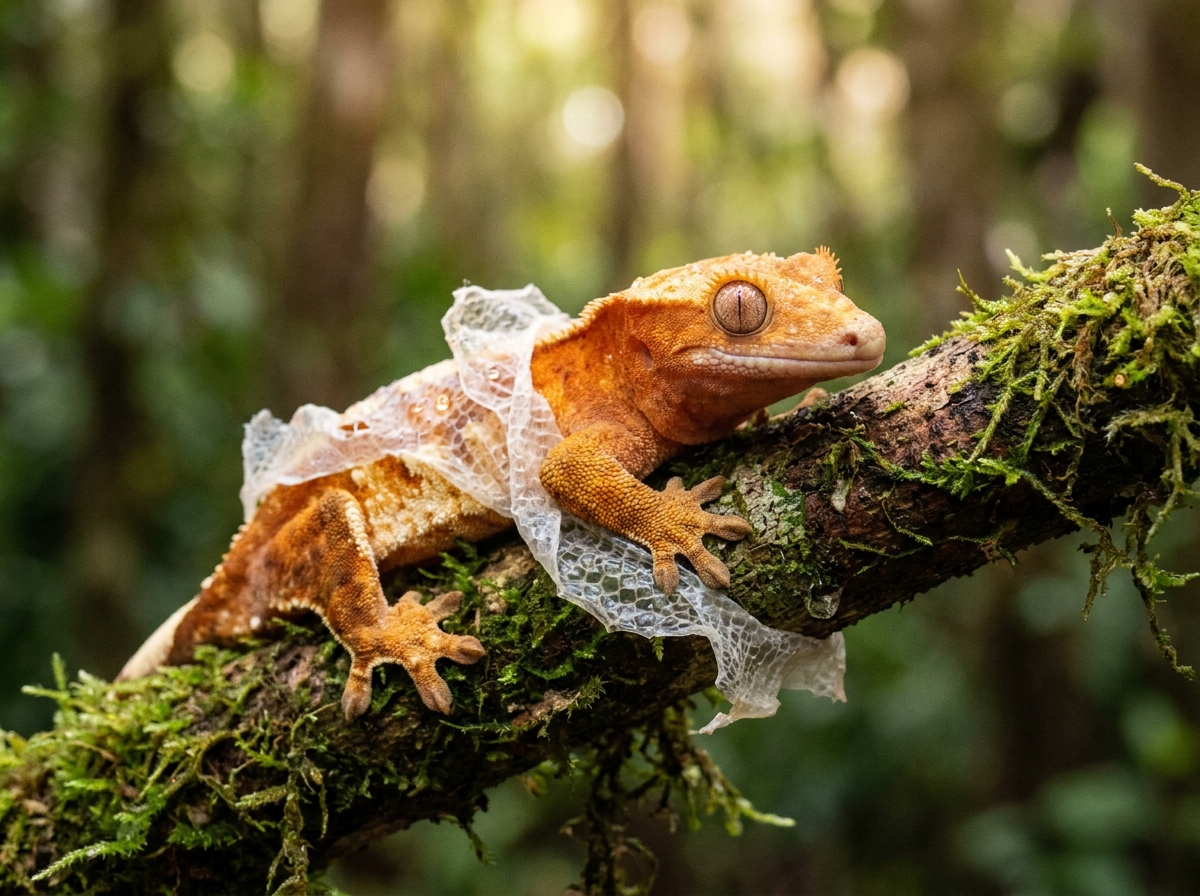
Body patches (crested geckos, gargoyles, chahoua). Crested geckos frequently retain shed on the crests, the lateral skin folds, and around the toes. Less catastrophic than leopard gecko toe loss but a sign that humidity has dropped.
Lips and mouth line (leopard geckos, occasionally fat-tails). Retained shed along the labial scales is often the first sign of underlying vitamin A deficiency or chronic low humidity. If both the eye caps and the mouth line are affected, the gecko needs a vet visit, not just a humidity bump.
The safe in-enclosure fix for body and toe shed
For body patches, crests, lateral folds, and fresh (under 24 hours) toe shed, you can almost always handle this without touching the gecko.
Step 1 — raise the ambient humidity for 48 hours. Mist the enclosure twice daily, add a larger water bowl near the warm end, and cover 30 % of the screen top with a damp towel to drop ventilation. Leopard geckos: 40 % → 55–60 %. Crested geckos: 60 % → 80 %.
Step 2 — verify the humid hide is functioning. A 12 × 12 cm Exo Terra or Zoo Med hide with a 5 cm entrance, packed with damp sphagnum moss (Zoo Med New Zealand Sphagnum or Besgrow Spagmoss), is the standard. Rehydrate the moss every 48 hours. If your moss is dry, the hide is just a hide.
Step 3 — add surface texture for the gecko to push against. Slate, rough ceramic tile, mopani wood, or a textured rock background gives the gecko something to push against during the next shed. Smooth PVC enclosures with only plastic plants are a common cause.
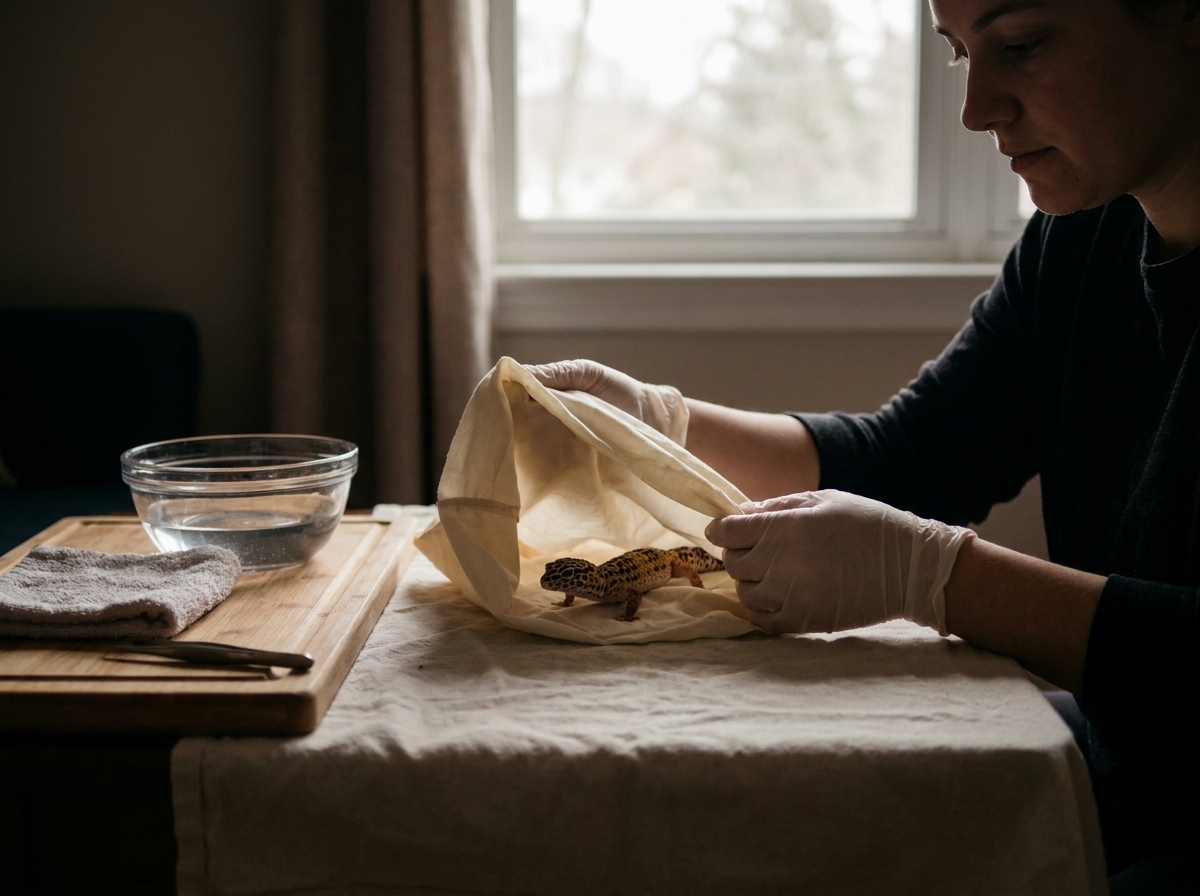
Step 4 — supervised warm soak if needed. 5–8 minutes in lukewarm water (28–30 °C, instant-read probe — never by hand) in a flat-bottomed plastic tub, watched the entire time, loosens body patches. Dry on a paper towel before returning. Soaks are a tool, not a daily ritual, and never a substitute for humidity.
**Do not** peel stuck shed off a sleeping or resisting gecko. The skin that is stuck is also fused to the new skin underneath. Tearing it off creates raw wounds and almost guarantees infection.
Toe shed: the 24-hour rule and the bag method
For leopard gecko toes, the safe order of operations:
- Within 24 hours of spotting the band, raise the enclosure humidity as above and add a damp paper towel under the warm hide. The next natural movement often pulls the band off.
- If the band is still present at 48 hours, set up a supervised "humidity bag": a small clear plastic tub with air holes, a layer of damp paper towel on the bottom, the gecko inside, and the lid loosely closed. Place the tub in the warm end of the enclosure (or on a heat mat set to 28 °C underneath). 10–15 minutes is usually enough. The gecko walks out with most bands released.
- If a single stubborn band remains after two bag sessions, it is a vet visit, not a tweezer visit. A reptile vet can use magnification and a fine iris scissors to cut the band without damaging the underlying tissue. The home-tweezer approach is how keepers amputate toes.
For crested gecko toe shed the urgency is lower — they tolerate retained toe shed for one or two cycles without the same tourniquet risk — but the same escalation applies.
Eye caps: hands off without a vet
Retained eye caps are the one location I will not advise a keeper to work on at home. The cap is fused to the spectacle, which sits directly on the cornea. Pulling on it without magnification risks corneal abrasion and permanent damage. A vet will:
- Confirm it is a retained cap and not a corneal opacity or early infection
- Use a fine forceps under magnification to lift the cap
- Apply a lubricant or saline soak beforehand
- Check the mouth line for concurrent retained shed (often linked)
The home treatment is the humidity bump in section 3, then the appointment. Do not use over-the-counter reptile "shed aid" sprays marketed for eye caps — most are saline plus glycerin and are not the issue. The issue is shedding mechanics, which humidity fixes.
What actually prevents stuck shed long-term
Once the immediate stuck shed is resolved, the long-term prevention list for the most common pet geckos:
Leopard gecko (Eublepharis macularius)
- Enclosure: minimum 90 × 45 × 30 cm for an adult, though 90 × 45 × 45 cm allows a proper thermal gradient
- Warm end ambient: 28–32 °C, basking surface 35 °C measured with an infrared probe
- Cool end: 22–24 °C
- Night drop: down to 20 °C is fine
- Ambient humidity: 40–50 % year-round
- Humid hide: 70–80 % humidity inside, sphagnum moss, replaced every 48 h
- UVB: Arcadia ShadeDweller 7 % or Zoo Med ReptiSun 5.0 T5 HO, mounted inside the enclosure, basking distance 20–25 cm
- Substrate: solid (slate, tile, paper towel, non-adhesive shelf liner) for juveniles; for adults, a 70/30 topsoil-playsand mix at minimum 8 cm depth if you want naturalistic
Crested gecko (Correlophus ciliatus)
- Enclosure: 45 × 45 × 60 cm for one adult, 45 × 45 × 90 cm preferred
- Ambient temperature: 22–24 °C, basking spot (if used) 26 °C, no higher — they overheat easily
- Night drop: 18–20 °C is fine
- Humidity: 60–70 %, with a 80–90 % mist cycle once daily that dries out within 2–3 hours
- UVB: Arcadia ShadeDweller 7 % or 6 % Forest, mounted 20–25 cm above the main perch
- Surface texture: cork bark rounds, rough bark panels, and at least three horizontal perches of differing diameter
African fat-tailed gecko (Hemitheconyx caudicinctus)
- Same husbandry as leopard gecko but ambient humidity 50–60 % year-round, humid hide 75–85 %
- More prone to retained eye caps than leopard geckos, so the humid hide is non-negotiable
When to stop trying to fix it at home
The three referral lines I draw for a keeper:
- Any retained eye cap, even a faint one. Vet visit within 7 days.
- More than one constricted or discoloured toe, or any toe that is cold, swollen, or has a blackened tip. Vet visit within 48 hours, because the distal bone is at risk.
- Recurring stuck shed across three or more cycles despite correct humidity and a working humid hide. There is usually an underlying issue — vitamin A deficiency, mite load, renal disease, or a thermal gradient problem you cannot see from the outside. Bloodwork and a faecal exam are the next step.
The short version
Stuck shed is a humidity, hydration, and texture problem. Fix those three and most dysecdysis cases resolve without you touching the gecko. Pull shed only when it is clearly loose at the edge and the gecko is calm. Send eye caps, constricted toes, and recurring cases to a reptile vet. The keepers who never see stuck shed are the ones who check the hygrometer weekly, replace the humid hide moss every 48 hours, and provide rough slate for the gecko to push against.