
Reef water-test log: a printable template and what to record
The single biggest difference between a reef tank that thrives for a decade and a reef tank that crashes in eighteen months is the log. Most reef keepers test their water. Few log it. The difference matters because the test gives you a snapshot. The log gives you a trend. A snapshot tells you where the tank is right now. A trend tells you where the tank is going. Reef problems are almost always visible in the trend weeks before they show up as a snapshot of bad numbers.
This is the template I use with my own consulting clients. It is not the only way to organize a log. It is the way I have found that surfaces problems earliest, requires the least time per week, and produces a record that is useful if you ever need to diagnose something six months in.
What to test, in order of priority
Not all reef parameters are equally important. If you have limited time to test, this is the order to prioritize:
Tier 1 - test weekly, every tank, no exceptions
- Salinity (refractometer, calibrated)
- Temperature (digital probe)
- Alkalinity (dKH, by titration or Hanna checker)
- Calcium (ppm)
- Magnesium (ppm)
- Nitrate (ppm)
- Phosphate (ppm)
These seven parameters define whether a reef tank is in the safe zone. Every one of them can drift in a way that stresses corals before the drift shows up as visible coral damage. Tracking them weekly is the minimum for a mixed reef or LPS-dominant tank. SPS-dominant tanks may want to test alkalinity and calcium twice a week.
Tier 2 - test every 2-4 weeks
- pH (especially if you have a calcium reactor or a heavily stocked tank)
- Ammonia and nitrite (only relevant during cycling or after a major disturbance)
- Iodine (less critical than was once thought; most reef salts and foods provide adequate iodine)
- Strontium (optional; most tanks do not need to supplement specifically)
Tier 3 - test occasionally or as needed
- Trace elements (iron, manganese, etc.) - unless you are dosing specifically and want to verify uptake
- Salinity calibration check - every 1-2 months
- Calcium reactor effluent pH (if applicable)
- Kalkwasser dosing rate verification (if applicable)
The template
The log is a simple table. I prefer a paper notebook kept next to the tank, but a spreadsheet works fine. The columns:
| Date | Salinity | Temp | Alk | Ca | Mg | NO3 | PO4 | pH | Notes |
|------|----------|------|-----|-----|-----|-----|-----|----|----|
| 2025-04-22 | 1.026 | 25.5 | 8.4 | 425 | 1320 | 8 | 0.04 | 8.1 | Routine, 10% WC |
| 2025-04-29 | 1.025 | 25.6 | 8.2 | 420 | 1340 | 6 | 0.03 | 8.1 | Replaced 4L kalk |
| 2025-05-06 | 1.026 | 25.5 | 8.0 | 410 | 1350 | 5 | 0.05 | 8.0 | Ca slightly down |
The Notes column is the most important column on the whole page. "Routine" is fine for a quiet week. For a week when something happened - a new coral added, a fish death, a power outage, an equipment failure, an unusual coral behavior - write it down. The notes are what make the log useful six months later when you are trying to figure out why a coral stopped growing.
The target ranges for a mixed reef
A practical reference for the seven tier-1 parameters:
- Salinity: 1.024-1.026 (35 ppt). Most reef keepers aim for 1.025. Pick a target and stay within 0.001 of it. Stability matters more than the exact number.
- Temperature: 25-26°C. Some keepers run slightly higher (26-27°C) to push coral growth, but stability is more important than the number.
- Alkalinity: 7.5-9.0 dKH. SPS-dominant tanks often run 7.5-8.5. Mixed reefs 8.0-9.0. Stability within the range matters more than the exact number.
- Calcium: 380-450 ppm. Maintain a Ca:Alk ratio of approximately 2.5-3.0 ppm Ca per dKH. If alkalinity is 8.0 dKH, calcium should be 400-440 ppm.
- Magnesium: 1250-1400 ppm. Below 1250, alkalinity becomes harder to maintain. Most reef salts provide adequate magnesium in the 1300-1400 range.
- Nitrate: 1-10 ppm for SPS-dominant, 5-20 ppm for mixed reef, 10-30 ppm for fish-only-with-live-rock. Zero nitrate is achievable but is not necessarily the goal - some nitrate is the sign of a working biological system.
- Phosphate: 0.01-0.05 ppm for SPS, 0.05-0.15 ppm for mixed reef. Phosphate above 0.1 ppm can fuel nuisance algae. Phosphate below 0.01 in a tank with corals can starve them.
The trend analysis
A single week's numbers are a starting point. Two or more weeks of numbers are a trend. A trend tells you whether the parameters are drifting and in which direction.
The most common trends I see in my consultation work:
- Alkalinity slowly dropping over weeks: calcium reactor media is exhausted, or kalkwasser slurry is running low, or two-part dosing is not keeping up with coral demand. Fix: increase the dose rate or replace the media.
- Alkalinity slowly rising over weeks: dosing rate is too high. Fix: reduce the dose. High alkalinity (above 10 dKH) causes coral tissue loss and brown jelly infections.
- Nitrate slowly rising over weeks: bio-load is increasing (corals and fish are growing), water change frequency may need to increase, or the skimmer is not pulling enough. Fix: increase water changes or adjust skimmer.
- Phosphate slowly rising: not enough water changes, not enough skimming, or GFO is exhausted. Fix: change GFO or adjust other nutrient export.
- Calcium and alkalinity both slowly dropping: dosing is not keeping up with consumption. SPS-heavy tanks consume more than mixed reefs. Fix: increase dose or supplement with kalkwasser.
The trend is the diagnosis. The weekly numbers are the verification that the diagnosis was right.
When something goes wrong
The log is also your best diagnostic tool when something goes wrong. A common scenario: a coral that was growing well suddenly stops. If you have a log, you can look back 4-6 weeks and almost always see the parameter that started drifting before the coral showed damage. Without the log, you are guessing.
The most common pattern: alkalinity and calcium drift up over 2-3 weeks, the coral starts to look pale or to recede slightly, the keeper does not connect the two because the test is in a kitchen drawer and the log is not being kept. By the time the coral is clearly damaged, the parameter drift is 4-6 weeks old and the recovery takes months.
The log also helps with the diagnostic question a vet (or, in the reef world, an online forum) will ask: "What are your parameters and have they been stable?" A clear answer with a log saves weeks of guessing.
The cost and the time
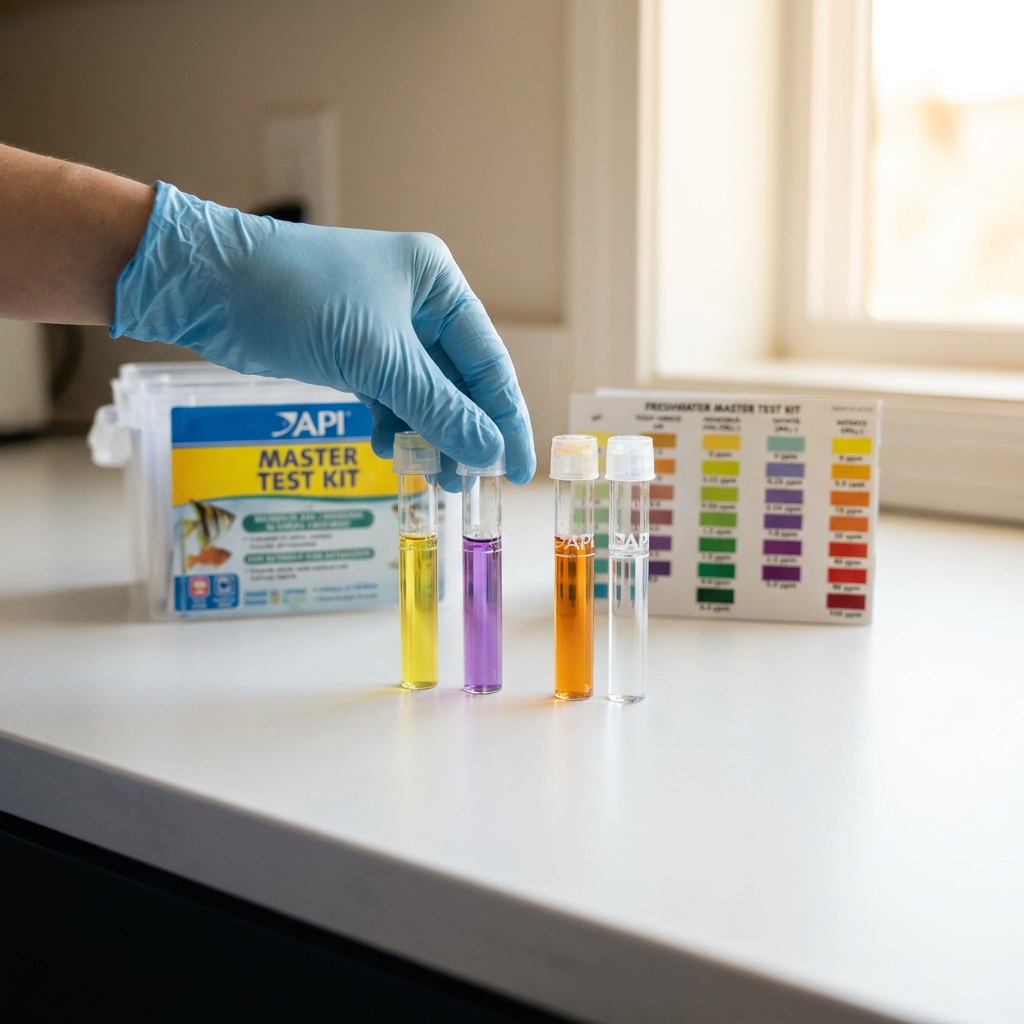
The test kits are the upfront cost. A complete tier-1 test kit (Hanna, Salifert, Red Sea, or API) runs from $80 to $250 depending on the brand and how many parameters you are testing. Hanna checkers are the most accurate for the parameters that matter most (alkalinity, calcium, magnesium, phosphate). Salifert and Red Sea are reliable for nitrate, phosphate, and the trace elements.
The weekly time cost is 20-30 minutes for all seven tier-1 parameters, plus 5 minutes to log the results. This is less time than most keepers spend each week watching their fish.
The bottom line
A reef log is not a chore. It is a 30-minute-per-week insurance policy against a 6-month diagnostic problem. Print the template, buy the test kits, log the results. The trend is what tells you whether the tank is healthy. The snapshot is what tells you whether to panic. The log gives you both, in time to do something about it.
About the author
Olivia Brown is a marine aquarium specialist based in San Diego with 18 years of experience in reef husbandry and 9 years consulting for advanced hobbyists and small public aquariums. She has a particular focus on mixed-reef and SPS systems, water chemistry stability, and long-term coral health, and has published articles in several reef-keeping magazines and online publications. See her full profile at [authors/Olivia Brown/](../Olivia%20Brown.md).