

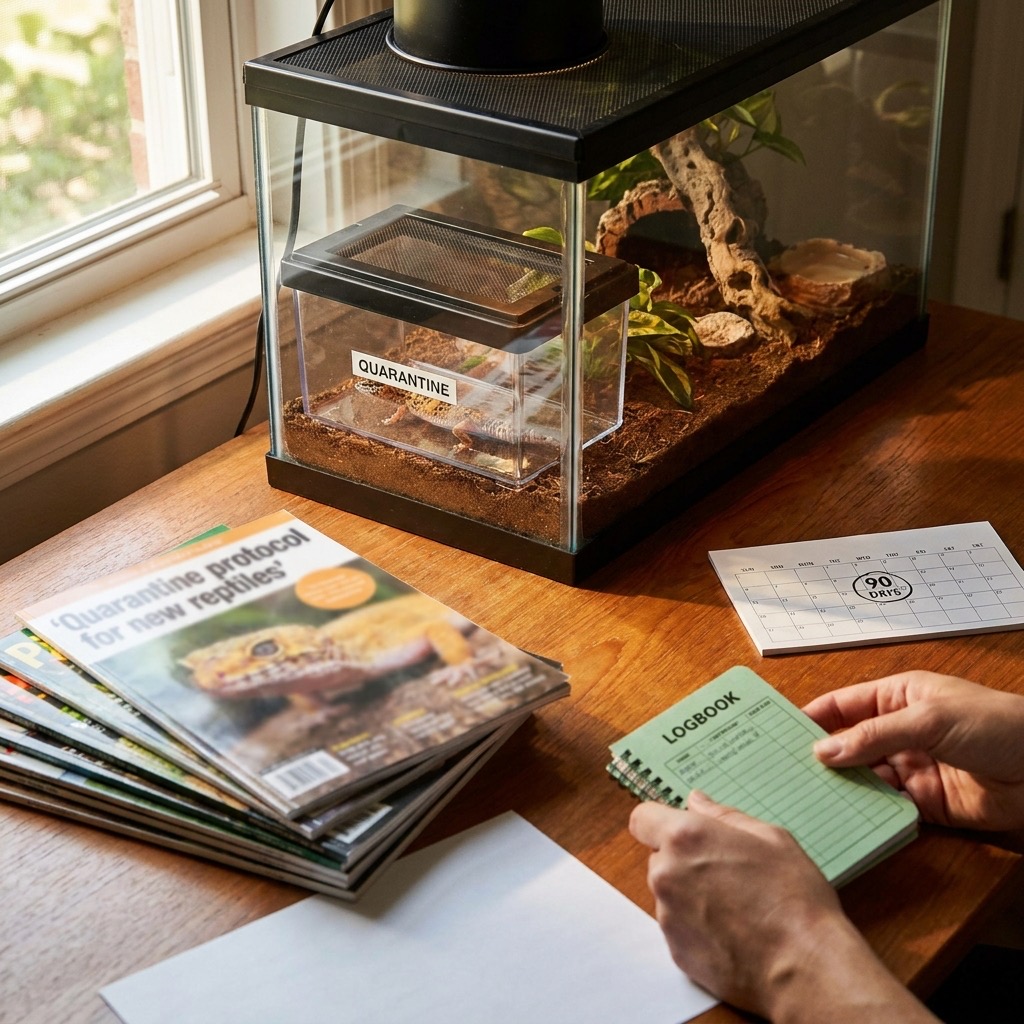
Quarantine protocol for new reptiles: why the 90 days save lives
I learned this the hard way back in 2014. Brought home a juvenile boa constrictor from a regional expo, put him straight into the rack with my established collection. Within six weeks three of my females tested positive for Cryptosporidium serpentis. Treatment failed in two of them. I lost a 9-year-old Dumeril's boa that I had raised from a hatchling. The lesson cost me about £4,000 in vet bills, eight months of agonising treatment, and a piece of my heart.
Never again. Every new reptile that enters my facility goes through 90 days of strict quarantine, no exceptions.
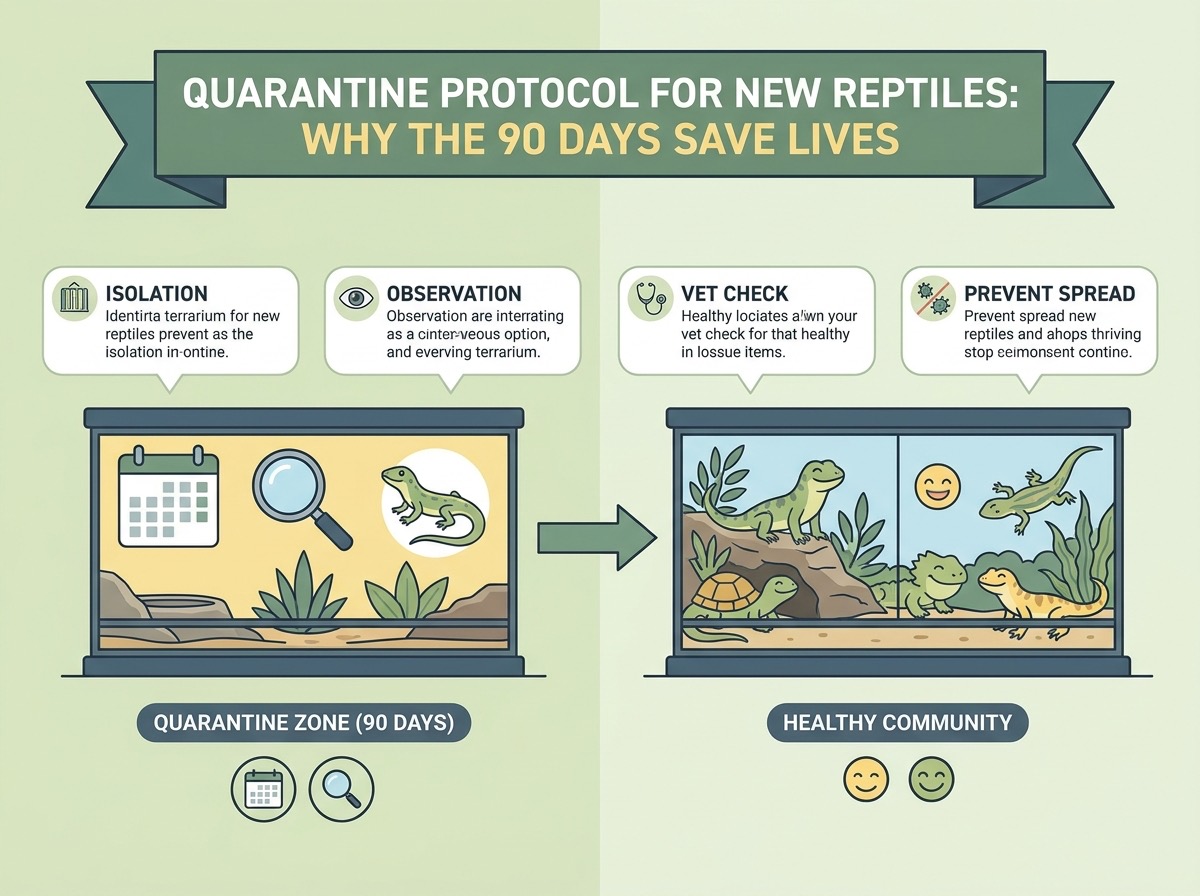
Why the 90 days
Most reptile pathogens have an incubation window before they show symptoms or shed detectable levels of parasite oocysts. Cryptosporidium typically shows up on a PCR test at 4–6 weeks post-exposure. Nidovirus (the one that wipes out entire snake collections) can take 6–8 weeks to convert. Inclusion body disease in boas can hide for 12+ weeks. If you test at 2 weeks post-arrival and clear, you have not cleared — you have just tested too early.
The room setup
The quarantine room needs to be physically separate from your main reptile area. Not "down the hall". A separate room with its own ventilation if you can manage it. I run a small bedroom converted to reptile quarantine; the door stays closed, and I treat it like a biosecurity boundary.
Inside the room:
- One enclosure per new animal (no co-habitation during quarantine)
- Substrate that is easy to replace entirely — paper towels work, reptile carpet works, loose substrate does not
- Dedicated water bowls, hides, and decor — nothing that ever goes back into the main collection
- A dedicated scale (I use a 5 kg digital kitchen scale, ±1 g accuracy)
- A small fridge for stool samples
- A notebook or spreadsheet for daily weights and observations
The cost of setting this up is far less than the cost of losing one or two established animals to a preventable pathogen.
The daily 5-minute check
Every animal gets a daily visual plus weight check. The data goes in the notebook, every day, no exceptions:
- Weight (in grams, same scale every time)
- Appetite (ate eagerly / ate reluctantly / refused)
- Faecal output (normal / loose / absent / abnormal colour)
- Shedding (in shed / clear / stuck shed)
- Behaviour (active / hiding / lethargic / defensive)
A consistent weight loss of more than 5% over two weeks is a yellow flag. A consistent refusal to feed for more than three consecutive weeks in a snake (six weeks for an established adult) is a red flag.
The vet schedule
There are three vet visits during the quarantine window:
| Visit | Timing | What we test |
|---|---|---|
| 1 | Within 7 days of arrival | Visual exam, initial faecal float, baseline weight |
| 2 | 45 days post-arrival | Full faecal panel, PCR for crypto and nidovirus (snakes), cloacal swab |
| 3 | 90 days post-arrival | Repeat full panel + final visual + clear certificate |
The PCR testing is non-negotiable for snakes. Visual inspection alone catches maybe 30% of crypto cases in early infection. PCR catches 95%+.
Hygiene protocol between animals
If you have multiple animals in quarantine, work the healthiest one first and the most suspect one last. Between every animal:
- Wash hands with chlorhexidine or F10SC veterinary disinfectant
- Use a fresh pair of nitrile gloves if you have any cuts on your hands
- Clean and disinfect any tools between animals (thermometers, forceps, scales)
- Change clothes if you are going back into the main collection
I also keep a spray bottle of F10SC (diluted to 1:500) by the door of the quarantine room. Anything that crosses the threshold gets a spray-down.
What to do if a test comes back positive
If the 45-day test returns positive for anything — Ophidian Paramyxovirus, Cryptosporidium, nidovirus, even a heavy nematode load — that animal stays in quarantine for an additional 60 days and is re-tested before any move. There is no negotiation on this. The alternative is potentially introducing a pathogen that can persist in your facility for years.
For crypto specifically, treatment is difficult and often unsuccessful. Euthanasia is sometimes the most humane option for severely affected snakes. This is a hard thing to write but pretending otherwise does not serve the reader.
A note on vendor trust
Quarantine is not because you distrust the breeder or the pet store. It is because even the most reputable breeders occasionally have asymptomatic carriers slip through. The 2018 outbreak of nidovirus in a well-known US ball python breeding operation showed that biosecurity matters at every level. Quarantine protects your existing collection, but it also protects the vendor's reputation by ensuring you do not blame them for something your new animal brought from somewhere else entirely.
The bottom line
90 days. Three vet visits. Daily weights. Separate everything. The protocol I just outlined takes about 15 minutes a day for a small quarantine room and costs roughly £300 in vet fees across the 90-day window. Compared to losing a single established animal to a preventable disease, it is the cheapest insurance you will ever buy.
---
About the author: [Amelia Sterling](../Amelia%20Sterling.md) is an MSc in Reptile Medicine from the Royal Veterinary College, London, with 14 years of reptile practice and a personal collection of more than 20 reptile species.