

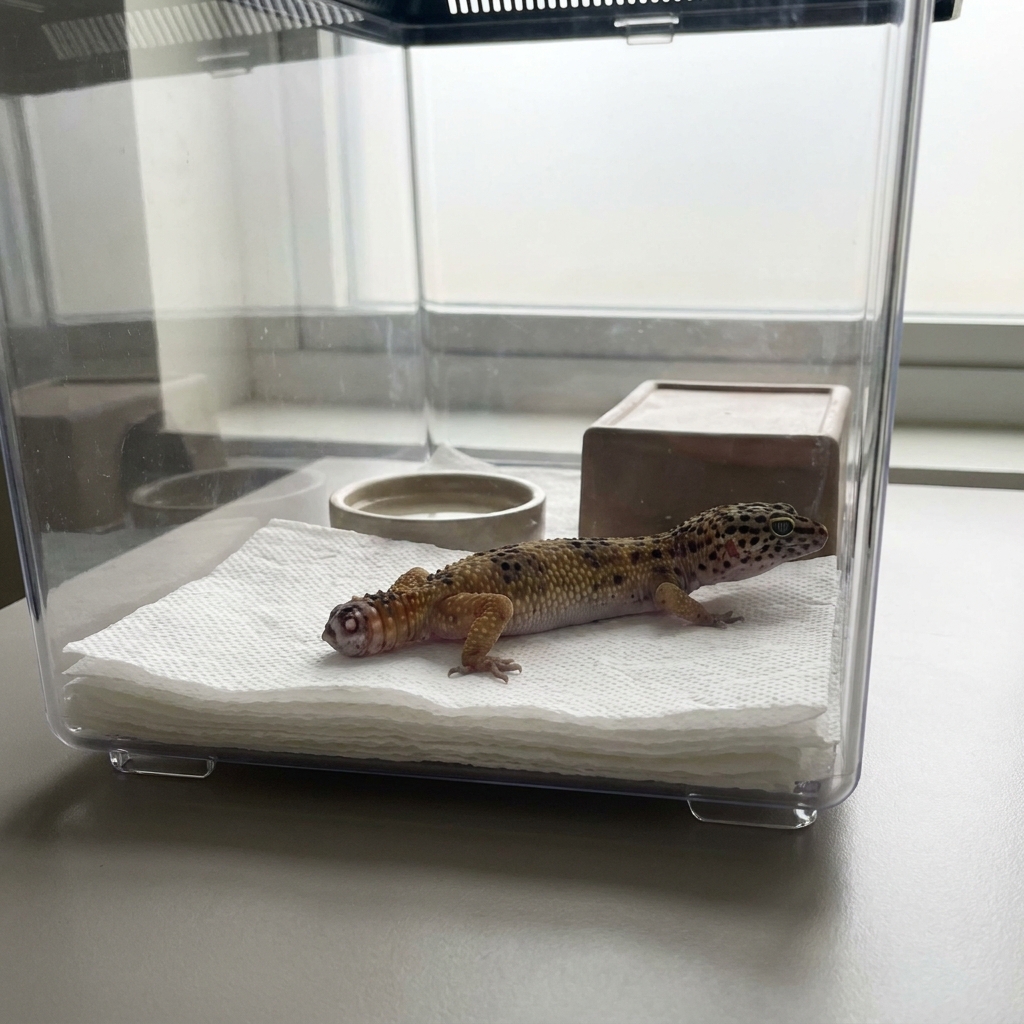
Gecko tail drop: can it regenerate, and what to do in the first 24 hours
Tail drop, also called caudal autotomy, is one of those things that sounds catastrophic but is actually a normal biological process in many lizard species. The tail detaches at a predetermined fracture plane in the vertebrae, the surrounding muscles contract to minimize blood loss, and the tail continues to wiggle on its own for several minutes - a behavior that distracts predators while the lizard escapes. It is an evolutionary adaptation, not an injury. That said, it is still a stressful event for the lizard, and how the keeper handles the first 24 hours determines whether the tail regrows cleanly or the gecko develops a chronic problem.
The good news: most gecko species regenerate their tails. The regenerated tail is not identical to the original - it is usually shorter, smoother, and a different color - but it serves the same functions. There are exceptions by species, and the exceptions matter for management.
Which geckos can and cannot regenerate
A simple list of the common pet gecko species and their tail regeneration status:
- Leopard gecko (Eublepharis macularius): regenerates. The regrown tail is shorter, fatter, and has a smoother scalation pattern. It can take 6-8 weeks to fully regrow.
- Crested gecko (Correlophus ciliatus): does not regenerate. Once dropped, the tail is gone for life. The gecko adjusts without it.
- Gargoyle gecko (Rhacodactylus auriculatus): regenerates, but the regrown tail is usually smaller and less perfectly formed than the original.
- African fat-tailed gecko (Hemitheconyx caudicinctus): regenerates, similar to leopard geckos.
- Day gecko (Phelsuma spp.): does not regenerate. The tail is gone permanently.
- Tokay gecko (Gekko gecko): regenerates.
- Gold dust day gecko (Phelsuma laticauda): does not regenerate.
The species determines everything. If you are not sure whether your gecko's tail will regrow, look up the species before assuming it will.
Why geckos drop their tails
The tail is dropped as a defense response. The triggers:
- Direct physical threat: a predator grab, a sudden grab by a human, a fight with a cage mate. The most common cause in captivity.
- Stress: loud noises, sudden movement, the gecko being cornered with no escape route.
- Improper handling: holding the gecko by the tail, rough handling, or grabbing a gecko that does not want to be held.
- Cage mate aggression: two geckos in the same enclosure, with one bullying the other. The bullied gecko drops the tail to escape. This is why leopard geckos are best housed singly.
- Reflex response to a perceived threat: a shadow passing overhead, a quick hand movement, a sudden temperature change.
In most cases, the tail drop is preventable. The most common preventable cause is handling - holding the gecko by the tail, or grabbing at the gecko when it is trying to hide.
What to do in the first hour
The tail has dropped. The gecko is probably on the substrate, possibly bleeding slightly from the tail stump. The detached tail is wiggling on the floor of the enclosure. The gecko is in a stress state and should not be handled further.
The actions in order:
- Leave the gecko alone. Do not pick it up. Do not try to reattach the tail. Do not apply anything to the stump. The gecko needs 15-30 minutes of stillness to recover from the stress.
- Remove the detached tail from the enclosure. A wiggling tail is a stress trigger for the gecko, and the tail can also start to decay and produce bacteria.
- Check the stump for active bleeding. A small amount of blood is normal. Active dripping or pooling blood is not - more on that below.
- Reduce stress for the next 24-48 hours. Dim lighting, no handling, no loud noises, no cage mate access. A hide with high humidity (damp paper towel) helps with the early healing.
- Check the substrate. Sand, walnut shell, and other particulate substrates can get into the open wound and cause infection. If the enclosure is on sand, temporarily switch to paper towel for 1-2 weeks while the stump heals.
What does normal healing look like
The stump closes over within 24-48 hours. The open wound is replaced by a dark scab. The scab lightens over 1-2 weeks. A small bump appears at the wound site - this is the start of the regenerated tail. Over 4-8 weeks, the bump elongates into a new tail. The new tail may look slightly different - smoother scales, rounder shape, different color - but it functions normally for fat storage, balance, and (in some species) autotomy again.
During the healing period, the gecko will be less active than usual. This is normal. The body is diverting energy to healing. Feeding continues, but the gecko may eat less for the first week.
When the vet is needed
Some situations are not normal and require veterinary attention within 24 hours:
- Active bleeding that does not stop within 30 minutes. A small amount of blood is fine. A stump that is dripping blood needs a vet visit. The vet may apply a hemostatic agent or suture the stump.
- The tail did not detach cleanly. If the tail is partially detached, hanging by a piece of skin or tissue, the gecko needs vet care to either complete the autotomy cleanly or to surgically close the wound. Do not pull the partially detached tail off yourself.
- Signs of infection in the first 1-2 weeks. Swelling, redness spreading from the stump, discharge that is not clear, foul smell. These are signs of a bacterial infection that needs antibiotics.
- The gecko has not eaten in 7+ days post-drop. A leopard gecko that drops its tail will be stressed and may not eat for the first few days, but should resume feeding within a week. Continued refusal needs a vet visit.
- The gecko is showing other symptoms of distress. Lethargy beyond a few days, abnormal posture, weight loss, abnormal stools. These suggest a secondary issue.
Diet during regeneration
The tail is the gecko's primary fat storage organ. A leopard gecko with a full tail is a leopard gecko with several weeks of food reserves. A leopard gecko that has just dropped its tail has lost those reserves. The regrowing tail requires protein, fat, calcium, and vitamin D3 to build new tissue.
Practical adjustments:
- Feed more often: increase feeding frequency from every other day to daily for 4-6 weeks while the tail regrows.
- Dust every meal with calcium + D3 for the regeneration period. The new tail growth is metabolically expensive.
- Offer higher-fat prey items: waxworms (in moderation), small amounts of hornworm, well-fed crickets. The regrowing tail will store the fat.
- Add a small amount of high-quality wet food: a teaspoon of Repashy or Pangea for leopard geckos that accept it, or a small amount of mashed silkworm for species that take it.
The regrown tail is usually fatter than the original because the body over-compensates. This is normal and is not a sign of obesity.
Preventing future tail drops
A few specific changes to keep in mind:
- Never grab a gecko by the tail. This is the single most common preventable cause of tail drop.
- Provide adequate hides. A gecko that cannot hide will be in a chronic low-level stress state. Multiple hides, one on each end of the thermal gradient, reduce stress-triggered drops.
- House leopard geckos and most other pet geckos singly. Cage mate aggression is a common cause of tail drops in leopard geckos, African fat-tails, and similar species. The only commonly kept social gecko is the day gecko, and even there, careful monitoring is required.
- Avoid sudden movements and loud noises around the enclosure. Geckos are sensitive to vibrations. A slamming door or a sudden shadow can trigger a stress response.
- Handle gently and slowly. The gecko should walk onto your hand, not be grabbed. If the gecko is squirming or trying to flee, return it to the enclosure.
The bottom line
A tail drop is not an emergency, but it is a sign that something in the gecko's environment or handling needs to change. The first 24 hours set the stage for clean healing. The next 6-8 weeks set the stage for proper regeneration. The keeper's job is to reduce stress, watch for complications, and feed well during the recovery. The gecko's job is to grow a new tail. Most do, beautifully.
About the author
Amelia Sterling is a reptile husbandry specialist based in the UK with 14 years of experience working with pythons, boas, geckos, and agamids. She runs a small breeding operation focused on Leopard geckos and Crested geckos, and consults on quarantine and biosecurity for hobby collections across Europe and North America. See her full profile at [authors/Amelia Sterling/](../Amelia%20Sterling.md).