

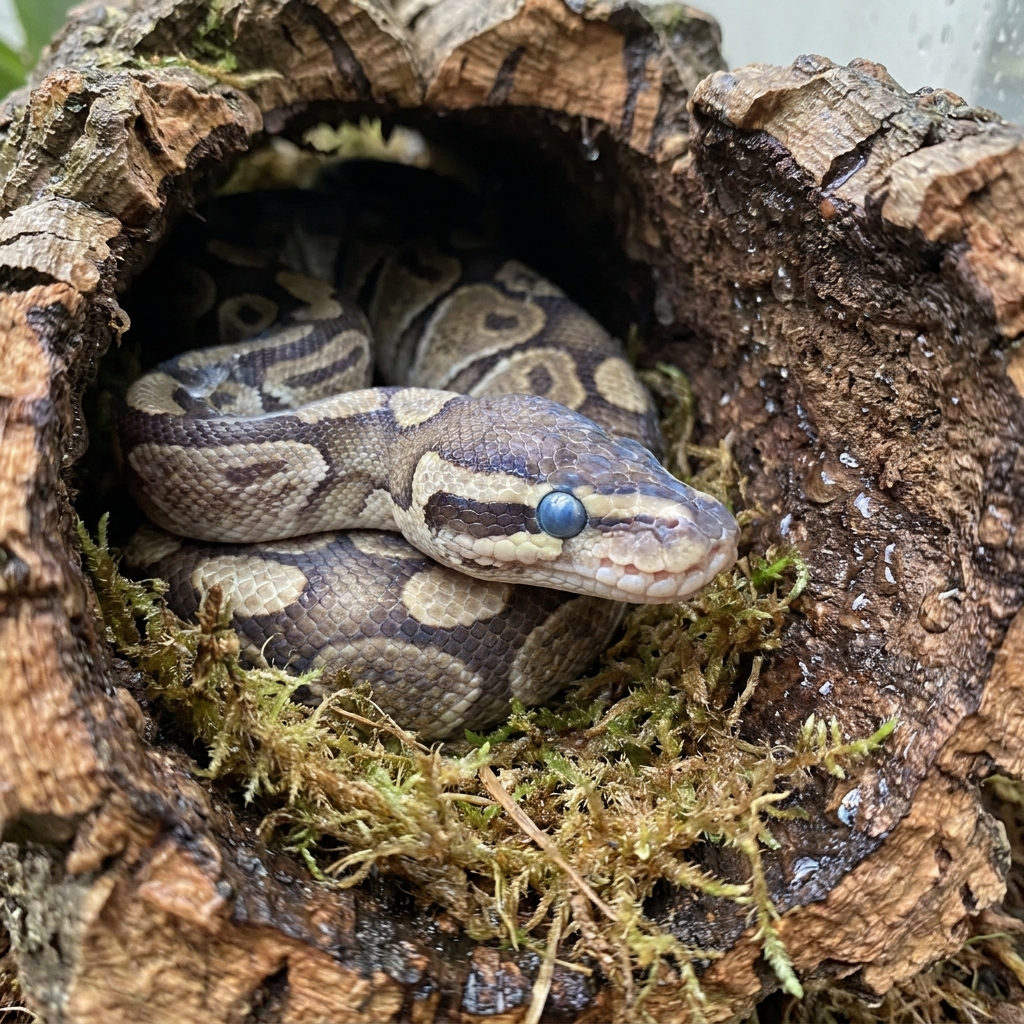
Ball python humidity and shedding management
The most common husbandry question I get from ball python keepers is about humidity. The most common ball python health problem I see in my consultation work is dysecdysis - stuck shed - which is almost always a humidity problem. The two are connected, and once a keeper understands the connection, the rest of the humidity question answers itself.
The short version: ball pythons need 60-80% relative humidity, with a temporary bump to 80-90% during the shedding period. Most home setups run too dry. The fix is usually not a more powerful humidifier - it is better enclosure design and a more thoughtful approach to the ventilation trade-off.
Why humidity matters for ball pythons
Ball pythons are native to West and Central Africa, where they live in savanna-grassland mosaics, termite mounds, and rodent burrows. The microclimate in those environments is stable, humid, and protected from wind. The snake's skin and respiratory system are adapted to that environment. A pet ball python kept at 30-40% humidity - typical of a heated home in winter - is in a chronically dehydrated state, even if the water bowl is full.
The visible effects of chronic low humidity:
- Stuck shed: shed skin comes off in patches instead of one piece. The eye caps, the tail tip, and the dorsal scales are the most common places to see stuck shed.
- Respiratory infection: low humidity dries the mucous membranes of the respiratory tract, making the snake more susceptible to bacterial and fungal infections.
- Poor feeding response: a dehydrated snake often refuses food.
- Chronic kidney stress: long-term dehydration puts extra load on the kidneys. This is harder to see acutely but shows up as kidney disease in older snakes.
The 60-80% baseline
The general range for ball pythons:
- Ambient humidity (most of the time): 60-70%
- Humid hide (always available): 70-80%
- Shedding period (the week before the shed): 80-90% ambient
The shedding period is the only time ambient humidity needs to be at the high end. Most of the time, 60-70% is the right target. A digital hygrometer with a probe is the only reliable way to know what your humidity is. The cheap stick-on analog gauges sold in pet shops are inaccurate by 10-20% in either direction.
The four ways to raise humidity
In order of effort and cost, from least to most:
1. Reduce ventilation
This is the cheapest and most effective change. A screen-top enclosure has continuous ventilation. In a dry climate or a heated home in winter, that ventilation is what keeps the humidity low.
Solutions:
- Cover 50-75% of the screen top with aluminum foil, plastic sheeting, or a custom-cut piece of acrylic. Leave a small uncovered section for air exchange.
- For PVC or wood enclosures, check that the ventilation slots are not larger than necessary.
- For rack systems, add a solid door to the tub.
A 50% screen-top reduction usually raises ambient humidity by 10-15 percentage points. The trade-off is reduced air exchange, which can cause the enclosure to smell stagnant if you have a heavy bio-load. For a single ball python in a properly cleaned enclosure, this is rarely a problem.
2. Increase substrate moisture
Substrates that hold moisture are your friend. Cypress mulch, coconut husk, sphagnum moss, and bioactive substrates all hold moisture and release it slowly. Newspaper, paper towel, and aspen shavings do not.
If the ambient humidity is too low, adding 5-10 cm of cypress mulch or coconut husk and pouring 250-500 ml of water into the substrate (away from the snake) raises ambient humidity for several days. This is the technique I use most often for keepers with chronic low humidity.
Avoid misting the snake or the enclosure walls. The water beads do not raise ambient humidity meaningfully and they can cause scale rot if the enclosure does not dry out between mistings.
3. Use a humid hide
A humid hide is a small enclosed space (a plastic container with an entrance hole, a purpose-built reptile humid hide, or a small cave with damp sphagnum moss inside) that the snake can enter when it needs higher humidity. The hide maintains 80-90% humidity regardless of ambient.
Most ball pythons will use a humid hide voluntarily, especially during the shedding period. Place it on the warm end of the enclosure - the snake is more likely to use it there because the heat helps the moisture penetrate the skin.
A humid hide is not a substitute for ambient humidity. The hide is a local solution. The ambient humidity should still be 60-70% outside the hide.
4. Add a humidifier
This is the most expensive option and the one I recommend last. Ultrasonic humidifiers, reptile-specific foggers, and cool-mist humidifiers can all raise ambient humidity, but they require monitoring to avoid over-humidifying, and they can introduce bacteria and minerals into the air.
If you do use a humidifier:
- Use distilled or RO water, not tap water. Tap water leaves mineral deposits on enclosure surfaces.
- Clean the humidifier weekly to prevent bacterial growth.
- Use a hygrometer with an alarm so you know if humidity climbs above 90% (which can cause respiratory issues at warm temperatures).
The shedding period protocol
The signs a ball python is about to shed:
- The eyes turn a milky blue ("blue phase" or "in blue"). This is fluid building up between the old and new skin layers to separate them.
- The body color looks duller, sometimes grayish.
- The belly may look pinkish.
Once you see these signs, the snake is in the shedding cycle. Most ball pythons shed within 7-14 days of the first sign of blue. The shedding itself takes a few hours - the snake rubs its nose on rough surfaces, finds a humid spot, and the skin comes off in one piece ideally.
What to do during the shedding period:
- Raise ambient humidity to 80-90% by reducing ventilation and adding damp substrate.
- Do not handle the snake. Handling can damage the new skin underneath if the shed is partially separated.
- Do not feed. The snake's eyes are cloudy and its vision is impaired. Feeding during this period is stressful and the snake may not eat.
- Check the snake once daily without handling. A visual check is enough.
What to do when the shed happens:
- Inspect the shed. A complete shed looks like a single piece of translucent skin, including the eye caps (look for clear discs at the shed opening).
- A stuck eye cap is a common problem. It looks like a small piece of shed skin still covering one or both eyes.
- A stuck tail tip is another common problem. The shed comes off the body but stays attached at the tail.
How to fix a stuck shed
For minor stuck shed on the body:
- Place the snake in a damp pillowcase or a small plastic container with damp paper towel for 20-30 minutes. The moisture softens the stuck shed.
- Gently roll the stuck shed off with your fingers or a soft cloth. Do not pull. If it does not come off easily, soak longer.
- Repeat daily until the shed is gone or until the next shed cycle (often the next shed resolves any remaining stuck shed on its own).
For a stuck eye cap:
- Do not try to peel it off yourself. The risk of damaging the eye is too high.
- Either wait for the next shed (often the next shed releases the eye cap) or take the snake to a reptile-experienced vet for removal.
For a stuck tail tip:
- The tail tip is a particular concern because the constriction can cut off blood flow to the tip. Same gentle approach - soak and roll. If the stuck shed is tight or the tail tip is swollen or discolored, vet visit.
Common mistakes
A few things I see keepers do that make humidity problems worse:
- Misting the snake directly. The water sits on the scales and can cause scale rot, especially if the enclosure does not dry between mistings.
- Using a heat lamp as the primary heat source. Heat lamps dry the air. A ceramic heat emitter, a radiant heat panel, or under-tank heating (with a thermostat) is better for humidity.
- A water bowl that is too small. The humidity contribution of the water bowl is proportional to the surface area. A large shallow water bowl contributes more humidity than a small deep one. Misting the water bowl can briefly raise humidity.
- Asking the snake to "tough it out" with stuck shed. Stuck shed that does not resolve on its own becomes a chronic problem. Treat it.
The bottom line
Ball python humidity is solvable. A 60-70% ambient, a humid hide always available, and a bump to 80-90% during the shed is the protocol. The most common mistake is keeping the enclosure too dry. The fix is rarely a more powerful humidifier - it is reducing ventilation and using a moisture-holding substrate. A digital hygrometer is the only way to know what is actually happening in the enclosure.
About the author
Amelia Sterling is a reptile husbandry specialist based in the UK with 14 years of experience working with pythons, boas, geckos, and agamids. She runs a small breeding operation focused on Leopard geckos and Crested geckos, and consults on quarantine and biosecurity for hobby collections across Europe and North America. See her full profile at [authors/Amelia Sterling/](../Amelia%20Sterling.md).