

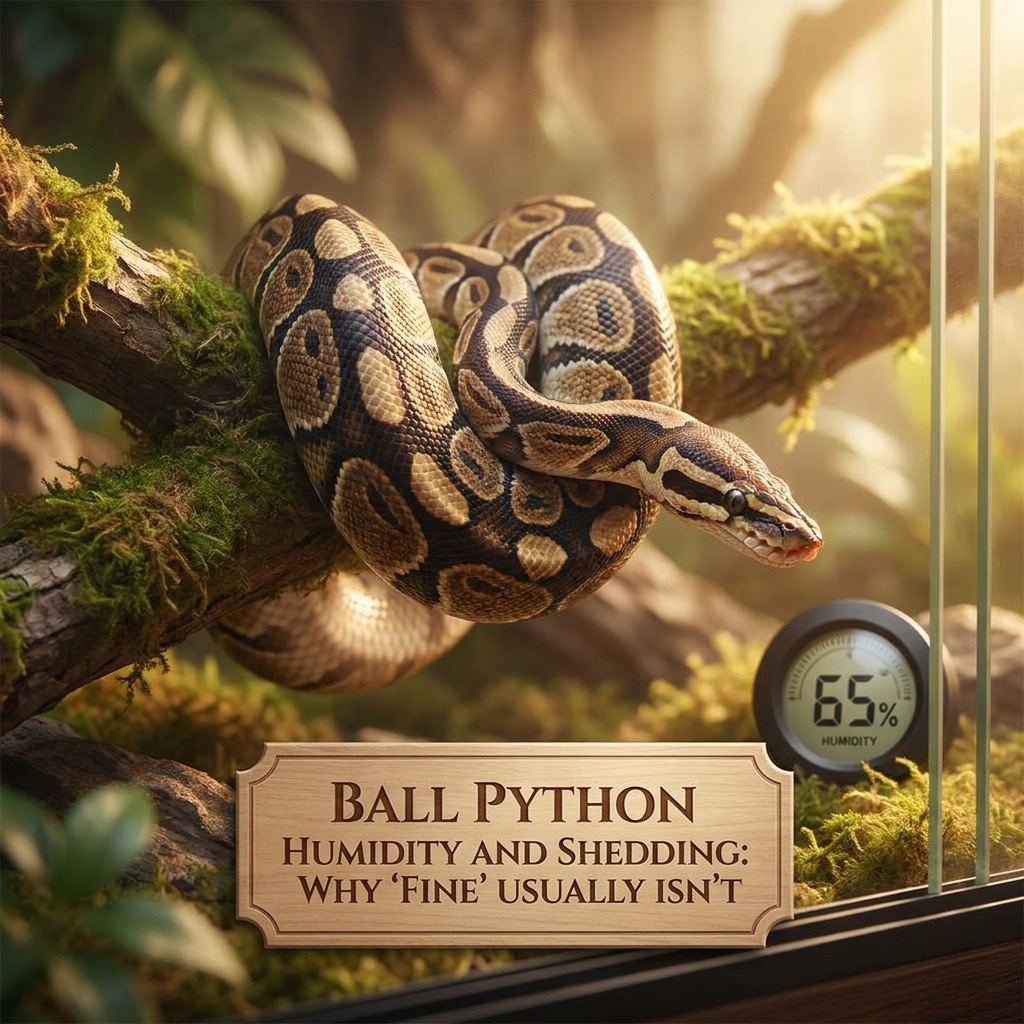
Ball python humidity and shedding: why "fine" usually isn't
The ball python (Python regius) is the most commonly kept pet snake in the world. They are also the species I see most often for chronic dysecdysis (stuck shed), respiratory infections, and the early stages of renal disease — all of which trace back, more often than not, to the same husbandry error: chronic low humidity.
Most ball pythons in captivity live in environments that are too dry. The reasons are mostly historical — pet trade advice from the 1990s and 2000s emphasised ambient room humidity of 50–60%, which sounds reasonable until you realise ball pythons spend 95% of their time inside a humid hide or burrow. The ambient number doesn't reflect what the snake is actually experiencing.
This is what I recommend for healthy, 30+ year captive ball pythons.
The humidity range that actually works
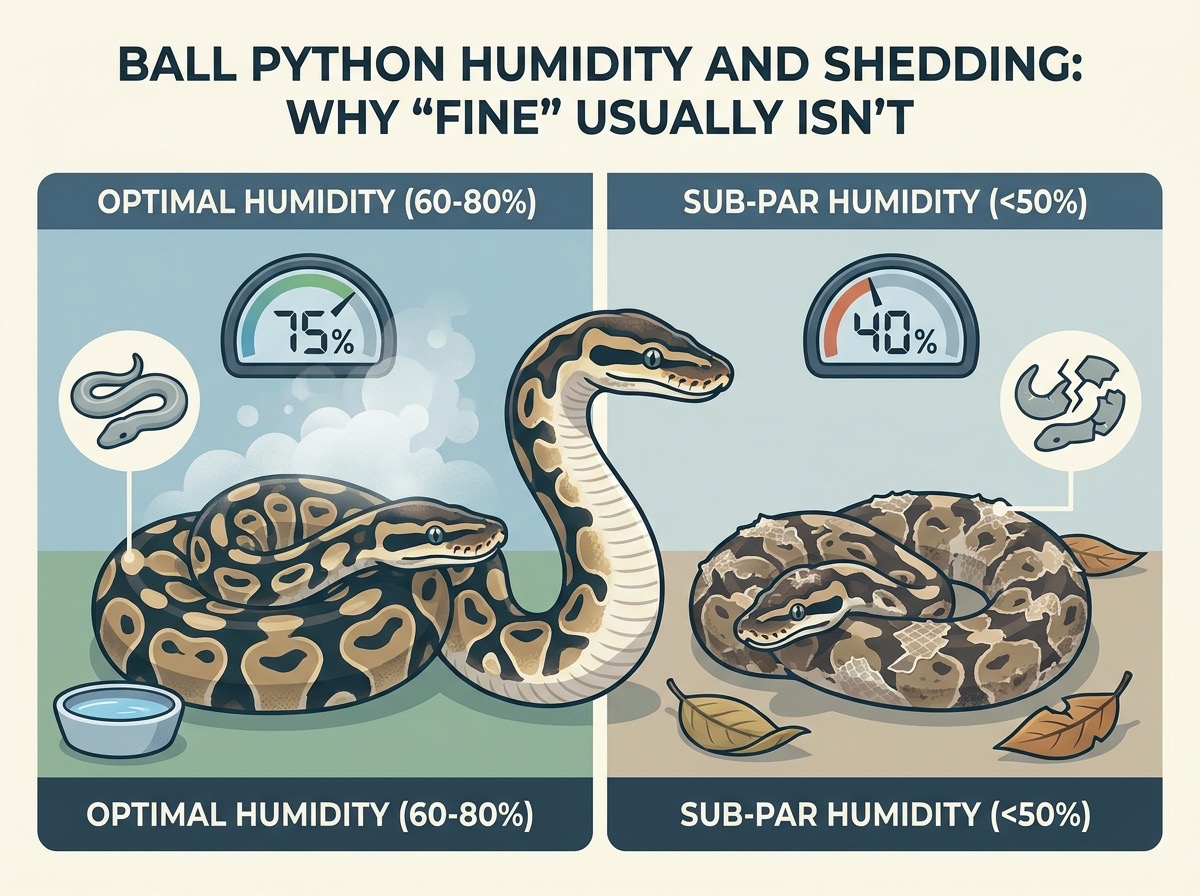
Ball pythons in their native West and Central African range live in humidity that swings between 60% and 90% across the day, with microclimates inside burrows and termite mounds at sustained 80–95%. Captive husbandry should target:
- Ambient humidity: 60–70% during the day
- Humid hide humidity: 75–85% sustained (this is what the snake experiences when curled in its hide for hours)
- Peak humidity during shed cycle: 80%+ ambient, 90%+ in the humid hide
- Night humidity: can rise naturally as temperature drops; this is fine
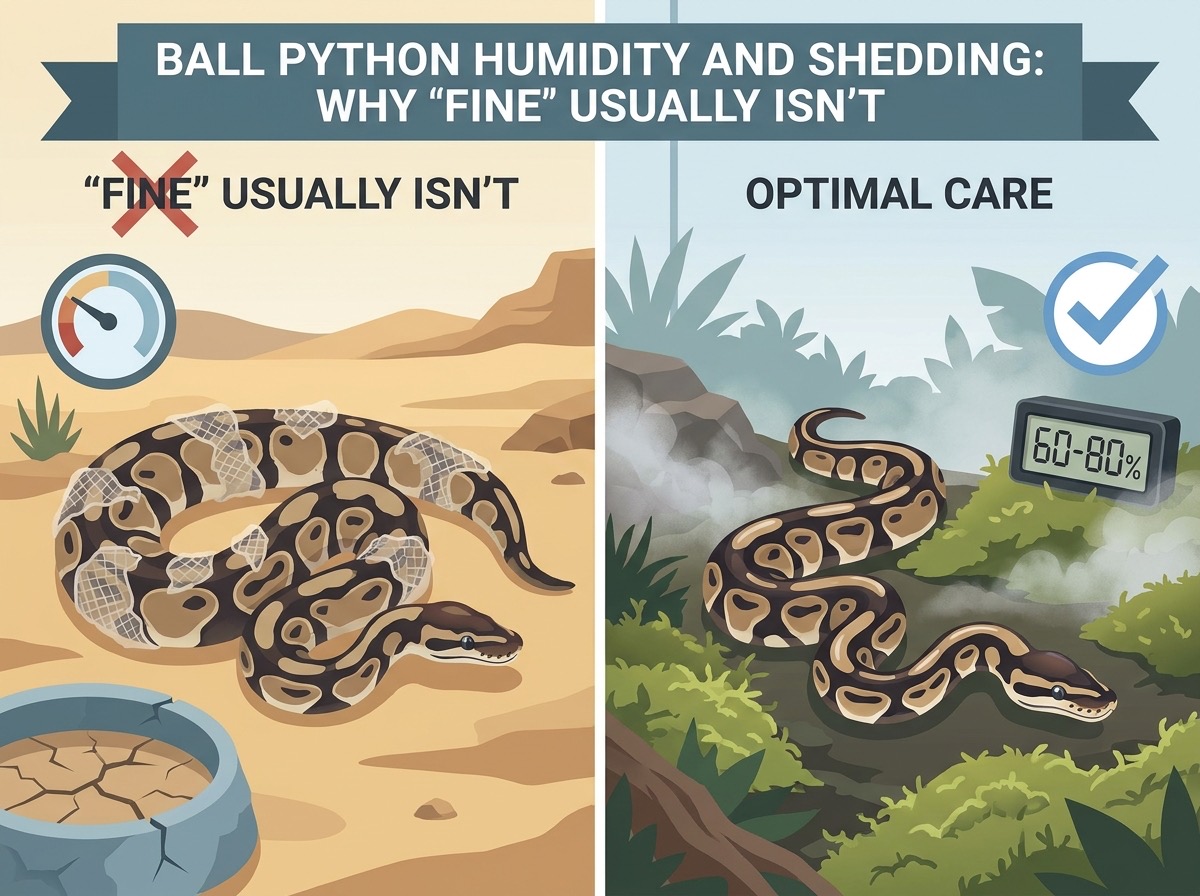
Anything that sits at ambient 40–50% (typical UK or US centrally heated home in winter) for sustained periods is too dry for the species. The snake may survive, but it does so at the cost of chronic dehydration, occasional dysecdysis, and progressive kidney stress.
How to measure humidity that matters
The single most common mistake is measuring humidity in the room, not in the enclosure. Room humidity in winter can be 30–40% in a heated home. The enclosure humidity, even with a water bowl, may still only reach 50–55%.
What I recommend:
- Digital hygrometer placed inside the enclosure at snake level (not at the top, not at the bottom of the glass)
- Pro: the Inkbird IBS-TH1 or the Govee H5179. Both log and Bluetooth-export
- Replace the cheap analogue dial hygrometers that come with most starter kits — they read ±15% which is useless for ball python husbandry
- Check the hygrometer accuracy once with the salt test: a sealed bag of table salt + a few drops of water should read 75% after 24 hours
How to raise humidity without overdoing it
Three reliable methods, in order of effectiveness for most homes:
1. Substrate moisture management
Switch from aspen shavings (which dries out fast) to a moisture-retentive substrate:
- Cypress mulch (Forest Floor, Zoo Med) — best option, holds humidity without going mouldy, resists fungal growth
- Coconut husk (Eco Earth, Zoo Med) — also good, slightly more prone to surface mould if over-wet
- Orchid bark + sphagnum moss mix — works for display enclosures
Maintain the substrate by adding water directly to one side (the "humid half") during water changes. The dry half stays dry, the humid half reads 75–85%, the snake thermoregulates between them.
2. Humid hide setup
A humid hide is non-negotiable for ball pythons. Even with ambient humidity corrected, the hide is where the snake spends 95% of its time, so it needs its own microclimate.
How to make one:
- A plastic container with a hole cut in the side (sized for the snake to enter easily)
- Damp sphagnum moss inside, replaced every 1–2 weeks to prevent mould
- Mist lightly every 2–3 days so the moss stays damp but not soaking
- Place it on the warm side, not the cool side — heat + humidity together is the combination that produces clean sheds
3. Enclosure size and ventilation
Smaller enclosures are easier to maintain humidity in. A 40-gallon breeder (90 × 45 × 45 cm) for an adult ball python is fine — they don't need the 6-foot enclosures that some pet stores push. Smaller volume + less ventilation = humidity holds better. If you have a large display enclosure, partially cover the screen top with a sheet of acrylic or aluminium tape to reduce ventilation by 50–70%.
The shedding cycle, week by week
Ball pythons shed roughly every 4–8 weeks when young (under 1 year), every 6–10 weeks as adults. The cycle has four stages, each with different husbandry implications:
Stage 1: pre-shed (first 7–10 days)
The snake's belly pinkens, then dulls. The eyes turn a milky blue ("blue phase" or "in blue"). The snake typically refuses food during this stage — completely normal. Do not attempt to feed.
Increase humidity: bump ambient to 75–80%, make sure the humid hide moss is fresh and damp.
Stage 2: clear phase (2–4 days)
The eyes clear from blue back to normal. The snake may still refuse food but is preparing to shed.
Stage 3: shed (1–2 days)
The snake rubs its nose against décor to break the shed, then crawls out of the old skin. The skin should come off in one piece, including the eye caps (spectacles) and the tail tip.
Stage 4: post-shed (1 week)
The new skin is brighter and more vivid. The snake is usually ready to feed again.
When shedding goes wrong: dysecdysis
Dysecdysis (stuck shed) is what happens when humidity is too low during the shed cycle, or when the snake is dehydrated for other reasons. Stuck shed most commonly appears:
- Eye caps — the most common site. The old spectacle does not come off with the rest of the shed and remains as a white film over the eye
- Tail tip — retained shed bands constrict blood flow and can cause tail-tip necrosis over weeks
- Body folds and creases — small patches of retained skin around neck folds, vent area, scale pits
How to help with stuck shed
For mild cases (small patches, no eye caps):
- Place the snake in a damp towel inside a closed plastic container for 30–60 minutes. The high humidity softens the retained skin.
- Gently roll the snake between your fingers with the damp towel. Most retained shed comes off without pulling.
- For stubborn eye caps, very gently roll the cap off with a damp cotton bud. If it doesn't come off easily, do not force it — rehydrate and try again the next day. Forcing an eye cap off can damage the underlying spectacle permanently.
For severe cases (multiple stuck sheds, eye caps, signs of constriction):
- Veterinary visit. Multiple retained sheds can indicate chronic dehydration, mites, dermatitis, or systemic illness.
- Vet-assisted removal under brief sedation if needed. Do not soak the snake for hours at home — prolonged soaking can cause scale rot.
Humidity and kidney health
The less obvious reason to maintain proper humidity is long-term kidney health. Ball pythons are adapted to humid environments, and their kidneys are adapted to producing relatively dilute urine. Chronic dehydration forces the kidneys to concentrate urine more aggressively, which over years causes progressive renal damage.
I have seen ball pythons at 15–20 years old with chronic kidney disease that I believe was avoidable with better humidity earlier in life. There is no large published cohort study on this — the evidence is clinical, not statistical — but the pattern is consistent enough that I treat it as established in my own practice.
Common mistakes
- Heating the entire enclosure with a ceramic heat emitter and not managing humidity — CHEs dry the air aggressively. Pair them with a moisture-retentive substrate and humid hide.
- Aspen shavings in dry homes — aspen is great for burrowing but dries fast. In dry climates, switch to cypress or a cypress/aspen blend.
- Misting the snake directly — most ball pythons find this stressful. Mist the enclosure, the moss, and the substrate. Don't spray the snake.
- Soaking the snake for stuck shed — 30–60 minutes in a damp towel is enough. Hours of soaking causes scale rot and stress.
- Pulling stuck shed off dry — rehydrate first. Pulling dry skin damages the underlying scales.
The bottom line
Ball python humidity is the single most common husbandry error I see in clinical practice. The fix is straightforward: a moisture-retentive substrate (cypress, coconut), a damp sphagnum humid hide, ambient humidity 60–70%, and a 10–14 day observation around shed cycles. With these basics, most ball pythons shed cleanly every cycle and avoid the chronic kidney stress that I believe contributes to early mortality in captivity.
---
About the author: [Amelia Sterling](../Amelia%20Sterling.md) is an MSc in Reptile Medicine from the Royal Veterinary College, London, with 14 years of reptile practice, and has served as visiting veterinarian at the London Zoo reptile house.