

Quality-of-life scoring: the tool that helps you decide when it's time
The decision to euthanise a pet is the hardest decision most pet owners ever make. It's also the most important. The pet's last day is in the owner's hands, and the owner will carry the memory of that day for the rest of their life. The decision is irreversible. The owner wants to be sure.
Most owners make this decision based on gut feeling, on the emotional state of the moment, on the family's opinion, on the cost of continued care, or on a single dramatic episode (a bad day, a collapse, a refusal to eat). These decision inputs are all real, but they're all unreliable. The owner who waits for a clear sign often waits too long. The pet suffers unnecessarily, and the owner is left with guilt.
Quality-of-life scoring is a structured framework that replaces gut feeling with a measured assessment. It doesn't make the decision. It makes the decision informed. The owner still has the final say. The owner is still the one who walks into the vet's office. But the decision is grounded in a score, a trajectory, and a clear-eyed look at the pet's actual life — not the life the owner hopes the pet is having.
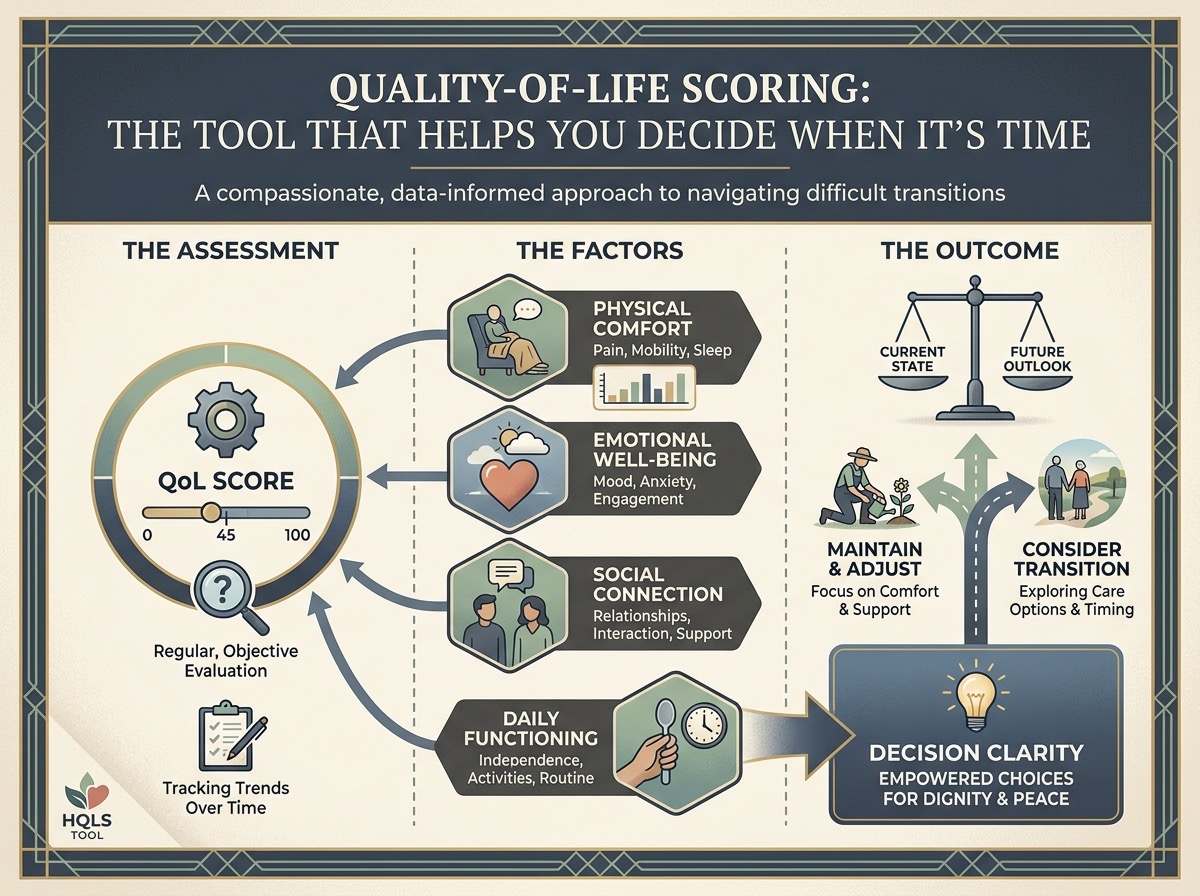
The principle: measure, don't guess
The principle of quality-of-life scoring is to convert a subjective judgment ("is my pet still happy?") into a structured assessment across multiple domains. Each domain is scored, the scores are added, and the total gives the owner a number that can be tracked over time.
A pet that scores high (a "good" life) is one whose owner should continue treatment and care. A pet that scores low (a "poor" life) is one whose owner should have a serious conversation with the vet about euthanasia. A pet whose score is declining over time is one whose owner should be planning for the decision, not waiting for the decision to make itself.
The score doesn't make the decision. The score gives the owner information to bring to the decision. The owner is still the one who decides.
The HHHHHMM scale: the most widely used
The HHHHHMM scale is the most widely used quality-of-life assessment in small animal practice. It was developed by Dr. Alice Villalobos and is now used by most palliative care and hospice veterinarians.
The acronym stands for:
- H: Hurt
- H: Hunger
- H: Hydration
- H: Hygiene
- H: Happiness
- M: Mobility
- M: More good days than bad
Each domain is scored from 1 to 10, with 10 being ideal. The total possible score is 70. A score above 35 is generally considered acceptable. A score below 35 suggests quality of life is poor and the owner should consider euthanasia.
Domain 1: Hurt (pain management)
Pain is the most important domain. A pet in pain is not living a good life, regardless of any other factor.
Scoring:
- 10: no pain, comfortable
- 7-9: mild pain, well-controlled with medication
- 4-6: moderate pain, partially controlled with medication
- 1-3: severe pain, not controlled with medication
Assessment:
- Is the pet showing signs of pain (panting, restlessness, hiding, vocalising, reluctance to move)?
- Is the pet on appropriate pain medication?
- Is the pain medication effective?
- Are there any signs of breakthrough pain?
A pet with osteoarthritis that is comfortable on carprofen and gabapentin is a 7-8. A pet with cancer that is partially controlled on opioids is a 4-5. A pet with severe pain that cannot be controlled is a 1-2.
Domain 2: Hunger
A pet that isn't eating is suffering. The reasons may be medical (nausea, pain, illness) or psychological (depression, anxiety). Either way, a pet that isn't eating needs intervention.
Scoring:
- 10: eating normally, good appetite
- 7-9: eating but with reduced appetite
- 4-6: eating selectively, requires encouragement
- 1-3: not eating, refuses food
Assessment:
- Is the pet eating on its own?
- Is appetite stimulation needed (mirtazapine, capromorelin)?
- Is assisted feeding needed (syringe feeding, feeding tube)?
- Has the pet lost significant weight?
A pet that eats a normal meal enthusiastically is a 10. A pet that eats half its meal and leaves the rest is a 7. A pet that requires syringe feeding to maintain weight is a 4-5. A pet that refuses all food is a 1-2.
Domain 3: Hydration
A pet that isn't drinking is at risk of dehydration. Subcutaneous fluids can be administered at home. A pet that requires subcutaneous fluids to maintain hydration is at a different stage of care than a pet that drinks normally.
Scoring:
- 10: drinking normally
- 7-9: drinking, but increased or decreased
- 4-6: requires subcutaneous fluids to maintain hydration
- 1-3: cannot maintain hydration even with intervention
Assessment:
- Is the pet drinking on its own?
- Is the pet dehydrated (skin tent, tacky gums, sunken eyes)?
- Are subcutaneous fluids being administered?
- Is IV fluid therapy being considered?
A pet that drinks normally is a 10. A pet that requires subcutaneous fluids every 2-3 days is a 5-6. A pet that cannot maintain hydration is a 1-2.
Domain 4: Hygiene
A pet that cannot maintain its own hygiene is in decline. The considerations:
- Urinary and fecal incontinence
- Coat and skin condition
- Wounds or sores from lying down
- Grooming ability
Scoring:
- 10: clean, well-groomed, continent
- 7-9: occasional accidents, manageable
- 4-6: frequent accidents, requires regular cleanup
- 1-3: complete incontinence, pressure sores, severe neglect of grooming
Assessment:
- Is the pet continent?
- Are there pressure sores or hot spots?
- Is the owner able to keep the pet clean?
- Is the pet mobile enough to avoid soiling itself?
A pet that is continent and well-groomed is a 10. A pet that has occasional accidents but is otherwise clean is a 7. A pet that requires diapers and daily baths is a 4-5. A pet with pressure sores and complete incontinence is a 1-2.
Domain 5: Happiness
The most subjective domain, but the most important. Is the pet engaged with life? Does the pet enjoy the things it used to enjoy? Does the pet interact with the family?
Scoring:
- 10: bright, alert, engaged, responsive
- 7-9: alert, responsive, but less engaged
- 4-6: intermittent engagement, periods of withdrawal
- 1-3: withdrawn, unresponsive, depressed
Assessment:
- Does the pet greet the owner?
- Does the pet show interest in food, walks, toys?
- Does the pet respond to the family's voice?
- Is the pet sleeping more than usual?
A pet that wags its tail at the door and greets the owner is a 10. A pet that responds to the owner but sleeps more is a 7. A pet that has withdrawn and no longer responds is a 3.
Domain 6: Mobility
A pet that cannot move is suffering. The considerations:
- Ability to stand and walk
- Ability to posture for elimination
- Muscle atrophy
- Falls or stumbles
- Willingness to move
Scoring:
- 10: normal mobility
- 7-9: stiff, slow, but mobile
- 4-6: requires assistance (sling, harness)
- 1-3: unable to stand or move without significant help
Assessment:
- Can the pet stand on its own?
- Can the pet walk to its food bowl?
- Can the pet posture to urinate and defecate?
- Does the pet fall or stumble?
- Is the pet in pain when it moves?
A pet that walks normally is a 10. A pet that is stiff but can walk to its bowl is a 7. A pet that needs a sling to walk is a 4-5. A pet that cannot stand is a 1-2.
Domain 7: More good days than bad
The aggregate assessment. A pet that has more good days than bad days is having a net-positive life. A pet that has more bad days than good days is having a net-negative life.
Scoring:
- 10: almost all good days
- 7-9: more good days than bad
- 4-6: even mix
- 1-3: more bad days than good
Assessment:
- Over the past week, how many good days?
- Over the past month, what's the trend?
- Is the trajectory stable, improving, or declining?
A pet with 6 good days out of 7 is a 9. A pet with 3 good days out of 7 is a 4. A pet with 1 good day out of 7 is a 1.
The interpretation of the total score
The total HHHHHMM score:
- Above 50: generally considered a good quality of life. Continue treatment and care
- 35-50: borderline. The owner should be having conversations with the vet about prognosis and options
- Below 35: poor quality of life. The owner should be seriously considering euthanasia
- Trajectory: a pet that is declining from 50 to 35 to 25 over weeks is in a different position than a pet that is at 40 consistently. The trajectory matters as much as the absolute score
The score is a tool, not a verdict. A pet at 30 may be having a good day today, and the owner is not obligated to euthanise. But the score is a signal that the time is approaching.
The other scales: alternatives and supplements
The HHHHHMM scale is the most widely used, but other scales exist.
The "Five Freedoms" adaptation
The Five Freedoms were developed for farm animal welfare but apply to companion animals:
- Freedom from hunger and thirst
- Freedom from discomfort
- Freedom from pain, injury, and disease
- Freedom to express normal behaviour
- Freedom from fear and distress
For a senior pet, the owner assesses each freedom on a 1-10 scale. A pet that has all five freedoms at 7 or above is having a good life. A pet that has lost three or more freedoms is in a poor life.
The "Pet's Bucket List" approach
A more emotional but useful framework. The owner lists the things the pet used to love:
- The morning walk in the park
- The evening meal with the family
- The belly rub on the couch
- The car ride to the store
- The greeting at the door
For each item, the owner assesses: can the pet still do this? Does the pet still enjoy it? Is the pet in pain when it does it?
A pet that has lost 80% of the items on its bucket list is in decline. A pet that has lost all of them has lost its identity.
The "3-3-3" rule for new senior pet adjustments
Not directly a quality-of-life scale, but useful for assessing how well a senior pet has adjusted to a major change (new medication, new environment, new routine):
- 3 days to decompress
- 3 weeks to settle in
- 3 months to feel at home
If the senior pet has had 3 months to adjust to a treatment and is still declining, the treatment may not be working. The owner may need to consider the next step.
The "bad day" trap
A common pattern: the pet has a bad day. The owner, panicked, takes the pet to the vet for euthanasia. The vet examines a pet that, on any other day, would be having a reasonable quality of life. The bad day was a single bad day, not a trend.
The fix: a quality-of-life score over a period of time, not a single day. The owner should score the pet weekly, ideally at the same time of day and in the same circumstances. The scores are tracked over weeks and months.
A single bad day in a sea of good days: not a reason for euthanasia. A consistent pattern of bad days: a reason to have the conversation.
The "guilt" factor
Owners carry guilt about the euthanasia decision, often for years. The guilt is not about making the wrong decision — it's about making the decision at all. The owner wonders: "Should I have done more? Should I have waited longer? Was I being selfish?"
The quality-of-life score addresses the guilt. The owner has a structured assessment, not just a feeling. The owner can show the score to the family, to the vet, to themselves. The decision is grounded in something other than guilt or panic.
A few specific guilt-busters:
- "I waited too long": the score shows the trajectory. The pet was declining. The owner acted when the score reached the threshold, not before, not after
- "I should have done more treatment": the score shows the pet was at a low quality of life despite the treatments. More treatment wouldn't have changed the score
- "The pet still had good moments": a single good moment doesn't override a low score. The aggregate is what matters
- "The family isn't ready": the family's readiness is a consideration, but the pet's quality of life is the primary factor. The pet is not a prop for the family's grief processing
The "natural death" alternative
Some owners choose to let the pet die naturally rather than euthanise. The considerations:
- Palliative care: the owner provides comfort care (pain management, hydration, nutrition) for as long as the pet has a reasonable quality of life. The pet dies at home or at the vet when the time comes
- Hospice care: a more structured palliative care approach, often with a hospice-trained vet. The pet's comfort is the primary focus
- Natural death: the owner chooses not to euthanise. The pet dies when its body fails
The natural death path is appropriate for some pets and some owners. It's not appropriate for pets in severe pain that cannot be controlled. It's not appropriate for owners who cannot provide the round-the-clock care required.
The natural death, when it comes, is not always peaceful. The pet may experience significant distress in the final hours. The owner should be prepared for this. The hospice vet can help with anticipatory guidance and emergency euthanasia if the pet's suffering becomes severe.
The "appointment" conversation
The euthanasia appointment is one of the most important moments in the owner's relationship with the pet. The decisions:
- Where: at the vet's office, at home, or at a pet hospice. Home euthanasia is becoming more common and is preferred by many owners
- When: planned in advance, or at the moment of crisis. Planned is usually better — the owner can say goodbye, the family can be present, the procedure is calm
- Who is present: the family, the vet, the vet tech. The owner decides
- What happens to the body: burial at home (where legal), cremation (private or communal), or other arrangements. The vet can help coordinate
- Memorial items: a paw print, a clipping of fur, a photo. Many vets offer these
The owner should discuss these decisions with the vet in advance, not at the moment of the appointment. The grief fog at the moment of the decision makes the planning harder. The pre-planning makes the appointment easier.
The "after"
After the pet dies, the owner goes through grief. The grief is real, intense, and long. The owner should:
- Allow themselves to grieve
- Lean on the family, the friends, the vet, the support groups
- Consider memorialising the pet in a meaningful way
- Not get a new pet until the grief has been processed (timing varies; weeks to months is common)
- Be aware that the grief can resurface at anniversaries, at moments of quiet, at the sight of a similar pet
The vet who helped with the euthanasia is often a good resource for the grieving owner. The vet can connect the owner to pet loss support groups, recommend grief counsellors, and provide information about the pet loss process.
The bottom line
Quality-of-life scoring is the most useful tool available for the hardest decision in pet ownership. The HHHHHMM scale converts the gut feeling of "is my pet still happy" into a structured assessment across seven domains. The score is tracked over time. The trajectory is what matters. A pet that scores consistently high is having a good life. A pet that scores consistently low is having a poor life. A pet that is declining is approaching the threshold. The owner uses the score to inform the decision, not to make the decision. The vet is the partner in the process. The family is the support. The pet's quality of life is the focus. The decision is irreversible, but the score makes it informed, measured, and grounded. The pet's last day is a gift — the gift of a peaceful, dignified, pain-free ending. The owner gives that gift, and the owner is not wrong to give it.
---
About the author: [James Morrison](../James%20Morrison.md) holds a BVSc from the University of Liverpool and has 22 years of small animal general practice, with a focus on preventive medicine and multi-pet household dynamics.