

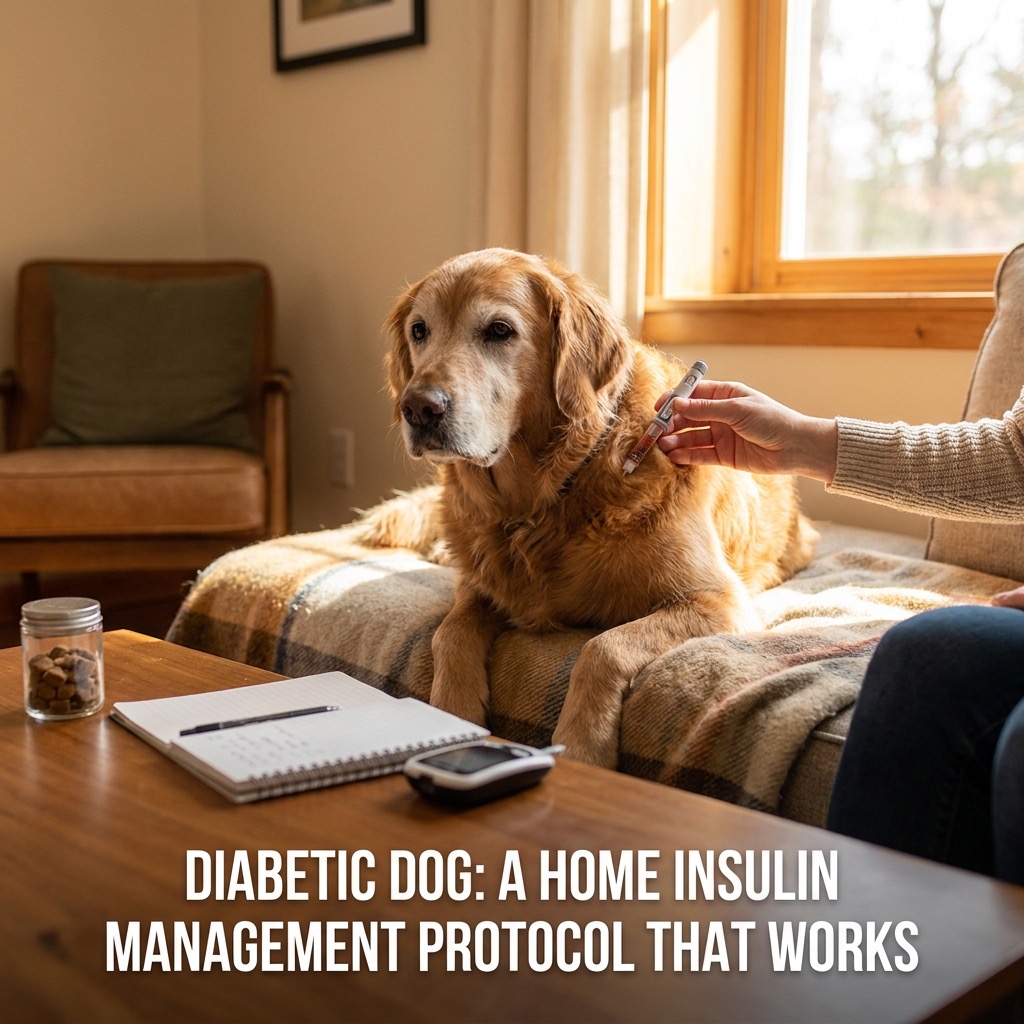
Diabetic dog: a home insulin management protocol that works
Diabetes mellitus in dogs is a manageable condition. The dogs that do well are the dogs whose owners have a structured protocol: consistent timing, correct dose, regular monitoring, and adjustment based on data. The dogs that do poorly are the dogs whose owners treat the insulin as "give a shot and hope". The difference between a stable diabetic dog and an unstable one is the owner's commitment to the protocol.
This is the protocol I give to every newly-diagnosed diabetic dog owner. The first month is the hardest. By month 2-3, the routine is established, the dog is stable, and the owner has the confidence to manage the condition long-term.
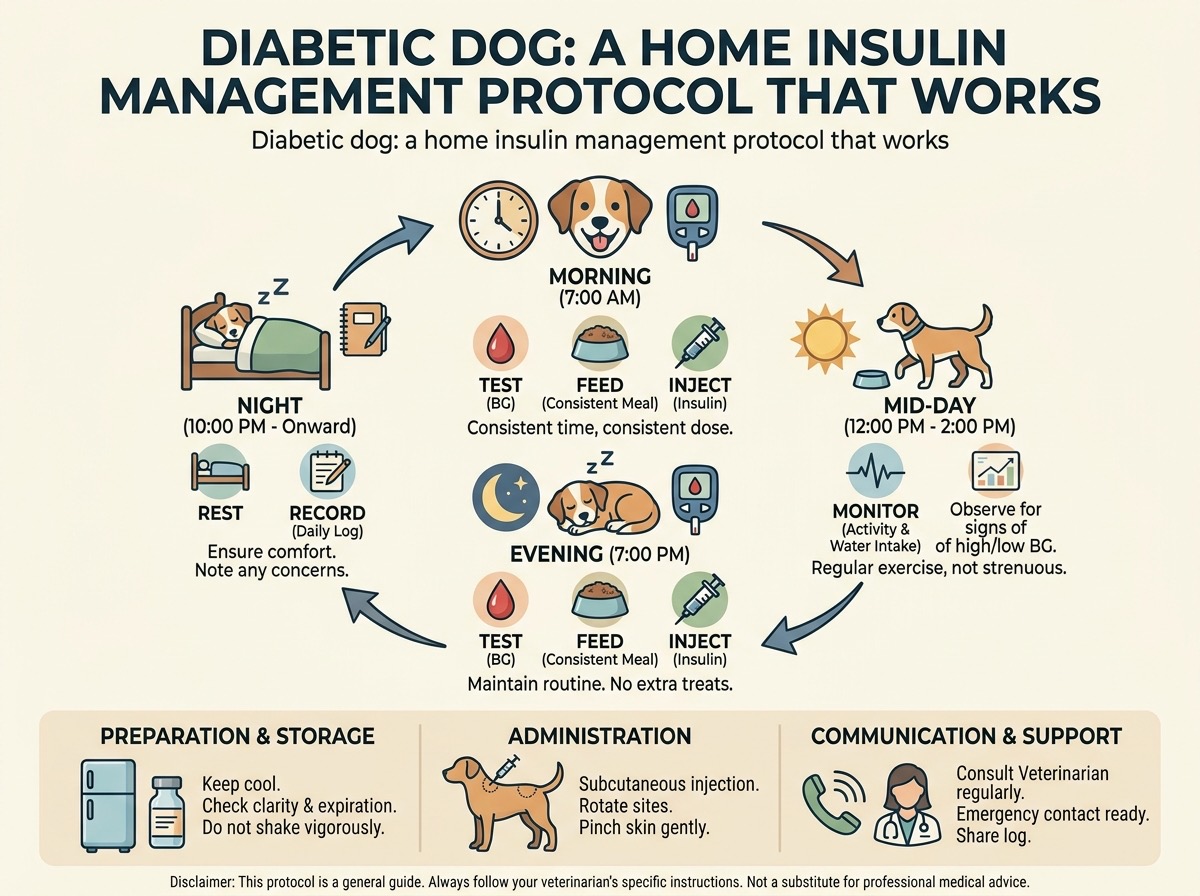
The diagnosis: what diabetes in dogs looks like
Diabetes mellitus in dogs is similar to Type 1 diabetes in humans. The pancreas fails to produce adequate insulin. The result:
- Hyperglycemia: blood glucose is persistently elevated
- Glucosuria: glucose spills into the urine (kidneys can't reabsorb all the filtered glucose)
- Polyuria: the dog urinates excessively
- Polydipsia: the dog drinks excessively to compensate for fluid loss
- Polyphagia: the dog eats excessively (cells can't use the glucose, so the body signals hunger)
- Weight loss: the dog loses weight despite eating more (cells are starving)
The classic presentation: a middle-aged to older dog (most commonly female, often overweight) with the sudden onset of excessive drinking, excessive urination, and weight loss. The owner often brings the dog in for "drinking too much water" or "having accidents in the house".
The diagnostic tests
The diagnosis is straightforward:
- Fasting blood glucose: above 200 mg/dL (normal is 70-110 mg/dL)
- Fructosamine: a measure of average blood glucose over the past 2-3 weeks. Elevated in diabetic dogs, normal in stressed dogs with transient hyperglycemia
- Urinalysis: glucose in the urine. Normal urine should have no glucose
The differentiation between diabetes and stress hyperglycemia is important. A stressed dog at the vet's office can have a blood glucose of 200-300 mg/dL without being diabetic. The fructosamine is the key test — it reflects average blood glucose over weeks, not just at the moment of the blood draw.
The insulin: the medication that controls the disease
Diabetes in dogs requires exogenous insulin. The oral hypoglycemic medications used in human Type 2 diabetes (metformin, glipizide) are not effective in dogs. The dog needs insulin injections.
The insulin types
The two main insulin types used in dogs:
Vetsulin (porcine insulin zinc suspension, Merck)
- Duration: 12-14 hours
- Onset: 1-2 hours
- Peak: 4-8 hours
- Dosing: twice daily, 12 hours apart
- Approved for dogs and cats
Vetsulin is the most commonly used insulin in dogs worldwide. It is intermediate-acting and well-suited to the twice-daily protocol.
NPH (Neutral Protamine Hagedorn) insulin
- Duration: 12-18 hours
- Onset: 1-2 hours
- Peak: 4-10 hours
- Dosing: twice daily
- Used in some dogs, particularly in the US
NPH is also a commonly used insulin in dogs, particularly in the US. It is similar in duration to Vetsulin.
Glargine (Lantus) and Detemir (Levemir)
- Duration: 18-24 hours
- Onset: 1-2 hours
- Peak: relatively flat
- Dosing: once or twice daily
- Used primarily in cats, occasionally in dogs with specific needs
Glargine and detemir are long-acting human insulin analogues. They are used primarily in cats (where they produce diabetic remission in a high percentage of cases) but can be used in dogs.
The choice
For most dogs, Vetsulin or NPH is the right choice. The vet prescribes based on availability, cost, and the individual dog's response.
The insulin storage
Insulin must be stored properly:
- Refrigerate at 36-46°F (2-8°C)
- Do not freeze
- Protect from light
- Do not use after the expiration date
- The bottle in use is stable at room temperature for 4-6 weeks (per the manufacturer's instructions)
- The bottle in the refrigerator is stable for the full expiration date
The owner should have a backup bottle in case the current bottle is damaged, lost, or accidentally frozen.
The injection: the technique that becomes routine
The injection is the part that frightens new owners. The needle is small (28-31 gauge, typically 8-12 mm long). The dog barely feels it. After the first few injections, the owner is comfortable, and the dog accepts the injection as part of the daily routine.
The injection sites
The standard injection site is the dorsal midline (back) of the dog, between the shoulder blades and the hip bones. The subcutaneous tissue is loose in this area, and the injection is easy to administer.
Rotation of injection sites is important. Repeated injections at the same site can cause:
- Lipodystrophy: thickening or pitting of the subcutaneous fat
- Inflammation: local skin reaction
- Reduced absorption: the insulin is not absorbed consistently
The owner should rotate sites: left shoulder, right shoulder, left hip, right hip, mid-back. A simple rotation pattern is fine.
The injection technique
The standard protocol:
- Draw up the insulin: clean the top of the bottle with alcohol. Insert the needle. Invert the bottle. Draw back the plunger to the correct dose. Check for air bubbles (small bubbles are fine; large bubbles should be expelled)
- Lift the skin: tent the skin between the shoulder blades. The "tent" is a small fold of skin lifted away from the underlying muscle
- Insert the needle: at the base of the tent, insert the needle at a 45-degree angle, bevel up. The needle should slide easily into the subcutaneous space
- Inject the insulin: push the plunger steadily. Don't pull back to check for blood (this is not necessary in dogs)
- Withdraw the needle: withdraw quickly. Reward the dog with a treat
The whole process takes 10-15 seconds. Most dogs don't react. The dog that does react usually becomes tolerant of the injection within 1-2 weeks.
The "first injection" coaching
The first injection is the hardest. The owner is nervous, the dog senses the nervousness, the dog moves. The fix:
- Vet coaching: most vets will coach the first injection in the clinic. The owner watches, the owner practices (on a stuffed animal or a saline vial), the owner performs the first injection on the dog
- Bring a helper: the helper holds the dog while the owner injects
- Use treats: a small treat before, during, and after the injection creates a positive association
- Be quick: the longer the owner hesitates, the more anxious the dog becomes. Quick, confident injections are better than slow, hesitant ones
After the first few injections, the owner and the dog are comfortable. By week 2, the injection is part of the routine.
The glucose curve: the data that drives the dose
The most important concept in diabetic management: the insulin dose is adjusted based on data, not feelings. The "data" is the glucose curve, a series of blood glucose measurements over 12-24 hours that show how the dog's glucose responds to the insulin dose.
The glucose curve protocol
A glucose curve is performed at the vet's office or at home. The protocol:
- Feed the dog normally at the regular time
- Inject the insulin at the regular dose
- Measure blood glucose every 1-2 hours for 12-24 hours
- Record the values on a graph or in a log
The vet (or the owner, with a home glucose meter) plots the glucose values over time. The resulting curve shows:
- The nadir: the lowest glucose value (typically 4-8 hours after injection)
- The duration: how long the insulin effect lasts
- The peak glucose: the highest glucose (typically at the time of the next injection)
The interpretation
The ideal glucose curve:
- Nadir: 80-150 mg/dL (close to normal, but not hypoglycemic)
- Peak: 150-250 mg/dL (controlled, but not too high)
- Duration: 10-12 hours (covers the time between injections)
The common patterns:
Pattern 1: nadir too high, peak too high
- The insulin dose is too low. The dog is consistently hyperglycemic
- Adjustment: increase the insulin dose by 10-20%. Re-curve in 5-7 days
Pattern 2: nadir too low, peak acceptable
- The insulin dose is too high. The dog is becoming hypoglycemic at the nadir
- Adjustment: decrease the insulin dose by 10-20%. Re-curve in 5-7 days
Pattern 3: nadir good, peak too high
- The insulin is working, but not lasting long enough. The dog is hyperglycemic for the second half of the day
- Adjustment: switch to a longer-acting insulin, or add a second injection. Re-curve
Pattern 4: nadir good, peak good, but Somogyi overshoot
- The dog's glucose drops too low, the body releases counter-regulatory hormones, the glucose rebounds high
- Adjustment: decrease the insulin dose. The rebound is the body's response to hypoglycemia, not a sign that the dose is too low
Pattern 5: nadir good, peak good, but inconsistent
- The dog's glucose varies day to day. Stress, exercise, diet changes, infections
- Adjustment: investigate the cause. Look for urinary tract infection, dental disease, pancreatitis, or other stressors
The frequency of curves
- Initial curve: within 1-2 weeks of starting insulin
- Adjustment curves: 5-7 days after each dose change
- Stable dog curves: every 1-3 months, or when the dog's clinical signs change
- Sick dog curve: any time the dog is sick or has a change in clinical signs
The glucose curve is the gold standard for dose adjustment. The owner's "feel" for the right dose is not reliable.
The home glucose monitoring: the owner's tool
The most important advance in diabetic management in the past 20 years: home glucose monitoring with a pet-specific glucose meter. The owner can measure the dog's blood glucose at home, multiple times per day, without a vet visit.
The glucose meter
- Pet-specific meters: AlphaTrak 3 (the most common), other pet meters. Calibrated for dog and cat blood (which has different glucose distribution than human blood)
- Human meters: less accurate for pets, but usable. The values are typically 10-15% lower than the pet meter values
- Continuous glucose monitors (CGMs): the FreeStyle Libre (human CGM) can be applied to dogs. The CGM measures glucose every few minutes for 14 days. Useful for dogs with brittle diabetes or for owners who want continuous data
The blood sampling
The standard sampling site is the ear (pinna) or the inner lip. The protocol:
- Warm the site: hold a warm cloth against the ear or lip for 30 seconds to dilate the blood vessels
- Prick the site: use a lancet (the same type used for human glucose testing). A small drop of blood forms
- Apply the blood to the test strip: the meter reads the glucose
- Reward the dog: a small treat
Most dogs tolerate the ear prick well. The inner lip is more sensitive but produces a more reliable blood drop.
The home glucose curve
The home glucose curve is similar to the in-clinic curve:
- Measure every 1-2 hours for 12 hours
- Record the values
- Share the data with the vet
- The vet uses the data to adjust the dose
The home curve has advantages over the in-clinic curve:
- The dog is in its normal environment (less stress)
- The dog is fed and exercised normally
- The cost is lower (no vet visit)
- The data is more representative of the dog's real life
The disadvantage: the owner must be willing to perform the blood sampling and record the data.
The diet: the other half of management
Diet is the other half of diabetic management. The diet affects the post-meal glucose spike, the insulin requirements, and the dog's weight.
The diet principles
- High fibre: dietary fibre slows glucose absorption and reduces post-meal spikes
- Moderate fat: lower fat content helps with weight management
- High quality protein: supports muscle mass
- Consistent timing: the meals are timed to coordinate with the insulin injections
- Consistent content: the diet is the same every day, in the same amount
The diet options
- Prescription diabetic diets: Hill's w/d, Royal Canin Diabetic, Purina DM. Specifically formulated for diabetic dogs. The most evidence-based choice
- High-fibre adult maintenance diets: some premium adult maintenance foods are appropriate for diabetic dogs. The owner should consult with the vet
- Low-fat, high-fibre home-cooked diets: appropriate if formulated by a veterinary nutritionist. Not a default choice
The feeding protocol
- Twice daily feeding, at the same time as the insulin injections
- The meal is given 5-10 minutes before the insulin injection
- The dog eats the entire meal (if the dog doesn't eat, the insulin dose may need to be reduced or skipped)
- Treats are limited to low-calorie options (baby carrots, green beans) and given at consistent times
The "dog won't eat" scenario
If the dog doesn't eat a full meal:
- Half meal: inject half the dose
- No meal: skip the dose, monitor the glucose, contact the vet
- Reduced appetite: investigate the cause (dental disease, GI disease, pancreatitis, infection). Diabetic dogs with reduced appetite need to be evaluated
A diabetic dog that doesn't eat and receives the full insulin dose can become hypoglycemic. The dose must be matched to the meal.
The exercise: the third component
Exercise affects blood glucose. The principles:
- Consistent exercise: the same amount of exercise at the same time each day
- Avoid intense, sporadic exercise: this can cause unpredictable glucose swings
- Moderate, regular exercise: improves insulin sensitivity and helps with weight management
For most diabetic dogs, 30-60 minutes of moderate exercise (walking, light play) once or twice per day is appropriate. The exercise should be at the same time each day, ideally after a meal.
The complications: what to watch for
Hypoglycemia (low blood glucose)
The most dangerous complication. Causes:
- Insulin dose too high
- Missed meal or reduced intake
- Intense exercise
- Vomiting or diarrhea
Signs:
- Mild: weakness, lethargy, hunger, restlessness
- Moderate: stumbling, disorientation, tremors
- Severe: seizures, coma
Treatment:
- Mild: feed a small meal or apply glucose syrup (Karo syrup) to the gums
- Moderate: apply glucose syrup to the gums, feed a small meal, monitor
- Severe: rub glucose syrup or honey on the gums (do not put anything in the mouth of a seizing dog), seek emergency vet care
The owner should keep glucose syrup or honey at home, and rub it on the dog's gums at the first sign of hypoglycemia.
Diabetic ketoacidosis (DKA)
A life-threatening complication. Causes:
- Insulin dose too low (or missed)
- Concurrent illness (infection, pancreatitis)
- Severe stress
Signs:
- Lethargy, weakness
- Vomiting
- Rapid breathing
- Dehydration
- Sweet or fruity breath (acetone)
DKA is an emergency. The dog needs immediate vet care, including IV fluids, insulin, and electrolyte management.
Cataracts
Diabetic dogs commonly develop cataracts within 6-12 months of diagnosis. The cause: high blood glucose is converted to sorbitol in the lens, which accumulates and causes lens opacity.
Cataracts are not reversible with insulin. The treatment is surgical removal (phacoemulsification). The surgery is generally successful, but it is expensive ($2,000-5,000 per eye) and not all owners pursue it.
Urinary tract infections
Diabetic dogs are prone to UTIs because the glucose in the urine feeds bacterial growth. The signs:
- Increased frequency of urination
- Straining to urinate
- Blood in the urine
- Accidents in the house (in a previously house-trained dog)
A urinalysis and culture should be performed at diagnosis and every 6 months. UTIs are treated with antibiotics.
Hypoglycemia unawareness
Some dogs stop showing the early signs of hypoglycemia. The cause: the body adapts to the low glucose. The risk: the dog becomes severely hypoglycemic without warning.
The fix: regular glucose monitoring, particularly at the expected nadir (4-8 hours after the injection). If the dog is hypoglycemic without showing signs, the dose is too high.
The owner's commitment
Diabetes management in dogs is a significant commitment:
- Twice daily insulin injections: 365 days per year, no days off
- Twice daily meals: timed with the injections
- Regular vet visits: every 1-3 months for curves and monitoring
- Home glucose monitoring: optional but recommended
- Vet bills: $1,000-3,000 per year for insulin, syringes, test strips, and vet visits
- Time commitment: 15-30 minutes per day for injections, meals, and monitoring
The owner who is committed to the protocol has a stable diabetic dog that lives a normal lifespan. The owner who is not committed has an unstable diabetic dog that develops complications.
The first month is the hardest. The owner is learning the technique, the dog is adjusting, the dose may not be right, the glucose is variable. By month 2-3, the routine is established, the dose is stable, and the dog is doing well. By month 6, the diabetes is part of the household routine, and the owner doesn't think twice about the injection.
The remission: possible in some dogs
A small percentage of diabetic dogs achieve remission, particularly:
- Dogs diagnosed early
- Dogs with well-controlled diabetes
- Dogs that lose weight
- Female dogs that are spayed
The remission rate in dogs is much lower than in cats (where remission rates can reach 30-50% with appropriate management). In dogs, the remission rate is 5-15% with intensive management.
The dog in remission is monitored for hyperglycemia recurrence. The owner continues to watch for the classic signs (PU/PD, weight loss). If the diabetes recurs, insulin is restarted.
The bottom line
Diabetes in dogs is a manageable condition. The protocol is structured: twice daily insulin, twice daily meals, consistent timing, regular monitoring with glucose curves, dose adjustment based on data. The owner is the primary caregiver. The vet is the partner. The dog is the patient. The first month is the hardest. The routine is established by month 2-3. The dog is stable by month 6. The dog that is well-managed lives a normal lifespan. The dog that is poorly managed develops complications. The protocol works. The owner's commitment is the key. The dog deserves the commitment.
---
About the author: [James Morrison](../James%20Morrison.md) holds a BVSc from the University of Liverpool and has 22 years of small animal general practice, with a focus on preventive medicine and multi-pet household dynamics.