
Power outage emergency plan for a reef tank: the 4-hour survival rule and the backup
The reef tank is more dependent on the power than any other aquarium. The protein skimmer, the return pump, the powerheads, the heater, the chiller, the lights, the auto top-off, the controller, the dosing pumps — every piece of equipment in the modern reef tank requires the power, and every piece of equipment that fails in a power outage is the piece of equipment that can cause the loss. The reef tank without the power for 4 hours is the reef tank that begins to lose the fish, the corals, and the invertebrates. The reef tank with the backup plan is the reef tank that survives the outage. In this article I will walk through the survival timeline, the backup equipment, the emergency actions without the equipment, the long-duration outage, and the preparation that every reef keeper should have in place.
The survival timeline
The dissolved oxygen in the reef tank drops at a rate determined by the tank's size, the fish and coral load, the water temperature, and the lighting. The typical survival timeline for a moderately-stocked reef tank at 78°F:
0-1 hour: the dissolved oxygen is at normal saturation (5-8 ppm), no distress. The equipment has failed, but the existing oxygen is enough for 1 hour.
1-2 hours: the dissolved oxygen drops to 4-5 ppm. The fish begin to show the mild signs of stress (the increased respiration, the surface gasping in the more sensitive species). The corals begin to retract the polyps.
2-4 hours: the dissolved oxygen drops to 2-4 ppm. The fish show the clear signs of distress (the heavy surface gasping, the rapid gill movement, the loss of coordination in the sensitive species). The corals show the full polyp retraction, the bleaching in the most sensitive species.
4-6 hours: the dissolved oxygen drops below 2 ppm. The fish begin to die, with the death starting with the most sensitive species (the anthias, the chromis, the mandarins, the seahorses) and progressing to the more tolerant species (the clownfish, the tangs, the wrasses).
6-12 hours: the dissolved oxygen drops below 1 ppm. The majority of the fish are dead, the corals are bleaching, the invertebrates are dying. The very tolerant species (some clownfish, some large angelfish) may survive.
12+ hours: the dissolved oxygen is essentially zero. The tank is in the catastrophic state, with the majority of the livestock dead. The very tolerant species (the eels, the lionfish, the sharks in the very large tanks) may survive.
The 4-hour survival rule: the reef tank in a typical configuration can survive for 4 hours without power before the significant mortality begins. The 4-hour rule is a guideline, not a guarantee. The reef tank with the heavy coral load and the warm temperature may not survive 4 hours. The reef tank with the light load and the cool temperature may survive 8-12 hours.
The backup equipment
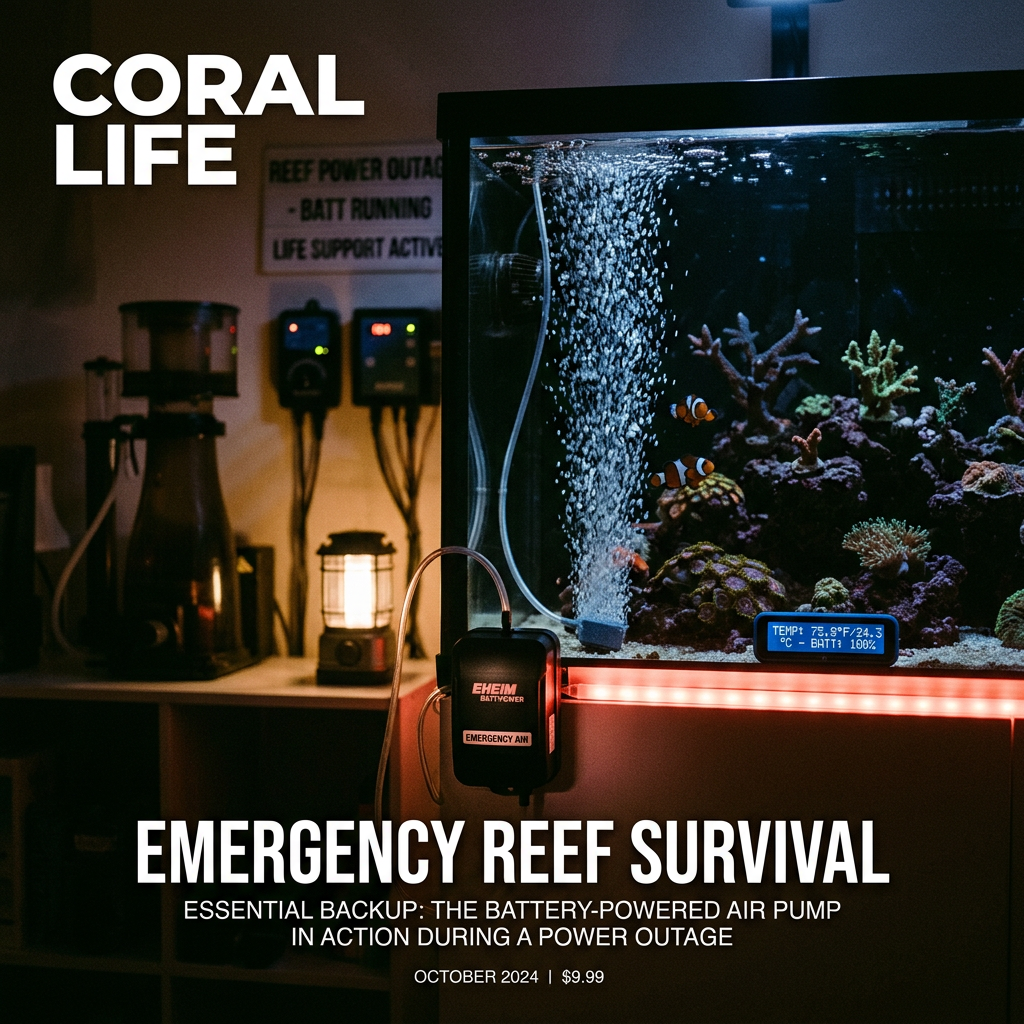
The single most important piece of backup equipment: a battery-powered air pump. The air pump runs on D-cell or rechargeable batteries, and the air pump provides the surface agitation that keeps the dissolved oxygen at the safe levels. The air pump should be running 24/7 during the outage, with the air stone placed in the tank for the maximum surface agitation.
The specifications: the air pump should have a run time of at least 8 hours on a fresh set of batteries, and the air pump should have a single air outlet. The cost is $20-50, and the cost is recovered in the first power outage that lasts more than 2 hours.
The alternative: a USB-rechargeable air pump with the built-in battery. The USB-rechargeable air pump has the longer run time (12-24 hours on a single charge) and can be recharged from the power bank, the car charger, or the generator. The cost is $30-70.
The other backup equipment that helps: the battery-powered powerhead for the larger tanks that need more circulation, the battery-operated thermometer to monitor the temperature, the battery-powered wavemaker for the flow that the corals need, the small bottle of the chlorine remover for the water that may need to be added during the outage, and the battery-operated controller (a simple timer that can run the lights on the reduced photoperiod).
The emergency actions without the equipment
The reef keeper who does not have the backup equipment can take the emergency actions to extend the survival time.
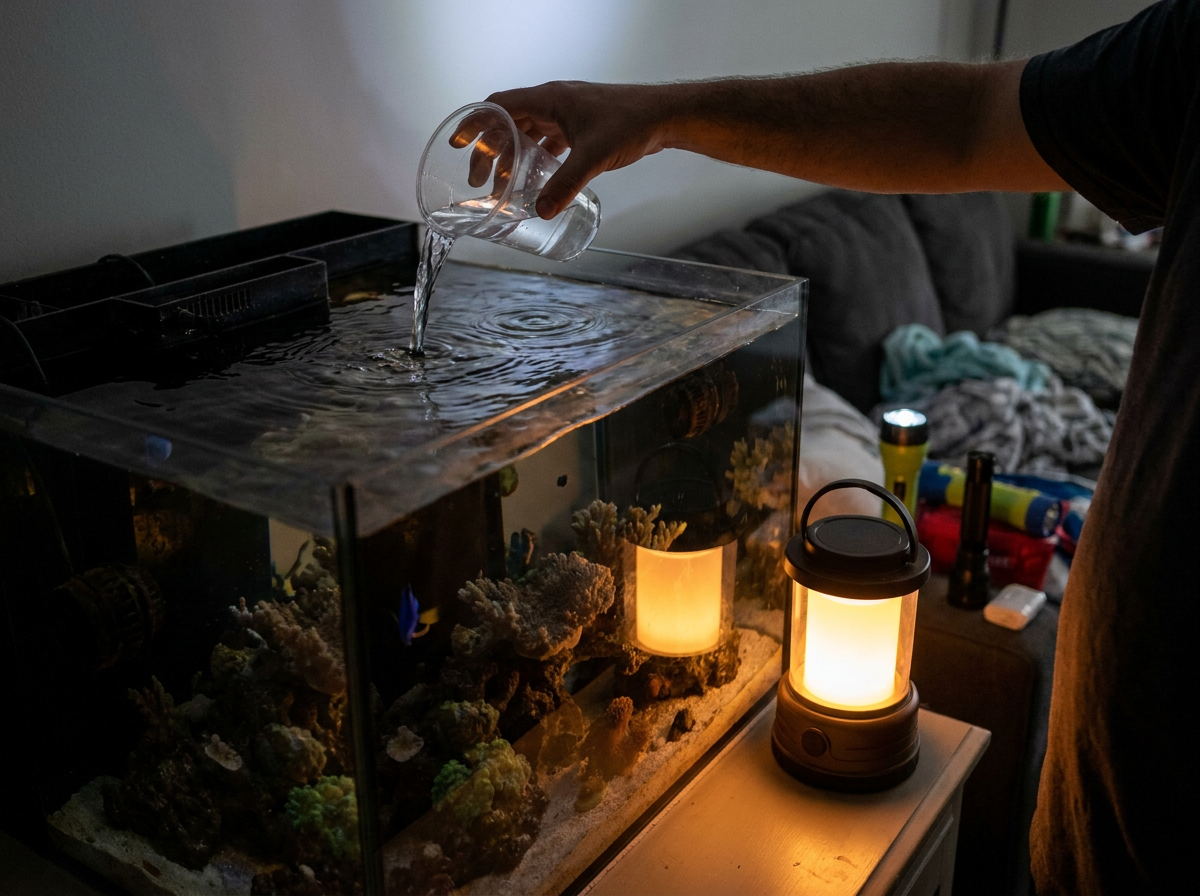
The first action: the manual surface agitation. The owner uses the cup or the pitcher to scoop the water from the tank and pour it back from a height, creating the surface agitation and the gas exchange. The agitation should be done for 5-10 minutes every 30-60 minutes, or continuously if the owner can do so. The continuous agitation can extend the survival time by 2-4 hours.
The second action: the reduced water level. The water level can be reduced by 25-50% during the outage, and the water can be replaced once the power is restored. The reduced water level increases the surface area to volume ratio, which increases the gas exchange.
The third action: the open top. The lid that is closed reduces the gas exchange. The lid that is open allows the gas exchange to continue. The lid should be removed or propped open during the outage.
The fourth action: the temperature adjustment. The cooler water holds more dissolved oxygen. The cooler water in the summer (adding ice in a plastic bag) can lower the temperature by 2-4°F. The warmer water in the winter (adding warm water in a sealed container) can raise the temperature by 2-4°F. The temperature change should be gradual.
The fifth action: the no-feeding. The fish that is fed produces more waste, which consumes more oxygen. The fish that is not fed produces less waste and consumes less oxygen. The fish can survive 3-7 days without the food, and the fish that is fasted during the outage is the fish that is more likely to survive.
The long-duration outage
The power outage that lasts more than 12 hours is the major emergency. The actions for the long-duration outage: the generator that can run the equipment. The portable generator that can run the return pump (50-100W), the protein skimmer (50-100W), the powerhead (10-30W), the heater (50-100W), and the chiller (100-300W) is the generator that can keep the small to medium reef tank running for the duration of the outage. The generator should be operated outdoors, with the extension cord run to the tank. The generator should never be operated indoors, because the carbon monoxide is fatal.
The alternative: the relocation. The friend or the family member with the tank, the local fish store, the vet clinic — each may be able to temporarily house the fish and the corals during the long-duration outage. The fish in the 5-gallon bucket with the battery-powered air pump can be transported for 30-60 minutes. The corals in the small container with the battery-powered air pump can be transported for 30-60 minutes. The relocation is the last resort, but the relocation may be the only option for the outage that lasts more than 24 hours.
The preparation that every reef keeper should have
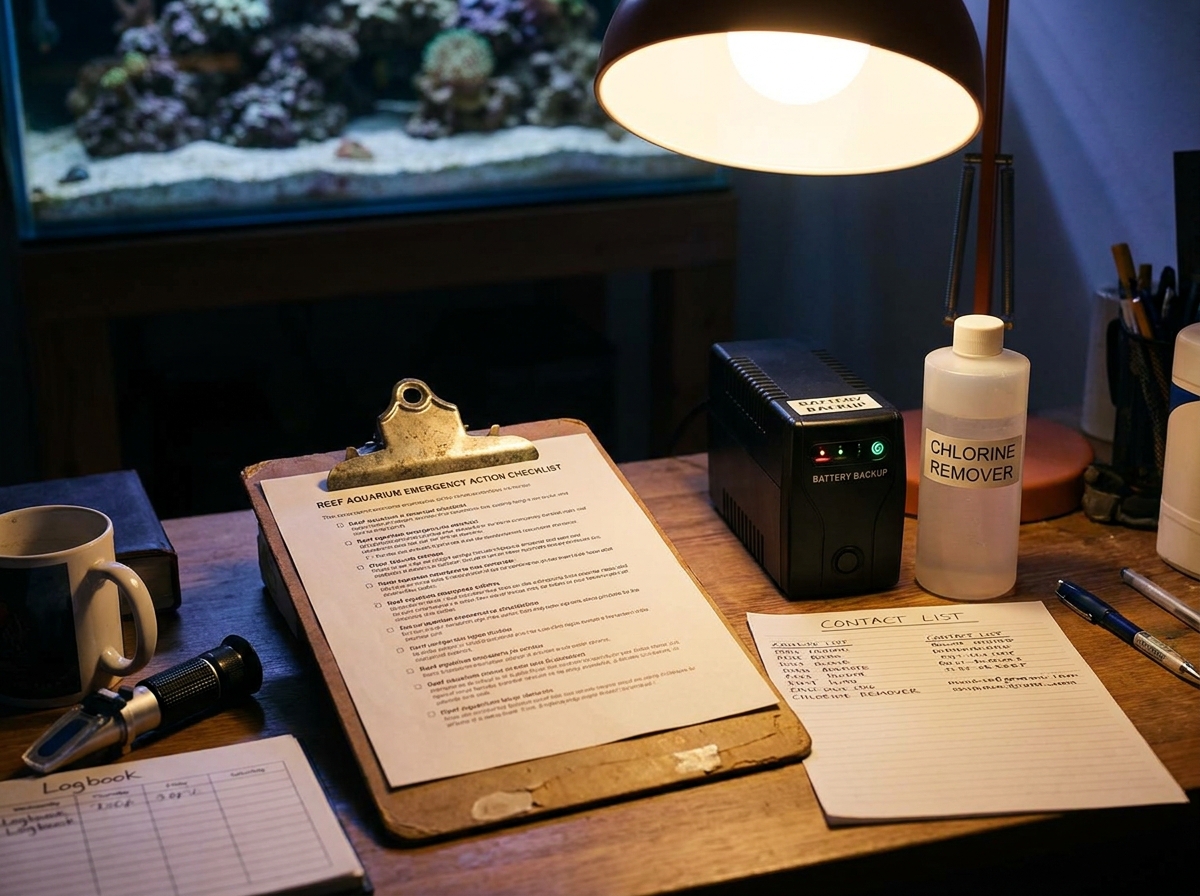
The preparation is straightforward and inexpensive. The checklist: the battery-powered air pump (1 per tank), the fresh batteries (replaced every 6 months), the small bottle of the chlorine remover, the 5-gallon bucket with the lid, the battery-operated thermometer, the printed copy of the emergency actions, and the contact information for the local fish store and the vet clinic. The preparation should be tested monthly (turn off the power for 5 minutes and verify the air pump is running), and the preparation should be reviewed with every member of the household.
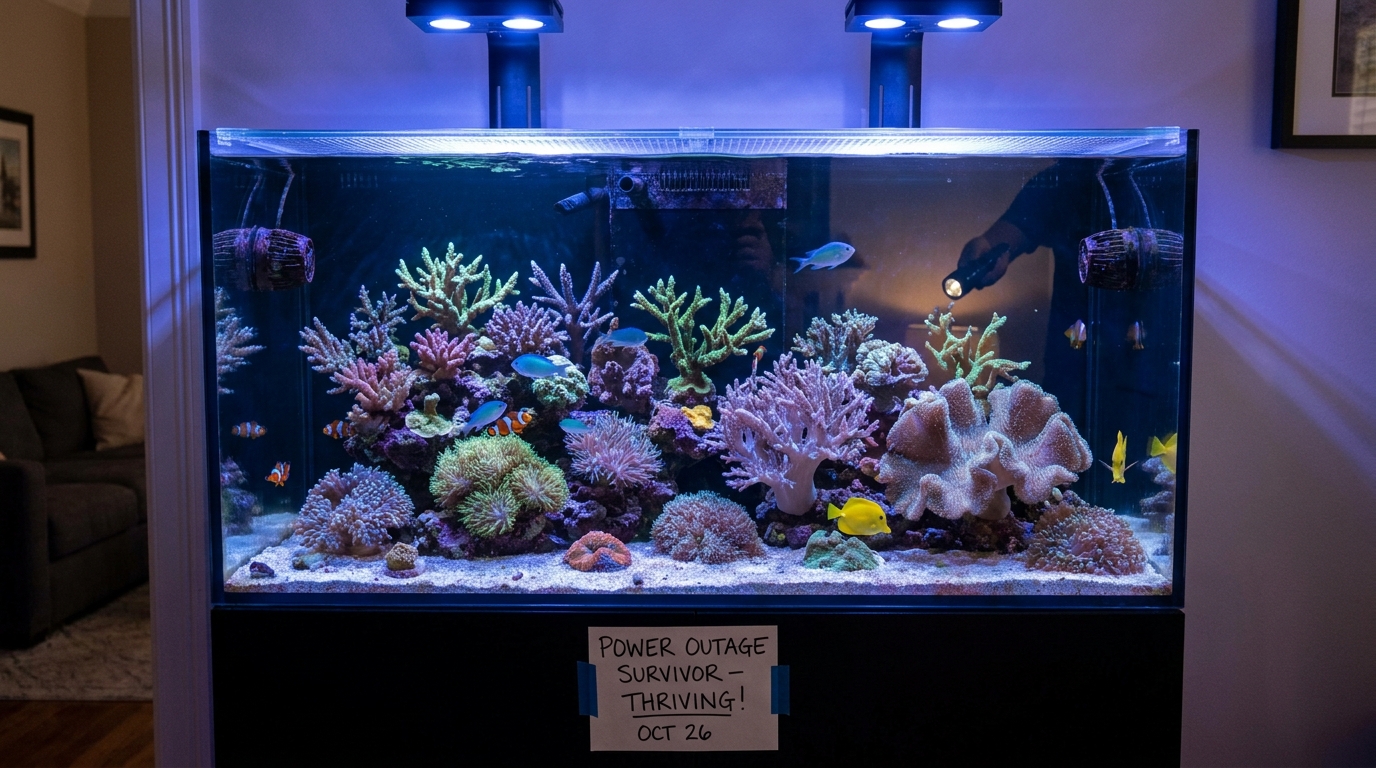
The cost of the preparation: $50-150 per tank, depending on the size and the equipment. The cost is trivial compared to the value of the livestock and the value of the peace of mind. The reef keeper who is prepared is the reef keeper who can ride out the next power outage without the loss. The reef keeper who is not prepared is the reef keeper who loses the livestock.
The one-page summary
The reef tank without the power for 4 hours is the reef tank that begins to lose the livestock. The battery-powered air pump is the single most important backup equipment. The manual agitation, the reduced water level, the open top, the temperature adjustment, and the no-feeding are the emergency actions. The long-duration outage requires the generator or the relocation. The preparation: $50-150 per tank, tested monthly. The reef keeper who is prepared is the reef keeper who survives the outage. The preparation is the work. The preparation is what makes the difference.