
Night-time yowling in cats: 6 root causes and what to actually do
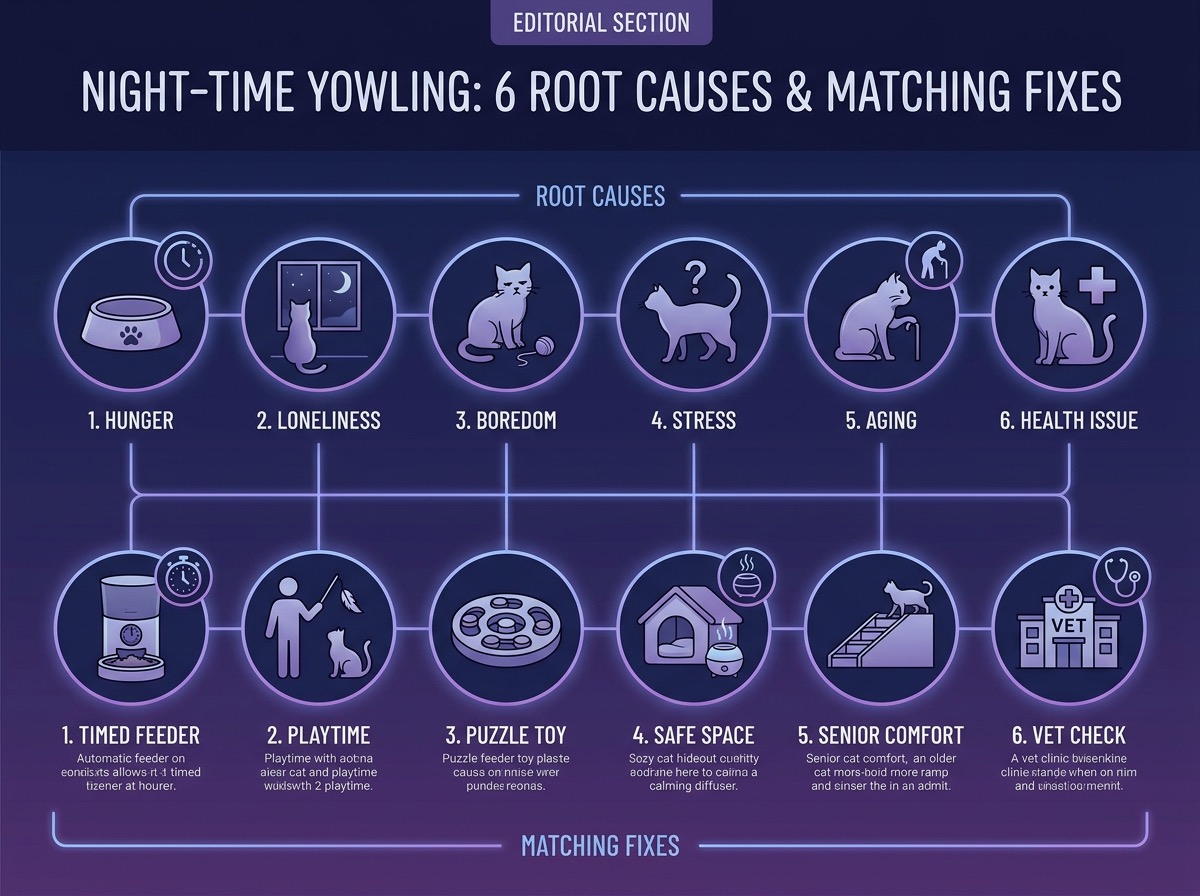
Of all the behaviour questions I receive from cat owners, night-time yowling is the one that most quickly frays the human-animal bond. The cat is awake, the owner is asleep, the noise is relentless, and by the third night everyone in the household is exhausted. The mistake most people make is treating the noise as the problem. The noise is the symptom. Six common causes, six different fixes.
The six root causes
1. Medical: pain, hyperthyroidism, or cognitive dysfunction
This must be ruled out first. Older cats (10+ years) that start yowling at night commonly have:
- Hyperthyroidism — increased vocalisation is one of the hallmark signs; appetite is often increased, weight is often decreased
- Hypertension — secondary to hyperthyroidism or kidney disease; can cause vocalisation and restlessness
- Chronic kidney disease — malaise and disorientation, especially at night
- Cognitive dysfunction syndrome (feline CDS) — analogous to dementia in humans; night-time confusion and yowling are core features
- Pain — arthritis, dental disease, or any source of chronic pain can manifest as nocturnal restlessness
The vet visit checklist for a cat with new night-time yowling:
- Physical exam
- Blood pressure measurement
- Bloodwork (CBC, chemistry, T4)
- Urinalysis
- Pain assessment (especially in senior cats)
Rule these out first. Behavioural work on a hyperthyroid cat is wasted effort.
2. Unspent energy: the crepuscular cat
Cats are crepuscular, meaning most active at dawn and dusk. This is biology, not defiance. In the wild, dawn and dusk are prime hunting times. A cat with no outlet for this energy will yowl, race around the house, and attack moving objects (including sleeping owners).
The fix is to simulate hunting cycles at the right times:
- A 20-minute high-intensity play session 1–2 hours before bed (use a wand toy, mimic prey movements)
- A small meal immediately after play (mimics the catch-eat-groom-sleep cycle)
- A second small meal right before you go to bed
- A third micro-meal timed via automatic feeder for 4–5 a.m.
This pattern — play, eat, sleep — is the single most effective intervention for "my cat wakes me up at 4 a.m."
3. Boredom and under-stimulation
Closely related to #2 but distinct. A cat with no environmental enrichment during the day sleeps poorly at night and seeks stimulation through noise.
Practical enrichment (not toys ignored after 3 days):
- Puzzle feeders: 2–3 across the house, rotated weekly
- Vertical space: cat trees, shelves, accessible tops of bookcases
- Window perches: especially near bird feeders or visible wildlife
- Cat grass or cat-safe plants for nibbling
- Rotating toy box: 5–7 toys out at a time, swap weekly
4. Attention-seeking yowling (learned behaviour)
This is the cycle: cat yowls → owner gets up, talks, feeds, plays → cat learns "yowl works". The cat is now training the owner.
Breaking the cycle:
- Completely ignore the yowling. Do not get up, do not speak, do not look at the cat, do not feed.
- The behaviour will get worse for 3–7 days (extinction burst) before it gets better
- Reinforce quiet behaviour: when the cat is quiet at night, reward with a treat tossed from the bed or attention the next morning
- This is hard. Earplugs help.
Critical: all household members must follow the same rule. One person getting up "just this once" resets the entire training.
5. Hunger or thirst
Simple but common. Cats that don't eat enough during the day (especially on a fixed twice-daily schedule) may genuinely be hungry at 4 a.m.
- Switch to multiple small meals per day if not already
- Automatic feeder set for 4 a.m. removes the human from the equation
- Ensure fresh water is available (some cats yowl for water from a preferred source — fountain vs bowl)
- For cats on weight loss, an automatic feeder dispenses the controlled amount without owner involvement
6. Stress, anxiety, or environmental change
Cats are sensitive to change. Night-time yowling often appears after:
- A move
- New pet or new baby
- Loss of a companion animal or human
- Change in routine (owner working from home vs office)
- Furniture rearrangement or renovation
Strategies:
- Feliway Classic (or Multicat / Friends depending on household) plug-in diffuser in the main living area. Evidence is mixed but it helps some cats.
- Maintain strict routine: same feeding times, same play times, same bedtime
- Provide safe retreat spaces in every room
- For grief/loss: increased attention and warmth for 2–4 weeks; in severe cases, behavioural medication short-term
A diagnostic flowchart
Cat yowling at night
    ↓
Senior cat? → Vet workup (bloodwork, BP, T4, urinalysis)
    ↓ (not senior, or workup negative)
Lifestyle audit: energy, enrichment, feeding schedule
    ↓
Bored/under-stimulated → Enrichment + play-eat-sleep cycle
    ↓
Learned attention-yowling → Extinction + reward quiet
    ↓
Hunger → Auto feeder + multiple meals
    ↓
Stress → Routine + pheromones + safe spaces
    ↓
Still yowling at 3–4 weeks? → Re-evaluate; consider behaviour medication
A two-week reset plan
| Day | Action |
|---|---|
| 1 | Vet appointment, bloodwork |
| 2 | Implement play-eat-sleep routine before bed |
| 3 | Set up auto feeder for 4 a.m. (small meal) |
| 4 | Add 1 puzzle feeder; rotate toys |
| 5 | Begin ignoring yowling (everyone in household) |
| 6–7 | Maintain all of above; expect extinction burst |
| 8 | Reinforce any quiet behaviour; do not break the rule |
| 9–14 | Continue; track yowl frequency nightly |
By day 14, most non-medical cases show meaningful improvement. Medical cases need the underlying condition treated for the yowling to resolve.
When medication helps
In some cases — particularly feline cognitive dysfunction — medication is appropriate:
- Selegiline (Anipryl): for cognitive dysfunction; modest evidence
- Gabapentin: evening dose can reduce anxiety-driven vocalisation; sedation is a common side effect
- Tricyclic antidepressants (clomipramine) or SSRIs (fluoxetine): in severe, refractory anxiety cases; require 4–6 weeks to take effect
These are not first-line but they are valid options when behaviour work alone is insufficient.
Bottom line
Night-time yowling is solvable in the majority of cases, but only if you identify the actual root cause. Treating "yowling" as the problem — by yelling back, by giving in, by locking the cat in a separate room — usually makes it worse. Take two weeks, do the workup if appropriate, implement the play-eat-sleep cycle, set up an auto feeder, and ignore the noise. By day 14 most cats are significantly quieter.
---
About the author: [Elena Rossi](../Elena%20Rossi.md) is an IAABC Certified Cat Behavior Consultant with 15 years of practice and former feline advisor at ENPA. She has provided in-home behaviour consultations to over a thousand families.