

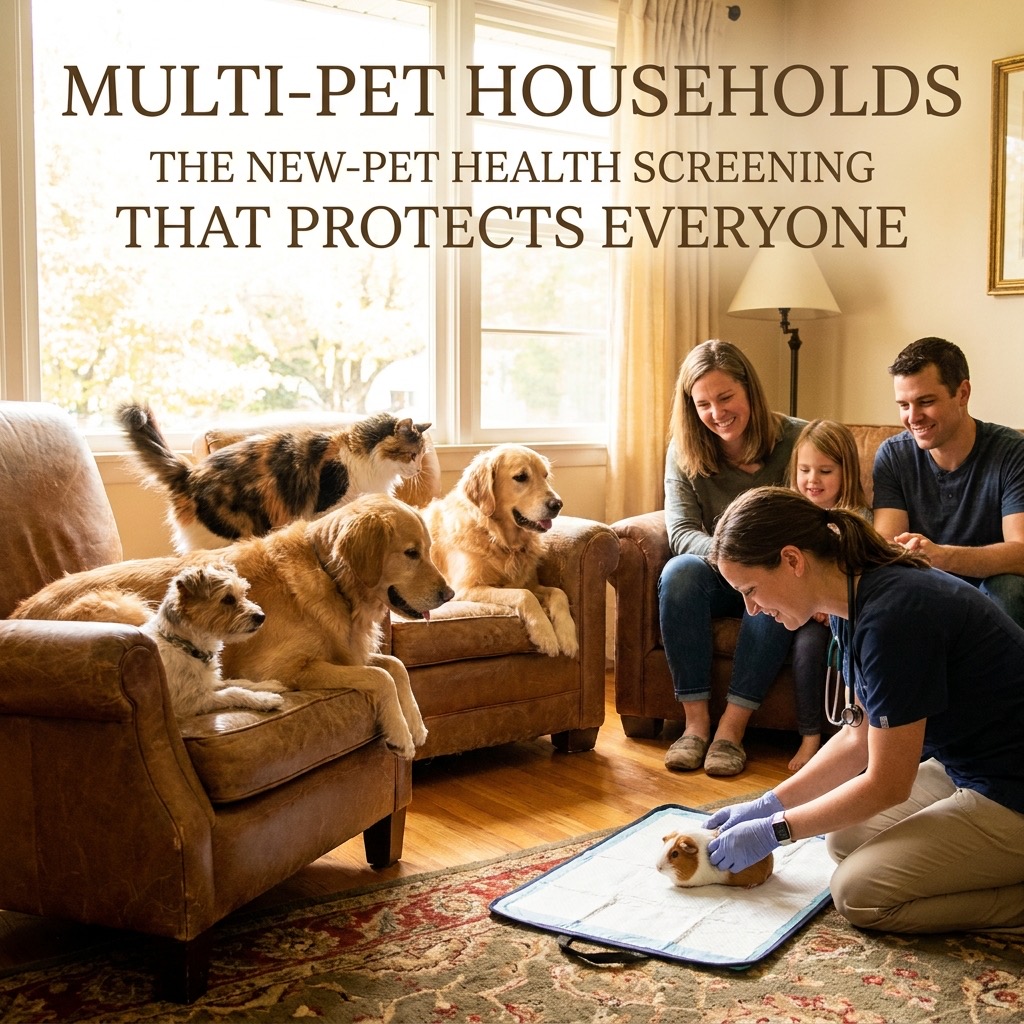
Multi-pet households: the new-pet health screening that protects everyone
A new pet arrives. The resident pets are excited. The family is excited. The new pet goes straight into the household, the dogs meet, the cat hisses, and the family is complete. Three weeks later, the cat has a respiratory infection. The dogs have kennel cough. The new puppy has coccidia. The humans have ringworm.
This scenario is preventable. The new-pet health screening is the standard of care for any responsible multi-pet household, and most owners skip it because they don't know what to ask for. This is what the screening looks like, what it tests for, and how to use the results to protect the household.
The principle: quarantine + screening + integration
The new-pet arrival protocol has three phases, and each phase has a specific purpose. Skipping any of them leaves the household exposed.
Phase 1: physical separation (7-14 days)
The new pet is housed in a separate area of the home for 7-14 days. The area should have:
- Separate air space if possible (a different room with a closed door)
- Separate food and water bowls
- Separate litter box (cats) or designated potty area
- Separate bedding and toys
- A separate person handling the new pet (or the same person handling the new pet last, after the resident pets)
The purpose: any incubating illness in the new pet will become apparent during the 7-14 day window. Most contagious diseases have incubation periods of 3-14 days. A pet that looks healthy on arrival may be incubating kennel cough (3-10 days), feline herpesvirus (2-10 days), canine influenza (2-4 days), or parvovirus (3-14 days). The quarantine period catches these before they spread.
For dogs adopted from a shelter or transported from a high-risk environment, the quarantine is non-negotiable. Shelter dogs have a 30-50% chance of carrying a respiratory pathogen, and the stress of adoption suppresses the immune system, making the new dog more likely to develop illness in the first 1-2 weeks.
For puppies and kittens, the quarantine is essential — their immune systems are still developing, and they may be partially vaccinated. A respiratory infection in a 10-week-old puppy can be life-threatening.
For cats adopted from a cattery or multi-cat household, the quarantine is similarly essential. Feline herpesvirus, calicivirus, and feline immunodeficiency virus (FIV) are all common in cattery cats.
Phase 2: health screening (during the quarantine)
During the quarantine, the new pet sees a vet for a comprehensive health screening. The screening is broader than a routine "wellness" check, because the goal is to identify anything that could be transmitted to the resident pets or to the humans.
Phase 3: gradual integration
After the health screening is clear and the quarantine period is complete, the new pet is gradually introduced to the resident pets and the household. The introduction is structured, not abrupt.
The new-pet health screening: what's actually tested
A new-pet health screening includes the following components. The exact tests depend on the species, the source, and the household, but this is the comprehensive version.
Physical exam
The vet does a complete physical exam:
- Eyes, ears, mouth: discharge, inflammation, dental disease
- Skin and coat: hair loss, lesions, parasites, signs of ringworm (a fungal infection transmissible to humans)
- Heart and lungs: murmurs, arrhythmias, abnormal lung sounds
- Abdomen: palpable masses, organ enlargement, pain
- Lymph nodes: enlargement suggesting infection
- Musculoskeletal: lameness, joint issues
- Body condition score: ideal weight or not
- Temperature, heart rate, respiratory rate: baseline measurements
The physical exam identifies obvious issues but misses most subclinical infections. Lab tests are required to catch what the physical exam cannot.
Fecal testing
Two to three fresh fecal samples, tested for:
- Intestinal parasites: roundworms, hookworms, whipworms, tapeworms
- Protozoa: Giardia, coccidia (Cystoisospora), Cryptosporidium
- Other pathogens: depending on geography, salmonella, campylobacter
A single negative fecal test is not sufficient. Parasites shed intermittently, and a single sample may miss an infection. Most vets recommend 2-3 samples collected on different days.
The treatment depends on the finding. Most intestinal parasites are treated with deworming medication (fenbendazole, pyrantel, praziquantel). Giardia is treated with metronidazole or fenbendazole. Coccidia is treated with sulfadimethoxine.
Blood testing
A standard blood panel includes:
- Complete blood count (CBC): identifies infection, inflammation, anaemia, clotting issues
- Comprehensive chemistry panel: identifies liver, kidney, pancreatic, and metabolic issues
- Heartworm test (dogs): identifies heartworm infection, which is transmissible through mosquitoes (not directly pet-to-pet but a baseline for the new pet)
- Tick-borne disease panel (dogs, depending on geography): Lyme, ehrlichiosis, anaplasmosis, Rocky Mountain spotted fever
Species-specific infectious disease testing
For dogs
- Distemper: part of the DHPP vaccine, but a titre test confirms immunity
- Parvovirus: part of DHPP, but a titre test or PCR confirms immunity
- Canine influenza: PCR or serology for H3N8 and H3N2 strains
- Kennel cough (Bordetella, parainfluenza): PCR or serology
- Leptospirosis: serology, particularly if the new dog will be exposed to wildlife or standing water
- Brucellosis: a serious bacterial infection transmissible to humans. Testing recommended for breeding dogs or dogs from high-risk sources
- Lyme disease: depending on geography, titre testing is appropriate
For cats
- Feline herpesvirus (FHV-1): PCR from conjunctival or throat swab
- Feline calicivirus (FCV): PCR from throat swab
- Feline panleukopenia (FPV): titre or PCR
- Feline immunodeficiency virus (FIV): ELISA or PCR
- Feline leukemia virus (FeLV): ELISA and IFA
- Feline coronavirus (FCoV) / FIP: titre or PCR, particularly in multi-cat households where FIP is a concern
- Toxoplasma: titre testing, particularly if the household has pregnant women or immunocompromised individuals
For small mammals, birds, reptiles
- Each species has its own panel. Avian testing includes psittacine beak and feather disease (PBFD), polyomavirus, and chlamydia. Reptile testing includes adenovirus, nidovirus, and parasites. Small mammals are tested for species-specific pathogens
Urinalysis
A urine sample is tested for:
- Urinary tract infection: bacterial, often subclinical
- Protein: indicates kidney issues
- Glucose: indicates diabetes
- Specific gravity: indicates kidney concentrating ability
Vaccinations
If the new pet is not fully vaccinated, the vet administers the appropriate vaccines. The new pet stays in quarantine until the vaccine series is complete and the vet confirms the pet is protected.
For puppies and kittens, the vaccine series is ongoing (every 2-3 weeks until 16 weeks of age). The new pet is not fully protected until the series is complete.
Parasite prevention
The new pet is started on appropriate parasite prevention:
- Dogs: heartworm prevention (Heartgard, ProHeart, Interceptor), flea/tick prevention (Bravecto, NexGard, Simparica)
- Cats: flea prevention (Revolution, Advantage, Bravecto), depending on outdoor access
- Other species: species-specific prevention
What the screening catches that the new pet's appearance misses
A healthy-looking new pet can be carrying a subclinical infection that becomes clinical under the stress of adoption. Common scenarios:
- The new dog looks healthy on day 1, develops a cough on day 5. Quarantine prevented transmission to the resident dog
- The new cat looks healthy on day 1, has Giardia on fecal test. Treated before the resident cat is exposed
- The new puppy looks healthy on day 1, has a low-grade heart murmur. Identified before the family commits
- The new rescue dog tests positive for heartworm. Treated before the infection progresses to heart failure
- The new cat tests FIV-positive. The household makes an informed decision about integration
- The new dog tests positive for Brucella. Rare but serious; affects breeding plans and human health
The screening provides information that allows the household to make informed decisions. Sometimes the information is good news (a healthy pet ready for integration). Sometimes the information is a serious problem that requires treatment or even rehoming. Either way, the information is valuable.
The resident pets: do they need testing too?
The new-pet screening is one half of the equation. The resident pets should also be assessed for any vulnerabilities.
Vaccination review
The vet reviews the resident pets' vaccination records:
- Are the resident pets current on core vaccines?
- Did the resident pets have a recent titre test confirming immunity?
- Are there any gaps that should be filled before the new pet arrives?
If the resident pets are not current on their vaccines, the new pet is at risk. The resident pets can be a source of infection to the new pet (reverse scenario).
Parasite prevention
The resident pets should be current on parasite prevention. The new pet may be carrying parasites that can infect the resident pets if prevention is not in place.
Existing health conditions
The vet reviews the resident pets' health:
- Is any resident pet immunosuppressed (steroids, chemotherapy, illness)?
- Is any resident pet elderly or medically fragile?
- Does any resident pet have a chronic condition that could be worsened by stress?
The integration plan should account for the resident pets' vulnerabilities.
The introduction phase: gradual, structured, supervised
After the quarantine and the screening, the new pet is introduced to the resident pets. The introduction is gradual:
Step 1: scent introduction (1-2 days)
- Swap bedding between the new pet and the resident pets
- Feed on opposite sides of a closed door
- Allow the pets to sniff each other through the door
- This builds familiarity without direct contact
Step 2: visual introduction (1-2 days)
- Use a baby gate or carrier to allow visual contact without physical access
- Monitor body language: relaxed, curious, or stressed
- Feed the pets on opposite sides of the gate, in view of each other
- Short sessions (5-10 minutes), several times per day
Step 3: supervised contact (3-7 days)
- Allow the pets to interact in a controlled setting
- Keep the new pet on a leash or harness for control
- Have treats ready to reward calm behaviour
- Separate if aggression or extreme fear appears
- Multiple short sessions (15-30 minutes) over several days
Step 4: unsupervised contact (after 7-14 days of successful supervision)
- Allow the pets to be together unsupervised
- Continue to monitor for several weeks
- Address any integration issues as they arise
The introduction timeline varies depending on the pets' temperaments and the species mix. Dog-to-dog introductions are usually faster (3-7 days). Cat-to-cat introductions are usually slower (2-4 weeks). Dog-to-cat introductions are unpredictable and require careful supervision.
The "foster-to-adopt" approach
For high-risk new pets (rescue dogs from shut-down operations, imported dogs, shelter dogs with unknown histories), a "foster-to-adopt" period is valuable. The new pet is fostered by the household for 2-4 weeks while the health screening is completed. If the new pet is healthy, the adoption is finalised. If the new pet has a serious condition, the rescue organisation takes the pet back.
Most reputable rescues support foster-to-adopt. The arrangement benefits the new pet (a temporary home while the screening is completed) and the family (information before commitment).
What the screening costs
The cost of a comprehensive new-pet health screening:
- Physical exam: $50-100
- Fecal testing: $30-75
- Bloodwork: $100-300
- Infectious disease testing: $50-300 (depending on the species and the diseases)
- Vaccinations (if needed): $25-75 per vaccine
- Total: $250-750 for a thorough screening
The cost of not screening:
- Treating a household outbreak of kennel cough: $200-500 per dog
- Treating a panleukopenia outbreak in cats: $500-3,000 per cat
- Treating a human ringworm infection: $100-500
- The emotional cost of watching a beloved pet get sick from a preventable exposure
The screening is a cost-effective investment.
The post-integration monitoring
After the new pet is integrated, the monitoring continues for 2-4 weeks:
- Daily observation: appetite, energy, droppings, breathing, behaviour
- Any sign of illness: vomiting, diarrhea, coughing, sneezing, lethargy, inappetence
- Watch the resident pets: any sign of new illness in the existing pets
Most integration-related illnesses present within 2-4 weeks. After that, the household is stable.
When the screening reveals a problem
A few common scenarios and how to handle them:
The new pet is FIV-positive
FIV is a retrovirus in cats that affects the immune system. FIV is transmitted primarily through bite wounds. An FIV-positive cat can live with FIV-negative cats if they get along, but the household should be informed and prepared.
Options:
- Keep the FIV-positive cat as the only cat
- Keep the FIV-positive cat with other cats that are FIV-positive
- Keep the FIV-positive cat with FIV-negative cats that don't fight (low transmission risk in a peaceful household)
The FIV-positive cat can live a normal lifespan with proper care.
The new pet has heartworm
Heartworm treatment is expensive ($500-1,500) and requires strict rest. The new pet can be treated and integrated after treatment.
The new pet has chronic kidney disease
A new pet diagnosed with kidney disease (common in older cats) requires ongoing care. The household can manage the condition with the new pet, but the cost and time commitment is real.
The new pet has a behavioural issue
Some new pets have behavioural issues (resource guarding, separation anxiety, aggression) that require professional intervention. The screening should include an assessment of the new pet's behaviour, and a referral to a behaviourist if needed.
The bottom line
The new-pet health screening is the standard of care for any responsible multi-pet household. Quarantine + comprehensive testing + gradual integration protects the new pet, the resident pets, and the humans. The cost is $250-750, the time is 2-4 weeks, and the value is preventing the predictable problems that arise from a poorly-managed introduction. The new pet's appearance is not enough. The healthy-looking dog that develops a cough on day 5, the healthy-looking cat with Giardia, the healthy-looking puppy with a heart murmur — these are caught by the screening, not by the eye. The household that skips the screening is rolling dice. The household that runs the screening is making a decision based on information.
---
About the author: [James Morrison](../James%20Morrison.md) holds a BVSc from the University of Liverpool and has 22 years of small animal general practice, with a focus on preventive medicine and multi-pet household dynamics.