

Year-round flea, tick, and heartworm prevention: what actually works in 2025
The parasite prevention market is the most over-marketed and under-explained category in small animal practice. The product lineup has tripled in ten years, the active ingredients are now genuinely different from each other, the dosing schedules vary from monthly to twelve-month, and the "ask your vet" advice is now insufficient because most vets carry only one or two of the major brands. In this article I will walk through the active ingredients that actually work in 2025, the regional and lifestyle differences that change the right choice for an individual dog or cat, the year-round question that is still debated more than it should be, and the three failure modes I see most often in practice when prevention goes wrong. I will not recommend specific products by brand — those change — but I will explain the active ingredient classes and the cases where one class is clearly better than another.
The three parasite categories, and the products that cover them
The three parasite categories that drive the prevention market are fleas, ticks, and heartworm. The fourth category — intestinal parasites (roundworm, hookworm, whipworm, tapeworm) — is covered by most heartworm preventives as a side effect, and the fifth — GI parasites like coccidia and giardia — is covered by a different set of products. For the rest of this article I am focusing on fleas, ticks, and heartworm.
Fleas are the most common parasite in dogs and cats worldwide. They are present in every U.S. state, every Canadian province, and in temperate zones of Europe and Asia year-round; in warmer climates they are present in far higher densities and for longer seasons. The active ingredients that actually kill adult fleas in 2025 are the isoxazolines (fluralaner, lotilaner, afoxolaner, sarolaner), the neonicotinoids (imidacloprid, dinotefuran, nitenpyram), and the spinosyns (spinosad). The isoxazolines are the most effective class, with kill times of 2-4 hours after a flea bite. The neonicotinoids are effective but slower (8-12 hours) and require the flea to land and start feeding. The spinosyns are oral-only and very effective for dogs; for cats, the topical neonicotinoids are still the standard.
Ticks are present in every U.S. state, but the species and the density vary dramatically. The Northeast and upper Midwest are the highest-pressure tick regions (Ixodes scapularis, the deer tick, carries Lyme disease; Dermacentor variabilis, the American dog tick; Amblyomma americanum, the lone star tick). The Southeast has the Gulf Coast tick and a growing lone star tick population. The West Coast has the western black-legged tick. The active ingredients that kill ticks in 2025 are the isoxazolines (same as for fleas), the pyrethroids (permethrin, flumethrin — for dogs only, toxic to cats), and the phenylpyrazoles (fipronil). The isoxazolines are the most effective; fipronil was the standard 15 years ago and is now considered second-line. Permethrin-based products for dogs are still used and are very effective against ticks but carry the cat-toxicity warning.
Heartworm (Dirofilaria immitis) is transmitted by mosquitoes. The active ingredients that prevent heartworm infection are the macrocyclic lactones: ivermectin, milbemycin oxime, moxidectin, and selamectin. All four are essentially equivalent in efficacy when given on schedule; the difference is in the spectrum (some also cover intestinal parasites, some do not), the formulation (oral, topical, injectable), and the duration (monthly oral, monthly topical, 6-month injectable, 12-month injectable). The 12-month injectable moxidectin product (ProHeart 12) is the lowest-failure option by a wide margin, because it removes the monthly compliance variable entirely. The trade-off is that the injection requires a vet visit and carries a small risk of anaphylaxis.
The year-round question
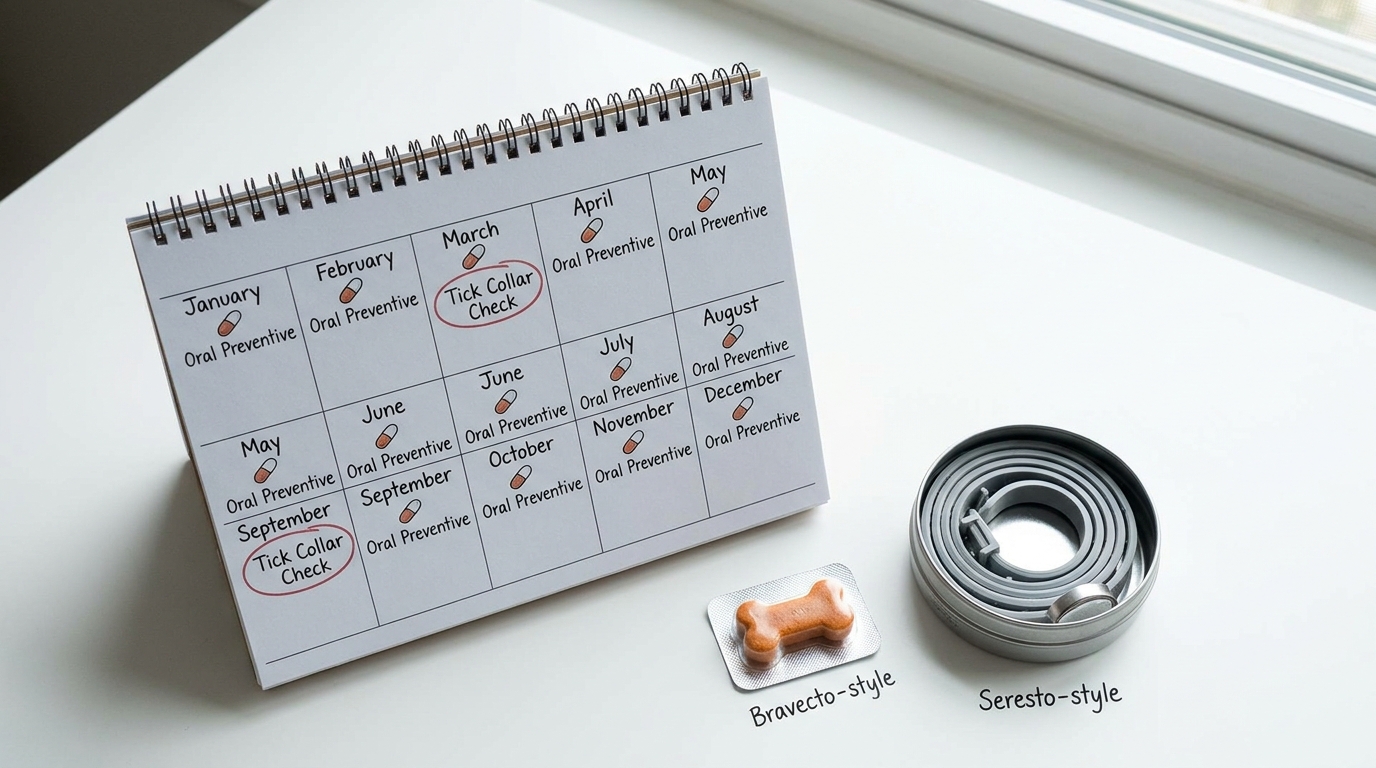
The year-round question is whether to give prevention in the winter. The traditional answer was "no, parasites die off in winter." The current answer, based on the most recent parasitology data, is "yes, give it year-round in most of the U.S. and Canada." Three reasons. First, fleas do not die off in winter. They survive indoors on pets, in carpets, and in wildlife hosts (raccoons, opossums, feral cats). A flea population that drops in November is back at full strength in March from a few surviving adults. Year-round flea prevention breaks that cycle. Second, ticks are active whenever the temperature is above freezing. In the Northeast, that is a much longer season than it used to be. The lone star tick in particular has expanded its range northward every year for the last decade. Third, heartworm transmission requires mosquitoes, and mosquitoes are present in much of the U.S. and Canada for at least 7-9 months of the year. The American Heartworm Society now recommends year-round prevention in all of the continental U.S. and Canada. The winters in the southern U.S. are warm enough that mosquitoes are active year-round in many locations.
The exceptions: dogs in true alpine regions, dogs in the high arctic, and dogs in climates that genuinely freeze for 4+ continuous months with no indoor mosquito exposure. For most of the population, year-round prevention is the right answer. The cost of year-round prevention is roughly the same as the cost of one heartworm treatment — which is several hundred to several thousand dollars — so the cost-benefit math is straightforward.
The three failure modes
The first failure mode is the missed dose. A heartworm preventive that is given every 11.5 months instead of every 12 has a 2-week window of susceptibility. A preventive that is given every 13-14 months has a 6-8 week window, which is enough for a heartworm larva to reach a stage that the preventive can no longer kill. The fix is automatic: a reminder on the phone, a 12-month supply of preventives dispensed at the annual checkup, and the injectable moxidectin option for owners who cannot reliably remember the monthly dose. The second failure mode is the wrong product for the lifestyle. A dog that swims daily cannot use a topical preventive that washes off; an oral or collar-based product is the right choice. A dog that travels to the Southeast for the winter needs coverage for parasites that are not present in the home state. A cat that goes outdoors needs a different preventive than a strictly indoor cat (and indoor cats still need prevention, because mosquitoes and fleas do get indoors). The third failure mode is the "natural" approach. There is no natural product that prevents heartworm. There is no essential oil combination that kills fleas reliably. The natural approach is the same as the no-prevention approach, and the no-prevention approach produces a steady stream of heartworm-positive dogs in every veterinary practice in the country.
The cat-specific notes
Cats are not small dogs for prevention purposes. The products, doses, and parasite spectrums are different. Cats do not get heartworm as commonly as dogs, but when they do, the disease is more severe and the treatment options are much more limited. There is no approved heartworm treatment for cats. Prevention is the entire game. Cats also get fleas more easily than dogs do because of their grooming behavior, and a single flea on a sensitive cat can trigger weeks of flea allergic dermatitis. The recommended prevention for an outdoor cat in a heartworm-endemic area is a monthly topical that covers fleas, ticks, and heartworm, or an oral flea + tick preventive paired with a separate heartworm preventive. For strictly indoor cats in a low-risk area, a flea preventive alone may be sufficient, but most feline medicine specialists now recommend at least a heartworm preventive for indoor cats in endemic areas because the cost of the preventive is trivial compared to the cost of a single heartworm-positive cat.
The take-home
The current best practice is year-round prevention, tailored to the local parasite pressure and the animal's lifestyle. The isoxazolines are the most effective single-product class for flea and tick coverage, and they pair with a macrocyclic lactone for heartworm. The injectable moxidectin eliminates the compliance variable. Cats need a separate product line. The most expensive mistake is the missed dose; the most expensive supplement is the "natural" alternative; the most expensive delay is waiting until the dog or cat is symptomatic. Prevention is one of the few areas of veterinary medicine where the cost is small, the evidence is strong, and the consequences of getting it wrong are catastrophic. Spend the money on the prevention.