
Legal reptile keeping and CITES basics: what the law says about which species you can own
The reptile owner who buys a tortoise at a reptile show, the owner who is told "it is captive-bred, so no paperwork is needed," and the owner who is surprised when a state fish and wildlife officer visits the home to check the paperwork — this is a scenario that happens more often than the hobby would like to admit. The legal framework for reptile ownership in the United States is a patchwork of federal, state, and local regulations, with international agreements layered on top, and the owner who does not understand the framework is the owner who is at risk of fines, confiscation, and in some cases criminal charges. In this article I will walk through the federal framework (CITES and the Lacey Act), the state framework (the four most common state-level restrictions), the invasive species concern, the documentation that a legal owner should have, and the steps to verify that a species is legal in the buyer's jurisdiction before the purchase.
The international framework: CITES
CITES (the Convention on International Trade in Endangered Species of Wild Fauna and Flora) is an international agreement signed by 183 countries that regulates the trade in endangered and threatened species. The agreement classifies species into three appendices, with the level of regulation increasing from Appendix III (least regulated) to Appendix I (most regulated). The appendix listings are maintained by the CITES parties and updated regularly.
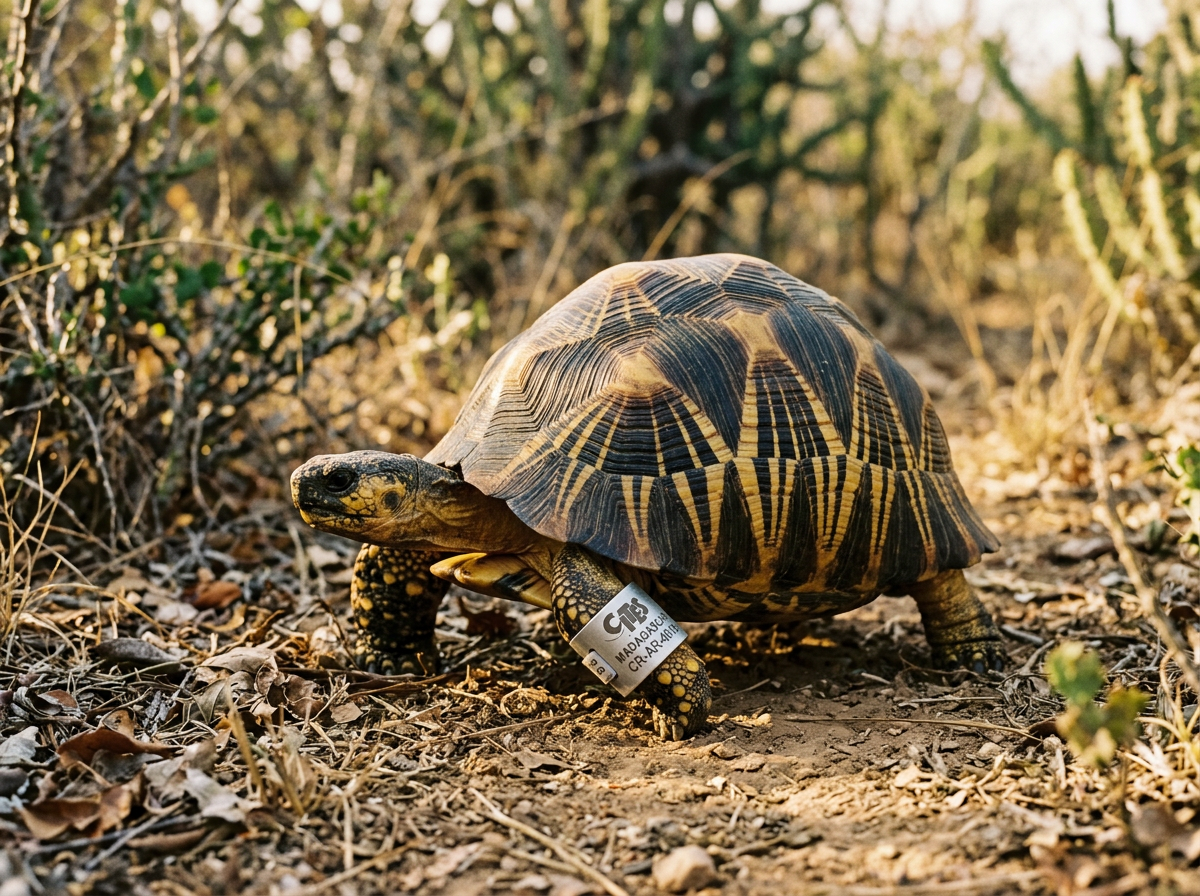
The reptile species that are commonly kept as pets and that are listed in CITES appendices: Appendix I includes all tortoises in the genus Geochelone (including the radiated tortoise, the ploughshare tortoise, the Indian star tortoise), all sea turtles, and several crocodilian species. Appendix II includes the ball python, the boa constrictor, many gecko species (including the crested gecko and the leopard gecko), the green iguana, the red-eared slider, the common kingsnake, and the majority of commonly kept pet reptiles. Appendix III includes a smaller number of species that are listed by individual countries.
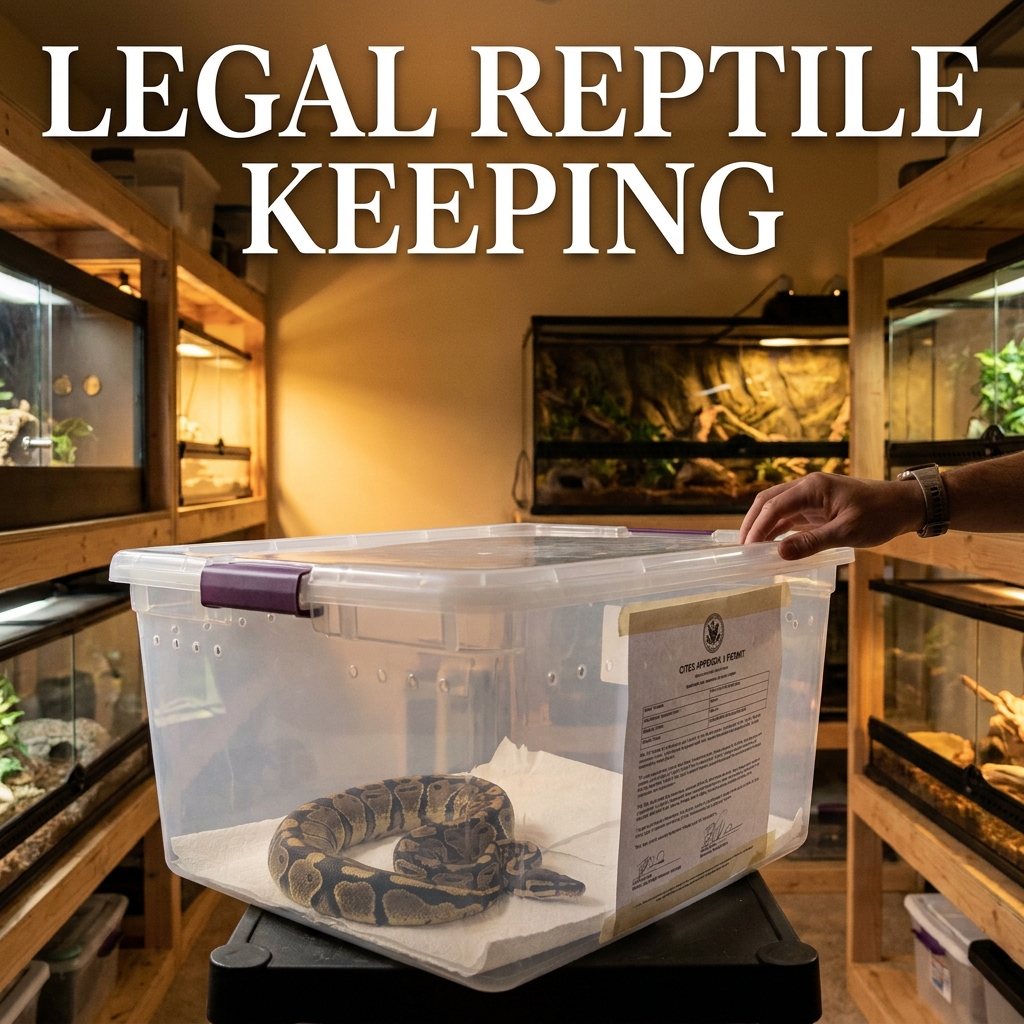
The regulation under CITES: Appendix I species cannot be traded internationally for commercial purposes. An Appendix I tortoise that is in the U.S. as a captive-bred individual is in the U.S. legally only if the captive breeding was done under a specific CITES registration, and the international trade in the species is prohibited. Appendix II species can be traded internationally, but each specimen has to be accompanied by a CITES export permit from the country of origin. The U.S. enforces CITES through the U.S. Fish and Wildlife Service (USFWS), and the USFWS requires documentation for any Appendix II species that crosses international borders.
The reptile owner who is buying a captive-bred ball python from a U.S. breeder is the owner who is not crossing international borders and is the owner who is not subject to CITES documentation. The reptile owner who is importing a ball python from a breeder in Ghana is the owner who needs a CITES export permit from Ghana and a USFWS import permit. The reptile owner who is buying a captive-bred radiated tortoise from a U.S. breeder is the owner who is buying a species that is illegal to import and that is only in the U.S. as a result of pre-CITES captive breeding. The legality of the purchase depends on the specific breeder's documentation, and the documentation is the owner's responsibility to verify.
The federal framework: the Lacey Act
The Lacey Act is a U.S. federal law that prohibits the import, export, transport, sale, receipt, acquisition, or purchase of fish, wildlife, or plants that are taken, possessed, transported, or sold in violation of any state, federal, tribal, or foreign law. The Lacey Act is the federal enforcement mechanism for state wildlife laws, and the Lacey Act makes it a federal crime to buy or sell a reptile that was taken illegally in the state of origin.
The practical implication: the reptile that is illegal in the state of origin is illegal in every state, and the federal government (USFWS) can prosecute the buyer and the seller. The reptile owner who buys a species that is illegal in the seller's state is the owner who is at risk of federal prosecution, regardless of whether the buyer's state allows the species.
The Lacey Act is also the mechanism by which CITES is enforced at the federal level. The reptile that is imported without a CITES permit is a reptile that is in violation of the Lacey Act, and the buyer can be prosecuted for the violation.
The state framework: the four most common restrictions
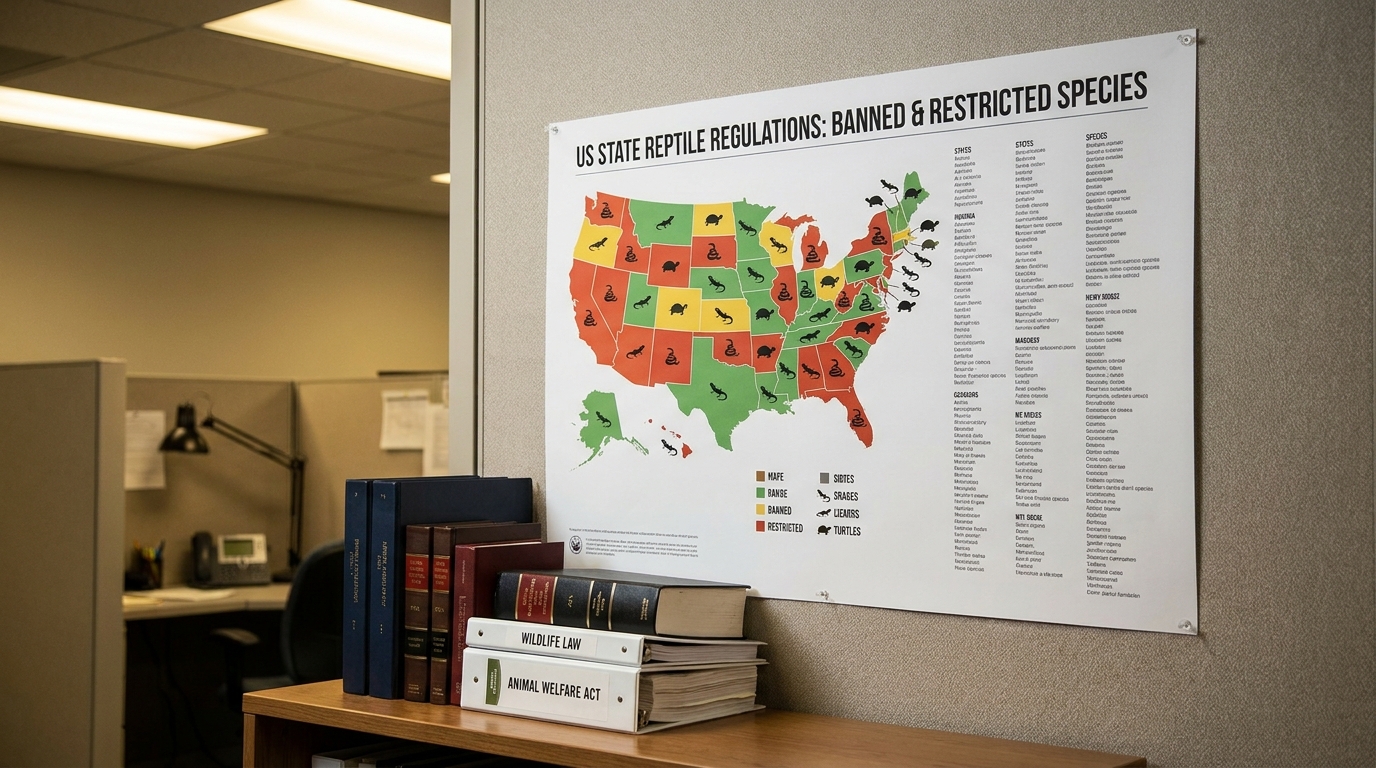
The state-level reptile regulations vary by state, but the four most common categories of restriction are:
Native wildlife restrictions. Most states prohibit the keeping of native reptile species without a permit. The turtle that was caught in the local pond is the turtle that is illegal to keep in most states, even if the owner intends to release it. The native snake that was rescued from the yard is the native snake that may need to be transferred to a licensed wildlife rehabilitator. The owner who keeps a native reptile without a permit is the owner who is in violation of state law.
Invasive species restrictions. Many states prohibit the keeping of species that are considered invasive in that state. The Burmese python is banned as a pet in Florida and several other states because of the established invasive population in the Everglades. The red-eared slider is banned in some states because of the impact on native turtle populations. The owner who buys a species that is invasive in the buyer's state is the owner who is at risk of confiscation and fines.
Dangerous species restrictions. Some states prohibit the keeping of species that are considered dangerous to humans. The venomous snake, the large crocodilian, and the large constrictor (Burmese python, reticulated python, anaconda) are restricted in many states, often requiring a specific permit. The owner who keeps a venomous snake without a permit is the owner who is at risk of serious legal consequences, particularly if the snake escapes and bites someone.
CITES Appendix I restrictions at the state level. Some states have additional restrictions on the keeping of CITES Appendix I species, even when the species was captive-bred in the U.S. The radiated tortoise, the ploughshare tortoise, and the Indian star tortoise are restricted in several states beyond the federal CITES restrictions. The owner who buys one of these species should check both the federal and the state-level restrictions.
The invasive species concern
The invasive species concern is the part of reptile law that has gotten the most attention in the last decade. The Burmese python in the Everglades is the most well-known example, but the concern extends to many species. The release of a non-native reptile into the wild — either intentionally by an owner who no longer wants the reptile, or accidentally by an escape — is the introduction pathway that has produced the established invasive populations. The legal framework in many states now includes a "don't release your pet" provision that makes it illegal to release a non-native reptile into the wild.
The responsible owner does not release a reptile that can no longer be kept. The responsible owner finds the reptile a new home through a rescue, a rehoming network, or a qualified zoo. The responsible owner also takes precautions to prevent escape — secure enclosures, escape-proof latches, and double-checking the enclosure before leaving the home.
The documentation a legal owner should have
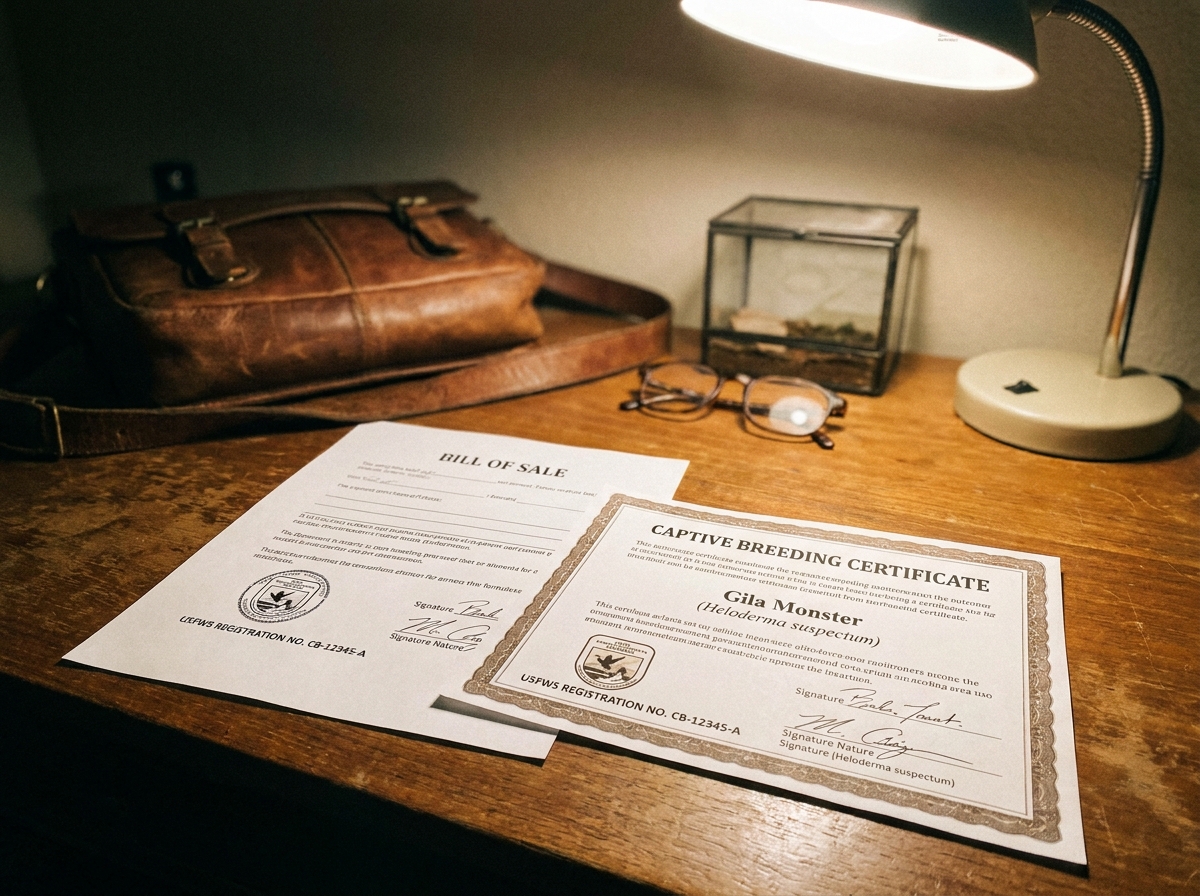
The documentation that a legal reptile owner should have: the original purchase receipt, the captive breeding documentation (the breeder's USFWS breeding registration, if the species is CITES-regulated), the bill of sale that includes the breeder's name and address, and any state-level permits that are required. The documentation should be stored with the reptile's records and should be available if the owner is asked to verify the legality of the reptile.
The owner who buys a reptile without documentation is the owner who is at risk. The breeder who sells a CITES-regulated species without documentation is the breeder who is in violation of the law, and the buyer is complicit in the violation. The owner who is offered a "deal" on a regulated species with no paperwork is the owner who is being offered a reptile that is being sold illegally. The deal is not a deal; the deal is a legal problem.
The steps to verify before the purchase
Before purchasing a reptile, the owner should verify: 1) that the species is legal in the owner's state, 2) that the species is legal in the owner's county and city (some local jurisdictions have additional restrictions), 3) that the species is not on the federal CITES Appendix I list (unless the owner is buying a captive-bred specimen with documentation), 4) that the breeder has the appropriate state and federal permits, and 5) that the purchase documentation will include the breeding records and the bill of sale.
The verification takes 15-30 minutes and a few phone calls to the state fish and wildlife agency, the USFWS, and the city or county animal control. The verification is the owner's responsibility, and the verification is what prevents the legal problems that follow an illegal purchase.
The single sentence to remember
The legal framework for reptile ownership is a federal-state-local patchwork, with international agreements on top, and the owner who does not understand the framework is the owner who is at risk. The verification is the owner's responsibility. The documentation is the owner's protection. The reptile that is legal in every jurisdiction, purchased from a breeder with the right permits, accompanied by the right documentation, is the reptile that the owner can keep for the next 20 years without legal risk. The reptile that is illegal in one jurisdiction is the reptile that can be confiscated at any time, with the owner facing fines and possibly criminal charges. The verification is what makes the difference.