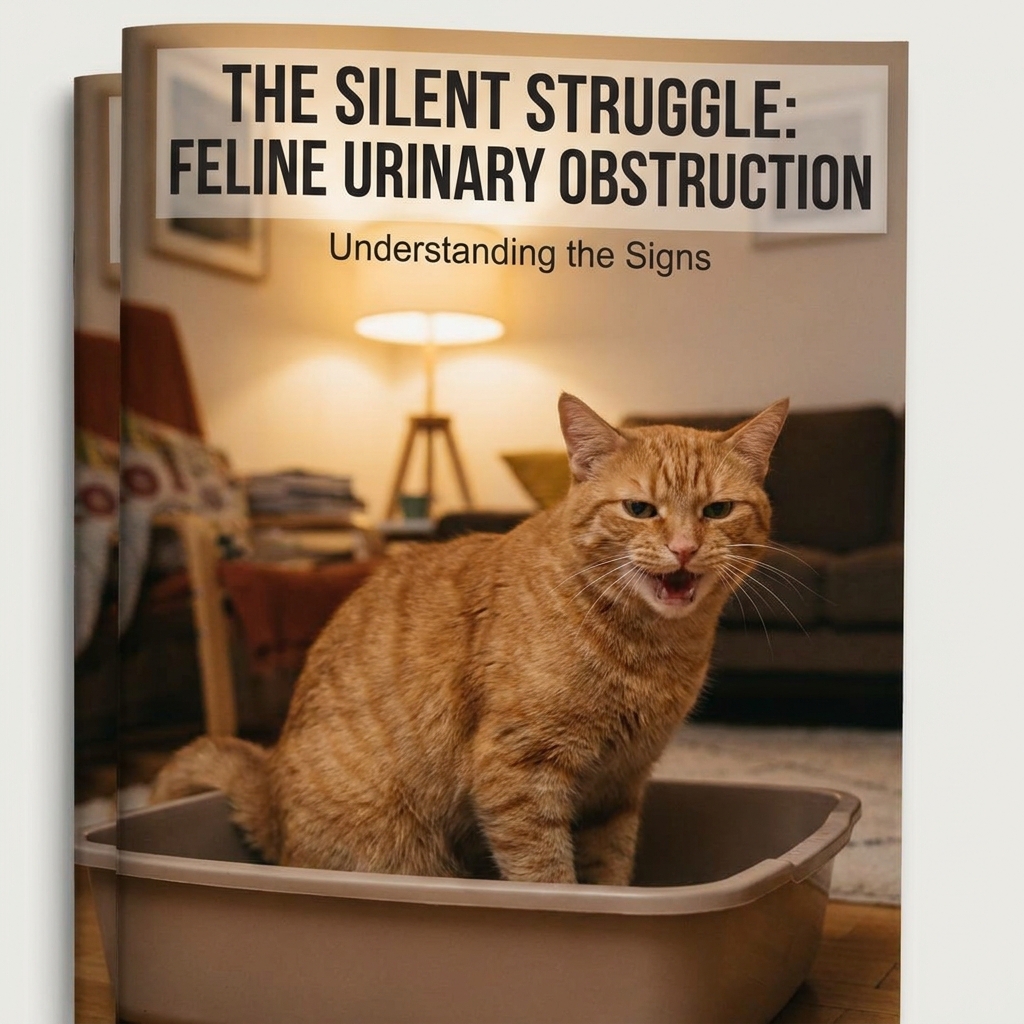

Inappropriate urination in cats: 12 behaviour vs medical causes (and how to tell)
When a cat starts peeing outside the litter box, the default assumption is usually "the cat is being spiteful" or "the cat is angry at me". This is almost always wrong. The cat is doing one of two things: communicating distress through scent marking (behaviour) or trying to tell you something is medically wrong (medical). Sometimes both. The path to resolution starts with telling them apart, and the rule I follow is "medical first, behaviour second".
This is the framework I use in every consultation.
The 12 causes, grouped
I think about inappropriate urination in five buckets: medical urinary, medical non-urinary, behavioural-marking, behavioural-environmental, and behavioural-stress. Within those, here are the 12 specific causes I screen for.
Bucket 1: Medical urinary (the urgent one)
1. Feline lower urinary tract disease (FLUTD)
A syndrome, not a single disease. Includes:
- Feline idiopathic cystitis (FIC) — the most common cause in cats under 10, accounting for ~60% of FLUTD cases. Sterile inflammation of the bladder.
- Urolithiasis — bladder stones, especially struvite and calcium oxalate
- Bacterial urinary tract infection (UTI) — uncommon in young cats, common in seniors
- Urethral obstruction — emergency, life-threatening, particularly in male cats
The presentation includes straining, frequent small urinations, blood in urine, crying while urinating. Any of these signs warrant a same-day vet visit, especially in male cats where obstruction can develop within hours.
2. Diabetes mellitus
Increased urine volume is one of the classic triad signs (polyuria, polydipsia, polyphagia). Cats with undiagnosed diabetes often start missing the litter box because they cannot get to it in time, the volume is too large for the box, or both.
3. Chronic kidney disease
Similar to diabetes, increases urine volume. Common in senior cats (12+ years). The cat may be using the litter box normally in frequency but missing it because of urgency.
4. Hyperthyroidism
Increases metabolic rate and urine output. Senior cat disease, often accompanied by weight loss despite increased appetite.
5. Degenerative joint disease / osteoarthritis
Pain when stepping into the litter box, especially high-sided boxes. The cat associates the box with pain and starts eliminating next to it instead. Often missed because owners assume the cat "doesn't like the litter" when in fact the cat cannot physically get into the box comfortably.
Bucket 2: Medical non-urinary
6. Cognitive dysfunction (feline CDS)
Senior cats with cognitive decline may forget where the litter box is or simply lose the cognitive link between the urge and the location. Often accompanied by other signs: night-time yowling, pacing, altered sleep-wake cycle.
7. Neurological disease
Spinal cord disease, lower motor neuron disease, or brain lesions affecting the micturition reflex. Less common but worth considering in cases that don't respond to first-line treatment.
Bucket 3: Behavioural — marking
8. Urine marking (territorial)
Standing posture, small volume on vertical surfaces (walls, doors, furniture). Usually intact male cats, multi-cat households, or cats exposed to outdoor cats through windows. Distinct from inappropriate elimination (squatting, large volume, horizontal surfaces).
9. Reaction to outdoor cats
A cat seeing or smelling an outdoor cat through a window may mark near that window, the door, or the owner's belongings (clothing, bedding) that carry the outdoor cat's scent from the owner's outdoor activities.
Bucket 4: Behavioural — environmental
10. Litter box aversion
A specific litter type, box location, box cleanliness level, or box style that the cat dislikes. Cats are particular. A litter that worked for years can suddenly become objectionable if the formulation changes, the box is moved, the hood is added, the hood is removed, or a new cat uses the box.
11. Litter box access issues
Not enough boxes (need N+1 in multi-cat homes), boxes in high-traffic or noisy locations, boxes the cat cannot reach (closed door, blocked by furniture, dog guarding the room).
Bucket 5: Behavioural — stress
12. Anxiety-related elimination
Stress events (move, new pet, new baby, renovation, loss of companion) trigger elimination outside the box. Often combined with other stress signs: hiding, overgrooming, appetite change, inter-cat aggression.
How to tell which one: the diagnostic tree
Here is the sequence I follow:
Step 1: Vet visit with urinalysis
Non-negotiable. The vet should:
- Palpate the bladder (small, hard bladder = possible obstruction; large, soft bladder = atony or obstruction)
- Run a urinalysis (specific gravity, blood, glucose, protein, sediment, culture if indicated)
- Run bloodwork (CBC, chemistry, T4) to rule out diabetes, kidney disease, hyperthyroidism
- If male cat straining or any cat with obstruction signs → immediate imaging and catheterisation
Cost: $150–$300 in most clinics. Rules out or confirms the medical bucket.
Step 2: Characterise the pattern
If medical is ruled out, look at the pattern of inappropriate elimination:
| Pattern | Likely bucket |
|---|---|
| Vertical surfaces, small volume, intact male | Marking |
| Horizontal surface, large volume, senior cat | Medical (often missed in step 1) or cognitive |
| Horizontal surface, squatting, near the litter box | Litter box aversion or access |
| Horizontal surface, multiple locations, post-stress event | Stress |
| Horizontal surface, occasional, multi-cat household with conflict | Inter-cat stress |
Step 3: Litter box audit
For behavioural cases, audit the litter box setup:
- Number: 1 per cat + 1 extra (so 3 cats = 4 boxes)
- Size: 1.5× the cat's body length
- Type: open top preferred (most cats dislike covered boxes), low entry for senior cats
- Litter: unscented clumping clay is the default; some cats prefer fine grain
- Cleanliness: scooped daily, fully changed weekly, washed with mild soap (no ammonia-based cleaners)
- Location: quiet, low-traffic, multiple escape routes, away from food and water
Step 4: Multi-cat dynamics audit
In multi-cat households, watch for:
- One cat blocking another from the litter box (guard behaviour)
- One cat bullying another near the box
- Resource competition (food, water, resting spots)
Feliway Multicat (or Friends, depending on the formulation) can help in some multi-cat stress situations.

A worked example
Case: 4-year-old spayed female cat, started peeing on the bath mat two weeks ago. Owner added a new dog.
Step 1: Vet visit, urinalysis, bloodwork. All normal. No medical cause.
Step 2: Pattern analysis. Squatting (not marking). Horizontal surface. Started two weeks ago. The bath mat is in a quiet bathroom, accessible.
Step 3: Litter box audit. Three cats in the household. Two boxes. Both in the basement. The dog can access the basement. The new dog has been seen lying near the basement door.
Step 4: Inter-cat dynamics. No overt aggression between cats. The new dog may be causing the cat to avoid the basement because of perceived threat.
Resolution plan:
- Add a third litter box on the main floor (in a quiet room)
- Use a baby gate to keep the dog out of the basement
- Clean the bath mat with an enzymatic cleaner (Nature's Miracle, Anti-Icky-Poo) — the residual scent encourages repeat behaviour
- Feliway Multicat diffuser in the main living area
- Reassess in 4 weeks
This is a typical stress-related elimination case. Resolution rate with the above plan: 70–80% within 4–8 weeks.
Common mistakes
- Assuming it's behavioural without a vet visit — you may be ignoring diabetes, kidney disease, or a UTI. These are treatable; missing them is cruel and dangerous.
- Cleaning with ammonia-based products — cat urine contains ammonia. Cleaning with ammonia-based products makes the area smell MORE like a litter box to the cat. Use enzymatic cleaners.
- Rubbing the cat's nose in the urine — does not communicate anything useful to the cat, damages trust, and may make the problem worse.
- Removing the litter box to "teach the cat a lesson" — the cat has a reason. Removing the box removes the only acceptable place to eliminate, and you end up with urine in more places.
- Adding a litter box hood to "contain the smell" — many cats dislike covered boxes because of the smell concentration and the perceived escape route restriction. Try an open box first.
- Punishing the cat after the fact — cats do not connect punishment with the elimination event if more than a few seconds have passed. The cat learns that you are unpredictable, not that the location is wrong.
When to escalate
- Male cat straining to urinate with no output → ER IMMEDIATELY. This is urethral obstruction, life-threatening.
- Inappropriate elimination in a senior cat that suddenly starts → vet visit within 24–48 hours
- Behaviour work that is not improving after 4–8 weeks → behaviour consultant
- Blood in urine, even small amounts → vet visit
- Cat that is also lethargic, off food, or hiding → vet visit
The bottom line
Inappropriate urination is communication, not misbehaviour. The communication is either "I have a medical problem" or "I have an unmet need in my environment". The diagnostic order is medical first (always), then a careful audit of the litter box, multi-cat dynamics, and stress events. Most cases resolve with the right combination of medical treatment (if needed), environmental change, and patience. The cases that don't are the ones where the underlying cause was misdiagnosed from the start.
---
About the author: [Elena Rossi](../Elena%20Rossi.md) is an IAABC Certified Cat Behavior Consultant with 15 years of practice, and former feline advisor at ENPA. She has provided in-home behaviour consultations to over a thousand families.