

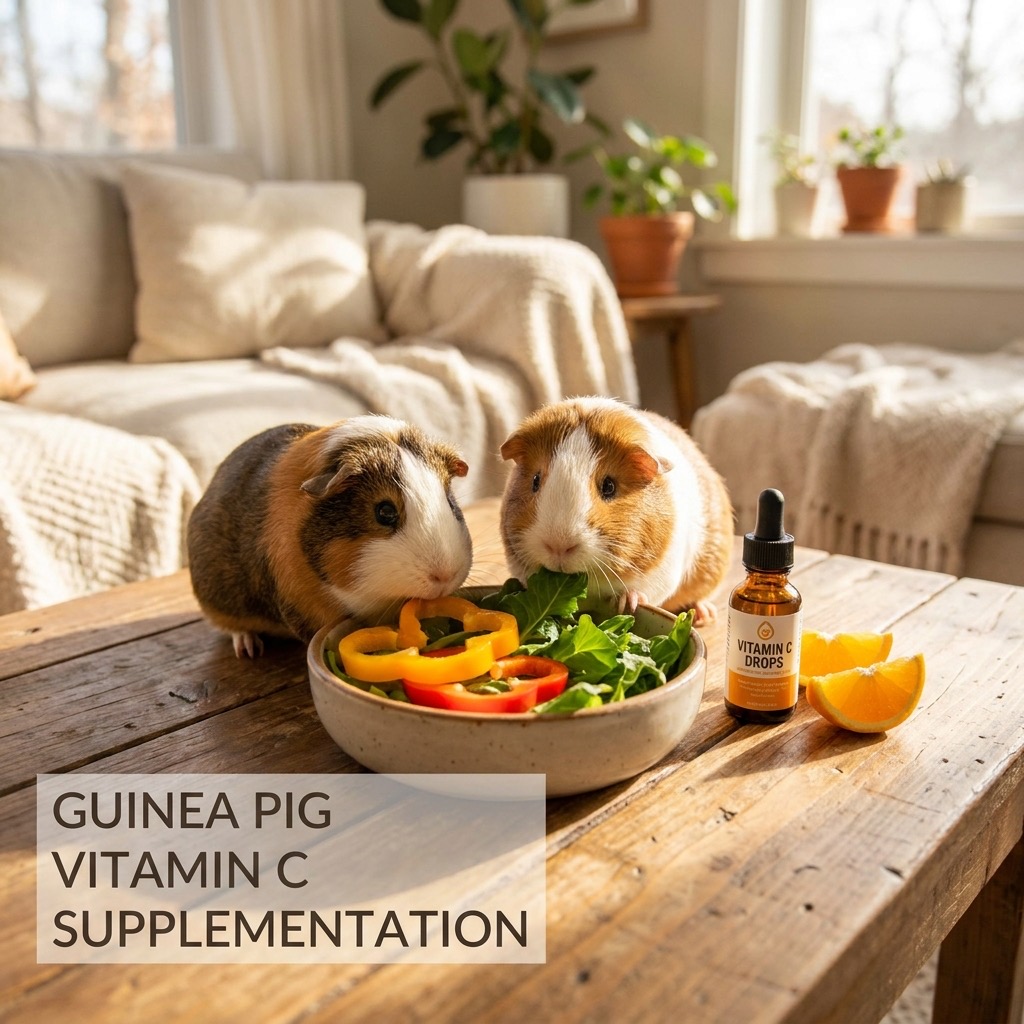
Guinea pig vitamin C supplementation: why guinea pigs can't make their own and what to do about it
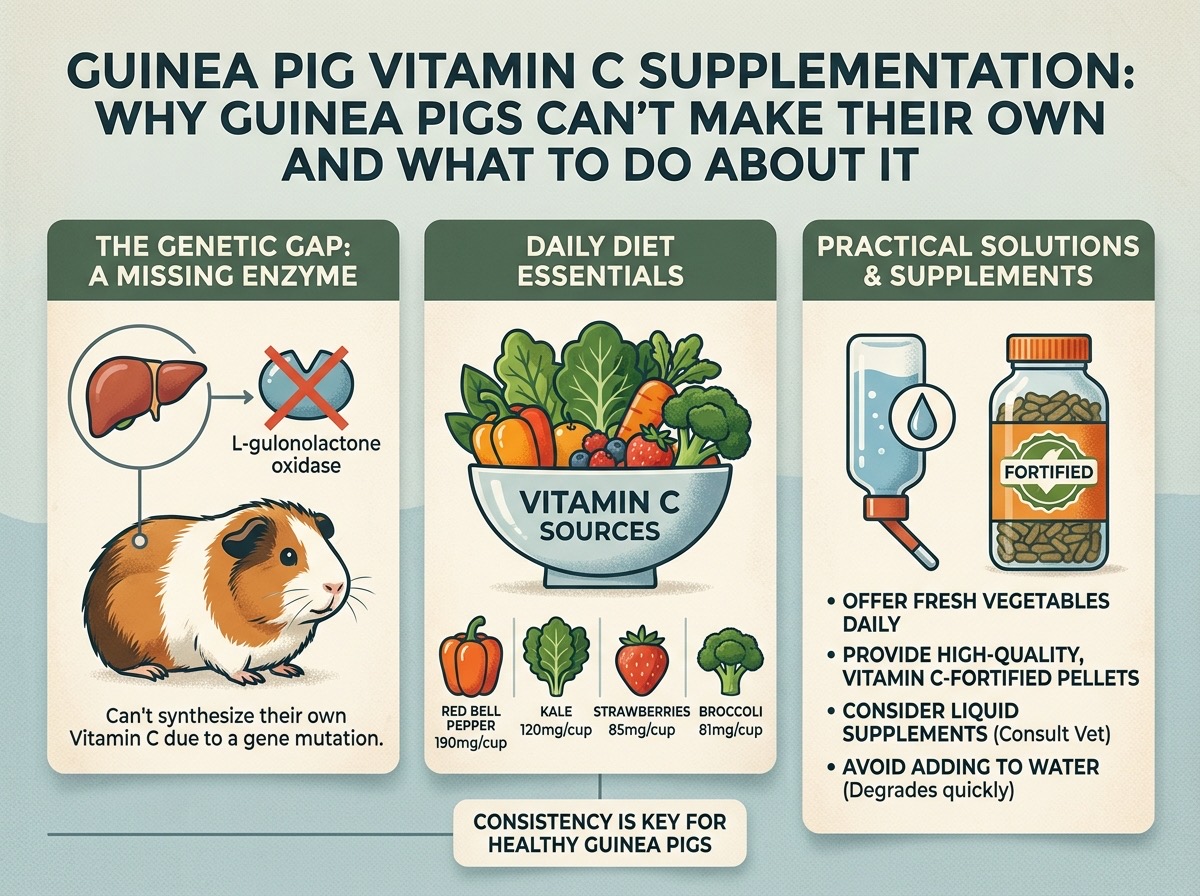
Most mammals can synthesise their own vitamin C in the liver from glucose. Guinea pigs (along with humans, primates, and some bats) cannot. The gene for the enzyme L-gulonolactone oxidase, which is the final step in vitamin C synthesis, is non-functional in guinea pigs. They must get vitamin C from their diet.
The dietary vitamin C requirement for guinea pigs is 25-50 mg per day for a healthy adult, more during pregnancy, illness, or stress. A deficiency of 2-3 weeks produces the clinical signs of scurvy, which is one of the most common and most preventable diseases in pet guinea pigs.
This is the supplementation protocol — the sources, the doses, and the warning signs of deficiency.
Why guinea pigs can't make vitamin C
The vitamin C biosynthesis pathway:
- Glucose → UDP-glucose → UDP-glucuronic acid → D-glucuronic acid → L-gulonic acid → L-gulono-1,4-lactone → L-ascorbic acid (vitamin C)
The final step requires the enzyme L-gulonolactone oxidase (GULO). In most mammals, this enzyme is functional. In guinea pigs (and humans, primates, fruit bats, and some Passeriformes birds), the GULO gene is non-functional — it has accumulated mutations that make the enzyme inactive.
Without the enzyme, the pathway stops at L-gulono-1,4-lactone, which cannot be converted to vitamin C. The guinea pig must obtain vitamin C from the diet.
The same mutation occurred independently in different mammalian lineages (a striking example of convergent evolution). The mutation is not fatal in captivity because the species can be fed vitamin C-rich foods. The mutation is fatal in the wild if vitamin C-rich foods are unavailable.
The vitamin C requirement
The recommended intake for guinea pigs:
- Adult (non-pregnant): 25-50 mg per day
- Pregnant or lactating: 50-100 mg per day
- Growing (under 6 months): 50-100 mg per day
- Sick or stressed: 50-100 mg per day
- Recovery from scurvy: 100-200 mg per day, with gradual reduction once signs resolve
The requirement is higher than for many other small mammals because guinea pigs metabolise vitamin C rapidly. A deficiency can develop within 2-3 weeks of an inadequate diet.
The dietary sources of vitamin C
Guinea pigs obtain vitamin C from three main sources:
1. Fresh vegetables
The primary source in a balanced diet. The high-vitamin-C vegetables:
- Bell peppers (red, yellow, green): 100-200 mg vitamin C per 100 g. Excellent source
- Kale: 90-120 mg per 100 g
- Parsley: 130-150 mg per 100 g
- Broccoli: 65-90 mg per 100 g
- Tomato: 15-25 mg per 100 g
- Spinach: 25-30 mg per 100 g
- Strawberries: 55-60 mg per 100 g
- Oranges: 45-55 mg per 100 g
- Kiwi: 75-90 mg per 100 g
The vitamin C content of fresh vegetables varies by season, ripeness, and storage. Older vegetables have less vitamin C. Vegetables stored at room temperature lose vitamin C faster than vegetables stored in the refrigerator.
The recommended daily fresh vegetable intake: 1 cup of mixed vegetables per guinea pig per day. The mix should include a high-vitamin-C vegetable (bell pepper, parsley) every day.
2. Commercial pellets
Most commercial guinea pig pellets are supplemented with vitamin C. The amount varies by brand:
- Standard supplementation: 500-1,000 mg of vitamin C per kg of pellets
- At the recommended pellet intake (1/8 to 1/4 cup per day): 25-50 mg of vitamin C per day from pellets
The problem: vitamin C in pellets is unstable. It oxidises over time, particularly with exposure to heat, light, and moisture. A bag of pellets that has been open for 2-3 months may have lost 50% of its vitamin C. A bag of pellets that has been stored improperly may have lost even more.
The fix: buy pellets in small bags, use within 4-6 weeks of opening, store in a cool dry place, and check the expiration date.
3. Supplements
When the dietary sources are insufficient (illness, stress, pregnancy, recovery from scurvy), supplements are needed. The supplement forms:
- Liquid vitamin C drops: added to water. Easy to administer but unstable in water (oxidises within hours)
- Tablet vitamin C: chewable tablets. More stable than liquid. Guinea pigs often take the tablets eagerly
- Powdered vitamin C: added to food. Stable if kept dry
- Chewable vitamin C treats: flavoured treats with added vitamin C. Some guinea pigs refuse them
- Injection: administered by the vet for severe deficiencies
The recommended supplement: a plain vitamin C tablet (no added sugar, no added flavours) of 50-100 mg, given daily. The tablet can be hidden in a small piece of vegetable, fed directly, or crushed and added to food.
The liquid vitamin C in water is the least reliable option. The vitamin C oxidises within hours, and the water often tastes different to the guinea pig, who may refuse to drink. Many guinea pig care resources actively discourage liquid vitamin C in water.
The signs of vitamin C deficiency (scurvy)
The early signs of vitamin C deficiency (after 2-3 weeks of inadequate intake):
- Lethargy: the guinea pig is less active, sleeps more
- Reluctance to move: the guinea pig sits still, refuses to walk
- Anorexia: the guinea pig stops eating, particularly refusing pellets and vegetables
- Weight loss: the guinea pig loses weight despite normal or increased appetite initially
The advanced signs (after 4-6 weeks):
- Joint swelling and pain: the guinea pig is reluctant to move, particularly the hind legs. The joints may be visibly swollen
- Bruising and bleeding: vitamin C is essential for collagen synthesis. Deficiency causes fragile blood vessels, leading to bruising and bleeding under the skin
- Loose teeth: vitamin C is essential for the dentin and the periodontal ligaments. Deficiency causes loose teeth, dental pain, and reluctance to eat
- Poor wound healing: cuts and abrasions don't heal normally
- Diarrhea: the gut lining is affected
- Coat changes: rough, dull coat, hair loss
- Respiratory signs: in severe cases, the ribcage becomes painful, and the guinea pig is reluctant to breathe deeply. The breathing is rapid and shallow
The late signs (severe scurvy):
- Haemorrhage: significant bleeding under the skin, into the joints, into the gut
- Death: untreated scurvy is fatal
The progression from early to late is 4-8 weeks. The owner who notices the early signs and provides vitamin C supplementation can prevent the progression. The owner who doesn't notice until the late signs has a critically ill guinea pig that may not recover.
The scurvy diagnosis
The vet diagnoses scurvy based on:
- History: inadequate diet, recent diet change, or stress event
- Clinical signs: lethargy, anorexia, joint pain, dental issues
- Physical exam: swollen joints, painful limbs, bleeding gums, loose teeth
- Radiographs: changes in the bones (osteoporosis, fractures, especially of the costochondral junctions of the ribs)
- Response to treatment: dramatic improvement within 24-48 hours of vitamin C supplementation confirms the diagnosis
A blood test for vitamin C levels is available but not commonly performed. The clinical response to treatment is the most practical confirmation.
The scurvy treatment
The treatment depends on the severity.
Mild to moderate scurvy
- Oral vitamin C supplementation: 100 mg per day, divided into 2 doses
- Diet correction: bell peppers, parsley, kale added to the daily diet
- Pain management: meloxicam for joint pain, if needed
- Supportive care: fluids if dehydrated, syringe feeding if not eating
- Response: improvement within 24-48 hours, full recovery within 2-3 weeks
Severe scurvy
- Vet-administered vitamin C injection: 100-200 mg, subcutaneous or intramuscular
- Fluid therapy: subcutaneous or IV fluids for dehydration
- Assisted feeding: Critical Care (Oxbow) for herbivores, syringe-fed
- Pain management: meloxicam or buprenorphine
- Hospitalisation: in severe cases, the guinea pig needs 24-hour care
- Response: improvement within 48-72 hours, full recovery within 2-4 weeks
The severe scurvy guinea pig is critically ill. The recovery is not guaranteed. The owner who provides vitamin C supplementation at the first sign of deficiency prevents the severe form.
The supplementation protocol
For a healthy adult guinea pig:
Daily
- Fresh vegetables: 1 cup of mixed vegetables, including a high-vitamin-C vegetable (bell pepper, parsley)
- Pellets: 1/8 to 1/4 cup of high-quality guinea pig pellets (with added vitamin C)
- Hay: unlimited timothy hay
- Optional supplement: 50 mg vitamin C tablet, given as a treat or hidden in food
Weekly
- Review the diet: is the guinea pig eating the vegetables? Is the pellet intake consistent? Is the hay available?
- Body condition check: is the guinea pig maintaining weight? Any signs of weight loss?
Monthly
- Check the pellet bag: how old is the open bag? If more than 4-6 weeks, replace with a fresh bag
- Check the vegetables: are they being eaten? Is the supply fresh?
Annually
- Vet check-up: physical exam, weight check, dietary review
The special situations
Pregnancy and lactation
- Increased requirement: 50-100 mg per day
- Sources: high-vitamin-C vegetables (bell pepper, parsley), supplemented with a 50-100 mg tablet
- Pellets: continue normal pellet intake
- Caesarean recovery: increased supplementation for the recovery period
Illness, stress, or surgery
- Increased requirement: 50-100 mg per day
- Sources: supplements (tablet or liquid), high-vitamin-C vegetables
- Duration: throughout the illness and recovery period
- Post-surgery: increased supplementation for 2-4 weeks
Growing guinea pigs (under 6 months)
- Increased requirement: 50-100 mg per day
- Sources: alfalfa-based pellets (more vitamin C than timothy-based), high-vitamin-C vegetables
- Cautions: alfalfa is high in calcium and should not be fed to adult guinea pigs, only to growing ones
Older guinea pigs
- Same as adult requirement: 25-50 mg per day, but with closer attention to actual intake
- Dental issues: older guinea pigs may have dental problems that affect eating. The diet may need to be adjusted to soft vegetables (cooked, pureed)
- Joint pain: osteoarthritis is common. The guinea pig may be less interested in chewing hay. The supplementation becomes more important
The "bell pepper" trick
The most reliable single source of vitamin C for guinea pigs is the bell pepper. A quarter of a red bell pepper provides 30-50 mg of vitamin C, more than the daily requirement. The bell pepper is:
- High in vitamin C (red has the most, green has less)
- Low in sugar (compared to fruits)
- Low in calcium (important for guinea pigs, which are prone to bladder stones)
- Liked by most guinea pigs (sweet, crunchy)
The recommended daily bell pepper: 1-2 slices (about 1/8 of a bell pepper) per guinea pig. Red, yellow, or orange bell peppers are higher in vitamin C than green.
The bell pepper is the foundation of vitamin C nutrition in most guinea pig households. The other vegetables add variety, but the bell pepper is the workhorse.
The "vitamin C in water" warning
A common but problematic recommendation: add liquid vitamin C drops to the guinea pig's water. The problems:
- Instability: vitamin C oxidises rapidly in water. The vitamin C content drops by 50% within 4 hours. By 24 hours, the water has very little vitamin C
- Palatability: the vitamin C drops change the taste of the water. The guinea pig may drink less, compounding the deficiency
- Inconsistency: the owner doesn't know if the guinea pig drank enough water to get an adequate dose
- False security: the owner thinks the guinea pig is getting vitamin C, but the actual intake is much less than expected
The recommendation: do not use liquid vitamin C drops in water. Use tablets, fresh vegetables, or pellets instead. The vitamin C is more stable, the intake is more reliable, and the guinea pig is more likely to get the required dose.
The "vitamin C in the daily vegetables" calculation
A typical day of vitamin C for a guinea pig:
- 1/8 red bell pepper: 40 mg
- A small piece of parsley: 15 mg
- A slice of tomato: 10 mg
- Romaine lettuce: 5 mg
- Total from vegetables: 70 mg
- Daily requirement: 25-50 mg
The vegetable intake above the daily requirement is typical of a well-fed guinea pig. The owner who provides a varied vegetable diet doesn't need additional supplementation, but a tablet is a safety net.
The owner who provides only lettuce, carrots, and apple (all low in vitamin C) is at risk of scurvy. The diet must include a high-vitamin-C vegetable daily.
The "during the winter" consideration
In winter, fresh vegetables are more expensive and sometimes less available. The guinea pig's vitamin C intake may drop. The owner should:
- Continue providing fresh vegetables: even in winter, bell peppers, cabbage, kale, broccoli are available
- Increase the pellet intake: the pellets are more reliable in winter
- Add a vitamin C tablet: as a safety net
The guinea pig that gets the same diet in winter as in summer is at lower risk of deficiency. The guinea pig whose diet is reduced in winter is at higher risk.
The "fresh vs. frozen vs. cooked" consideration
- Fresh: highest vitamin C content. Best option
- Frozen: similar vitamin C to fresh if frozen quickly after harvest. Acceptable
- Cooked: lower vitamin C content. Heat destroys vitamin C. The guinea pig fed only cooked vegetables may not get enough vitamin C
- Dried: very low vitamin C. Dried vegetables and hay do not provide meaningful vitamin C
The recommendation: fresh is best, frozen is acceptable, cooked is suboptimal.
The "piggie vitamins" myth
A common product: "Vitamin C drops for guinea pigs" or "multivitamin drops for guinea pigs". Most of these products are:
- Unstable: liquid vitamins oxidise quickly
- Poorly absorbed: the form of vitamin C may not be bioavailable
- Unnecessary: a well-fed guinea pig doesn't need additional vitamin supplementation
- Potentially harmful: some multivitamin drops contain other vitamins (D, A) that can be toxic at high doses
The recommendation: skip the multivitamin drops. Use plain vitamin C tablets (50-100 mg) or rely on a balanced diet.
The "guinea pig food pyramid"
For a balanced guinea pig diet:
- Hay (80% of diet): timothy hay, unlimited. Provides fibre and wear for the teeth
- Fresh vegetables (15% of diet): 1 cup per day, with a high-vitamin-C vegetable every day
- Pellets (5% of diet): 1/8 to 1/4 cup per day, high-quality pellets with added vitamin C
- Treats (rare, <5% of diet): small amounts of fruit, special treats. Limited because of the sugar content
The hay is the foundation. The vegetables provide vitamins, minerals, and water. The pellets provide a nutritional safety net. The treats are occasional.
The bottom line
Guinea pigs cannot synthesise their own vitamin C. The dietary requirement is 25-50 mg per day for a healthy adult, more during pregnancy, illness, or stress. The primary source is fresh vegetables — bell peppers, parsley, kale, broccoli, tomato, with bell pepper as the workhorse. The secondary source is commercial pellets (with added vitamin C, but the vitamin C is unstable in opened bags). The tertiary source is a vitamin C tablet (50-100 mg per day) for a safety net. The early signs of deficiency are lethargy, anorexia, and joint pain. The late signs are joint swelling, bruising, loose teeth, and death. The owner who provides a varied diet with daily high-vitamin-C vegetables and a vitamin C tablet has a guinea pig that never develops scurvy. The owner who feeds a low-vitamin-C diet (lettuce and carrots only) has a guinea pig that develops scurvy within 2-3 weeks. The disease is preventable. The protocol is straightforward. The guinea pig is worth the bell pepper.
---
About the author: [Ravi Patel](../Ravi%20Patel.md) is an MSc in Exotic Animal Medicine from Edinburgh with 18 years of practice, and a founding member of the Wildlife and Exotic Animal Veterinary Association (India).