

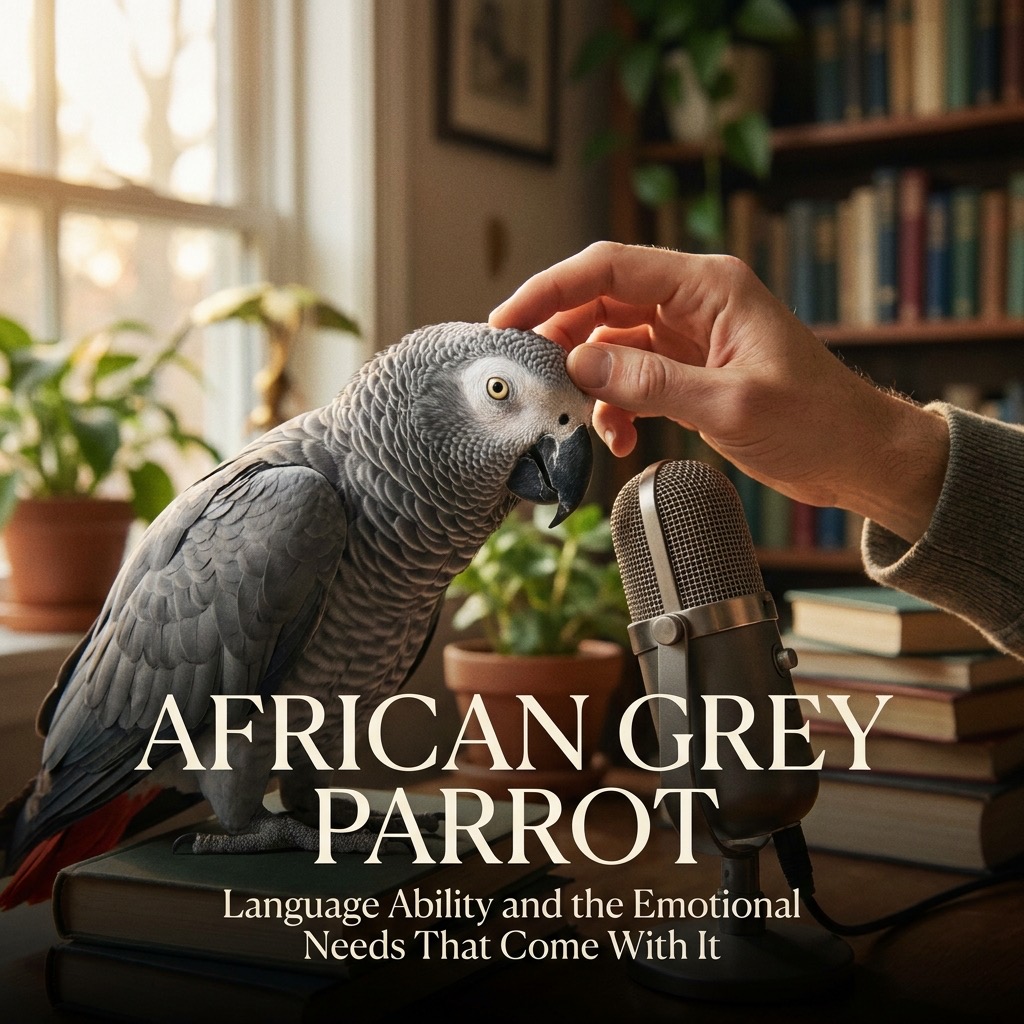
African grey parrot: language ability and the emotional needs that come with it
The African grey is the most cognitively sophisticated bird in the pet trade. Alex, the Harvard-research grey of Dr. Irene Pepperberg, demonstrated a vocabulary of over 100 words, identified colours, shapes, materials, and quantities, and could string novel phrases together in contextually appropriate ways. A pet African grey has the same neural architecture. They learn the names of family members, request specific foods, ask for the dog by name, mimic phone ringtones, and use words they have heard once or twice.
The same intelligence that produces these abilities also produces a bird that requires more from its human than almost any other pet. Owners who are prepared for the language are rarely prepared for the bird behind it.
The cognitive profile: what an African grey actually is
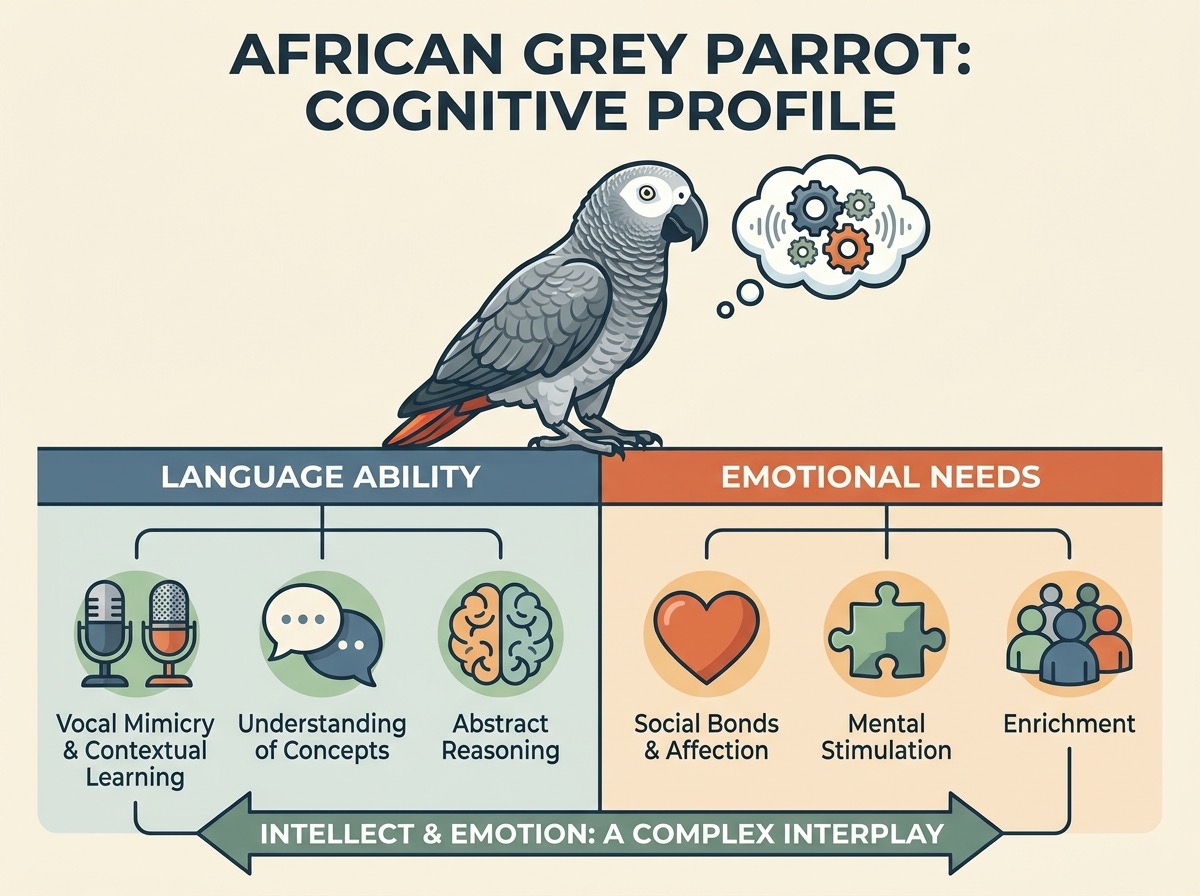
The African grey's brain-to-body ratio is comparable to a chimpanzee's. The forebrain (responsible for complex cognition) is unusually large. They demonstrate:
- Vocal learning: ability to mimic and use human speech, including novel combinations
- Categorical thinking: ability to group objects by colour, shape, material
- Numerical concepts: ability to count up to about 6
- Self-recognition: pass the mirror test
- Theory of mind precursors: ability to attribute knowledge to others
- Long-term memory: recall of people, places, and events over years
- Empathy and emotional contagion: respond to household emotions
This cognitive profile is closer to a 3-5 year old child than to a typical pet bird. The African grey is a juvenile primate in feathers. Owning one is closer to parenting a toddler than owning a parakeet.
The implications are practical. The bird:
- Needs 4-6 hours of direct social interaction per day
- Requires environmental enrichment (foraging, training, novel objects)
- Experiences boredom, frustration, grief, and anxiety like a primate
- Develops behavioural disorders (feather plucking, self-mutilation, screaming) when needs aren't met
- Can become aggressive, possessive, or phobic in response to handling mistakes
- Forms a primary bond with one person and may become aggressive to others
- Lives 50-70 years in captivity — longer than most human marriages
The bird's cognitive needs don't decline with age. A 30-year-old grey still needs the same 4-6 hours of interaction, the same enrichment, the same consistency. The commitment is generational.
The language ability: what the science shows
Dr. Irene Pepperberg's work with Alex and subsequent greys demonstrated capabilities that were once thought to be uniquely human. The most important findings:
Referential communication
African greys don't just mimic — they use words referentially. They label objects correctly, request objects by name, and reject incorrect labels. Alex learned "no" and used it to refuse unwanted food or activities.
Categorical concepts
Alex identified objects by colour, shape, and material, and could answer questions like "what colour is the wood block?" — categorising by two attributes simultaneously. This is the level of cognition of a 4-5 year old human child.
Numerical concepts
Alex could count up to 6 objects and could report the number correctly. He could also answer "how many X?" when X varied, demonstrating that "number" was a concept, not a memorised pattern.
Novel combinations
Alex would combine words in new ways: "want nut" became "want cork nut" when he wanted a nut to use as a play object. He would say "you tickle me" to a researcher. The combinations were not just novel but appropriate to context.
Social referencing
Greys look to their humans for emotional cues. They will refuse food that a human they trust has called "yucky", and approach objects a trusted human has called "scary" with caution. The bird reads the room.
The takeaway: an African grey's language is not tricks. It is communication, often with real intent. The bird is telling the owner things, not just performing.
What "talking" looks like in a pet grey
Most pet African greys don't reach Alex's level, but the typical well-socialised pet grey has:
- 50-200 word vocabulary over their lifetime
- Context-appropriate use of common words (says "hello" to people, "bye" to departures, "good night" at bedtime)
- Mimicry of household sounds: doorbell, microwave beeps, phone rings, dog barking, baby crying, owner's laugh
- Whistled tunes, sometimes entire melodies with rhythm
- Recognition of names: calls family members by name, asks for the dog by name
- Request speech: "want water", "want scratch", "want out"
- Negative statements: "no", "stop", "go away", "bad dog"
The vocabulary develops over years. A new grey may not talk for the first 6-12 months. Once it starts, the vocabulary grows steadily. Many greys are most vocal at dawn and dusk (natural calling times for wild parrots). Some greys develop very large vocabularies by 5-10 years of age; others never exceed 20 words.
The bird picks up words the owner uses frequently, in emotional contexts. A grey in a quiet household with little conversation has a small vocabulary. A grey in a household with constant conversation, where people talk to the bird directly, has a large vocabulary.
The emotional needs: the harder side of the package
The intelligence that makes the African grey a great talker is the same intelligence that makes it a high-maintenance pet. The most common emotional and behavioural problems in pet greys are not the bird's fault — they are unmet needs.
The 4-6 hour social requirement
A grey is a flock animal. In the wild, a grey is never alone — it is in constant contact with its mate, its flock, and its environment. The flock provides social contact, predator vigilance, foraging partners, and preening partners.
A pet grey in a human household has a flock of humans. But humans leave for work, school, and errands. The grey is alone for 8-10 hours a day. This is a long time for a flock animal. The result:
- Screaming: the bird's call to its flock. Wild greys call loudly in the morning and evening. A pet grey left alone for long periods may scream throughout the day, especially in the late afternoon when the flock (humans) is not responding
- Feather plucking: the bird's self-soothing behaviour, similar to trichotillomania in humans. Caused by boredom, loneliness, anxiety, or environmental frustration
- Self-mutilation: severe feather plucking progressed to skin and tissue damage. A grey that is chewing its own flesh is in severe psychological distress
- Phobic behaviour: sudden fear of previously normal objects (a new broom, a change in furniture). Often follows a stressful event during a sensitive period
- Aggression: biting, lunging, screaming at specific people. Often directed at non-flock members (the spouse, the children, the visitors)
The 4-6 hour per day interaction is non-negotiable for a healthy grey. Not "in the same room" — direct, focused interaction. Talking to the bird, training, playing, preening.
The environmental enrichment requirement
A grey in the wild spends 6-8 hours per day foraging for food, preening, vocalising, and interacting with the flock. A pet grey in a typical cage spends 30 minutes foraging (it just eats from a bowl), 30 minutes preening, and the rest of the day... staring at the wall.
The unstimulated grey develops behavioural disorders. Enrichment is essential:
- Foraging toys: the bird works to extract food from a puzzle. Multiple levels of difficulty, rotated daily
- Training sessions: 10-15 minutes, 2-3 times per day. The bird learns new behaviours using positive reinforcement
- Out-of-cage time: 3-6 hours per day, supervised. The bird interacts with the household
- Novel objects: rotated every few days. New perches, new toys, new foraging opportunities
- Social contact: the bird is part of the household, not isolated in a back room
A grey without enrichment is a grey heading toward feather plucking, screaming, or aggression.
The primary bond dynamic
Greys typically bond closely to one person. This person becomes the bird's "mate" in the bird's perception. The bird follows this person, calls for this person, and may become aggressive to others (especially the person's spouse or children).
This dynamic is manageable but requires active effort:
- All family members handle the bird from the start, so the bird is comfortable with everyone
- The primary person doesn't do all the feeding, training, and play — share responsibilities
- The bird's cage is in a common area, not the primary person's bedroom (the bird becomes more bonded if it's in the family space)
- The bird's "mate" is the flock, not one person — reinforce that the bird is part of the household, not a bonded pair
A grey that is bonded to one person and is aggressive to the rest of the family is a common rehoming scenario. The bird isn't "mean" — it's a flock animal that has been inadvertently given the wrong social structure.
Common behaviour problems and their solutions
Screaming
Two types of screaming: contact calling (normal, twice a day) and excessive screaming (hours daily).
Contact calling (5-10 minutes at dawn and dusk): normal, healthy, cannot be eliminated. Acknowledge the call (say "hello" back) and the bird will quiet. Do not yell at the bird to be quiet — the bird reads yelling as a flock response and will yell back.
Excessive screaming: usually caused by under-stimulation, lack of social contact, or learned reinforcement. Solutions:
- Increase interaction time
- Add foraging toys and training
- Ensure 10-12 hours of sleep per night (cover the cage at dusk; greys are sensitive to light)
- Do not reward screaming by coming to the cage when the bird screams. Wait for a pause, then come
- Background noise (radio, TV) when the bird is alone — the bird hears voices and feels less alone
Feather plucking
Feather plucking is the most common presenting complaint for African greys. Causes:
- Boredom / under-stimulation: most common. The bird has nothing to do
- Anxiety: change in household, new pet, new baby, new home
- Medical: skin infection, parasites, allergy, liver disease, psittacine beak and feather disease (PBFD), malnutrition
- Hormonal: in some birds, hormonal changes trigger plucking
A grey that suddenly starts plucking needs a vet visit first to rule out medical causes. If the vet finds no medical cause, the work is environmental and behavioural:
- Increase enrichment: more foraging, more training, more out-of-cage time
- Add a "plucking distraction": a foraging toy the bird works on during peak plucking times (often the evening)
- Address the underlying emotional cause: the new pet, the new baby, the change in routine
- In severe cases, an avian vet may prescribe clomipramine or haloperidol
Feather plucking can become a habit even after the cause is addressed. The earlier the intervention, the better the outcome. A grey that has plucked for 5 years may never fully recover.
Aggression to family members
The grey bites the spouse, the kids, or the visitors. The bird may scream and lunge. Causes:
- Mate-bonding to one person: the bird perceives the primary person as its mate and is "protecting" the mate from others
- Fear: the bird is afraid of the person
- Pain: the bird is hurting and doesn't want to be touched
- Lack of socialisation: the bird was not handled by multiple people as a chick
Solutions:
- All family members participate in positive interactions (treats, training, gentle handling)
- Avoid forcing interactions. The bird approaches on its terms
- The primary person doesn't "rescue" the bird from the others — the bird learns to handle being with non-primary people
- Slow desensitisation: the non-primary person sits near the cage, offers treats, talks softly, doesn't reach in
- For severe cases, consult an avian behaviour consultant
Phobic behaviour
The grey becomes terrified of a specific object or situation. Often after a traumatic event: a loud noise, a vet visit, a fall, a near-collision with a window.
Solutions:
- Identify the trigger and avoid it during recovery
- Counter-conditioning: pair the trigger with high-value food at low intensity
- Increase environmental predictability: same routine, same location, same handler
- Time: phobias often resolve over weeks to months as the bird re-learns safety
The diet behind the behaviour
A grey's diet has measurable effects on behaviour. The common all-seed diet is nutritionally inadequate — high in fat, low in vitamins and minerals, and lacking the phytochemicals the bird would get from a varied wild diet.
The diet for behavioural health:
- Pelleted base (60-70% of intake): a high-quality formulated pellet (Harrison's, Roudybush, Zupreem Natural). The bird's primary nutrition
- Fresh vegetables (20-30%): dark leafy greens, carrots, sweet potato, bell peppers, broccoli, squash. Variety is essential
- Fresh fruit (5-10%): apple, banana, berries, melon. Limit high-sugar fruit
- Sprouted seeds and nuts (5-10%): a handful of sprouted seeds or a few nuts as treats
- Foraging opportunities: hide pellets in foraging toys so the bird "works" for its food, as it would in the wild
The diet transition is gradual. A grey raised on seeds may resist pellets for months. Persistence and offering pellets as the only "always available" food eventually works.
The age and commitment question
The African grey lives 50-70 years. The 5-year-old grey is a juvenile. The 20-year-old grey is in middle age. The 40-year-old grey is a senior. The bird may outlive its owner.
A grey needs a plan for the bird's later decades. Options:
- A family member committed to taking the bird
- A reputable parrot sanctuary (limited capacity, long waiting lists)
- A trust or legal provision for the bird's care
A grey that's rehomed at 30 years old has been the only home the bird has ever known. The bird's psychological well-being depends on continuity. The owner must plan ahead.
The "right" home for an African grey
The right home for a grey:
- Has at least one person home for 4-6 hours per day (work-from-home, retired, part-time worker)
- Has time for daily training, out-of-cage time, and social interaction
- Has space for a large cage (minimum 36"x24"x48") and a playstand
- Has other family members willing to participate in care
- Has no small children (the bird is fragile; a toddler can injure a grey)
- Has financial resources for vet care, food, and supplies ($1,000-2,000 per year)
- Has researched the species thoroughly and understands the 50-70 year commitment
- Has a plan for the bird's later decades
The wrong home:
- Both adults work full-time outside the home
- Limited time for daily interaction
- Small children
- Rented housing that doesn't allow large birds (noise complaints are common)
- Impulse purchase without research
- Expectation that the bird is a "pet" in the traditional sense (low maintenance)
The bottom line
The African grey is the most cognitively sophisticated bird in the pet trade, and the same intelligence that produces 200-word vocabularies and referential communication produces a bird with profound social, emotional, and cognitive needs. A grey in the right home — with 4-6 hours of daily interaction, environmental enrichment, a varied diet, and a committed owner who plans for the bird's 50-70 year lifespan — is one of the most rewarding pets a person can have. A grey in the wrong home — alone 10 hours a day, with seeds in a bowl and a small cage, no social interaction, no enrichment — develops screaming, feather plucking, self-mutilation, and aggression. The species isn't a pet for everyone. For the people who can meet the needs, it's a peer.
---
About the author: [Ravi Patel](../Ravi%20Patel.md) is an MSc in Exotic Animal Medicine from Edinburgh with 18 years of practice, and a founding member of the Wildlife and Exotic Animal Veterinary Association (India).