

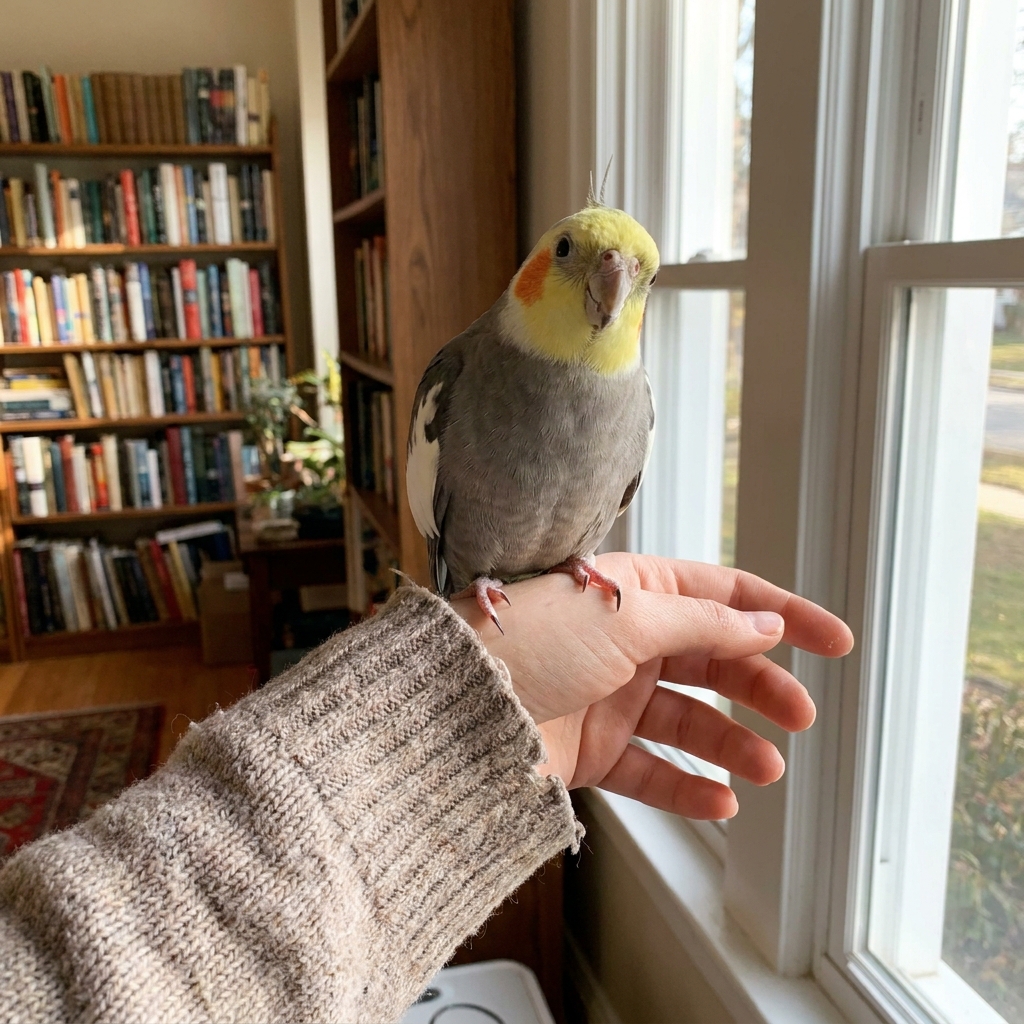
Cockatiel daily care checklist: the 15-minute morning and evening routine
A cockatiel (Nymphicus hollandicus) in the wild flies 30–60 km a day across semi-arid Australian grasslands, eats 30+ plant species, and nests in tree hollows 2–6 m up. A pet cockatiel lives in a 60 × 45 × 90 cm cage, eats whatever is in the bowl, and is alone for 8–10 hours while the family is at work. The species is forgiving — they adapt to almost anything — but the adaptation is not the same as thriving. The bird on a clean pellet diet with daily out-of-cage time and weekly weigh-ins lives 20–25 years. The bird on an all-seed diet in a small cage dies at 12–15 from hepatic lipidosis, atherosclerosis, or obesity-related respiratory failure.
The gap is not talent or money. It is a routine. This is the one I walk every cockatiel owner through at first consult, and the one I run on my own three at home.
The morning routine — 15 minutes, before you leave the house
1. Visual check, 60 seconds. Look at the bird on the perch before you do anything. Check posture (upright, weight on both legs, wings folded), breathing (no tail bob, no open-mouth, no clicking), eyes (round, clear, alert), and droppings on the paper (formed faeces + white urate + clear urine — no yellow or green urates, no blood). The single highest-yield habit in cockatiel ownership. A bird who looked fine last night and is fluffed, tail-bobbing, or on the cage floor at 7 a.m. is a vet visit, not a wait-and-see.
2. Replace water, 30 seconds. Empty, rinse, refill with room-temperature filtered water. Do not add vitamins or supplements to the water — they degrade in hours and breed bacteria. Check bottle spouts are not stuck with seed or algae.
3. Refill pellets, 30 seconds. Top up the dry pellet bowl. The brands I actually feed:
- Roudybush Daily Maintenance (crumble or mini) — cleanest ingredient list, my default
- Lafeber Classic Nutri-Berries — useful for conversion off seed and for scatter foraging
- Zupreem Natural (medium or large) — acceptable, slightly higher sugar than Roudybush
- Harrison's Adult Lifetime (super fine or fine) — organic, certified, for birds with suspected liver or kidney issues
The bowl should be about 70 % pellets by volume. The remaining 30 % is the morning chop.
4. Prepare the morning chop, 5 minutes. The most skipped step. Cockatiels are granivores but eat sprouted seed, fresh greens, berries, and the occasional insect. A basic chop for one or two birds:
- 1 tablespoon cooked quinoa or brown rice (cooled)
- 1 tablespoon chopped carrot or grated zucchini
- 1 teaspoon chopped dark leafy greens (kale, bok choy, romaine — no iceberg, no spinach in volume)
- 1 teaspoon fresh fruit (apple, pear, blueberry — no avocado, no cherry pits)
- 1 teaspoon sprouted seed (mung bean, lentil)
In a separate ceramic bowl, not on top of the pellets. Remove uneaten chop after 4 hours — wet food spoils fast.
5. Mist or offer a bath, 2 minutes. Cockatiels need bathing 2–4 times a week. The cleanest method: a flat ceramic dish with 2–3 cm of lukewarm water, in the cage for 20–30 minutes while you finish the routine. Most walk in voluntarily. If yours does not, a light mist from a clean spray bottle held 30 cm away is the fallback.
6. Quick room check, 2 minutes. Windows closed or screened (cockatiels hit glass at full flight speed and die). Ceiling fans off. No teflon-coated pans heating on the stove (PTFE fumes kill birds within minutes — the single most common acute toxicosis I see). No scented candles, no essential oil diffusers running. No cigarette smoke in the room, ever.
**Teflon warning in full**: when a non-stick pan, self-cleaning oven, or PTFE-coated space heater reaches 200 °C, it releases an odourless gas that causes acute pulmonary haemorrhage in birds. The bird drops from the perch. No warning. If you keep a bird, you do not use PTFE cookware pre-heated dry, and you do not run a self-cleaning oven cycle while the bird is in the house.
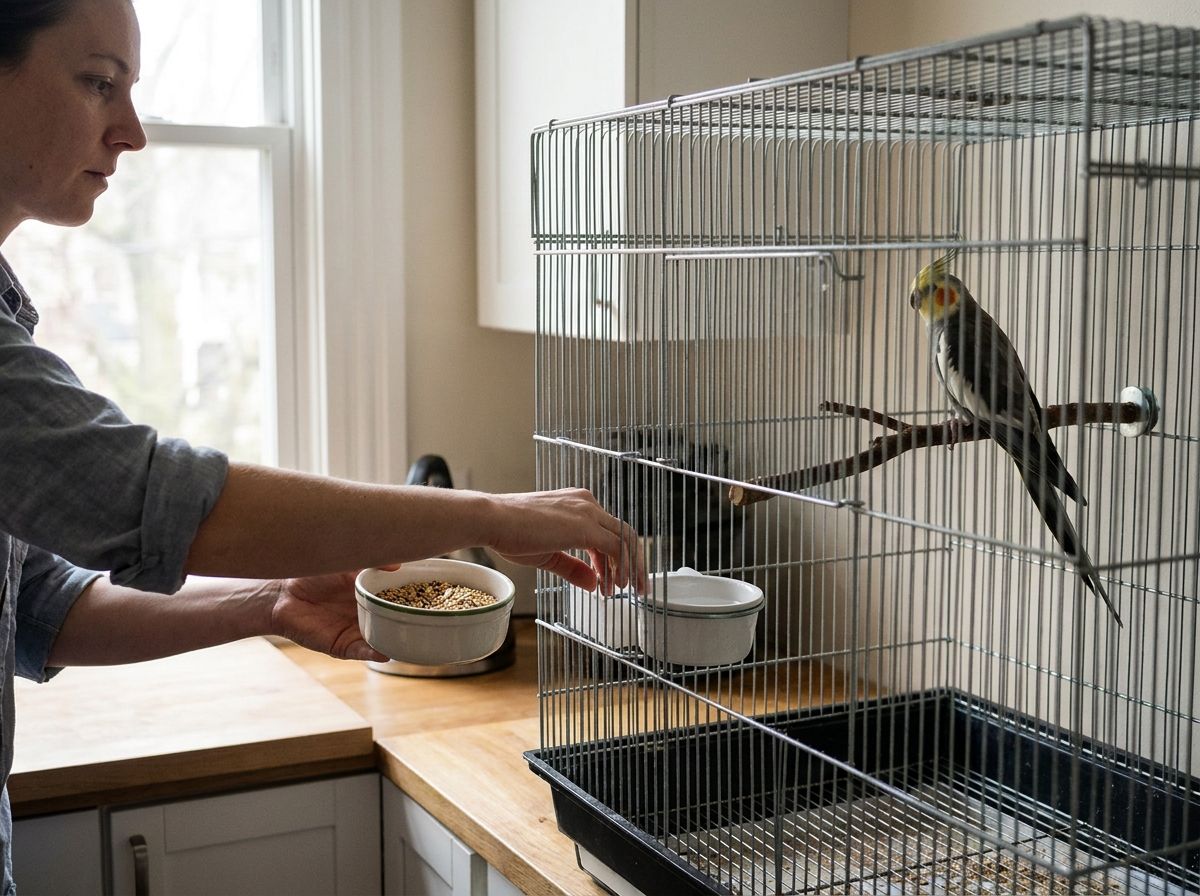
The evening routine — 15 minutes, after work
7. Weigh the bird, 60 seconds. The second most important habit, and the one nobody does. Cockatiels mask illness so well that by the time a casual owner notices a problem, the bird has lost 15–20 % of body weight. A healthy adult sits between 80 g and 125 g. Weigh weekly on a digital kitchen scale that reads to 1 g — a 5 g drop over two weeks in a bird that looks fine is an appointment. Use a T-stand or a flat bowl of seed on the scale.
8. Replace chop, 60 seconds. Throw out what is left, rinse, refill with a smaller portion of fresh chop. Cockatiels alone all day eat more reliably when fresh food is offered at this hour — it coincides with their evening activity peak.
9. Out-of-cage time, 30–90 minutes. A minimum of one hour of supervised time in a bird-proofed room. Bird-proofing: windows and mirrors decaled, fans off, doors closed, no other pets, no open toilet bowls, no hot stovetops, no candles. If clipped or young, start with 20 minutes and build up.
10. Training micro-session, 5 minutes. The highest-value 5 minutes in the day. One behaviour, three to five reps, treat-based, then stop. Useful starters: step-up, target stick (a chopstick the bird touches with its beak for a treat), recall over 1 m. Treats: 1 cm of millet spray (millet is sugar and fat), one safflower seed, or a pine nut. Five minutes daily for a month produces a cockatiel that steps up on command, recalls across a room, and is far less likely to develop behavioural problems in year two.
11. Replace water and check droppings, 60 seconds. Same visual check as the morning. A bird fine in the morning and fluffed at 7 p.m. is a same-day vet visit. Photograph unusual droppings.
12. Cover or leave uncovered, 30 seconds. Cockatiels need 10–12 hours of sleep in a quiet, dim room. Whether you cover the cage is personal — what matters is consistency. If covered, use a dark cotton cover, not synthetic fleece (birds chew fibres and crop-impactions follow). If uncovered, the room is dark and quiet from the same hour every night. Irregular sleep cycles cause hormonal behaviour: screaming, biting, chronic egg-laying in hens, feather destruction in both sexes.
The weekly routine — 20 minutes, usually Sunday
13. Full cage clean. Move the bird to a carrier. Empty all bowls and perches. Wash the grate and tray with hot water and white vinegar (1:4). Avoid bleach, phenols, and any "pet cage cleaner" with a strong scent — they leave residues that irritate the respiratory tract. Rinse twice, dry, replace the paper liner.
14. Toy rotation and perch check. Cockatiels need 4–6 toys, with at least 2–3 destructible (paper rolls, palm strips, sola wood, balsa, vine balls). Rotate one out and one in every Sunday — the cheapest behaviour intervention in the trade. Perches: natural branches of varying diameter (manzanita, java wood, eucalyptus) keep the feet healthy. One dowel perch only is a future foot problem.
15. Nail and wing check. Nails should not catch on fabric. A quick clip of the tip with a small human nail clipper, bird wrapped in a towel, is enough. If you can feel the quick, stop. Wing trim: I do not recommend routine trims. A clipped cockatiel cannot escape a foot, a cat, or a fall. Decide per bird and per household.
The twice-yearly routine — the avian vet visit
Cockatiels hide illness, so the well-bird check matters. Twice a year, the same vet. The exam should include visual exam and palpation, weight and body condition score, gram stain of the choana, faecal parasite screen, and bloodwork (basic panel at 5+ years old), annually.
An avian-certified vet, not a small-animal vet who sees birds occasionally. The Association of Avian Veterinarians ([aav.org](https://www.aav.org)) maintains a searchable directory.
UVB, calcium, and the things people forget
Two long-term topics that don't fit the daily checklist but determine whether the bird makes it past year 15.
UVB. A full-spectrum LED or T5 HO fluorescent that emits UVB in the 290–320 nm range is the single most under-provided item in cockatiel husbandry. Without UVB, the bird cannot synthesise vitamin D3 in the skin, cannot absorb dietary calcium, and develops osteopenia, egg-binding in hens, and seizures in advanced cases. A bulb marketed "full spectrum" without a confirmed UVB output is not UVB. Brands I install:
- Arcadia Bird Lamp 12 % UVB T5 HO — for birds near a window with no direct sun. Mounted 25–30 cm from the main perch.
- Arcadia PureSun Bird — for birds kept in rooms with no natural daylight.
- Replace every 12 months even if it still glows — UVB output drops to negligible after the rated life.
Calcium. Cuttlebone is a supplement, not a toy. Hang a cuttlebone or mineral block inside the cage, near a perch the bird actually uses. Replace every 3–4 months — they go stale. For hens in lay or at risk of egg-binding, a calcium supplement in the water once a week (Calcivet or similar) is reasonable, but do not exceed the dose. Excess calcium causes renal issues in males and in non-laying hens.
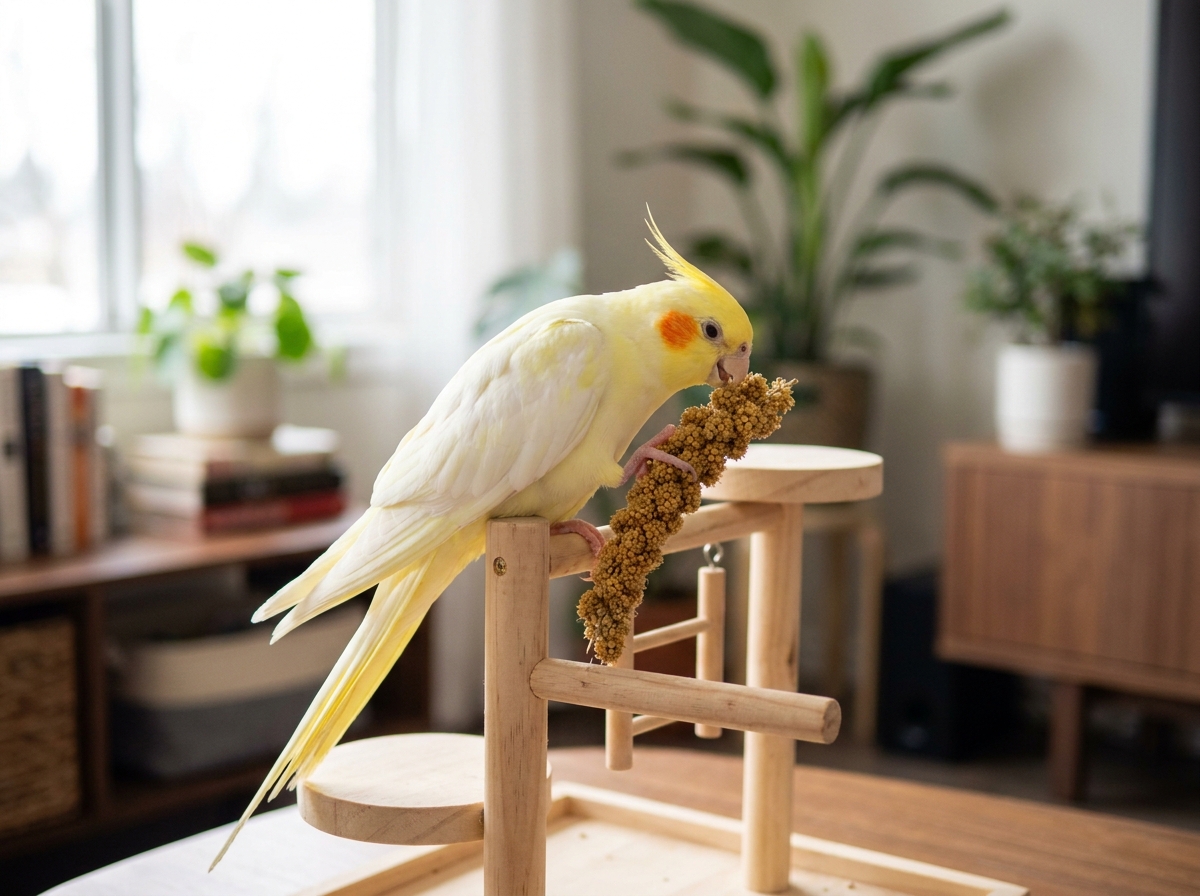
The fifteen-minute evening summary
Morning: visual check, water, pellets, fresh chop, mist or bath, room safety. Evening: weigh, replace chop, out-of-cage time, five minutes of training, second visual check, consistent lights-out. Weekly: cage clean, toy rotation, perch and nail check. Twice yearly: avian vet visit with gram stain and faecal screen. Year-round: a 12 % UVB tube replaced every twelve months, a cuttlebone, a varied chop, and one hour of out-of-cage time.
The keepers who run this routine spend about 30 minutes a day on a bird that costs roughly $0.80 a day to feed. They get a cockatiel that is alert, vocal, easy to handle, and lives past 20. The routine is the insurance policy. The bird is the dividend.