

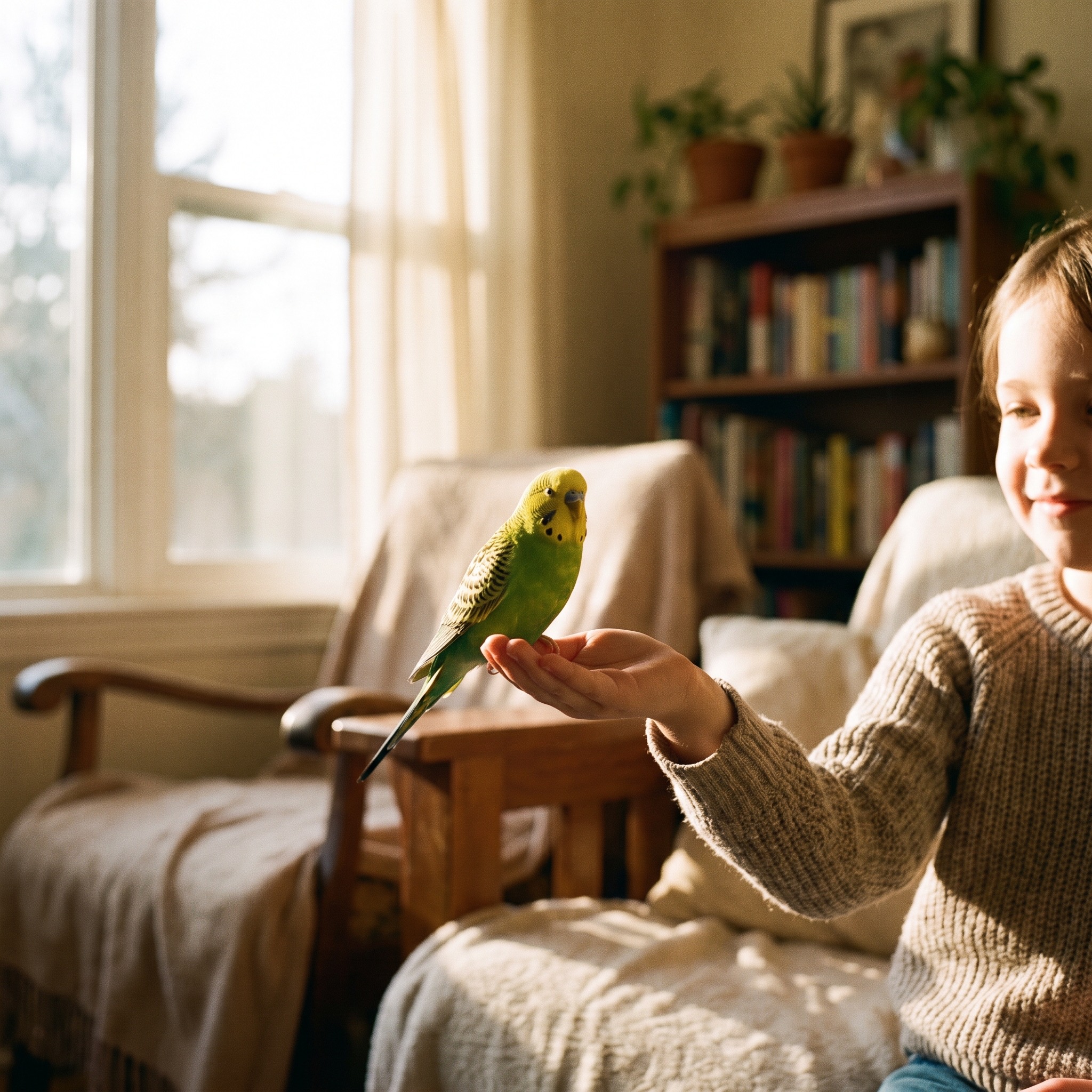
Budgerigar: choosing and hand-taming a young bird, week by week
A budgerigar (Melopsittacus undulatus) in the wild lives in flocks of 20 to several thousand, flies up to 60 km a day, and breeds in tree hollows after the rains. The pet budgie in most homes lives alone in a small cage, eats a single seed mix, and dies at three from obesity or isolation stress. The budgie that lives 15 is the same species. The difference is the source, the cage, the diet, and the four weeks of slow work after the bird comes home.
Where the bird comes from, and why it matters
Three sources exist, and they produce very different animals.
Hand-fed by a breeder, weaned at 6–8 weeks. Pulled at 2–3 weeks, hand-fed with Kaytee Exact or Harrison's Juvenile, used to humans before its fear window closes. A hand-fed baby steps up the same day and is the only realistic source for a true companion bird. Cost: $80–$200. Ask for the hatch date and hand-feeding log.
Parent-raised, fledged, sold at 8–12 weeks. The mainstream option. Taming possible but takes 3–6 weeks of patient work.
Imported, parent-raised, sold at a chain pet store. The bird I see most in consults. Imports carry a meaningful load of Macrorhabdus, Chlamydia, and Sternostoma mite. Request a health certificate and 14-day quarantine. If they cannot produce one, walk out. A $40 chain-store budgie becomes a $400 vet bill in month three.
Buy hand-fed for a companion, parent-raised if you have patience, and skip imports.
Choosing a young bird: the actual signals
The optimal age for a hand-tame project is 6–10 weeks — weaned, still a bit fluffy, fully feathered.
- Head barring. Young budgies have clear black or brown bars from crown to cere, receding at the 3–4 month moult. Heavy even barring = young. Patchy or absent barring = adult.
- Cere colour. Males over 4 months develop a blue or purplish cere. Females develop a tan or brown cere. A pink or pale cere on a chick under 4 months is normal and tells you nothing about sex.
- Eyes. Solid black = young. A visible white iris ring = adult.
- Behaviour and vent. A healthy chick is curious and nibbles your finger. A fluffed, on-the-floor, eyes-half-closed chick is sick. Vent should be clean and dry; a pasted vent in a chick is almost always bacterial enteritis and needs a vet.
Walk away from any source that mixes budgies with cockatiels, finches, and parrots in the same open-air cage — psittacine cross-infection risk is real.
Cage, bar spacing, and the room
The minimum cage for a single budgie is 60 × 30 × 40 cm (W × D × H). Width matters more than height — budgies fly horizontally. For a bird spending real time in the cage, 80 × 40 × 50 cm is the realistic minimum.
Bar spacing is the most important cage number. Budgies' heads fit through anything 1.5 cm or wider. A budgie that gets its head stuck and panics can break its neck in seconds. Bar spacing 1.0–1.5 cm, never more.
Brands I use: Prevue Hendryx Flight Cage F050 (78 × 36 × 88 cm, 1.0 cm spacing — the default), Yaheetech 81 × 49 × 84 cm (similar, cheaper), and Mcage 90 × 50 × 130 cm for a pair. Skip the "budgie starter cage" under 50 cm wide. Round cages are worse than square.
Perches and toys. Three perches minimum: a manzanita or eucalyptus natural branch (1.5–2.0 cm), a calcium or mineral perch as a foot conditioner, and a cotton or sisal rope perch for sleeping. No sandpaper perch covers — they cause bumblefoot. Budgies are parrots and need 4–6 toys, with at least 2 destructible (paper rolls, palm strips, vine balls, sola wood), one swing, one foraging toy. Rotate one in and one out every two weeks.
Room. A busy room — budgies are flock animals and an isolated bird develops screaming, feather-plucking, and chronic egg-laying in hens. Avoid the kitchen (PTFE fumes from non-stick cookware kill birds within minutes). A corner with two walls behind the cage is ideal.
The first 48 hours at home
The mistake I see most: owner brings the budgie home, opens the carrier inside the cage, and immediately tries to handle the bird. The budgie panics, hits the bars, and the trust clock resets to zero.
- Hour 0. Place the carrier inside the cage, dim the lights, close the door, leave the house. The budgie will exit in 30–60 minutes.
- Hours 1–24. No approach, no hand in the cage, no staring. Talk softly when you pass. Refill water and pellets from outside (long-spouted bottle, outside-mount hopper). Room 20–24 °C, humidity 40–60 %.
- Hours 24–48. Sit next to the cage, 30 cm away, and read or use your phone. No eye contact, no reaching. Five sessions of 20–30 minutes.
- Hour 48 onwards. Begin the hand-taming progression.
The parent-raised budgie is now at the "your hand is not a predator" stage — roughly 30 % of the work.
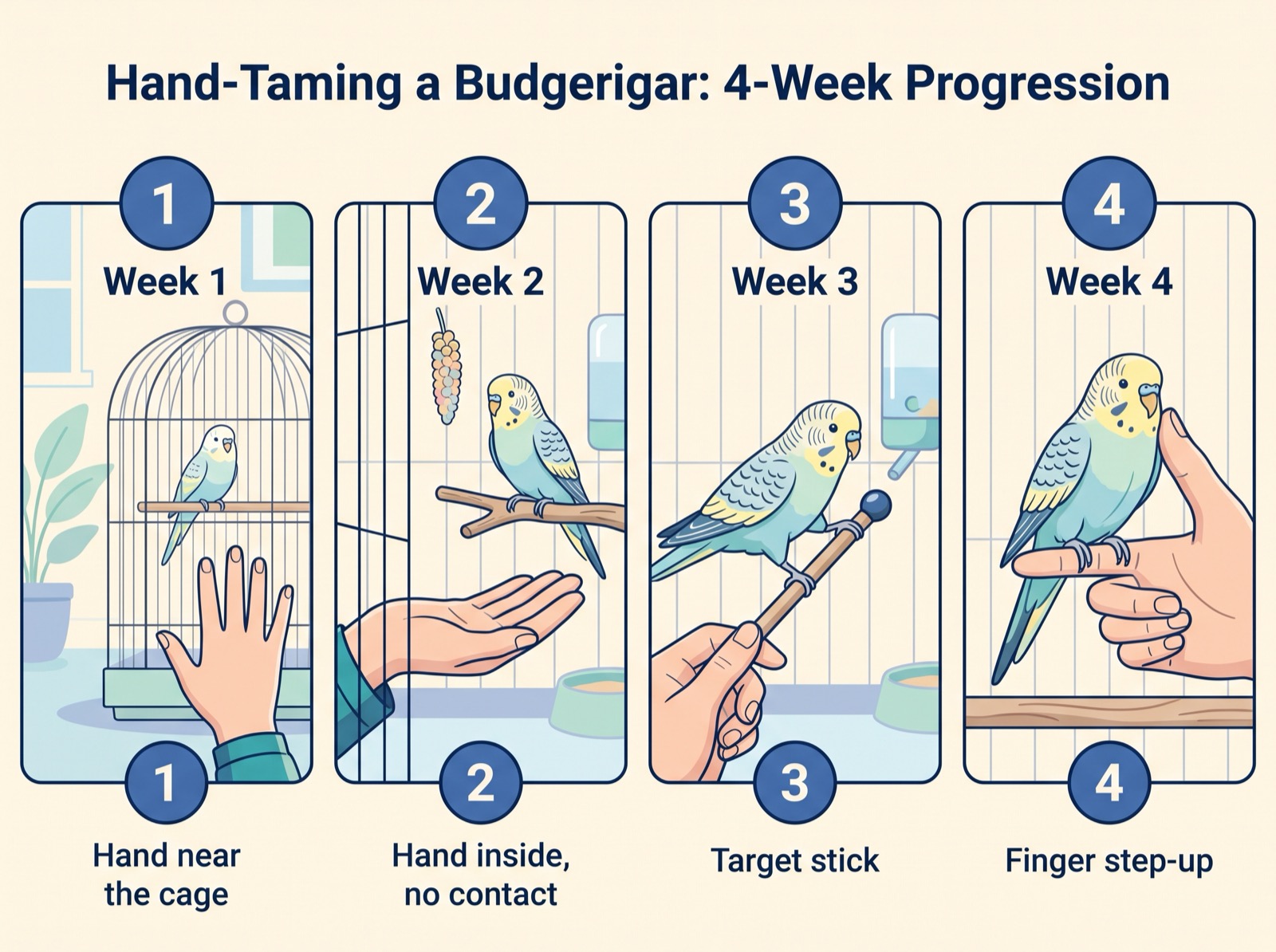
Hand-taming: the 4-week progression
The most common reason hand-taming fails is the owner moving to the next step before the bird is ready at the current one. The progression is sequential, not parallel.
Week 1 — hand near the cage. Hand flat against the outside of the bars, palm out, fingers still. Hold 5 minutes, 4 times a day. End the session when the bird is calm near the hand, not when it is curious.
Week 2 — hand inside the cage, no contact. Hand inside, palm up, perfectly still, 10 minutes, 3 times a day. Do not close your fingers, do not move toward the bird.
Week 3 — target stick. Replace your hand with a wooden dowel, held 5 cm from the budgie's feet in line with the keel. The bird steps up, gets a single millet seed, steps down. Five minutes, three times a day. Once the bird steps up reliably on the stick, you are 60 % of the way there.
Week 4 — finger taming. Replace the stick with your index finger. Same geometry, same treat. Most parent-raised budgies step up on the finger in this week. The first time the budgie sits and preens, you have a tame bird.
A hand-fed chick condenses this into 1–2 weeks. A parent-raised adult unhandled for a year can take 3 months and may never become a hands-on bird — owners need to hear that before they buy.
**Handling the safe way.** Correct hold: thumb and index finger either side of the head. Incorrect hold: body gripped in the fist. The first is a vet's restraint; the second is a predator's grip and the most common cause of bite-trust injuries in young budgies.
Diet: the 70/20/10 split
A budgie on an all-seed diet lives 5–8 years and dies of lipoma or atherosclerosis. A budgie on a pellet-based diet lives 12–18 years.
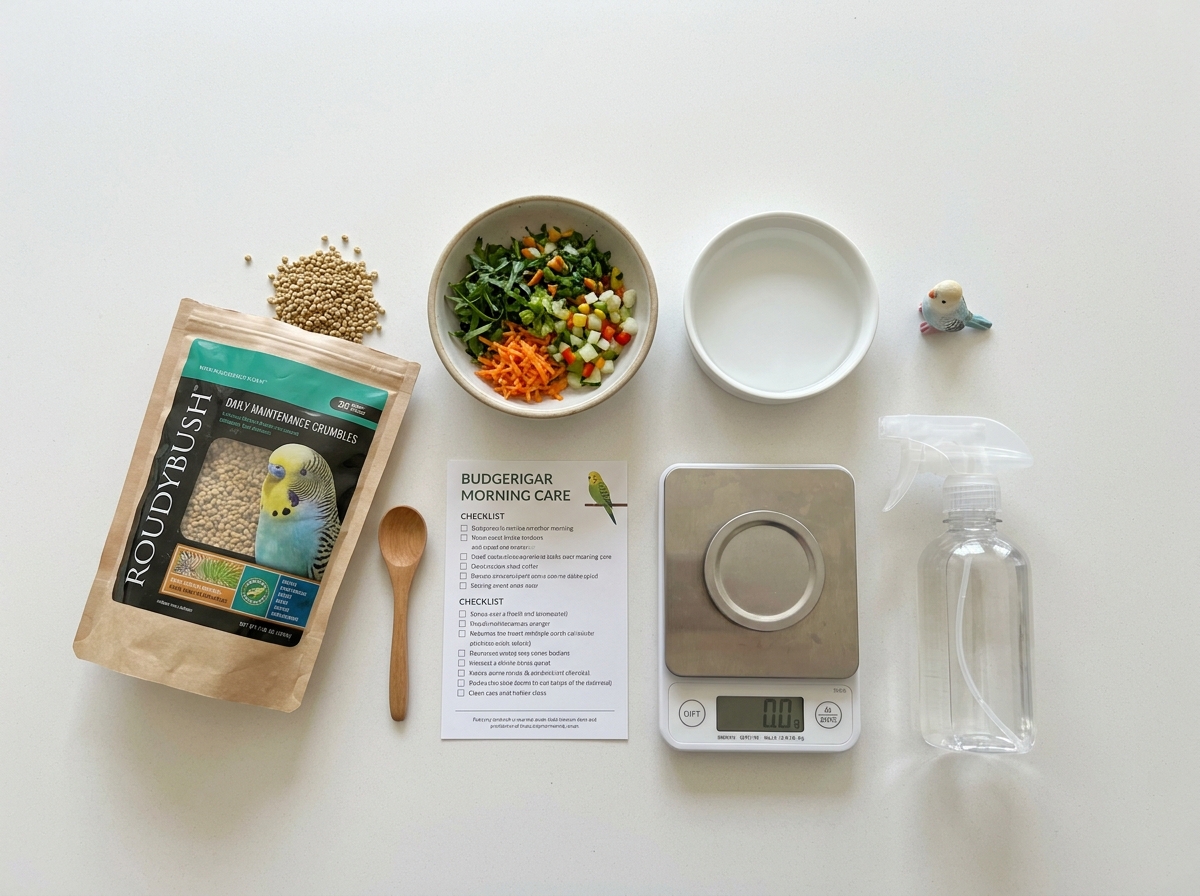
- 70 % pellets by weight. Roudybush Daily Maintenance mini crumbles (default), Harrison's Adult Lifetime super fine (organic, for sensitive birds), or Zupreem Natural small.
- 20 % fresh foods. Daily chop: 1 tsp cooked quinoa, 1 tsp grated carrot or zucchini, 1 tsp dark leafy greens (kale, romaine, bok choy — no avocado, no onion, no chocolate, no caffeine), 1 tsp sprouted seed. Remove uneaten chop after 4 hours.
- 10 % seed and treats. A small dish of seed mix, a millet spray as a training reward. Sunflower seeds are a snack — 3–5 per day max.
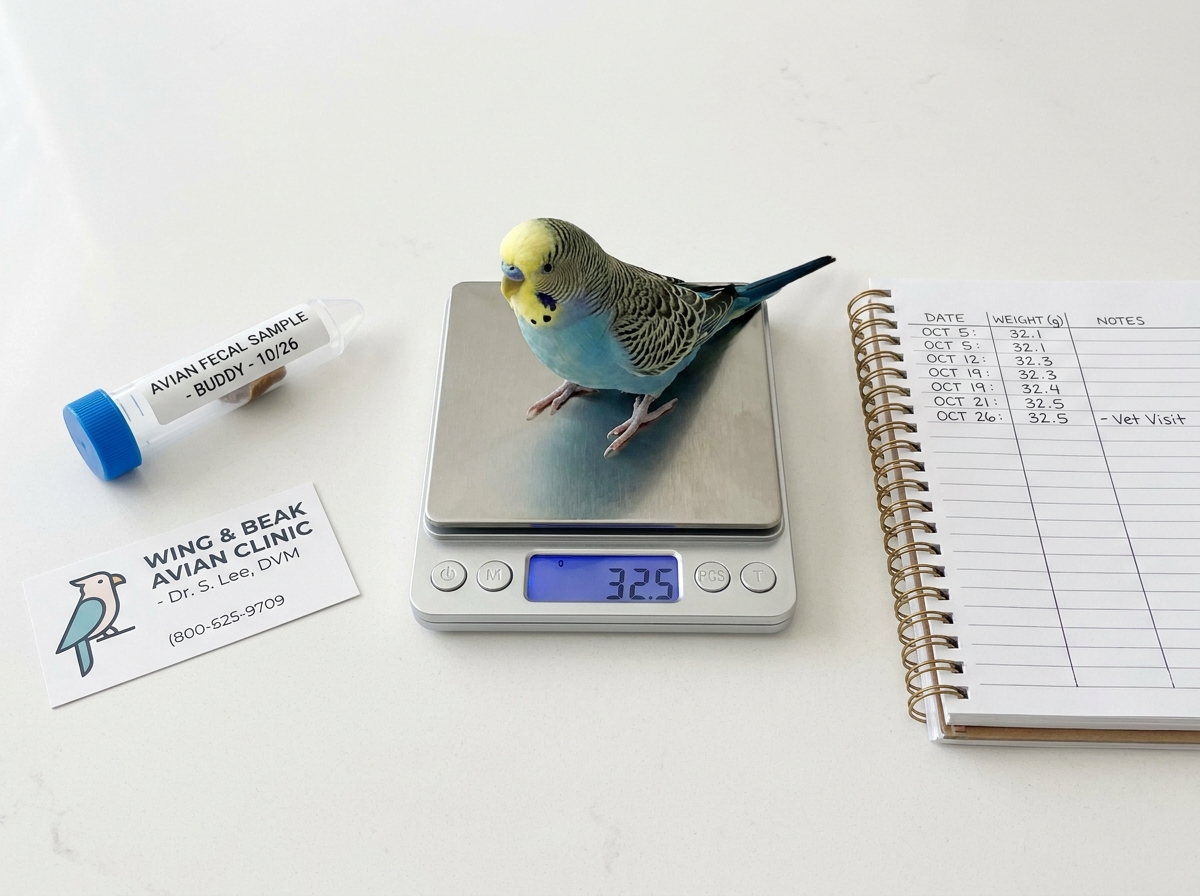
Conversion takes 2–6 weeks: 25 % pellets + 75 % seed for one week, then 50/50, then 75/25, then 100 % pellets. Weigh weekly on a gram scale — a healthy adult is 30–45 g (male) or 35–55 g (hen); a 5 g drop in a 35 g bird is a vet visit. Cuttlebone on the bars, replaced every 3–4 months. Fresh water daily.
UVB matters: without UVB, no vitamin D3 synthesis, no calcium absorption, osteopenia and egg-binding follow. A 12 % T5 HO tube (Arcadia Bird Lamp or equivalent) mounted 20–25 cm from the main perch, replaced every 12 months, is the standard. A "full spectrum" LED without confirmed UVB output is not UVB.
When taming stalls: the five common mistakes
1. Moving too fast. Drop back two steps, hold for a week, then progress again. Budgies generalise backward, not forward.
2. Wrong time of day. Sessions at 7 a.m. before work fail because the bird has not eaten. Sessions at 6–7 p.m. are the productive ones.
3. Pairing too early. A budgie with a cage mate tames to the cage mate, not the owner. Do not add a second budgie until the first is reliably stepping up.
4. Inconsistent out-of-cage time. A budgie let out 5 hours on Saturday and locked in the rest of the week is stressed. Out-of-cage time should be daily, even if only 30 minutes.
5. Skipping the avian vet. A budgie that has not seen an avian-certified vet in the first 30 days may be carrying Chlamydia, Macrorhabdus, or beak-and-feather disease without symptoms. First-visit panel: visual exam, weight, faecal Gram stain, Chlamydia PCR, faecal parasite screen. Annual after that. The Association of Avian Veterinarians ([aav.org](https://www.aav.org)) maintains the directory.
The four-week summary
Source a hand-fed chick or a weaned parent-raised juvenile from a breeder who gives you the hatch date. Cage at least 60 × 30 × 40 cm, 1.0–1.5 cm bar spacing, three perches, four to six toys with at least two destructible, in a busy room away from the kitchen. First 48 hours: hands off, voice on, refill water and pellets from outside the cage. Weeks 1–4: hand-near-cage, hand-in-cage, target stick, finger step-up, daily short sessions at 6–7 p.m. Diet: 70 % pellets, 20 % fresh chop, 10 % seed, with cuttlebone and a 12 % UVB tube. Avian vet within 30 days, then annual.
A budgie bought well, caged well, and walked through this protocol becomes the bird the owner thought they were buying. The one bought from a chain store, dumped in a small cage, fed seed, and ignored becomes the bird that screams, bites, and dies at three. The species is the same. The work is the difference.