
Cat-to-cat aggression: from hissing to full fight, when to step in and when to wait
The two cats that have lived together for three years and are now hissing at each other, the new cat that the resident cat is stalking, the cats that are having full fights in the hallway at 3 am — each of these is a different stage of the same escalation ladder, and the intervention at each stage is different. The owner who treats every hiss as a fight is the owner who intervenes too aggressively, suppresses the warning signs, and produces a household where the cats do not communicate and the next interaction is a full fight without warning. The owner who waits through a full fight is the owner who intervenes too late, allows the cats to injure each other, and produces a household where the cats live in fear. The middle ground — the escalation ladder and the right intervention at each level — is what produces a peaceful multi-cat household. In this article I will walk through the escalation ladder, the right intervention at each level, the most common triggers of cat-to-cat aggression, and the slow reintroduction protocol that brings peace back after a serious fight.
The escalation ladder
Cat-to-cat aggression is not random. The aggression follows a predictable escalation ladder, and each step on the ladder is a more serious version of the step before. The owner who knows the ladder is the owner who can intervene at the right level.
Level 1: staring and posturing. One cat is staring at the other, the body is tense, the tail is twitching, the ears are slightly back. This is the "I want this to stop" stage. The other cat can choose to look away, walk away, or escalate. Most cat-to-cat encounters end at this level — the other cat looks away, both cats walk away, the situation de-escalates without physical contact. The owner intervention at this level: do nothing, or use a gentle distraction (a toy, a treat toss) to redirect the staring cat.
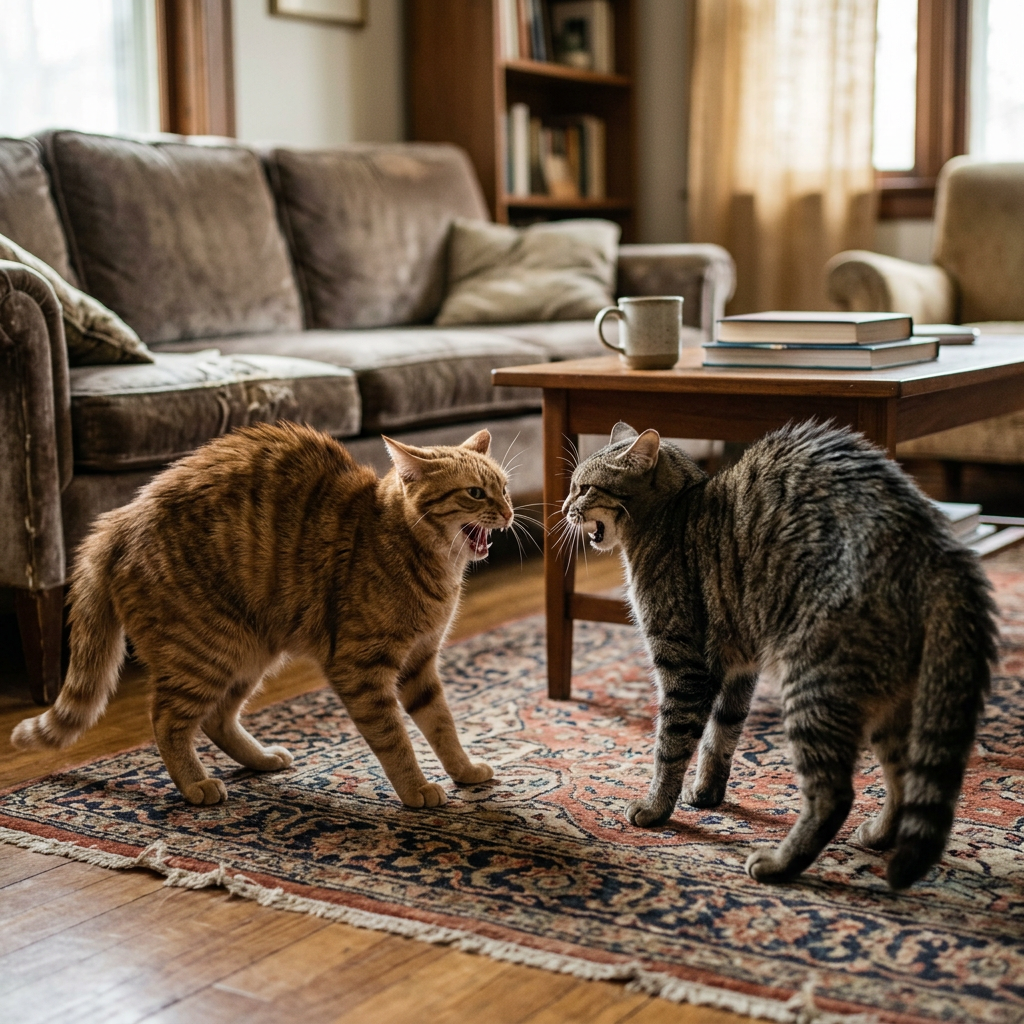
Level 2: vocalization. The hissing, the growling, the yowling. The cat that is vocalizing is the cat that is escalating the warning. The other cat is still able to back down, and the vocalization is the last warning before physical contact. The owner intervention at this level: a sudden, non-threatening distraction (a loud noise, a thrown pillow near the cats, a spray of water from a distance) to interrupt the escalation. Do not reach between the cats. Do not pick up either cat.
Level 3: swatting and batting. The cat is using a paw to swat at the other cat, usually with claws sheathed or partially sheathed. The swat is a physical warning, and the swat typically lands on the other cat's face or body. The other cat is still able to back down, and the swat is the last physical warning before a full fight. The owner intervention: a strong distraction (a loud noise, a thrown pillow) to interrupt the swat, then separate the cats into different rooms for a cooling-off period of 15-30 minutes.
Level 4: full fight. The cats are locked together, with claws extended, with vocalization, with rolling and biting. The full fight is a crisis, and the full fight is when serious injuries happen. The owner intervention: do not reach between the cats with bare hands. Use a barrier (a pillow, a piece of cardboard, a blanket) to separate the cats, then put each cat in a separate room. The cats that are separated and allowed to cool down for 30-60 minutes are the cats that can be reintroduced. The cats that are left together through the full fight are the cats that escalate to higher levels of aggression.
Level 5: stalking and ambush. One cat is actively stalking the other, hiding and waiting, then jumping out and attacking. The stalking cat has moved past the warning signs and is using predatory behavior to attack the other cat. The stalked cat is living in fear, hiding constantly, not using the litter box or eating in the open. The owner intervention: separate the cats completely, with separate rooms, and begin the slow reintroduction protocol.
The most common triggers
The trigger that is the most common: a recent change in the household. A new pet, a new baby, a move, a renovation, a change in the owner's schedule — each of these changes the household dynamic and can trigger cat-to-cat aggression. The cat that is stressed by a change is the cat that takes the stress out on the other cat, often through redirected aggression. The fix: address the underlying stress (separate the cats during the change, provide extra resources, give the stressed cat extra attention).
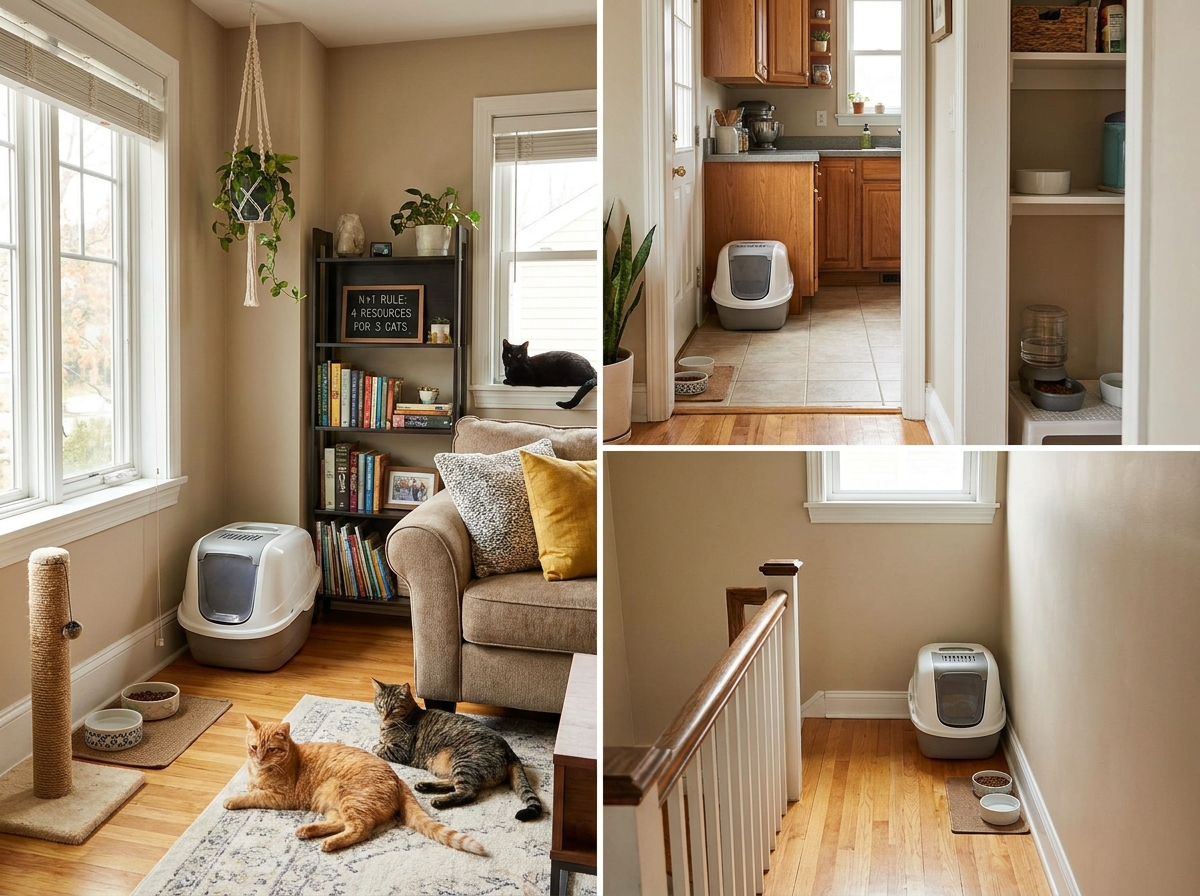
The trigger that is the second most common: resource competition. The household that does not have the N+1 rule applied to all resources is the household where the cats are competing for the litter box, the food bowl, the perch, the human. The fix: apply the N+1 rule to every resource, and place the resources in different rooms.
The trigger that is the third most common: redirected aggression. The cat that sees another cat outside the window and is aroused, then attacks the cat that is next to it. The redirected aggression is the cat that cannot reach the outside cat and takes the frustration out on the household cat. The fix: block the visual access to the outside cat (close the blinds, cover the window with a static-cling film), and separate the cats during the high-arousal period.
The slow reintroduction protocol
The cats that have had a Level 4 or 5 encounter need a slow reintroduction. The protocol is the same as the initial introduction of a new cat to a household: scent exchange, visual contact through a barrier, supervised contact, and full integration. The timeline: 1-2 weeks for each phase, with the phases moving at the cats' pace.
Phase 1: scent exchange. Each cat is in a separate room. A cloth is rubbed on one cat and placed in the other cat's room, and vice versa. The cats smell each other without seeing each other. The feeding happens on either side of the closed door, so the cats associate the other cat's scent with food. The phase takes 3-7 days.
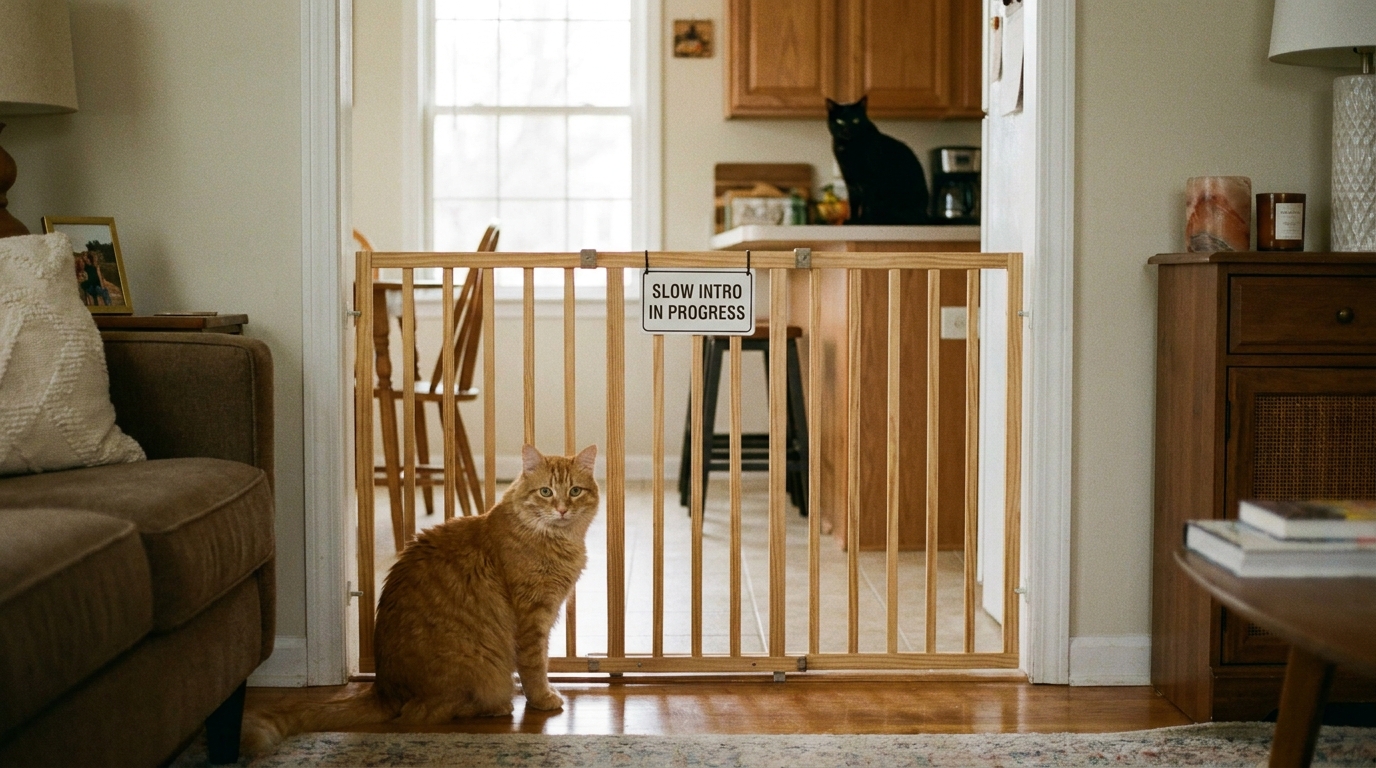
Phase 2: visual contact through a barrier. A baby gate, a screen door, or a slightly open door with a visual barrier. The cats see each other but cannot reach each other. The feeding happens on either side of the barrier, and the cats are rewarded for calm behavior in the presence of the other cat. The phase takes 7-14 days.
Phase 3: supervised contact. The cats are in the same room, supervised, with the ability to escape. The owner is present, watching for the escalation signs, and intervening at the right level. The feeding happens in the same room, with the bowls far apart. The phase takes 7-14 days.
Phase 4: full integration. The cats are together unsupervised, with the N+1 rule applied to all resources, and the escalation signs monitored. The phase continues indefinitely.
The two mistakes to avoid
The first mistake is punishment. The owner who punishes the cats for fighting is the owner who adds another stressor to a household that is already stressed. The punished cat becomes more fearful, more aggressive, and more likely to escalate. The fix: distraction and separation, not punishment.
The second mistake is forcing the cats to "work it out." The owner who lets the cats fight because "they need to establish the hierarchy" is the owner who is applying the debunked dominance theory to cats. Cats do not have a rigid dominance hierarchy, and the cats that are forced to fight are the cats that escalate to serious injury. The fix: intervene at the right level on the escalation ladder, and use the slow reintroduction protocol.
The one-page summary
Cat-to-cat aggression follows a predictable escalation ladder. The owner intervention at each level is different: do nothing at the staring level, distract at the vocalization level, separate at the swatting level, barrier-separate at the full-fight level, and slow-reintroduce at the stalking level. The most common triggers are household change, resource competition, and redirected aggression. The slow reintroduction protocol takes 4-6 weeks and produces the long-term peace. The owner who knows the ladder and intervenes at the right level is the owner who prevents serious fights. The owner who waits too long or intervenes too aggressively is the owner who produces a household where the cats cannot live together peacefully.