

Bringing a new cat home: the base-room isolation method, step by step
The carrier door opens, the new cat shoots under the bed, and the resident cat sits on the armchair with a tail like a pipe cleaner. The owner is on the floor with a treat in one hand and a feather toy in the other, calling "kitty kitty kitty." Within forty-eight hours, someone is peeing on the duvet.
I have seen this scene in hundreds of homes. Almost all of it is preventable. The prevention looks, to a well-meaning owner, like neglect. It is the most generous thing you can do for a cat on the first day of a new life with you.
The technique is the base-room isolation method, recommended by every IAABC-certified behavior consultant I have trained with. Cats usually do this because they need a small territory they can understand before they can tolerate a larger one. Before we change the cat, let's change the room.

Why the first 72 hours set the tone for ten years
Cats are territorial, descended from a solitary wildcat ancestor whose social life consists mostly of "do not approach." A house, to a cat, is a map of scent marks, sight lines, hiding places, and resource locations it has memorised. Bringing a new cat in is asking it to learn a new map in a few hours, under the worst stress of its life.
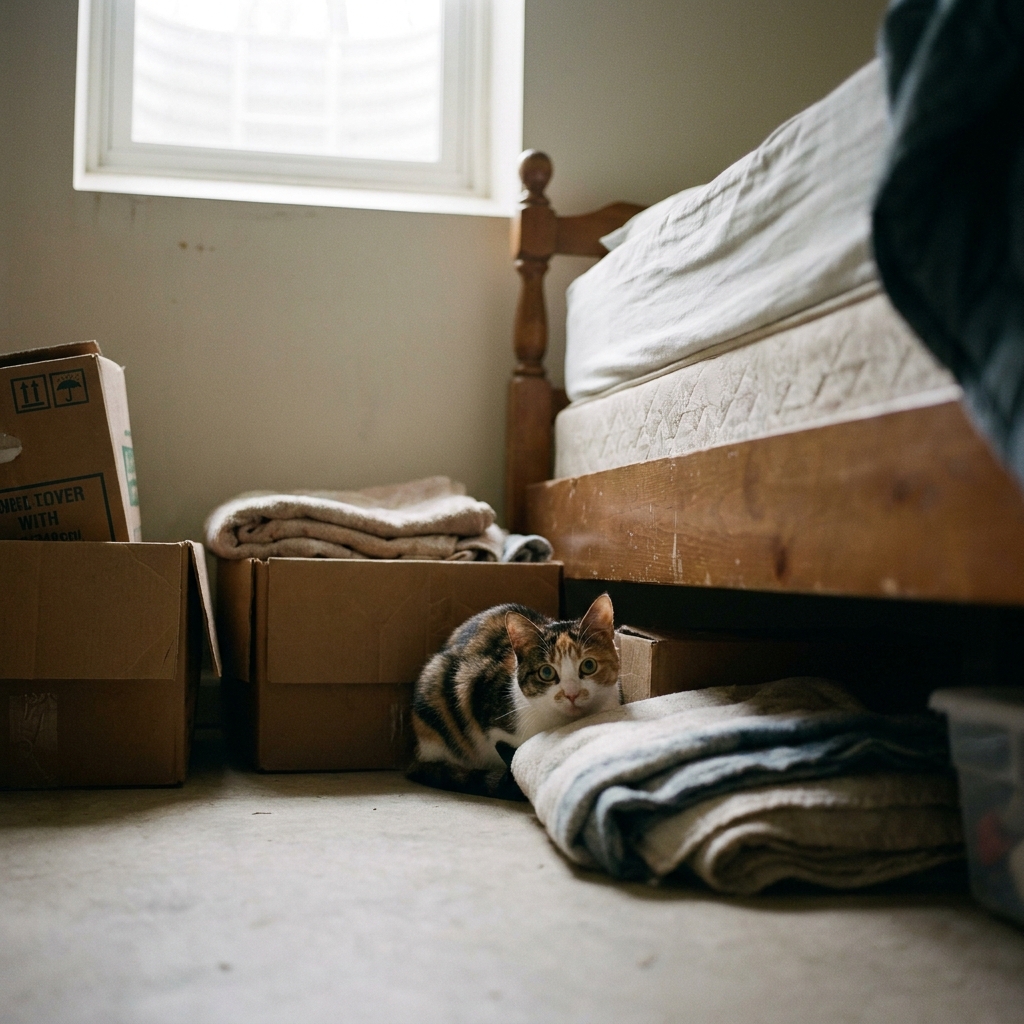
A cat under acute stress shuts down appetite, stops self-grooming, hides, and marks — urine outside the box, scratch marks on the door frame, chin rubbing on your shoes. Hiding is healthy; forcing the cat out is not.
The base room is the answer. Give the cat a small, fully equipped room, let it learn that room, then expand. Done correctly: 7 to 14 days. Done badly: six months.
The base room: a checklist you can finish in an afternoon
A base room is a spare bedroom, a home office, or a bathroom. Smaller is better, with two caveats: a door that closes, and a window. A walk-in closet with no window is a trap. A small bedroom with a window is ideal.
Five non-negotiables:
- A litter box, in a corner the cat can see from the hiding spot. Not next to the food. A cat who has to walk past a sight line will hold it, and a cat who holds it gets a urinary tract issue.
- Food and water, on opposite sides of the room. Cats evolved near water sources, not next to prey. This is hardwired.
- A vertical scratching post, tall enough for a full body stretch. Horizontal scratchers are a different (textural) behavior.
- A hiding spot, dark and enclosed. A cardboard box on its side, a cat cave, or a carrier with the door removed. The hiding spot should be visible from the litter box but not in the open.
- A perch, off the floor. A cat tree, a shelf, or a stack of books with a folded towel. Cats survey from height. A cat above eye level is a cat starting to feel safe.
Optional but useful: a Feliway Classic diffuser plugged in 48 hours before arrival, and a soft blanket or towel for the scent-swap step below.
A real home detail: a family set up the base room in the guest bathroom because "the cat will be quieter in a small space." No window, no perch, the box wedged between toilet and shower. The cat hid behind the toilet for a week. We moved the base room to the home office — same square footage, but a window, a chair to perch on, the box three feet from the wall. The cat emerged in 26 hours. Room design, not room size, is the variable.
Days 1 to 3: the quiet room
You bring the new cat in the carrier. You open the carrier in the base room. You leave. That is the whole procedure for the first hour.
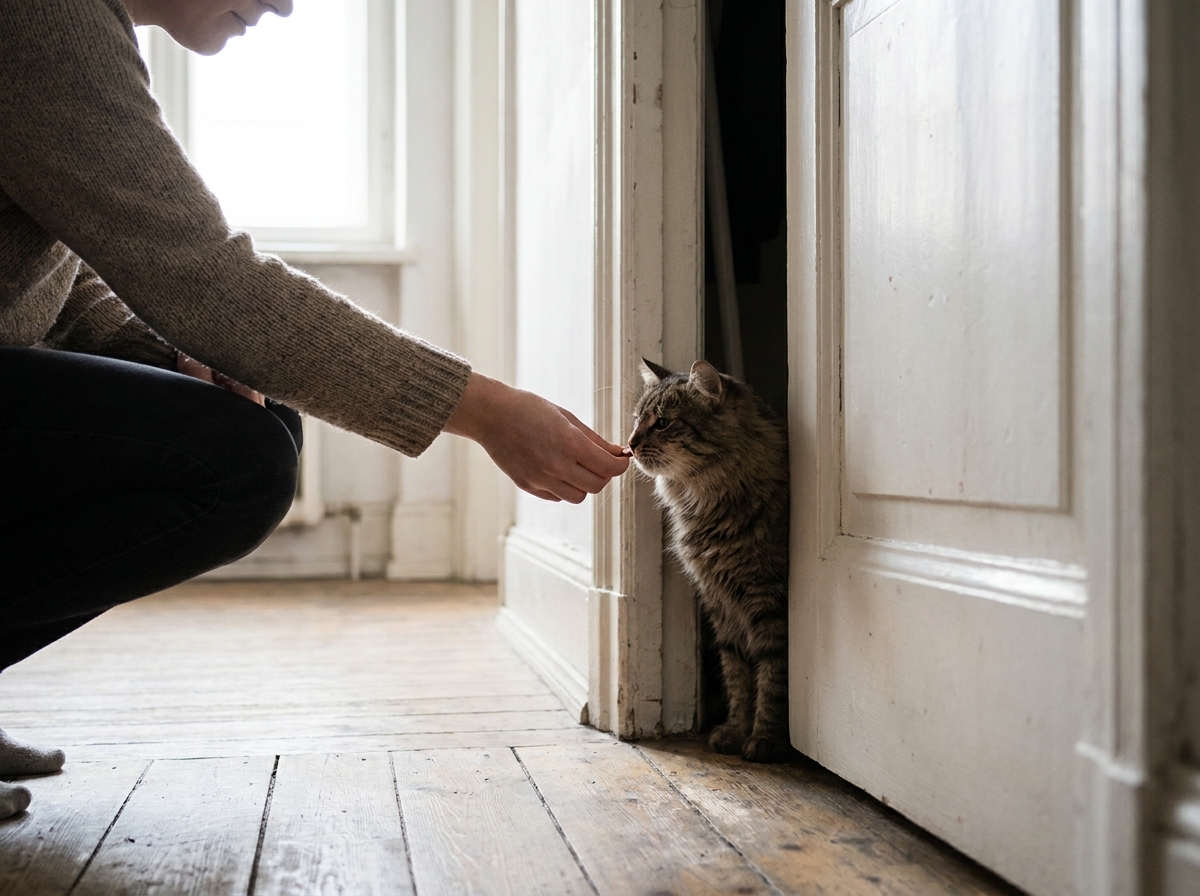
For the next 72 hours, be in the room as little as possible, and when you are, ignore the cat. Sit on the floor. Read. Work on a laptop. Do not make eye contact. Do not reach for the cat. Do not call the cat's name in a sing-song voice, which to a cat sounds like a predator's cackle.
Every time you grab the cat, the cat's confidence regresses by about a day. Every time you ignore the cat and the cat emerges on its own, the cat's confidence moves forward by about a day.
Behavioural cues in these first three days:
- Slow blink from across the room: the cat is starting to accept your presence. Slow-blink back.
- Tail tip twitch while watching you: curiosity, not yet trust.
- Ears rotated sideways (the "airplane ears"): anxiety. Leave the room.
- Eating when you are in the room: the green light.
In one home, the new cat hid behind the toilet for 36 hours. The owner was ready to give up. On day three, the cat emerged, ate in front of the owner, and used the box. By day nine, the resident cat was grooming the new cat's ears. The base room worked because the owner did not.
Days 4 to 7: first contact
By day four, the cat should be eating and using the litter box in your presence. The next step is voluntary physical contact. The mechanism is the same as day one: you do nothing, and the cat does it.
Bring a high-value treat — freeze-dried chicken, a piece of plain cooked shrimp, a Churu lickable. Put it on the floor between you and the cat, about a meter closer to the cat than you. Do not hand it over. Do not call the cat. Just put it on the floor and read your book.
Over days four through seven, move the treat a little closer each session. The cat will, at some point, eat from your fingers. That is the first contact. Do not pet the cat yet. The cat will, at some point, head-bunt your hand. Now you can pet — cheeks and chin only.
If the cat never approaches by day seven, do not panic. Some cats, especially former strays and cats from hoarding situations, need three weeks. You are not on a clock. You are on the cat's clock.
A second real-home note: in a home with two resident cats, the new cat would not approach the older female for the first nine days. The female was blocking the doorway with her body every time the door cracked. We added a second hiding spot on the other side of the room, out of her line of sight. The new cat started eating there on day ten. By week four, the three cats were sharing a sunny windowsill in shifts.
Days 7 to 14: the scent handshake and the first door
The introduction to a resident cat is not a meeting. It is a scent negotiation, then a sight negotiation, then a space negotiation.
Scent, days 7 to 10: rub a soft cloth on the new cat's cheeks (scent glands sit behind the whiskers) and put it in the common area. Rub another cloth on the resident cat's cheeks and put it in the base room. Swap bedding. Feed the cats on opposite sides of the closed door, bowls moving closer over days.
Sight, days 10 to 14: prop the door open an inch with a doorstop. A baby gate with a blanket draped over it is even better — they see in glimpses, not in a face-off. Short sessions, 5 to 10 minutes, three to four times a day.
Space, day 14 and beyond: open the door. Supervise. Have a towel ready, not for the cats, but for you to toss over a fight. Most cats introduced this way will hiss, then ignore each other, then cautiously share a sunny spot. The hissing can last two to three weeks. The ignoring is the goal.
A cue to watch for: the resident cat stopping grooming, stopping eating, or starting to urine-mark the door frame. These are signs the introduction is moving too fast. Go back one step. Patience, here, is not a virtue — it is a technique.

When to slow down — and when to escalate
Slow down if: the new cat hides for more than 72 hours without emerging; the new cat eats only when no one is in the room; the resident cat stops using the litter box; the resident cat starts overgrooming (belly or inner thighs); hissing or swatting during the sight phase increases over three days.
Escalate to a vet or behavior consultant if: either cat has not eaten in 24 hours (cats who don't eat develop hepatic lipidosis, a liver emergency within 48 to 72 hours); either cat is vomiting, has diarrhea, or is straining in the box (strain-without-output is a urinary blockage — a same-day vet visit); or aggression is escalating past hissing into full-contact fights (a behavior consultant can do a 90-minute in-home reset).
Sudden behavior change in a cat — hiding, aggression, litter box avoidance, appetite loss — is, as a rule, a vet visit first and behavior work second. The base-room method is for healthy cats in a stable home. Medical rule-out always comes first. If the new cat came from a shelter, schedule a vet visit in the first 72 hours regardless of how the cat is acting.
The 14-day plan in one breath
- Day 0: Set up the base room. Plug in the Feliway 48 hours early. Bring the cat in the carrier, open the carrier, leave.
- Days 1 to 3: Quiet room. Ignore the cat. Read the room for stress cues.
- Days 4 to 7: Treats on the floor. First voluntary contact. No petting until invited.
- Days 7 to 10: Scent swap, bedding exchange, feed on opposite sides of the door.
- Days 10 to 14: Visual access through a gate or cracked door. Short sessions.
- Day 14+: Open the door. Supervise. Expect hissing for two to three weeks.
If any step fails, repeat the previous step. No penalty for going slow. Heavy penalty for going fast.
A cat who has had a clean, quiet, well-resourced first two weeks is, statistically, a cat who will live peacefully with you for the next fifteen years. The base room is not a cage. It is a runway. The cat takes off from it, or it doesn't, depending on what you do in the first fourteen days. That is the work: mostly waiting, mostly watching, and almost never cuddling. In my experience, the single highest-return investment in a cat's welfare that an owner can make.