
Ball python sexing and breeding primer: from probing to pairing to pipping
The ball python (Python regius) is the most commonly bred pet snake in the world, and the most commonly bred reptile overall. The reason: the ball python is a small (3-5 feet), docile, easy-to-keep snake that breeds readily in captivity, that has a huge variety of color and pattern morphs (over 7,000 documented), and that has a strong market for the offspring. The ball python breeder who is starting a breeding project has to master four skills: the sexing of the snake, the conditioning of the breeding pair, the egg incubation, and the morph genetics. Each skill has its own learning curve, and the breeder who masters all four is the breeder who produces healthy, marketable offspring year after year. In this article I will walk through each of the four skills, the equipment and the protocol for each, the most common mistakes, and the realistic expectations for a first-year breeding project.
The sexing: probing is the most reliable method
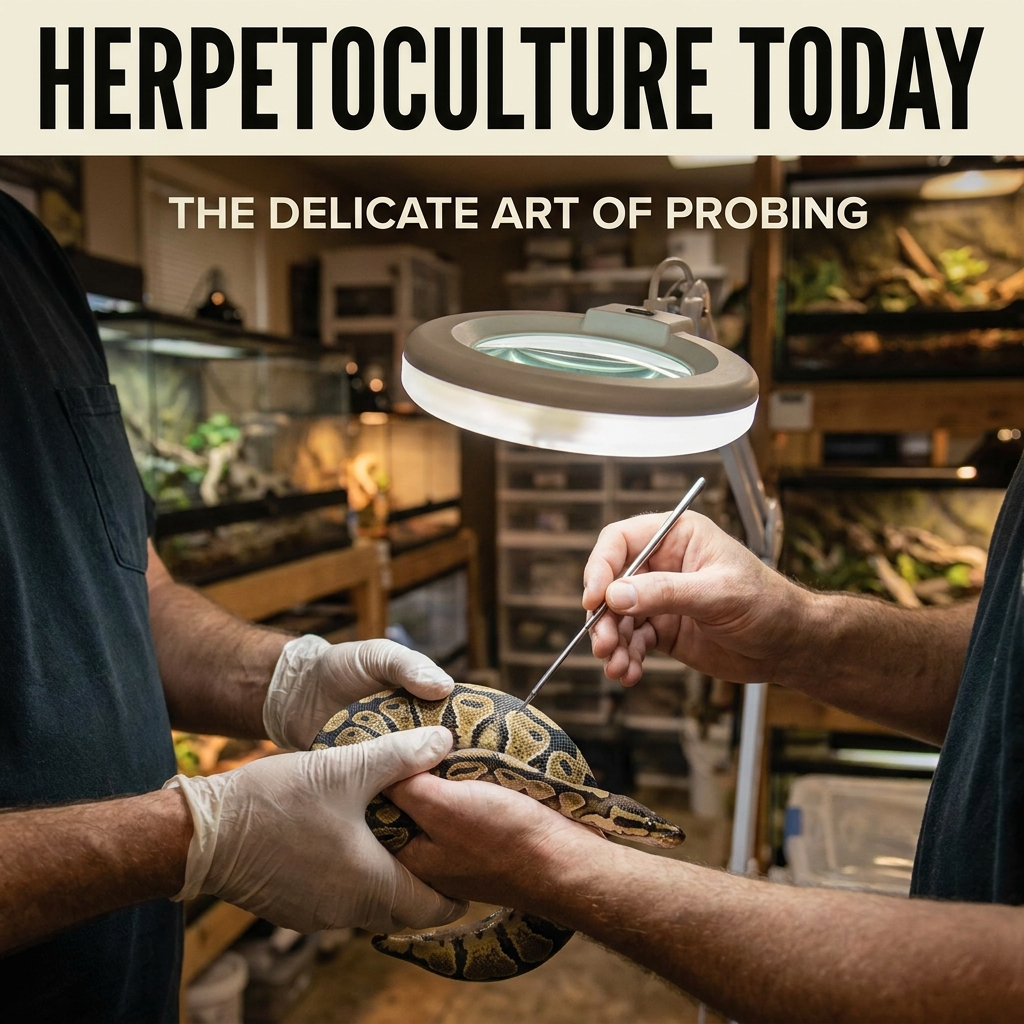
The ball python is sexually monomorphic — the males and females look identical. The only way to determine the sex is by physical examination, and the most reliable method is probing. Probing involves inserting a small, smooth, stainless steel probe (a sexing probe, available at any reptile supply retailer) into the cloaca and the hemipenes (in males) or the cloacal scent gland (in females). The depth of the probe insertion determines the sex: in males, the probe enters the inverted hemipenes and goes 8-12 subcaudal scales deep; in females, the probe enters the scent gland and goes 2-4 subcaudal scales deep. The difference is dramatic and immediately apparent to the experienced prober.
The probing technique: the snake is held firmly but gently, with the head and the body secured, and the tail is lifted to expose the cloaca. The probe is lubricated with a water-based lubricant, and the probe is inserted into the cloaca, angled toward the tail. The probe is gently advanced, and the depth of insertion is noted. The male has the deep insertion; the female has the shallow insertion. The probe is removed, and the snake is returned to its enclosure.
The probing should be done by an experienced breeder or a vet. The probing done by an inexperienced person can injure the snake, particularly the female, whose scent gland can be perforated by a probe that is advanced too aggressively. The breeder who is new to ball pythons should have the first few snakes probed by a mentor or a vet, and the breeder should learn the technique by observation before attempting it on their own snakes.
The alternative methods: the "pop" method, in which the male's hemipenes are manually everted by applying pressure to the base of the tail. The method is faster than probing but is less reliable on small or juvenile snakes, and the method can injure the snake if done aggressively. The cloacal popping should also be done by an experienced person.
The conditioning: cooling and feeding
The ball python breeds seasonally in the wild, with the breeding season triggered by the cooler and drier conditions of the African winter (November to March in the Northern Hemisphere). The captive ball python is conditioned for breeding by simulating the seasonal change. The conditioning protocol: reduce the day length from 12-14 hours to 8-10 hours, reduce the temperature from the normal summer range (88-92°F basking) to the breeding range (78-82°F basking), and stop feeding the snake 2-3 weeks before the cooling begins. The cooling period is typically 4-8 weeks, with the snake kept at the cooler temperature and the reduced day length.
The feeding during conditioning: the male and the female are kept on a reduced feeding schedule during the cooling period, with small meals every 10-14 days. The snake that is fed heavily during the cooling period is the snake that may regurgitate the meal and become stressed. The snake that is fed lightly is the snake that maintains body condition without putting the digestive system under stress.
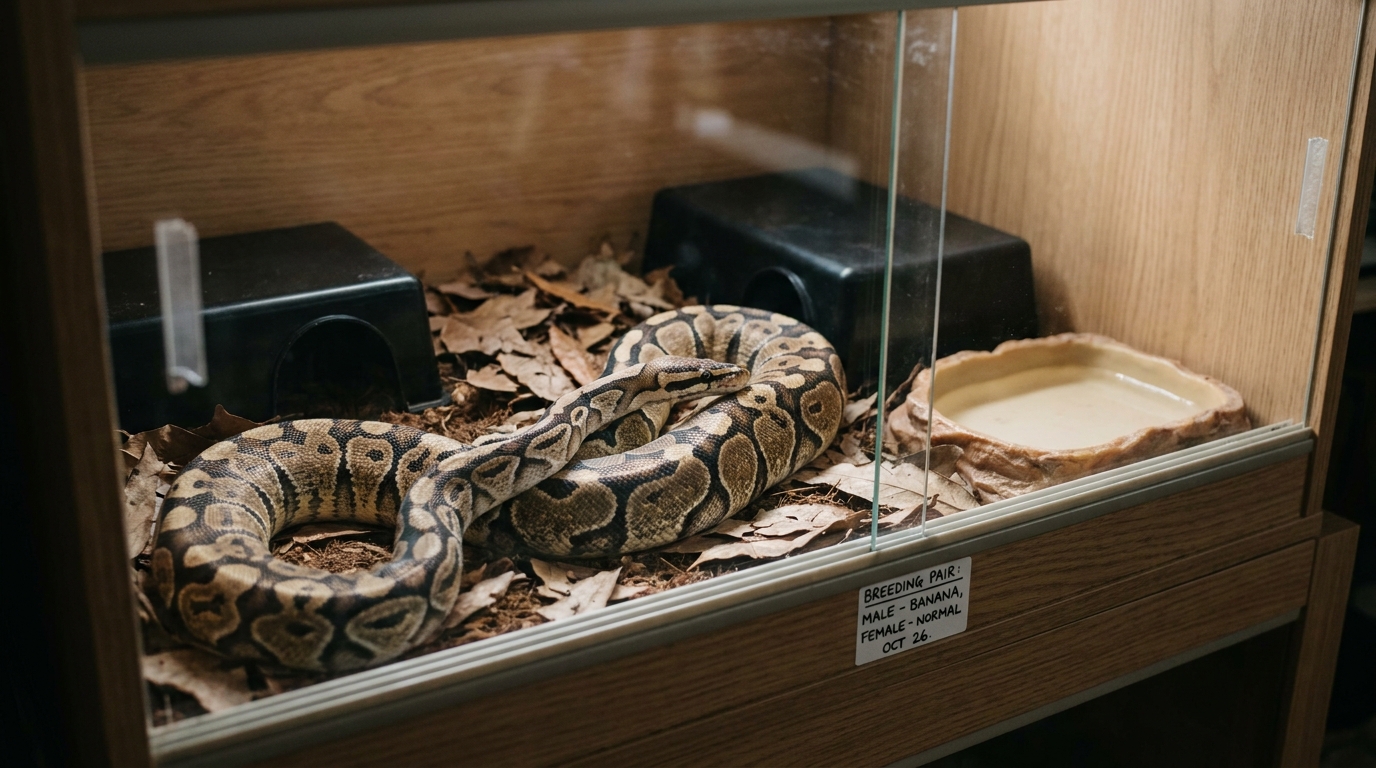
The pairing: after the cooling period, the male is introduced to the female's enclosure. The male typically shows immediate interest, and the male will crawl over the female, chin-rub the female, and attempt to copulate. The copulation may last 15 minutes to several hours, and the copulation may be repeated multiple times over the next 24-48 hours. The male and the female can be left together for 2-3 days, and the male can be removed and re-introduced every 2-3 weeks for the next 2-3 months. The female typically ovulates 2-4 weeks after the first successful copulation, and the female typically lays the eggs 30-50 days after the ovulation.
The breeding signs: the female's mid-body swells visibly around the time of ovulation, and the female typically goes through a pre-lay shed 25-35 days after the ovulation. The pre-lay shed is the most reliable sign that the eggs are coming within the next 2 weeks.
The egg incubation
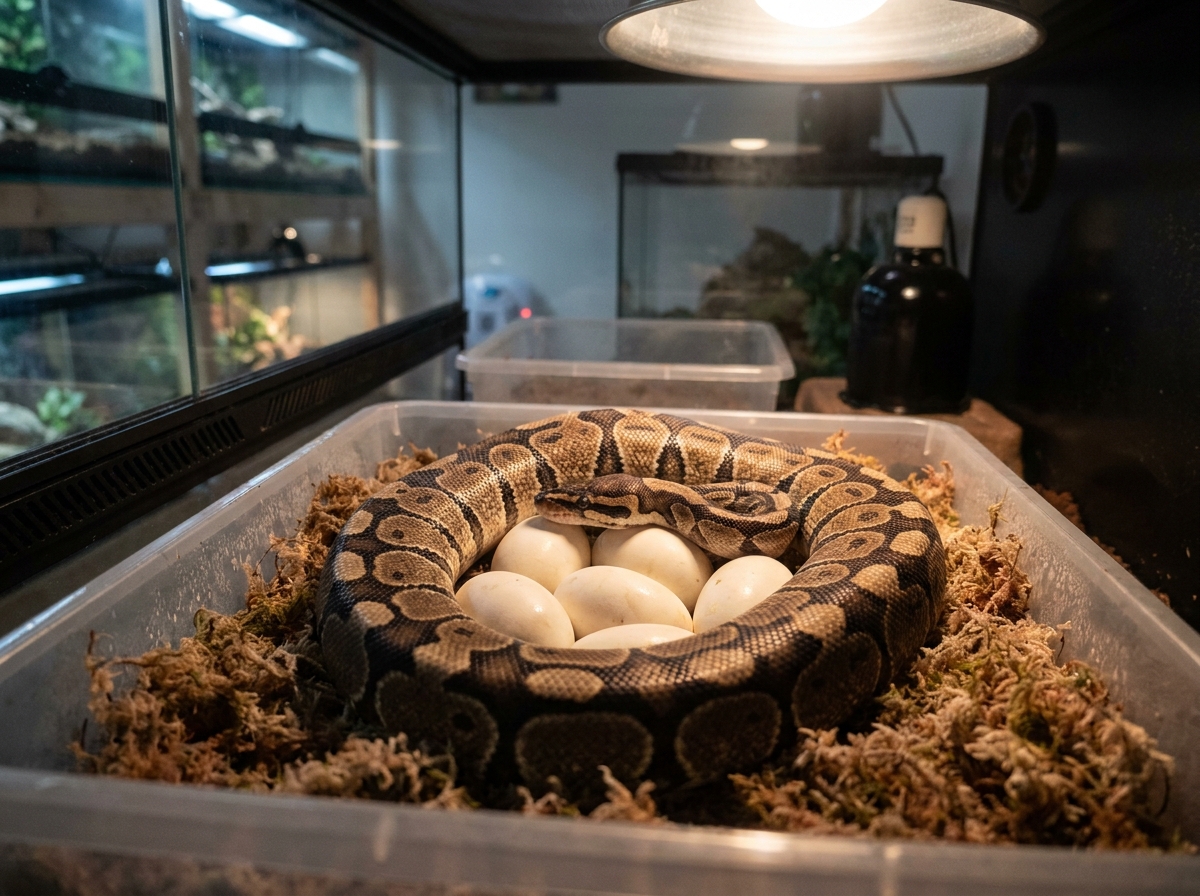
The female ball python lays the eggs in a nest box, typically a small, enclosed, humid container placed in the female's enclosure. The female lays 3-11 eggs (typically 5-7) and the female coils around the eggs to protect them. The eggs should be removed shortly after laying, because the female may inadvertently damage the eggs or because the female's high humidity may promote mold growth on the eggs.
The incubation medium: vermiculite or perlite mixed with water at a 1:1 ratio by weight (the medium should be moist but not dripping). The medium is placed in a small plastic container, and the eggs are placed on the medium, not buried. The container is placed in an incubator at 88-90°F, with the humidity at 90-95%. The temperature should be stable, with no fluctuations more than 1°F.
The incubation period: 50-60 days, depending on the incubation temperature. The eggs develop slowly, and the eggs should be checked weekly for mold, collapse, or damage. The eggs that are not viable will mold or collapse within the first 2-3 weeks, and the viable eggs will continue to develop.
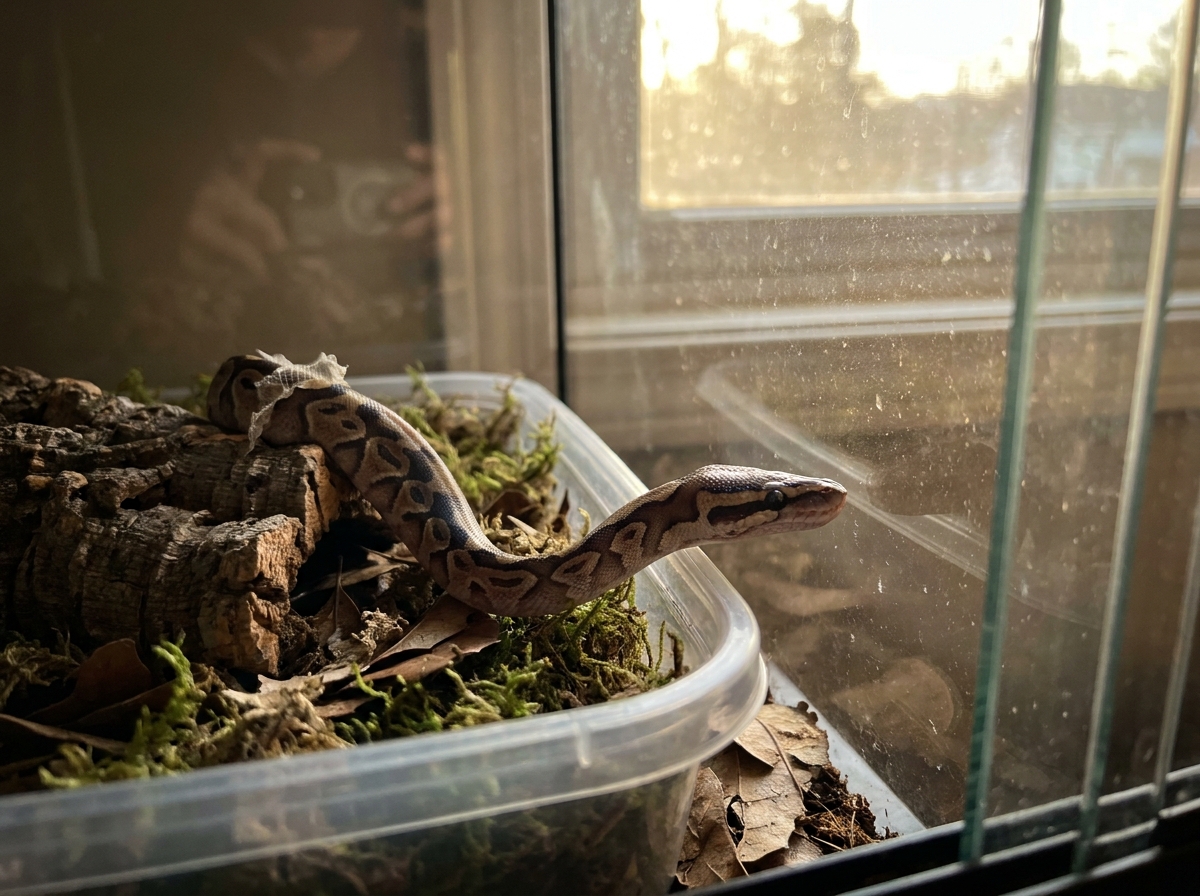
The hatching: at the end of the incubation, the eggs will "pip" — the hatchling will cut a small hole in the eggshell with the egg tooth, and the hatchling will emerge. The hatching can take 12-48 hours from the first pip, and the hatchlings should be left in the incubator until the hatchlings have absorbed the yolk sac and have completed the first shed. The hatchlings are then moved to individual enclosures.
The morph genetics
The ball python morph market is built on the genetics of the various color and pattern mutations. The morphs are inherited in predictable patterns, and the breeder who understands the genetics is the breeder who can produce specific morphs on demand.
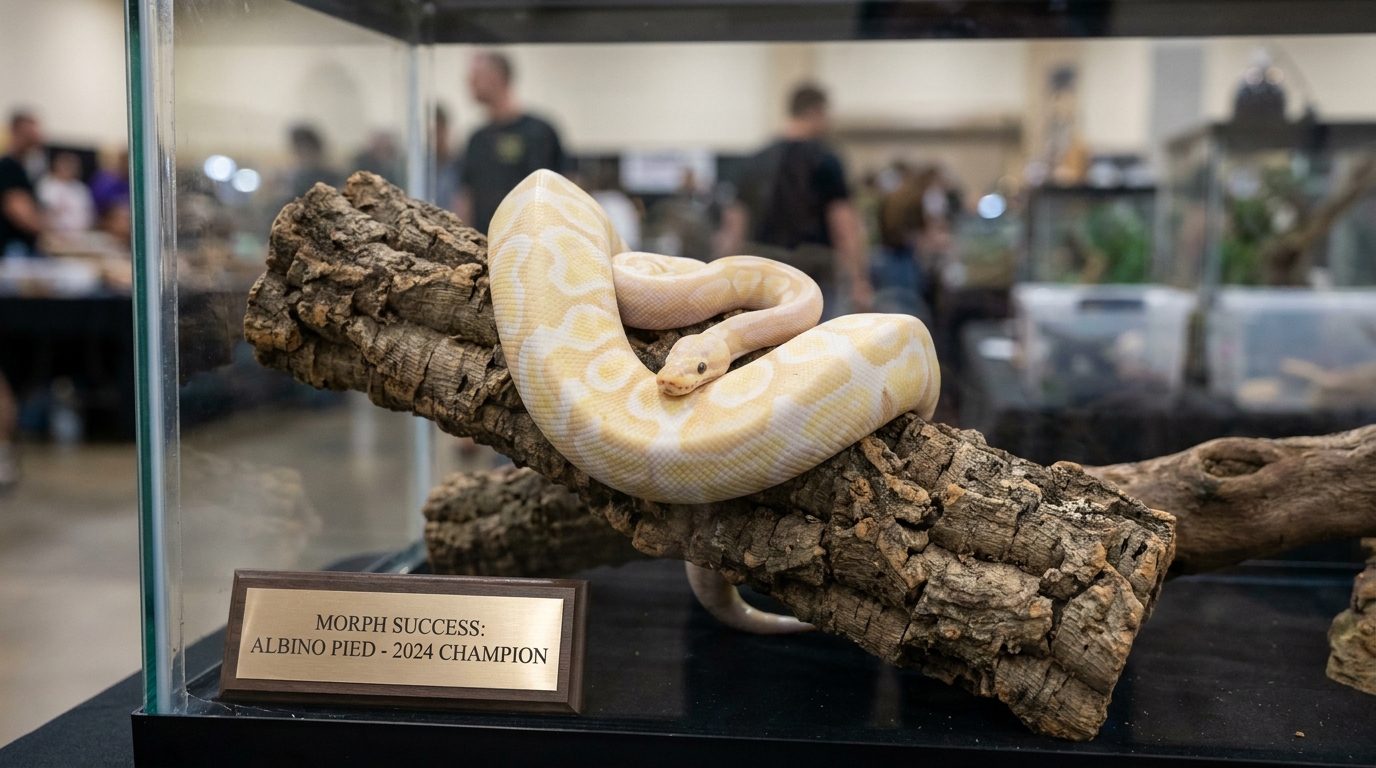
The inheritance patterns: the morphs are inherited as either dominant, codominant (incomplete dominant), or recessive. The dominant morphs (Pastel, Spider, Pinstripe) require one parent to carry the morph for the offspring to express the morph. The codominant morphs (Mojave, Lesser, Fire) require one parent to carry the morph, and the offspring that inherit the morph from both parents are "super" forms that are typically more extreme in appearance. The recessive morphs (Albino, Piebald, Clown) require both parents to carry the morph for the offspring to express the morph.
The breeding for morph: the breeder who wants to produce a specific morph selects the parents based on the morph genetics. A breeder who wants to produce a Pastel (dominant) crosses a Pastel with a normal, and 50% of the offspring are Pastel. A breeder who wants to produce an Albino (recessive) crosses two Albinos, and 100% of the offspring are Albino. A breeder who wants to produce a "combo" morph (a snake that carries multiple morphs) crosses two snakes that each carry the desired morphs, and the offspring that inherit all the morphs are the combo morphs.
The genetics calculator: the online morph calculators (World of Ball Python, MorphMarket) are tools that allow the breeder to enter the morphs of the parents and predict the morphs of the offspring. The calculator is essential for the breeder who is producing specific morphs, and the calculator is the right tool to use before any breeding pair is set up.
The mistakes
The first mistake: breeding the snake that is too young or too small. The male ball python can be bred at 8-12 months of age and 600-800 grams. The female ball python should be bred at 18-24 months of age and 1500+ grams. The female that is bred too young is the female that may have difficulty laying the eggs, may produce a smaller clutch, and may have a higher risk of egg-binding (dystocia). The fix: wait until the female is at the proper age and weight.
The second mistake: breeding the snake that is underweight or overweight. The snake that is underweight does not have the body reserves to produce a healthy clutch. The snake that is overweight may have a hormone imbalance that affects the breeding. The fix: maintain the breeding snake at the ideal body condition through the conditioning period.
The third mistake: incubating the eggs at the wrong temperature. The eggs that are incubated below 86°F develop slowly and may not hatch. The eggs that are incubated above 92°F develop quickly but may have deformities. The fix: a reliable incubator with a stable temperature and a backup thermometer to verify the temperature.
The fourth mistake: selling the offspring before the first shed. The hatchlings that are sold before the first shed are the hatchlings that may have unabsorbed yolk sacs, retained shed, or other issues that the buyer may not recognize. The fix: keep the hatchlings until after the first shed, and only sell the hatchlings that are feeding and shedding normally.
The honest summary
Ball python breeding is a multi-year project that requires sexing, conditioning, incubation, and morph genetics. The probing is the reliable sexing method. The cooling is what triggers the breeding readiness. The incubation at 88-90°F is what produces the hatchlings. The morph genetics is what produces the marketable offspring. The breeder who masters the four skills is the breeder who produces healthy hatchlings year after year. The breeder who skips the steps is the breeder who produces deformed hatchlings, egg-bound females, and offspring that do not match the expected morph. The skill is the work. The skill is what makes the difference.