
Tortoises indoors: a Hermann's and Russian tortoise husbandry guide
Hermann's (Testudo hermanni) and Russian (Testudo horsfieldii) tortoises are among the most commonly kept pet tortoises in temperate countries. Both are hardy, personable, and long-lived (50+ years in captivity). Both also suffer in captivity because the husbandry parameters owners build for them are wrong for their natural history.
This is the setup I recommend for keeping these species healthy indoors for decades.
The wrong mental model: "tortoise = warm tank"
The most common mistake is treating a tortoise like a tropical lizard. These are Mediterranean species — they experience hot dry summers, cool wet winters, and wide daily temperature swings in nature. They are NOT tropical. They are NOT tropical-humid.
A correct indoor setup has:
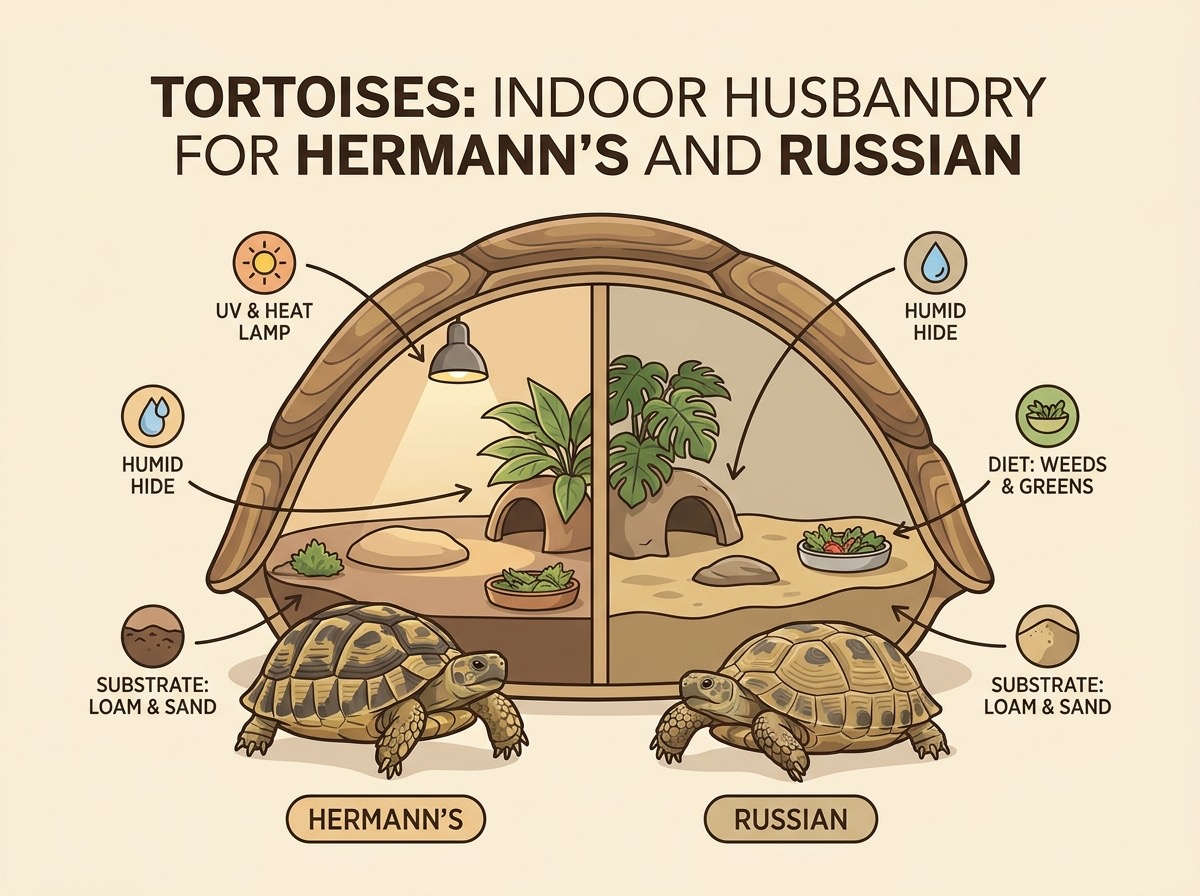
- A basking zone of 35–40°C (95–104°F)
- An ambient warm zone of 24–28°C (75–82°F)
- A cool zone of 18–22°C (65–72°F)
- A nighttime drop to 15–20°C (59–68°F)
- A humidity gradient with a humid hide (60–70%) on one end and a dry zone (30–40%) on the other
That cool nighttime drop is what most owners skip, and it matters. Constant warmth without a night drop stresses the immune system over years.
Enclosure size
For an adult Hermann's or Russian, the minimum indoor enclosure is roughly:
- 2 m × 1 m for one adult (around 20–25 cm shell length)
- 3 m × 1.5 m for two adults
- Height at least 40 cm (these are not climbers but they can flip, and tall sides help)
This is much larger than the glass tanks sold in pet stores (typically 1 m × 0.5 m). A wooden tortoise table or a converted bookcase on its side works better than a glass aquarium. Outdoor access during warm weather is even better and strongly recommended in temperate climates.
Substrate
The substrate has three jobs: hold humidity in the cool zone, allow digging, and not cause impaction if eaten.
Good choices:
- Coco coir + playsand mix (50/50) — holds humidity well, diggable
- Organic topsoil (no perlite, no fertiliser) + playsand — more naturalistic
- Reptichip / coconut husk — easy to clean, holds humidity less well
Avoid:
- Calcium sand (causes impaction)
- Gravel (impaction risk)
- Wood shavings (too dry, dust)
- Reptile carpet (harbours bacteria, catches nails)
Substrate depth should be at least 10 cm — these species burrow for thermoregulation and security.
UVB lighting: the most common husbandry failure
Tortoises need UVB to synthesise vitamin D3 and metabolise calcium. Without adequate UVB, you get metabolic bone disease (MBD) — softened shell, deformed limbs, eventual death.
The right UVB setup:
- Type: T5 HO fluorescent tube (not compact bulb, not coil)
- Strength: 10.0 or 12.0 UVB for species from sunny Mediterranean habitats
- Distance from basking surface: 25–35 cm (closer = too much UVB, risk of photokeratitis; farther = too little, rickets)
- Replacement: every 12 months (UVB output drops well before the visible light does)
- Photoperiod: 12 hours on, 12 hours off, with a seasonal adjustment (12.5 hours in summer, 11 hours in winter)
The most common mistake I see: owners using a "10.0 UVB" compact bulb at 50 cm distance. That's effectively zero UVB reaching the tortoise. Use a T5 tube.
Basking and heating
- Basking bulb: incandescent or halogen flood, 50–100 W depending on enclosure size
- Basking surface temperature: 35–40°C measured with an infrared thermometer at the shell surface directly under the bulb
- Cool side: 18–22°C, never warmer than 28°C
- Ceramic heat emitter (CHE) for night if ambient drops below 12°C — but most homes don't need this. Use a thermostat.
A thermostat is non-negotiable. Without one, a basking bulb can overheat the basking zone to 50°C+ and kill the tortoise.
Diet
Mediterranean tortoises are herbivores and grazers. Their natural diet is high-fibre, low-protein, calcium-rich, low-sugar.
A correct diet:
- 80% leafy greens and weeds: dandelion, plantain, clover, mallow, romaine, escarole, endive, chicory
- 10% vegetables: squash, bell pepper, carrot (grated), occasional tomato
- 5% flowers: hibiscus, nasturtium, rose petals, pansy
- 5% fruit: only as a rare treat; high sugar causes gut dysbiosis
- Calcium supplementation: calcium carbonate powder on food 2–3x per week; cuttlebone available at all times
Avoid:
- Commercial "tortoise pellets" with high protein content
- Dog or cat food (causes shell pyramiding)
- Iceberg lettuce (no nutrition)
- Spinach and parsley in large amounts (oxalates bind calcium)
- Fruit daily
Water
Despite being a "dry" species, fresh water must always be available. Soak adults in shallow lukewarm water (just covering the plastron) for 15–20 minutes, 2–3 times weekly, to ensure hydration. Hatchlings should be soaked daily.
Brumation (winter rest)
Hermann's and Russian tortoises naturally brumate for 2–4 months in winter. This is healthy and should not be prevented unless the tortoise is sick or underweight. In captivity:
- Pre-brumation vet check — confirm healthy weight, no parasites, no respiratory infection
- Gradual cooling over 2–3 weeks
- Brumation temperature: 4–8°C in a refrigerator or cool basement
- Duration: 6–10 weeks for adults
- Check weekly for weight loss (>10% = end brumation)
Refusing to brumate is not "toughness" — it usually means the tortoise is metabolically stressed.
When to see the vet
- Runny nose, bubbly eyes, open-mouth breathing (respiratory infection)
- Soft shell, deformed shell growth, soft jaw (MBD)
- Refusing food for >2 weeks in season
- Visible parasites in faeces
- Lethargy outside normal brumation
Bottom line
A Mediterranean tortoise in a tropical-tank setup will get sick eventually — the question is just when. The right indoor husbandry is bigger, drier at the cool end, more variable in temperature, and uses real T5 UVB. Get the basics right and these animals live 50+ years in good health.
---
About the author: [Amelia Sterling](../Amelia%20Sterling.md) is an MSc in Reptile Medicine from the Royal Veterinary College, London, with 14 years of reptile practice. She has served as visiting veterinarian at the London Zoo reptile house.