
Orthopedic surgery: the post-op rehab plan that determines the long-term outcome
The orthopedic surgery — the TPLO for the cranial cruciate ligament rupture, the FHO for the hip dysplasia, the fracture repair for the broken bone — is the dramatic event in the dog's orthopedic journey. The surgery is what the owner focuses on, and the surgery is what the owner remembers. But the surgery is only half the work. The post-op rehab is the other half, and the rehab is what determines whether the dog returns to full function or ends up with the chronic lameness, the muscle atrophy, and the reduced quality of life. The dog that has the surgery with the comprehensive rehab is the dog that has the best long-term outcome. The dog that has the surgery with the minimal rehab is the dog that has the slower recovery, the incomplete restoration, and the higher risk of the secondary problems. In this article I will walk through the phases of the post-op rehab, the specific exercises and therapies at each phase, the milestones to track, the mistakes to avoid, and the realistic timeline for the full recovery.
The phases of the post-op rehab
The post-op rehab is divided into four phases, with each phase having specific goals, specific exercises, and specific milestones. The phases overlap and the dog's progression is individual, but the four-phase framework is the standard for the orthopedic rehab.
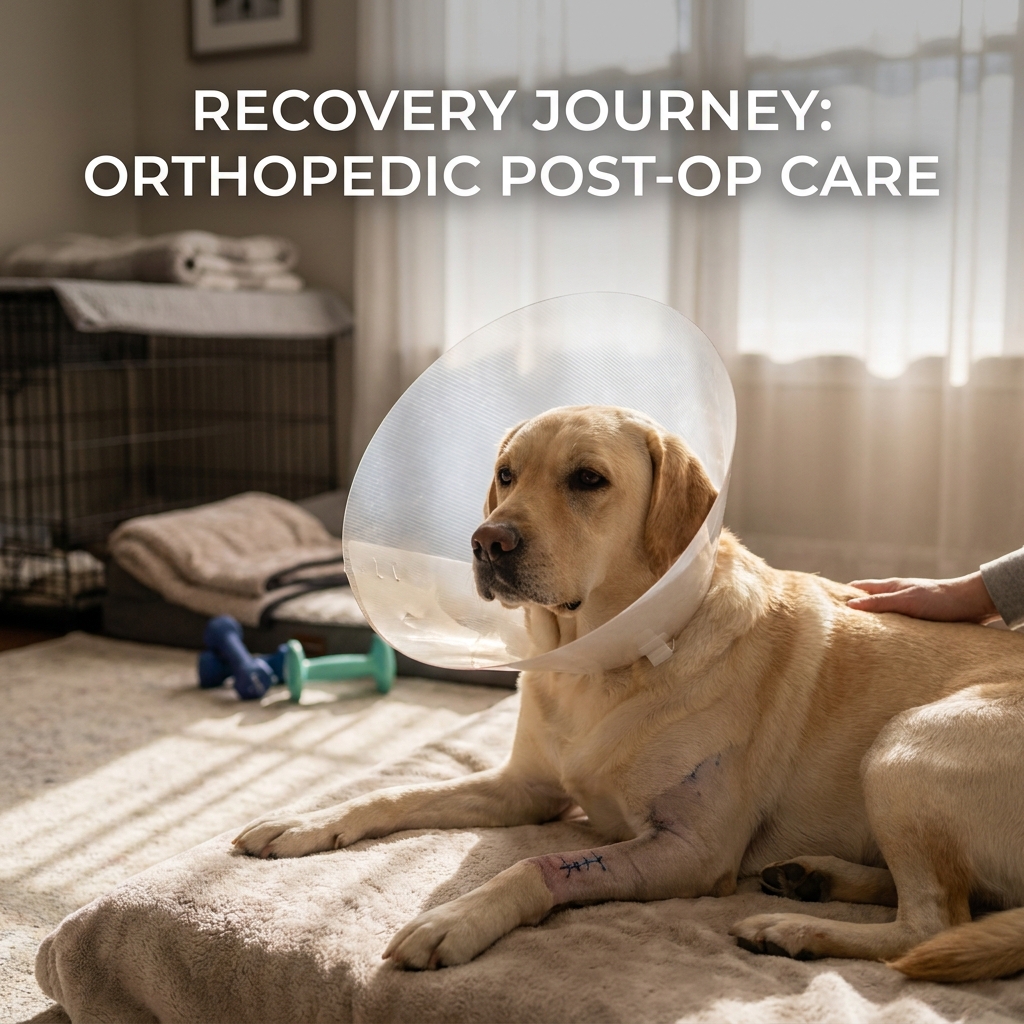
Phase 1: the immediate post-op (days 1-14). The goals: pain control, wound healing, prevention of the complications (infection, swelling, self-trauma). The specific measures: pain medication (NSAIDs, opioids as needed), antibiotics (if prescribed), wound care (the cone, the incision monitoring, the suture removal at 10-14 days), and the strict rest (the crate rest, the leash-only for the bathroom breaks, no jumping, no running, no stairs).
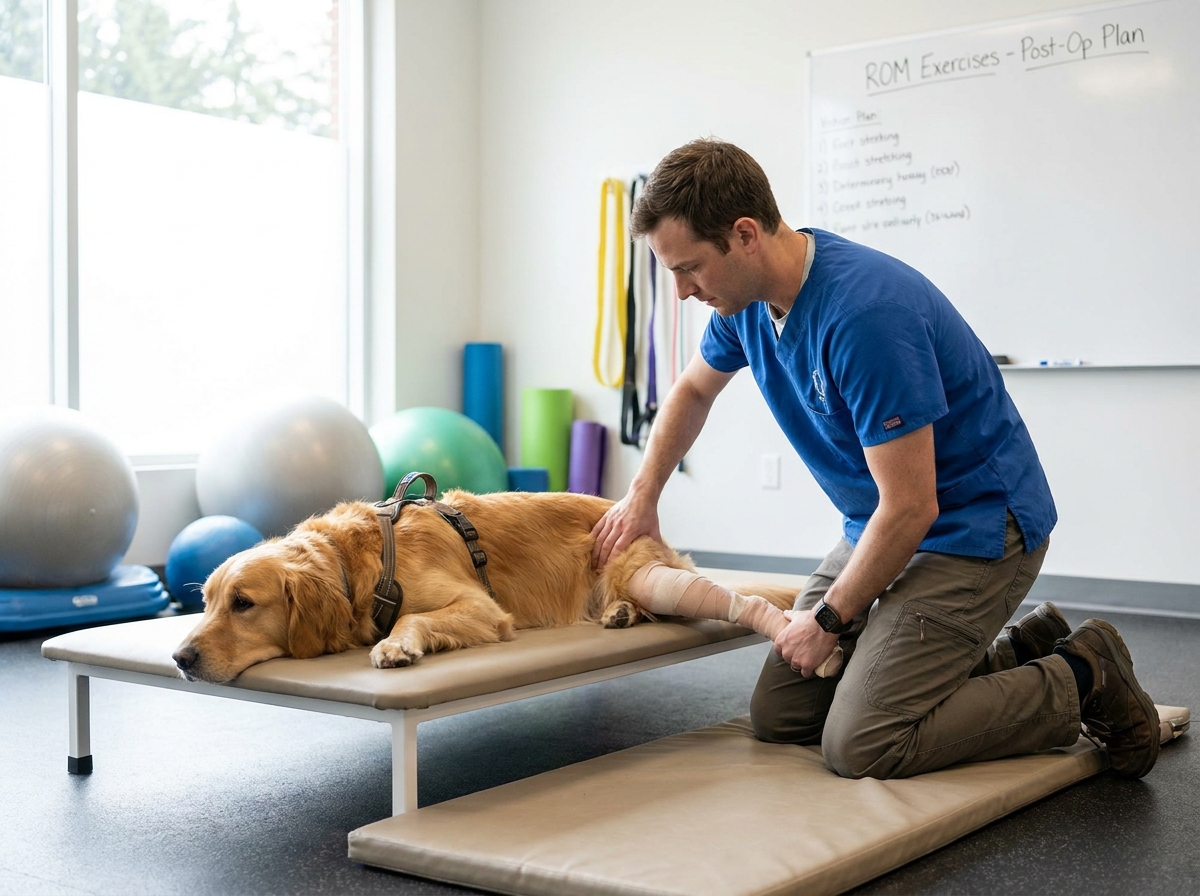
The exercises in Phase 1: range of motion (ROM) exercises, multiple times per day, gently flexing and extending the joint through the pain-free range. The ROM exercises prevent the joint stiffness and the muscle contracture. The massage of the muscles around the joint, to reduce the spasm and the pain. The cold therapy (ice packs) for 10-15 minutes, 2-3 times per day, particularly after the exercises. The cryotherapy reduces the inflammation and the pain.
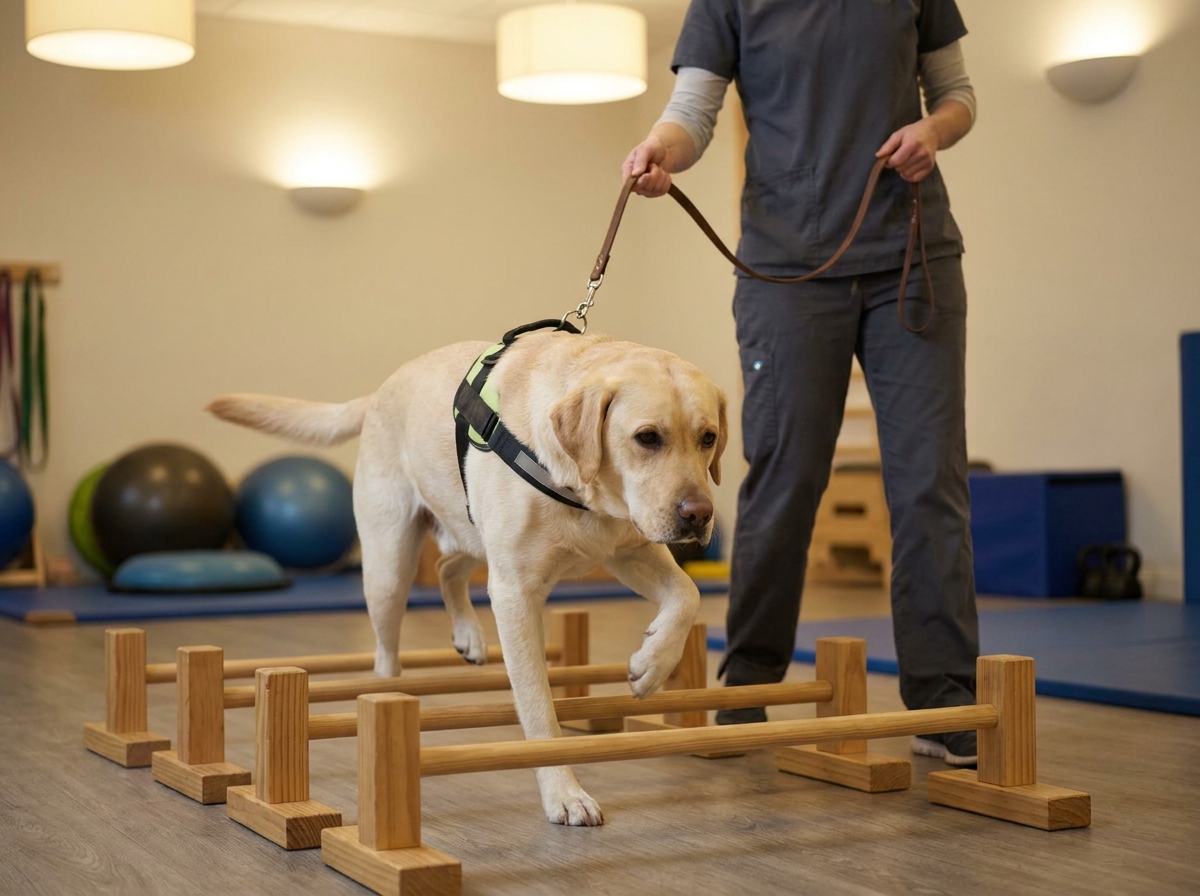
Phase 2: the early rehab (weeks 2-6). The goals: gradual return of the joint range of motion, gradual restoration of the muscle strength, prevention of the disuse atrophy. The specific measures: continued rest (the crate rest or the small room, the leash-only for the bathroom breaks), the gradual increase in the leash walk duration (5 minutes per day in the first week, increasing by 5 minutes per week), the introduction of the controlled exercises (the sit-to-stand, the weight shifting, the cavaletti walks at the very low height).
The exercises in Phase 2: the therapeutic exercises (the sit-to-stand for the hindlimb strength, the weight shifting for the proprioception, the cavaletti walks for the coordination). The underwater treadmill (if available), which allows the controlled exercise with the reduced weight-bearing. The passive range of motion (PROM) continued, but with the increased intensity and the increased repetitions.
Phase 3: the intermediate rehab (weeks 6-12). The goals: return of the muscle mass, return of the joint stability, return of the functional movement. The specific measures: the gradual increase in the leash walk duration (15-30 minutes per day, with the off-leash time in a secure area), the introduction of the hills (the gradual incline for the muscle building), the introduction of the trotting (the controlled trot for the cardiovascular and the muscle), the continued therapeutic exercises.
The exercises in Phase 3: the hill work (the gradual incline for the hindlimb strength), the trotting (the controlled pace for the coordination), the more advanced cavaletti (the higher rails for the more challenge), the wobble board or the balance pad (for the proprioception), the stair work (the gradual increase in the number of stairs).
Phase 4: the advanced rehab (weeks 12-24). The goals: return to full function, return to the sport or the activity, prevention of the re-injury. The specific measures: the gradual return to the off-leash activity, the gradual return to the sport (the agility, the flyball, the running), the maintenance exercises (the ongoing muscle strength, the ongoing proprioception, the ongoing flexibility).
The exercises in Phase 4: the full off-leash activity, the sport-specific training (the agility obstacles, the running, the jumping), the maintenance program (the weekly strength exercises, the weekly proprioception exercises, the weekly flexibility exercises).
The milestones to track
The milestones to track at each phase:
Phase 1: the pain is controlled (the dog is using the leg, even if the leg use is minimal), the wound is healing (the incision is clean, the swelling is reduced), the dog is eating and drinking normally.
Phase 2: the dog is using the leg consistently (the toe-touching at the walk, the gradual increase in the leg use), the joint range of motion is improving (the gradual increase in the flexion and the extension), the muscle mass is starting to recover (the thigh muscle is no longer severely atrophied).
Phase 3: the dog is using the leg at the trot (the dog is consistently using the leg at the faster pace), the muscle mass is returning (the thigh muscle is approaching the pre-surgery size), the dog is starting the off-leash activity (the dog is off-leash in the secure area, with the controlled activity).
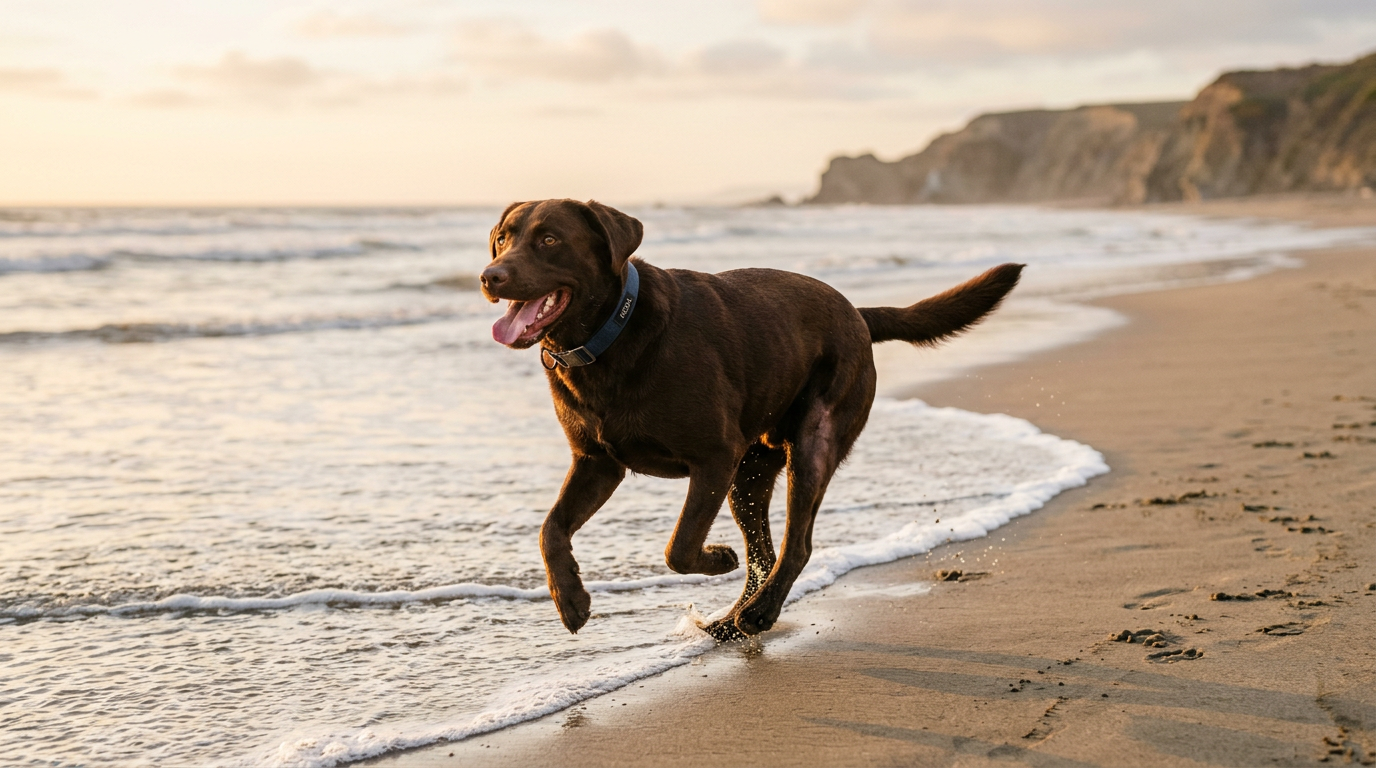
Phase 4: the dog is back to full function (the dog is running, jumping, playing), the muscle mass is symmetric (the thigh muscle is the same size as the opposite side), the dog is back to the pre-surgery activity (the dog is back to the sport or the work).
The mistakes to avoid
The too-much-too-soon. The owner who lets the dog off-leash too early, or who allows the dog to run and play too early, is the owner who risks the re-injury, the implant failure, and the chronic lameness. The strict rest is the hardest part of the rehab, and the strict rest is the most important. The owner who respects the strict rest is the owner who has the successful outcome.
The too-little-too-late. The owner who does not do the ROM exercises, who does not do the controlled exercises, who does not do the strengthening exercises is the owner who has the muscle atrophy, the joint stiffness, and the chronic lameness. The rehab exercises are the work, and the rehab exercises are what produces the recovery.
The skipping the recheck. The recheck at 2 weeks, 6 weeks, 12 weeks, and 24 weeks is the vet's opportunity to assess the progress, to identify the complications, and to adjust the rehab. The owner who skips the recheck is the owner who misses the complications and the adjustments.
The not addressing the other leg. The dog that has the cranial cruciate ligament rupture on one side has a 30-50% chance of the same injury on the other side within 1-2 years. The owner who focuses only on the surgical leg and does not address the other leg is the owner who has the second surgery. The prevention: the weight management, the exercise modification, the joint supplements, the regular vet check.
The realistic timeline for the full recovery
The full recovery timeline depends on the surgery and the dog. The typical timelines:
- TPLO (cranial cruciate ligament): 4-6 months for the off-leash activity, 6-9 months for the full sport, 12 months for the full bone healing.
- FHO (femoral head ostectomy): 6-8 weeks for the basic recovery, 4-6 months for the full function. The FHO dogs typically have the more rapid recovery than the TPLO dogs, because the FHO does not require the bone healing.
- Fracture repair: 8-12 weeks for the bone healing, 4-6 months for the full function. The timeline depends on the fracture type and the location.
- Luxating patella repair: 6-8 weeks for the basic recovery, 4-6 months for the full function.
The dog that has the comprehensive rehab is the dog that hits these milestones on time. The dog that has the minimal rehab is the dog that lags behind, and the dog that has the re-injury is the dog that has the long-term consequences.
The most important sentence in this article
The surgery is half the work. The post-op rehab is the other half. The dog that has the surgery with the comprehensive rehab is the dog that returns to full function. The dog that has the surgery with the minimal rehab is the dog that has the chronic lameness. The owner who does the rehab is the owner who gives the dog the best chance. The rehab is the work. The rehab is what makes the difference.