
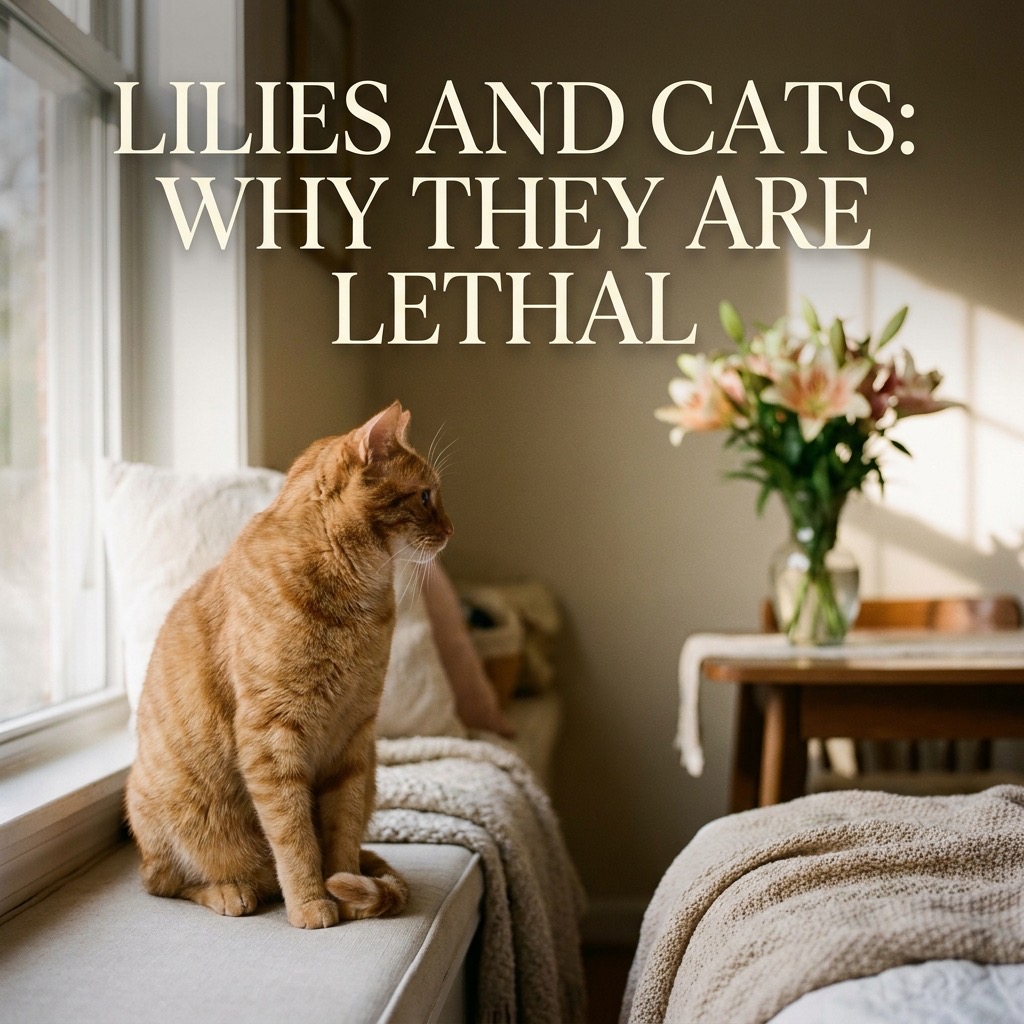
Lilies and cats: why they are lethal and what to do if exposure happens
Of all the toxicities I see in feline emergency work, lily toxicity is the one I wish every cat owner understood better. It is preventable, the timeline is brutally short, and a single exposure can mean a lifetime of kidney care or death. I have seen otherwise healthy young cats present in acute kidney failure within 72 hours of brushing past a bouquet.
This is what you need to know.
Which lilies are dangerous
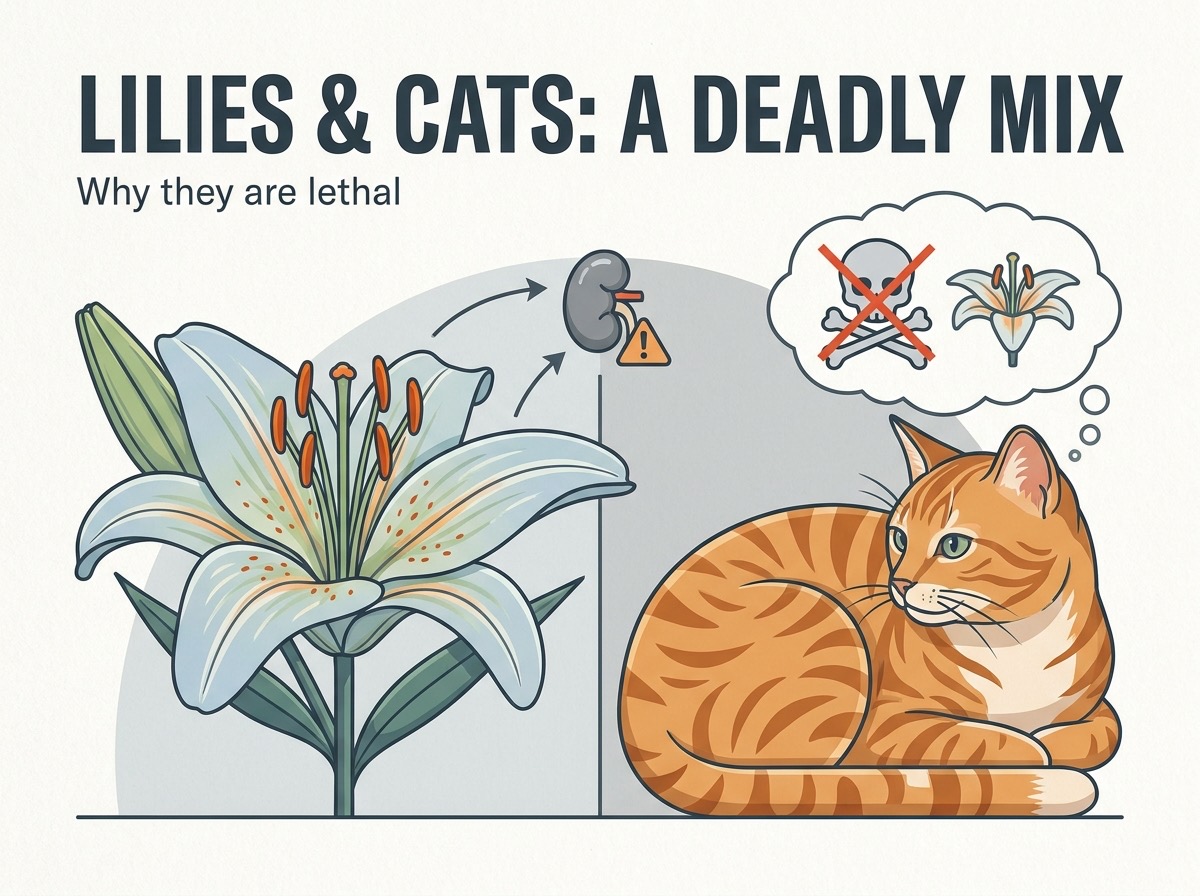
The "true lilies" (genus Lilium and Hemerocallis) are nephrotoxic to cats. This includes:
- Easter lily (Lilium longiflorum)
- Tiger lily (Lilium lancifolium / tigrinum)
- Asiatic lily (most hybrid Lilium varieties)
- Oriental lily (Stargazer, Casablanca, and similar)
- Daylily (Hemerocallis species)
- Japanese show lily
- Rubrum lily
The entire plant — petals, leaves, pollen, stem, even the water in the vase — is toxic. A cat that brushes against pollen and then grooms it off the fur has had a toxic exposure.
"Lily-like" plants that are NOT nephrotoxic but can still cause GI upset:
- Calla lily (Zantedeschia) — oral irritation
- Peace lily (Spathiphyllum) — calcium oxalate irritation
- Peruvian lily (Alstroemeria) — mild GI upset
These are uncomfortable but not life-threatening. The true lilies above are the emergency.
The timeline of toxicity
| Time after exposure | What's happening clinically |
|---|---|
| 0–2 hours | Often no visible signs; cat may groom, eat pollen, drink vase water |
| 2–6 hours | Early GI signs possible (vomiting, lethargy) — but not always |
| 12–24 hours | Vomiting, depression, decreased appetite may begin |
| 24–72 hours | Polyuria, then oliguria, acute kidney injury |
| 72+ hours | Azotaemia, anuria, severe illness |
The critical window is the first 18 hours. Treatment started within 18 hours of exposure has a very good prognosis. Treatment started after 48 hours often does not.
What to do in the first 30 minutes
If you see your cat near a lily — even just brushing past — act immediately:
- Remove the cat from the area. Wash any pollen from the fur with mild dish soap and water. Towel dry.
- Identify the lily. Photograph it. *Lilium* and *Hemerocallis* species are the emergency. If you're not sure, treat it as an emergency.
- Call your nearest emergency veterinary hospital. Tell them: cat, possible lily exposure, time of exposure. They will tell you to come in immediately.
- Bring the plant or a photo so the vet can confirm species.
- Do NOT induce vomiting at home unless explicitly told to by the vet. Some substances cause more damage coming back up than staying down.
What the vet will do
Standard decontamination and treatment:
- Induce vomiting (if very recent and cat is alert)
- Activated charcoal by mouth to bind any remaining toxin in the GI tract
- IV fluid diuresis for 48–72 hours — large volumes to flush the kidneys
- Bloodwork: baseline kidney values (BUN, creatinine, SDMA), repeat at 24h, 48h, 72h
- Urinalysis: monitoring urine output is critical
- Anti-nausea medication as needed
Cats treated within 18 hours of exposure typically recover fully. Cats treated at 24–36 hours have a guarded prognosis. Cats treated after 48 hours with established anuria have a poor prognosis.
How to lily-proof a cat household
Three rules:
- No true lilies in the home or garden. Ever. This is non-negotiable if you have cats.
- No lilies in bouquets sent to cat-owning households. If you send flowers, ask the recipient first or choose from the cat-safe flower list (roses, sunflowers, snapdragons, orchids, gerberas).
- At vet visits, mention to the vet that you have cats before bringing flowers home.
Bottom line
Lilies and cats are a one-strike combination. There is no safe level of exposure, no "small amount is OK", and no at-home monitoring that works. If exposure happens, the clock starts immediately, and the difference between full recovery and lifelong kidney disease is whether you reach an emergency vet within 18 hours. The simplest rule: no lilies in a cat home, period.
---
About the author: [Dr. Sofia Martinez](../Sofia%20Martinez.md), DVM, CertECC, is a UCM-trained veterinarian with 13 years of practice and former head of emergency surgery at Hospital Veterinari 24h in Barcelona.