

Drowning and near-drowning in pets: a CPR primer that actually helps
Drowning in pets is uncommon but high-stakes. Pools, ponds, lakes, even bathtubs can become hazards — and the most common scenario I see is a dog pulled from a pool after an unseen struggle. The difference between a survivor and a non-survivor is almost always what happened in the first 5 minutes.
This is the sequence that saves lives.
First 30 seconds: get the pet out and assess
- Pull the pet out of the water carefully. Support the body and neck if you can; do not lift by a single limb.
- Lay the pet on its right side on a firm surface. The heart is on the left side of the chest, so right lateral recumbency makes compressions more effective.
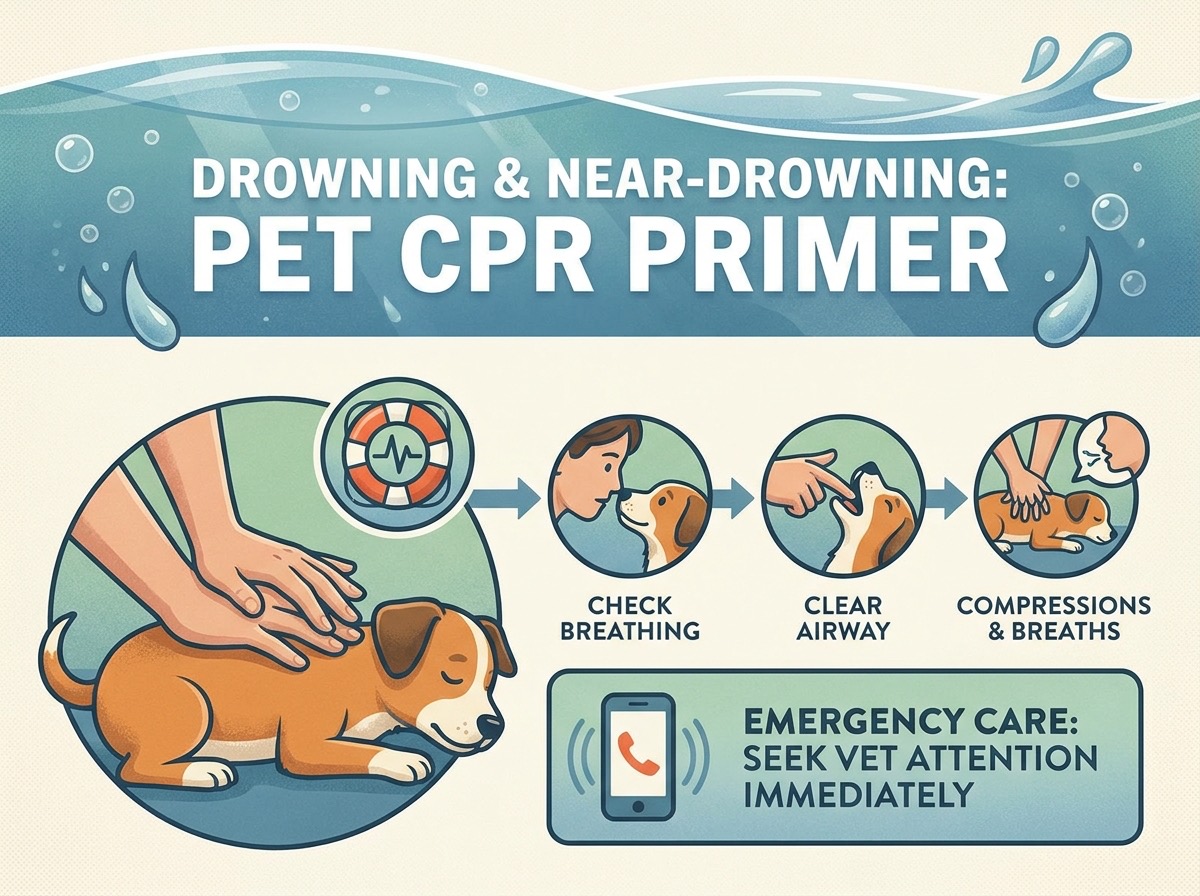
- Check for breathing. Look at the chest. Listen at the nostrils. Feel for air movement.
- Check for a heartbeat. Place your fingers in the groin area where the femoral artery runs. You can also place your hand directly on the chest behind the elbow.
If the pet is breathing and has a heartbeat
- Clear the airway. Gently extend the head and neck, pull the tongue forward, sweep the mouth with your finger to check for debris.
- Hold the pet upside down by the hips for 10–15 seconds (small dogs and cats only) to help drain water from the lungs. For large dogs, lift the hindquarters with a helper.
- Keep the pet warm. Wrap in a towel or blanket.
- Transport to the nearest emergency vet immediately, even if the pet seems to recover. Near-drowning victims can develop delayed pulmonary oedema 6–24 hours later.
If the pet is NOT breathing
Begin rescue breathing:
- Extend the neck, pull the tongue forward, clear the mouth.
- Close the mouth. Hold it shut with your hands.
- Seal your mouth around the nose (for medium and large dogs) or around the mouth and nose (for small dogs and cats).
- Give 4–5 quick breaths, watching the chest rise. The chest should rise with each breath; if it doesn't, reposition the neck and try again.
- Recheck for breathing and heartbeat after the initial breaths.
If the chest does not rise:
- Re-extend the neck
- Pull the tongue further forward
- Check again for airway obstruction with a finger sweep
- Try a more forceful breath
If still no rise, suspect airway obstruction from water or debris. Do not give up. Five minutes of effective rescue breathing can resuscitate a pet that initially appears dead.
If there is no heartbeat
Begin chest compressions:
For medium and large dogs (>15 kg)
- Position: pet on right side
- Hand position: directly over the widest part of the chest (usually behind the elbow)
- Compression depth: 1/3 to 1/2 of chest width
- Rate: 100–120 compressions per minute
- Compression-to-breath ratio: 30 compressions, then 2 breaths, repeat
For small dogs and cats
- Position: pet on right side
- Hand position: wrap one hand around the chest just behind the elbows, thumb on one side, fingers on the other
- Compression technique: squeeze the chest between thumb and fingers
- Rate: 100–120 per minute
- Compression-to-breath ratio: 30 compressions, then 2 breaths
The "Stayin' Alive" tempo
The beat of "Stayin' Alive" by the Bee Gees is approximately 100 BPM. Sing it in your head. It matches the target compression rate exactly.
Cycle and reassess
Continue CPR for 2 minutes, then reassess:
- Is there a heartbeat? If yes, stop compressions. Continue rescue breathing if not breathing on their own.
- If no heartbeat, continue CPR for another 2 minutes.
Transport to the nearest emergency vet while continuing CPR if you have a helper. Do not stop CPR to drive unless you are alone.
What about water in the lungs?
Contrary to old movies, you do not need to "drain the water" before CPR. Most drowned pets do not have large amounts of water in the lungs — the larynx usually seals shut during the drowning reflex. Effective compressions and breaths are more important than trying to drain water.
After successful resuscitation
The emergency is not over. Near-drowning causes:
- Pulmonary oedema — fluid build-up in the lungs, often delayed 6–24 hours
- Hypothermia — even on a warm day, immersion drops body temperature
- Cardiac arrhythmias — from hypoxia and electrolyte shifts
- Aspiration pneumonia — from water in the lower airways
- Acute kidney injury — from hypoxia
The pet needs:
- Oxygen supplementation
- IV fluids
- Active warming
- Cardiac monitoring
- Repeat chest X-rays at 12 and 24 hours
Hospitalisation for 24 hours is standard after a near-drowning event, even if the pet seems recovered.
Prevention
- Pool fences that the dog cannot jump or climb
- Pool alarms that detect surface disturbance
- Teach dogs the pool exit — point them at the steps repeatedly until they reliably use them
- Supervise all bath time — even a calm dog can slip and not be able to right itself
- Cover ponds and water features with sturdy grates in yards with small dogs or puppies
- Don't leave a dog unattended near any water, even briefly
When to give up
After 20 minutes of effective CPR with no signs of life and no response, the prognosis is essentially zero. This is a hard decision but it is an honest one.
Bottom line
Drowning is preventable and reversible if caught early. The first 5 minutes are decisive. Learn the compression rate, the hand position for your dog's size, and the breath technique. Take a pet first-aid class if you can — they include hands-on CPR practice that is hard to learn from a webpage alone. The 60 minutes spent on training could save a life you love.
---
About the author: [Dr. Sofia Martinez](../Sofia%20Martinez.md), DVM, CertECC, is a UCM-trained veterinarian with 13 years of practice and former head of emergency surgery at Hospital Veterinari 24h in Barcelona.